If you’ve just lost someone you love, you’re not alone.
This section walks you through the first critical days after a death—from what to do at the hospital to notifying loved ones and legal authorities. Let this space gently hold your hand and offer clarity during life’s most disorienting moments.
It might be early morning or the middle of the night. The nurse walks in, quiet and kind. “I’m so sorry,” she says. “She’s gone.”
You might suddenly notice the hum of the refrigerator or the way your hands are shaking. You might find yourself holding a mug you don’t remember making. This article is for that moment. If you’re wondering what happens to the body after death—or what you’re supposed to do next—this will walk you through it, gently.
🚚 Part II: What Happens to the Body — and Where It Goes
The funeral home will transport your loved one with care. The body is stored in a climate-controlled space until decisions about burial or cremation are made. No procedures happen without your signed consent.
“We expect families to be in shock. We repeat everything twice and provide written handouts.” — Bereavement Coordinator, 2023
🛠️ Part III: 6–48 Hours — Balancing Emotion and Logistics
Gather documents: ID, insurance cards, Social Security, will if applicable.
Contact Social Security: 1-800-772-1213.
Call your funeral home to confirm next steps.
Let someone help notify friends or extended family.
Case Study: Maria’s First 48 Hours
Maria’s mom passed peacefully at home. The hospice nurse handled arrangements. Maria wrote everything down and let others help with notifications. She didn’t rush through decisions. She just took one moment at a time.
Grief in the first 48 hours doesn’t follow a pattern. You might forget what you were saying mid-sentence, cry without warning, or feel numb and detached.
This isn’t failure. It’s grief.
If You’re Feeling Utterly Alone:
Call or text someone. Even a short message is enough.
Write a memory, a word, or a question in a notebook.
Wrap yourself in something soft. Light a candle. Step outside.
It might have been a phone call. A hospital hallway. A quiet hospice room.
The moment you hear “they didn’t make it,” time distorts. You may have thought you’d scream, but instead you just stood there. You may have sobbed, or maybe you simply nodded and sat down.
Now, someone is talking about an autopsy.
You’re not ready. You weren’t expecting that. You are not doing this wrong.
This guide is designed for those first 24 to 72 hours. It goes beyond basic steps to give you clear, confident, even clinical knowledge—so that despite the fog of grief, you can stand tall in understanding.
An autopsy is a detailed medical examination of the body after death. It is conducted by a pathologist, a specially trained physician who examines organs, tissues, and sometimes toxicology to determine the cause and manner of death.
There are two main types:
Forensic autopsy – Ordered by law when a death is sudden, unexplained, or suspicious. Performed by a coroner or medical examiner.
Clinical autopsy – Requested by family or doctors for medical understanding. Voluntary and often used to inform family health history.
In both cases, the process is thorough, respectful, and private.
Myth: Autopsies always delay the funeral. Fact:
Most are completed within 24–72 hours and do not interfere with services.
Myth: The body is disfigured and cannot be viewed. Fact:
Pathologists take care to preserve the body. Open-casket services are usually still possible.
Myth: Families must give consent. Fact:
If the autopsy is legally mandated, consent is not needed. But families can ask for clarification or documentation.
A moment like this is full of myths. The truth brings peace.
Most autopsies occur in a hospital pathology lab or medical examiner’s office—not where the person passed. Families are not required to return to the hospital.
You likely do not need to go back unless retrieving personal items or paperwork.
Maria’s 68-year-old mother collapsed unexpectedly. EMS could not revive her. Because her mother had no diagnosed condition, the coroner required an autopsy.
“I thought I was supposed to feel differently. But mostly, I just felt blank.”
The final report brought answers—and a strange sense of calm. Maria learned her mother had undiagnosed arrhythmia. “Knowing helped me let go of what-ifs.”
(This article was written with enough gentleness to be shared with family.)
When the call comes — “They’re gone” — the world tilts. Time bends strangely. Maybe the coffee you made sits untouched. Maybe your phone buzzes with messages you can’t yet answer. Grief moves in waves: shock, sadness, anger — sometimes all at once.
And almost immediately, tensions with family can begin to rise.
If you’re here, you’re already doing something brave. You are reaching for peace — even while your heart is breaking. There’s no perfect roadmap for grief. But there is a way to move forward with grace.
This guide was created tenderly, with the hope that it could serve not just you — but your whole family, if you wish to share it.
You might feel overwhelmed. You might feel angry, guilty, exhausted, numb — or all of these at once. You might worry you’re not doing enough, or doing it wrong.
Please hear this:you are grieving exactly the way you need to.
There is no perfect way to lose someone you love. There is only the next breath. The next step. The next small act of love.
You are enough. You are brave. And you are not alone.
If you’ve walked this road — or are walking it now — your voice could be a light for someone else in the dark. Please share your thoughts or experiences in the comments below. Your story matters here.
You hear it, but the world around you remains strangely intact. The toothbrush still sits by the sink. The coffee mug remains on the counter.
Everything looks the same, but nothing feels the same.
If you’re reading this, you are already doing something brave.
Pause. Breathe. ❤️ You are not doing this wrong.
This guide walks gently with you through the emotional fog and the small first steps after loss — offering comfort, clarity, and remembrance.
First Steps After Death: What Happens in the First 48 Hours
(based on Social Security Administration, hospital bereavement protocols, and hospice guidelines)
No matter where death occurs — at home, in a hospital, at work, or in public — the first steps stay rooted in respect, small actions, and breathing space.
If expected, hospital or hospice staff will assist with paperwork.
If sudden or public, emergency services and often the coroner will step in first.
First 24 Hours
Obtain a Legal Pronouncement of Death — Needed for all steps that follow (Centers for Medicare & Medicaid Services, 2022).
Notify Immediate Family or Trusted Friends — Start small. You don’t have to tell everyone at once.
Secure Property and Pets — Lock the home, collect mail, arrange temporary care if needed.
Case Study: Her Mom Passed Unexpectedly. Here’s What Happened Next
Anna’s mom died suddenly during a routine surgery.
At 4 a.m., Anna sat frozen in the kitchen, staring at the refrigerator, paralyzed.
“Let’s start with just one thing,” a family friend said. “We’ll call the hospital together.”
That first call was enough. Later, they secured her mother’s home, contacted a funeral provider, and sent a group message: “Anna needs time. We’ll update you soon.”
There is no perfect way to move through this. Only your way.
Timeline: When to Do What ⏳
Timeframe
Actions
First 12 Hours
Obtain legal death pronouncement
First 24 Hours
Contact immediate family/friends
24–48 Hours
Arrange funeral home or cremation provider
By Day 2
Notify Social Security Administration, employer, insurance
By Day 3
Secure documents, finalize service or memorial plans
Place your hand over your heart.
Take one slow breath in. Hold. Release.
✨ You are doing enough. ✨
Organizing Affairs After Death: Honoring Memories
Choosing how guests share their memories is a tender decision.
A traditional guest book is a beautiful, time-honored choice.
Many families also explore creative alternatives for more personal storytelling.
Here are a few ideas — and remember, you can create whatever feels most meaningful to you.
Creative Guest Book Alternatives for Funerals and Memorials
Memory Stones — Guests write short blessings on smooth stones to keep or plant in a memorial garden.
Video Memory Booth — Short recorded messages collected on a simple tablet or phone.
Fingerprint Tree — Guests add ink “leaf” fingerprints to a tree illustration for framing later.
Memory Cards — Prompts like “I’ll always remember…” collected into a keepsake book.
Scrapbook Station — Creative pages guests decorate with drawings, photos, or memories.
❤️ Gentle Reminder
There is no wrong way to grieve.
There is no wrong way to honor them.
Every breath you take forward weaves their memory into life.
✨ A Blessing for the Journey
May your hands find small tasks to ground you.
May your heart find small mercies to sustain you.
And may you always remember: Love does not end here.
It carries on — through memory, through legacy, through you.
Share Your Heart
What helped you during your first days after a loss?
We invite you to share your story in the comments below.
Your words may become the light someone else needs today.
Sources and Gratitude
Centers for Medicare & Medicaid Services. (2022). Hospice care and the end of life.cms.gov
National Hospice and Palliative Care Organization. (2023). After a loved one dies: Helping with practical and emotional needs.nhpco.org
Social Security Administration. (2024). What to do when a loved one dies.ssa.gov
“I can’t think straight. I’m not in the same state. I don’t know what to do. Help!”
The Moment That Shatters Everything
The phone rang. The words hit like a punch:
“I’m so sorry… they’re gone.”
You freeze. You stare at nothing. You forget where your shoes are. You walk into a room and forget why.
Your hands are shaking, but your heart hasn’t caught up yet.
This is trauma. This is grief in motion. You’re in the foggy aftermath of the unthinkable. And even though it feels like the world is spinning around you, you don’t have to figure this out alone.
This guide was created for you — the person who just heard, “They died.” Maybe you’re across the country. Maybe you’re holding a crying child. Maybe you can’t cry at all.
You are not doing this wrong.
Let’s walk forward. Gently. Together. 🕊️
Crisis Grounding First
Pause. Breathe. Sit Down.
Place your hand on your chest. Inhale for 4 seconds. Hold. Exhale for 6. Now again. One more time.
You don’t need to do everything right now. This guide will walk you step by step.
Case Study #1: Anna’s Story (Loss from Afar)
Anna was mid-flight when her brother texted:
“Mom’s gone. It was a heart attack. Paramedics tried. I’m so sorry.”
“I was stuck in Dallas. I didn’t know where to go. I walked around the airport for 40 minutes before I realized I was just walking in circles.”
She called her mom’s best friend. Cried in an airport chapel. Texted work:
“Emergency. Death in the family.”
A stranger helped her rebook her flight.
“I had no plan. But the checklist below gave me a rhythm. I just did the next thing. And then the next.”
What to Do When Someone Dies Suddenly: The First 5 Days
🗓️ Day 1 – Shock + Survival
If you’re not there:
Call the hospital, coroner, or hospice to confirm the death
Ask what’s happening with the body (transfer, autopsy, etc.)
If elsewhere, authorities will begin protocols (911, coroner)
Travel if needed:
Ask a friend to help you book
Bring ID, clothes, a notebook, phone charger
Don’t overthink packing
Notify your workplace:
“There’s been a sudden death in my immediate family. I’m traveling and unavailable. I’ll update as I can.”
🗓️ Day 2 – Logistics Begin
Make the following calls:
A funeral home (many will pick up the body)
Close family/friends
A support person to help with meals, rides, or child care
Locate essential documents:
ID (yours and theirs)
Insurance, will, power of attorney
Medical paperwork
👉 Don’t forget to rest. Cry. Eat something small. Write things down... thoughts, what you’ve done, anything.
🗓️ Day 3 – Decisions + Pressure
This is often when pressure begins: extended family asking questions, funeral planning, etc. You can go at your own pace.
You may need to:
Order death certificates (request 10–15 copies)
Begin funeral or memorial planning
Notify Social Security (1-800-772-1213)
Cancel medications, hospice, or in-home care services
🗓️ Day 4 – The Shock Begins to Fade
The calls slow. Reality sets in. You may feel guilt, anger, emptiness, exhaustion… even moments of relief. All of this is normal.
Consider:
Asking others to handle communication or errands
Creating a memory board or private journal
Letting yourself feel whatever comes up
🗓️ Day 5 – A New Grief Rhythm Begins
Today might be the day you:
Choose an obituary photo
Return to your home
Sit in silence for the first time
Wonder if the worst is behind you or ahead
Whatever today looks like—you’re doing better than you think.
Case Study #2: Jason’s Story (With Children)
Jason’s wife passed from a sudden embolism. His kids were 5 and 8.
“I had to tell them. And I didn’t know how. I googled it at 3am and still couldn’t do it.”
Eventually, he said:
“Mommy’s body stopped working. The doctors tried very hard, but they couldn’t help. She died, which means she can’t come back. We are going to miss her very much.”
He asked a neighbor to watch the kids for a few hours while he made arrangements.
“I needed ten minutes alone to fall apart. And then ten more to call the funeral home.”
What Grief Looks Like in Crisis
Forgetting appointments, names, or entire conversations
Laughing one moment, sobbing the next
Not feeling anything at all
Needing silence—or needing to talk nonstop
Feeling like time isn’t real
You are not broken. Grief lives in your body as much as your heart. This is biology, not failure.
What NOT to Do (And That’s Okay)
🚫 Don’t rush to clean their home 🚫 Don’t pressure yourself to answer every text 🚫 Don’t feel guilty if you laugh 🚫 Don’t try to carry everything alone
Gentle Words You Can Use
To a coworker:
“Thanks for checking in. I’m not ready to talk, but I appreciate your message.”
To extended family:
“I’m still processing. I’ll share details when I’m able.”
To a child:
“We can talk about this again later, or tomorrow, or as many times as you need. I’m here.”
Need Cultural or Spiritual Guidance?
Not sure what rituals or practices are expected in your tradition? We’ve created a special space for that. Visit: 👉 Culture & Spirituality
Affirmations for the Fog
🫶 I am not broken 🫶 I don’t have to rush 🫶 I can ask for help 🫶 I am allowed to grieve 🫶 I am doing enough
Your Voice Matters
Have you been through sudden loss? What helped you get through those first few days? What do you wish someone had told you?
💬 Please share your thoughts or experiences in the comments. Your story could bring hope to someone who feels lost right now.
💔 When Maria received the unexpected call about her father’s passing, she was engulfed by a wave of emotions—shock, grief, and uncertainty. Amidst her sorrow, she faced immediate decisions: whom to notify, how to arrange the funeral, and how to manage her father’s affairs.
Maria’s experience is not unique. Many find themselves unprepared for the logistical and emotional challenges that follow the death of a loved one. It’s normal to feel overwhelmed. This guide provides clear, compassionate steps to help families navigate the immediate aftermath of a loss.
🕊️ Immediate Steps After a Death
1. Confirm and Document the Death
Expected Death: If your loved one was under hospice care, contact the hospice nurse to pronounce the death.
Unexpected Death: Call emergency services (911) immediately. Emergency responders will guide you through the next steps.
2. Notify Immediate Family and Close Friends
Inform immediate family members and close friends. If the emotional toll is too heavy, ask someone close to help with notifications.
3. Secure Property and Care for Dependents
Ensure the deceased’s home and belongings are secure.
Arrange immediate care for pets or dependents.
4. Arrange for Body Transportation
Contact a funeral home to transport the body. If the death occurred at home and was unexpected, the medical examiner may also be involved.
5. Obtain a Death Certificate
A death certificate is essential for handling legal and financial matters. The funeral home typically helps obtain multiple certified copies.
📞 Essential Contacts to Notify
Funeral Home – Coordinate services and transportation.
Social Security Administration – Report the death and inquire about survivor benefits: ssa.gov.
Employer – Inform them about the passing for final paychecks and benefits.
Insurance Providers – Notify life, health, and vehicle insurers.
Banks and Financial Institutions – Secure or close accounts.
Credit Bureaus – Notify Equifax, Experian, and TransUnion to prevent identity theft.
Veterans Affairs (VA) – If applicable, request benefits or honors.
🗓️ Timeline and Checklist for the First Weeks
Within 24 Hours
Notify immediate family and close friends
Arrange care for dependents and pets
Secure the deceased’s property
Within the First Week
Meet with a funeral director
Obtain death certificates
Locate the will and financial documents
Start probate if required
Within the First Month
Notify government agencies and financial institutions
Experiencing the death of a loved one can plunge you into emotional turmoil, making it difficult to know exactly how to proceed. During these challenging moments, selecting the right funeral home becomes a critical decision that can significantly influence your family’s grieving process. This comprehensive guide aims to gently navigate you through what to do when someone dies, offering a reassuring hand and clear, actionable steps to choose a funeral home with confidence and clarity.
Reassuring First Steps After Death
The immediate aftermath of a loved one’s death can feel overwhelming, often filled with confusion and anxiety. It’s important first to allow yourself a moment to breathe. Understanding the practical tasks ahead and following a clear death checklist can greatly ease your emotional burden.
Checklist: Immediate Steps to Take After Death
Obtain a Death Certificate: The attending physician typically issues a death certificate immediately. If the death occurs at home without medical personnel present, contact emergency services, who will guide you on contacting the coroner or medical examiner.
Notify Immediate Family and Close Friends: Inform immediate family members and close friends, offering and receiving mutual emotional support.
Contact a Funeral Home: Selecting the right funeral home is crucial. Consider proximity, services offered, cultural or religious accommodation, and budget alignment.
Notify Relevant Authorities and Institutions: Inform employers, financial institutions, insurance providers, and government bodies.
How to Confidently Choose a Funeral Home
Selecting a funeral home is more than just an administrative task—it’s an essential step in honoring your loved one and facilitating your family’s healing journey. Here’s how to approach this sensitive decision:
1. Determine Your Needs and Preferences
Clarify what kind of services your loved one would have wanted. Consider religious practices, traditional versus modern ceremonies, burial or cremation preferences, and your budget.
2. Seek Recommendations and Reviews
Ask for recommendations from trusted friends, religious leaders, or healthcare providers. Additionally, read online reviews from previous clients to gauge service quality and compassion.
3. Evaluate Transparency and Communication
A good funeral home should provide clear and detailed pricing upfront. Look for transparency in services included, optional costs, and their willingness to answer your questions openly.
4. Visit in Person
If possible, visit potential funeral homes. A face-to-face meeting can provide critical insights into staff professionalism, empathy, facility cleanliness, and overall atmosphere.
5. Verify Credentials and Accreditation
Ensure the funeral home is licensed and accredited by relevant state or national funeral directors associations. Accreditation typically ensures compliance with professional standards.
6. Assess Cultural and Religious Competence
Ensure the funeral home can respectfully accommodate any specific cultural or religious requirements your family may have, providing sensitivity to rituals and traditions.
Frequently Asked Questions
Who issues the death certificate, and why do I need it?
The death certificate is issued by a doctor or coroner and is essential for legal tasks such as settling estates, claiming insurance, and accessing benefits.
Do I always need to contact the coroner?
Not always. A coroner is required if the death was sudden, unexpected, or unattended. In other circumstances, your healthcare provider or hospice service will guide you.
How quickly must funeral arrangements be made?
While arrangements are often made within days, you typically have some flexibility to ensure the funeral planning aligns with your family’s emotional and logistical needs.
Can I change funeral homes after making initial contact?
Yes, you are free to choose another provider if you feel uncomfortable or unsatisfied with your initial selection. Communicate openly to transfer any arrangements already begun.
Choosing the right funeral home can profoundly affect your grieving journey, offering crucial emotional support and logistical ease. By following these clear, structured steps and knowing exactly what to do when someone dies, you empower yourself to make informed, compassionate decisions during a sensitive time.
Bookmark or share this guide with someone who might need it.
References
Lensing, V. (2020). The Guide to Planning a Funeral: Practical Advice and Resources. Rowman & Littlefield Publishers.
Wolfelt, A. D. (2016). Funeral Home Customer Service A–Z: Creating Exceptional Experiences for Today’s Families. Companion Press.
When a loved one dies, you are suddenly faced with both grief and a long list of urgent tasks. The immediate hours and days after a death can feel like a blur. If you’re wondering what to do when someone dies, or how to write an obituary during this emotional time, you’re not alone.
This article is your calm companion during chaos, providing a gentle, detailed walkthrough of how to write an obituary step-by-step, and offering a helpful death checklist to guide you through the first steps after death. Use it as a practical tool and share it with others who may be walking the same road.
Immediate Death Checklist: First Steps After a Death
Before writing the obituary, there are urgent steps you’ll need to take. Here’s a simplified death checklist:
Step 1: Confirm and Document the Death
At home: Call the hospice nurse or family doctor (if expected), or emergency services (if unexpected).
At a hospital or care facility: Staff will typically handle this step and issue a medical certificate of death.
Step 2: Contact a Funeral Director
Choose a reputable funeral home or director who can help with body transportation, service planning, and publishing the obituary.
Step 3: Inform Immediate Family
Call or text close family members before anything goes public. Gently coordinate who else will be informed and by whom.
Step 4: Secure the Deceased’s Property and Pets
Lock their home, retrieve valuables, and ensure pets or plants are cared for.
Step 5: Locate Key Documents
Look for the will, funeral instructions, or prepaid burial/cremation agreements. You may also need access to ID, insurance, and legal documents soon.
Writing the Obituary: Step-by-Step Instructions
Writing an obituary is your opportunity to honor a life. It also helps notify the community and provide details about memorial services. Here’s a compassionate, step-by-step guide:
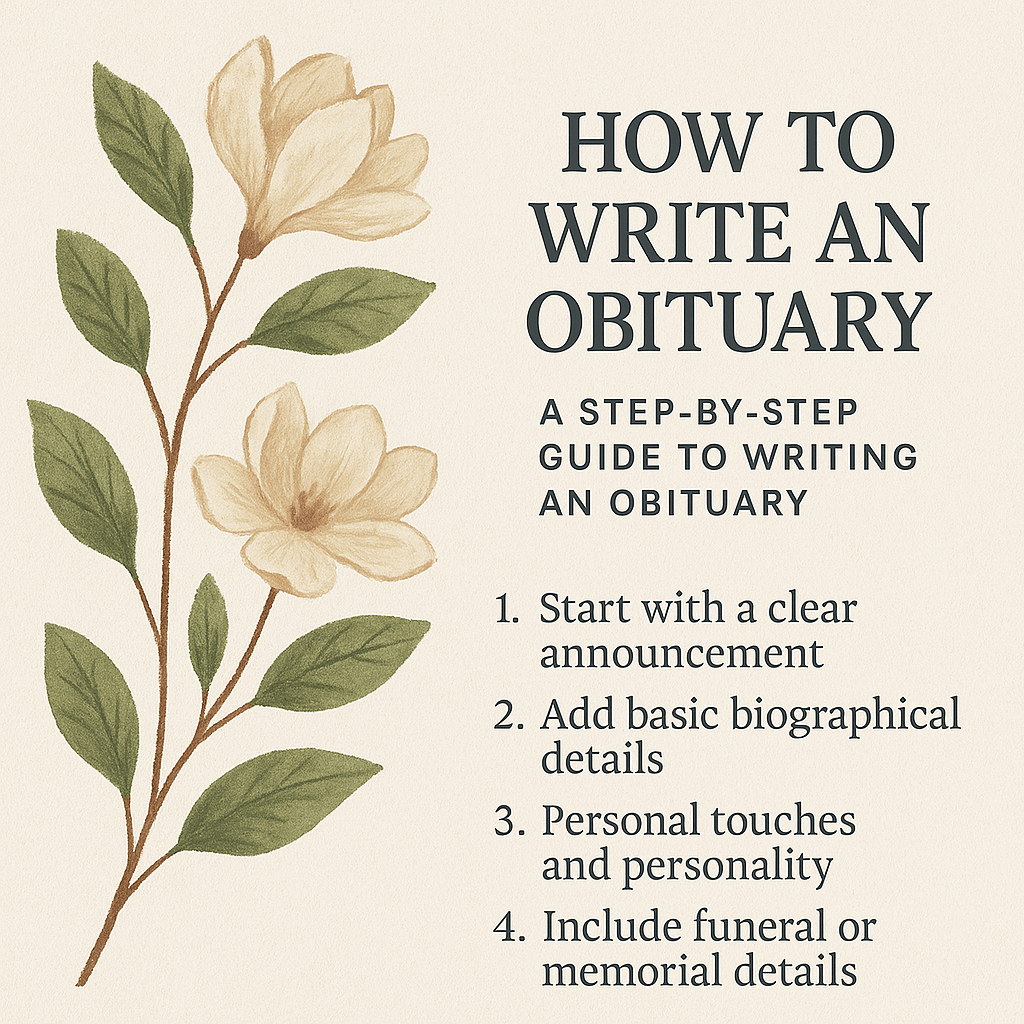
1. Start with a Clear Announcement
Use a respectful, direct sentence: “Elizabeth Mary Thompson, 78, of Denver, Colorado, passed away peacefully on March 30, 2025.”
2. Add Basic Biographical Details
Date/place of birth
Parents’ names (if relevant)
Education or career highlights
Achievements, hobbies, or roles in the community
3. Personal Touches and Personality
Highlight what made them special: “A passionate gardener and avid storyteller, Elizabeth filled her home with laughter and lilacs. She loved mentoring young teachers and never missed a grandchild’s soccer game.”
4. List Immediate Family Members
Example: “She is survived by her daughter, Rachel; her son-in-law, Marco; two grandchildren, Liam and Ava; and her brother, James.”
And optionally: “She was preceded in death by her husband, Paul, and her sister, Margaret.”
5. Include Funeral or Memorial Details
Add date, time, location, and whether the public is invited. Include streaming info or donation suggestions if relevant.
6. End With Appreciation or Legacy
Example: “Her strength, kindness, and humor touched everyone she met. Her family invites you to celebrate her legacy with stories, joy, and remembrance.”
Sample Obituary Template
John Robert Edwards, 68, passed away peacefully on April 1, 2025, surrounded by loved ones in Baltimore, Maryland. Born August 2, 1956, John was a devoted father, skilled carpenter, and Army veteran. He is survived by his wife, Dana; children, Lisa and Jared; and three grandchildren. He was preceded in death by his parents, George and Lillian. A memorial service will be held at Oak Grove Chapel, 11 a.m. on Saturday, April 6. In lieu of flowers, donations can be made to the Wounded Warrior Project.
FAQs: Common Questions Families Ask
Do I need a death certificate to write an obituary?
No, but you will need the legal pronouncement of death from a doctor or coroner for funeral arrangements and death registration.
How long should an obituary be?
Most are 150–300 words. Newspapers often charge by length. Online obituaries can be longer and include photos.
Should I mention cause of death?
Only if the family is comfortable. Many families choose to say “passed away peacefully” or “after a long illness.”
Can I publish an obituary later?
Yes. You can also write a short public announcement first and a fuller obituary later. It’s okay to grieve and take your time.
Writing an obituary may be one of the most emotional things you’ll ever do. But it can also be a sacred moment—honoring a life, comforting others, and anchoring your own grief in meaningful reflection.
Bookmark or share this list with someone who might need it. One day, it may bring someone comfort, clarity, and a sense of calm when they need it most.
References
Cruse Bereavement Support. (2023). What to do when someone dies. Retrieved from https://www.cruse.org.uk
Funeral Consumers Alliance. (2022). How to write a great obituary. Retrieved from https://www.funerals.org
National Hospice and Palliative Care Organization. (2023). First steps after a death. Retrieved from https://www.nhpco.org
When someone we love passes away, the immediate moments and hours following their death can feel overwhelming and disorienting. Understanding what to do when someone dies and navigating the first steps after death can provide a sense of calm and direction during this emotional and stressful time. The following guide serves as a compassionate death checklist, helping families and loved ones address necessary tasks thoughtfully and systematically.
1. Confirming the Death and Notifying Authorities
The initial step after someone has passed is to confirm the death and involve appropriate authorities or medical professionals. If the death occurs in a hospital, hospice, or long-term care facility, medical personnel typically handle this step, providing formal documentation such as a death certificate (American Medical Association [AMA], 2020).
However, if the death occurs at home or unexpectedly elsewhere, immediately call emergency services (911). Calling 911 is essential in any unexpected or sudden death situation. If the individual was under hospice care or had a known terminal illness, contacting their healthcare provider or hospice nurse is appropriate, as they are already familiar with the patient’s health condition and can guide you through the next steps.
When authorities arrive, they will confirm the death and guide you regarding the next steps, including whether further investigation or an autopsy is required. Be prepared to answer basic questions about the deceased’s medical history and the circumstances surrounding their passing.
2. Contacting a Funeral Director
Selecting and contacting a funeral director early can provide significant emotional and logistical relief. Funeral directors offer invaluable support, assisting families with immediate arrangements such as transporting the deceased to a funeral home, planning for a viewing or service, and ensuring compliance with state and local regulations (National Funeral Directors Association [NFDA], 2023).
Consider reaching out to funeral directors recommended by trusted sources or those previously chosen by the deceased as part of pre-planning arrangements. To determine if the deceased made pre-arrangements, look through their personal files, legal documents, estate paperwork, or consult with their attorney, executor, or immediate family members who may have this information.
At this stage, it isn’t necessary to finalize funeral details, but connecting early with a funeral director helps guide subsequent decisions and alleviates unnecessary burdens during grief.
3. Notifying Immediate Family and Close Friends
Informing immediate family and close friends promptly allows loved ones to support each other and make necessary arrangements. While making these notifications, it’s advisable to enlist help from a trusted family member or friend to share the emotional weight of this task.
Communicate sensitively and clearly, sharing essential information such as the date and circumstances of death and initial arrangements. Establishing a small phone tree or appointing someone to manage further communications can help maintain clarity and ensure no important contact is overlooked.
4. Securing Important Documents
Gathering and securing key documents is crucial for addressing immediate practical matters and preparing for upcoming responsibilities. Documents to locate include:
Marriage certificates, birth certificates, military records
If you’re uncertain where the deceased stored important documents, begin by checking secure locations within their home, like a safe, file cabinet, home office desk, or lockbox. You can also speak with close family members, a lawyer, or financial advisors who may know the whereabouts of these documents.
Keep located documents in a safe, accessible place, as you will frequently need them in the coming days and weeks for estate management and funeral planning (Consumer Financial Protection Bureau [CFPB], 2022).
5. Caring for Pets and Securing Property
If the deceased had pets or lived alone, it’s important to quickly arrange care for animals and secure their residence. Ensure pets have temporary caretakers, and verify the home is locked, safe, and secured against potential intrusions or emergencies.
Delegate this responsibility to trusted friends, family members, or neighbors, if possible, to ease your immediate burden.
6. Self-care and Emotional Support
The first 24 hours after losing someone are emotionally exhausting and stressful. Acknowledging and attending to your emotional and physical needs is vital. Ensure you take breaks, stay hydrated, and eat regularly. Seek emotional support from friends, family, or professional counselors, allowing yourself space to express your grief openly.
Connecting with grief support organizations, either online or locally, can offer immediate reassurance and guidance from professionals and individuals who have experienced similar losses.
7. Informing the Deceased’s Employer and Social Security Administration
Informing the deceased’s employer and the Social Security Administration within the first few days is necessary to halt payments, adjust benefits, and initiate possible survivor benefits. The funeral director often helps with notifying Social Security, but the employer should be informed directly to address payroll, benefits, or insurance matters.
Contact the employer’s Human Resources department and be prepared to provide essential details, such as the deceased’s employee ID number and a copy of the death certificate (Social Security Administration, 2023).
Conclusion
The hours immediately following a death are uniquely challenging. While emotions run high, having a clear and compassionate checklist helps families navigate these difficult tasks more comfortably. Remember, you do not have to manage everything alone—seek professional assistance from funeral directors, healthcare providers, and grief support services to help guide you through these initial crucial steps.
“Grief is not a project—it’s a process. And love is found in the details.”
When Sarah’s father died unexpectedly, her mind went blank. The hospital handed her a folder. Friends asked questions. She felt the pressure to do something, but all she wanted was a moment to breathe.
This guide is for the Sarahs of the world—for anyone quietly carrying the weight of love and loss, who needs a clear, gentle starting point.
Grief clouds the mind. It’s okay—necessary, even—to pause before making decisions. It’s normal if your mind feels scattered—this is your body’s natural response to loss.
Try this grounding technique: Inhale 4 seconds → Hold 4 → Exhale 6.
Even a single intentional breath can shift your body out of “crisis mode” and into a place where decisions feel less overwhelming.
Start with those who must know immediately—close family, legal representatives, and anyone who will help coordinate arrangements. Pausing to breathe between calls is perfectly okay.
Tip: Use a shared group chat or document so everyone stays informed without repeated calls.
This decision affects cost, timing, and emotional meaning. Some cultures and faiths have strong traditions—lean on them if they bring comfort, or choose what aligns with your family’s values and finances.
Tip: If unsure, ask your funeral director to walk through the practical and cultural implications.
Notice how you’re treated—respect and patience matter.
If this step feels intimidating, bring a trusted friend or family member to help take notes and ask questions. Choose a place where you feel heard, informed, and never rushed.
There is no perfect way to plan a funeral. But there is love in every thoughtful step—and that matters. You don’t have to do it all at once. And you are not alone.
At Solviah, we are here to walk with you—step by step—so you never have to face this alone.
🌿 Just a Note on Heaven
At Solviah, we respect all faiths and the many ways people find hope in loss. This space is for everyone, without pressure or persuasion.
We simply note this because it’s unusual: in the Christian faith, Heaven is described as a guaranteed promise—not through personal effort, but as a gift of salvation through Jesus Christ. For those curious, this promise is offered freely to all who wish to receive it.
The heart of it: Jesus is God incarnate. He lived a sinless life, died for our sins, and rose again. Through Him, forgiveness, freedom, and eternal life are offered—not by earning it, but by receiving it.
No one is too far gone. You are already deeply loved.
Jesus, I believe You are Lord. I receive Your forgiveness and salvation. Please lead me into new life—now and forever. Amen.
Simple Prayer of Salvation
🕊️ Speak with a Christian or pastor
📖 Begin reading the Bible (start with the book of John)




 Solviah
Share Your Experience
Have you been through this? What helped? What was confusing? Share your thoughts in the comments—your words may bring peace to someone else.
🕊 Return to the beginning