Honoring Life, Embracing Memories

Category: Library

  • What Happens to the Body After Death — And What You Need to Do in the First 48 Hours

    What Happens to the Body After Death — And What You Need to Do in the First 48 Hours

    🕯️ The Moment After: “She’s Gone.”

    It might be early morning or the middle of the night. The nurse walks in, quiet and kind. “I’m so sorry,” she says. “She’s gone.”

    You might suddenly notice the hum of the refrigerator or the way your hands are shaking. You might find yourself holding a mug you don’t remember making. This article is for that moment. If you’re wondering what happens to the body after death—or what you’re supposed to do next—this will walk you through it, gently.

    Back to Top

    ⏳ Part I: First 0–2 Hours — Breathe. You Don’t Have to Rush.

    What to Do Immediately:

    • If death occurred at home (unexpected): Call 911.
    • If expected (hospice): Call the on-call nurse.
    • If at a facility: Staff will confirm and begin arrangements.

    What’s Happening to the Body:

    • Breathing stops, muscles relax.
    • 2–6 hrs: Rigor mortis sets in.
    • 6–12 hrs: Skin color may change due to blood settling.

    Back to Top

    🚚 Part II: What Happens to the Body — and Where It Goes

    The funeral home will transport your loved one with care. The body is stored in a climate-controlled space until decisions about burial or cremation are made. No procedures happen without your signed consent.

    “We expect families to be in shock. We repeat everything twice and provide written handouts.”
    — Bereavement Coordinator, 2023

    Back to Top

    🛠️ Part III: 6–48 Hours — Balancing Emotion and Logistics

    • Gather documents: ID, insurance cards, Social Security, will if applicable.
    • Contact Social Security: 1-800-772-1213.
    • Call your funeral home to confirm next steps.
    • Let someone help notify friends or extended family.

    Case Study: Maria’s First 48 Hours
    Maria’s mom passed peacefully at home. The hospice nurse handled arrangements. Maria wrote everything down and let others help with notifications. She didn’t rush through decisions. She just took one moment at a time.

    Back to Top

    💬 Part IV: You Are Not Doing This Wrong

    Grief in the first 48 hours doesn’t follow a pattern. You might forget what you were saying mid-sentence, cry without warning, or feel numb and detached.

    This isn’t failure. It’s grief.

    If You’re Feeling Utterly Alone:

    • Call or text someone. Even a short message is enough.
    • Write a memory, a word, or a question in a notebook.
    • Wrap yourself in something soft. Light a candle. Step outside.

    If you need support right now:

    • Mental Health Crisis Line: 988
    • Hospice Bereavement Support: 1-844-GET-HOPE

    Back to Top

    📋 First 3 Days Checklist

    Day 1:

    • Confirm the death
    • Notify one or two people (ask them to help share the news)
    • Contact hospice or funeral home
    • Secure the home and check on pets

    Day 2:

    • Begin gathering documents
    • Rest. Eat something light.
    • Start a list of questions for the funeral home

    Day 3:

    • Contact Social Security, banks, insurance providers
    • Let someone else handle errands or food

    Back to Top

    📌 More Guidance When You’re Ready

    When you’re ready to take the next step, we’re here for that too. Explore more guidance here.

    We invite you to share:
    Your experience might be exactly what someone else needs. Share your story in the comments below.

    Back to Top

    📚 References

    Back to Top

  • Unexpected Funeral Costs: What Most Families Forget to Budget For

    Unexpected Funeral Costs: What Most Families Forget to Budget For

    A calm, clear guide for emotionally overwhelmed first-time planners

    🌿 If You’re Overwhelmed, Breathe

    Whether you just lost a parent, partner, or child—you might be staring at a list of things to do and wondering: How am I supposed to plan a funeral when I can’t even make breakfast?

    You are not failing. You are grieving. And you’re doing your best.

    Take a deep breath. Count to five with me: one… two… three… four… five.
    Now exhale slowly. You’re not alone. Let’s take this one step at a time.

    Back to Top

    📘 Before the Funeral: Emotional Planning & Hidden Costs

    This is the phase where things move quickly—and overwhelm is common. You don’t have to do it all today. Let’s slow down and walk through the pieces together.

    Many decisions need to be made quickly, especially in the first 24–48 hours. This list will help you gently prioritize what matters most right now.

    What may come up sooner than expected:

    • Choosing a funeral home
    • Transportation of the body
    • Ordering multiple death certificates (CDC, 2022)
    • Burial vs. cremation decisions
    • Checking for pre-paid arrangements or insurance
    • Notifying next of kin, workplaces, or spiritual leaders

    Hidden Costs:

    Item Why It’s Overlooked
    Death certificates Most families need 6–10 for banks, accounts, and claims
    Clothing for the deceased Not always included or provided by the funeral home
    Immediate transport fees Often separate from full-service packages
    Translation or emergency document help Especially for international or legal cases
    “You’ll need the death certificate for everything from bank accounts to utility bills.” — CDC, 2022

    Reflection: Is there one decision you feel clear about right now? That’s your starting point. Don’t try to answer everything at once.

    ✅ Before-the-Funeral Checklist

    • Choose a funeral home & request a General Price List
    • Confirm burial or cremation
    • Request 6–10 death certificates
    • Gather insurance, ID, and essential legal papers
    • Start obituary draft or tribute materials
    • Notify family and delegate where possible

    See Legal & Financial Matters

    Back to Top

    🕯️ During the Funeral: Ceremony, Support & Holding It Together

    This is the phase where you carry the weight—of schedules, emotions, and expectations. It’s okay to feel like it’s too much. You’re not alone in this.

    If you’re reading this, you’re probably managing the whole service—while still grieving. Be gentle with yourself.

    Often-Forgotten Expenses:

    • Venue rental (if not at the funeral home)
    • Clergy or speaker honorarium
    • AV tech for music, slideshows, or livestreams
    • Printed programs or memory cards
    • Flowers, catering, and reception supplies
    “The average cost of a traditional funeral is $8,300—but can rise to $12,000+ depending on services.” — NFDA, 2023

    Reflection: Who can help with one thing—music, guest communication, printing? Let someone walk with you.

    See Honoring a Life

    Back to Top

    🕊️ After the Funeral: Quiet Moments and Lingering Tasks

    Things may settle down—but loose ends can stretch out. You don’t have to resolve them all at once.

    Post-Funeral Costs That Surprise Many:

    • Headstone or grave marker
    • Obituary printing or placement fees
    • Grief counseling (individual or family)
    • Belongings, storage units, or home downsizing
    • Memorial keepsakes, jewelry, or photo albums

    Reflection: What is one small act of peace you can offer yourself this week—a walk, a call, a bath? Even 10 minutes counts.

    See Grief & Healing

    Back to Top

    🤍 For Supporters and Friends: What to Say, Do, and How Much

    Your care matters more than your perfection. The goal is to help without overwhelming.

    Supportive Actions:

    • Offer task-based help (“Can I create the slideshow?”)
    • Volunteer to communicate on their behalf
    • Create a music playlist, gather photos, or manage RSVPs
    • Send check-ins weeks after the service ends

    Things to Avoid:

    • Taking over or giving unsolicited advice
    • Filling silence with explanations or religious phrases
    • Forcing conversations or quick replies

    Reflection: What small kindness can you offer today—with no strings attached?

    See For Supporters & Friends

    Back to Top

    Looking for a Calm Companion to Help You Plan?

    Soon, we’ll be offering free printable tools to help you navigate grief and logistics—one small step at a time.

    No downloads or email signups required right now, just peaceful support when you need it.

    💬 Share Your Voice

    You’ve made it this far—and that’s something. You’re walking through grief and logistics with strength you may not even feel yet.

    What helped you most during this process?
    What do you wish someone had told you earlier?

    Please share in the comments—your story may help someone else find light in their own dark hour.

    Explore More:
    Grief & Healing |
    Legal & Financial Matters |
    Honoring a Life |
    Culture & Spirituality

    Back to Top

  • Jewish Grief and the Meaning of Second Passover (Pesach Sheni): Finding Belonging in Sacred Time

    Jewish Grief and the Meaning of Second Passover (Pesach Sheni): Finding Belonging in Sacred Time


    “Why should we be kept from bringing the Lord’s offering?”
    —Numbers 9:7

    “Even in darkness, light dawns for the upright…”
    —Psalm 112:4

    🕯️ When You Miss Both Tables

    Some people miss the first Passover because someone died. Then grief lingers—or deepens. Another death comes. And they miss Second Passover too.

    What if you’re too sad to celebrate again? What if the grief never lifted from the first loss—let alone made space for another? What if sacred time feels like it’s passing without you?

    You are not alone. Many mourners feel disoriented when holidays return too soon. Rituals arrive with songs and memory, but the heart may still be in silence. Second Passover is not a deadline. It is mercy.

    It is a whisper: “Even if you missed the feast, your place remains.”

    “Don’t rush back to the table. Sit as long as you need. I am not waiting for a ritual—I am already in your memory, your love, your life.”
    —A whisper from the ones you grieve

    Back to Top ↑

    🌸 Ways to Honor a Loved One

    • 🕯️ Light a candle and whisper their name
    • 🍽️ Share their favorite dish with someone who knew them
    • 💝 Donate to a cause they cared about
    • 📖 Recite a line from a favorite poem or psalm
    • 🧘 Sit with their memory without rushing to feel better

    Back to Top ↑

    🗣️ Voices from the Community

    “My father died the day before Passover. I couldn’t bring myself to go to the seder. Then, a month later, I lit a candle on Second Passover and just sat with his photo. It wasn’t a feast. But it was sacred.”
    —Leah S., Brooklyn, NY

    “My rabbi said God gave us Second Passover because even grief belongs in the story of freedom. That stayed with me.”
    —David R., Jerusalem

    Back to Top ↑

    🤝 Interfaith Reflection

    Even if you’re not Jewish, the concept of Pesach Sheni offers something timeless: a second chance to honor grief, to mark remembrance, to find sacred space after a missed moment. Light a candle. Share a meal in silence. Say their name. Rituals don’t need to be religious to be real.

    Back to Top ↑

    ❤️ How to Support Someone

    If someone you love has missed both Passovers due to overlapping grief, don’t pressure them to return to joy. Offer quiet presence, ongoing kindness, and thoughtful invitations without expectation.

    • 🫶 Offer a meal with no conversation required
    • 💬 Send a message weeks later: “I’m still thinking of you.”
    • 🌿 Invite them to a walk or space to just be

    Back to Top ↑

    🌅 The Path to Heaven

    In Judaism, access to the World to Come (Olam HaBa) is rooted in righteousness, memory, mercy, and community. The Talmud says: “All Israel has a share in the World to Come… and the righteous of all nations too.” Heaven is not earned by perfection—it is entered by compassion.

    Back to Top ↑

    📘 Glossary

    • Pesach Sheni – Second Passover, observed one month after the first
    • Olam HaBa – The World to Come in Jewish belief
    • Shiva – Seven-day mourning period
    • Kaddish – Mourner’s prayer praising God
    • Yahrzeit – Anniversary of a loved one’s death
    • Yizkor – Memorial prayer recited on holidays
    • Tzedakah – Charitable giving in someone’s memory
    • Aninut – Period between death and burial

    Back to Top ↑

    💬 Share Your Story

    Have you experienced grief that collided with a holiday? Please share your story or a remembrance in the comments below. Someone else may need your words today.


    Explore More:

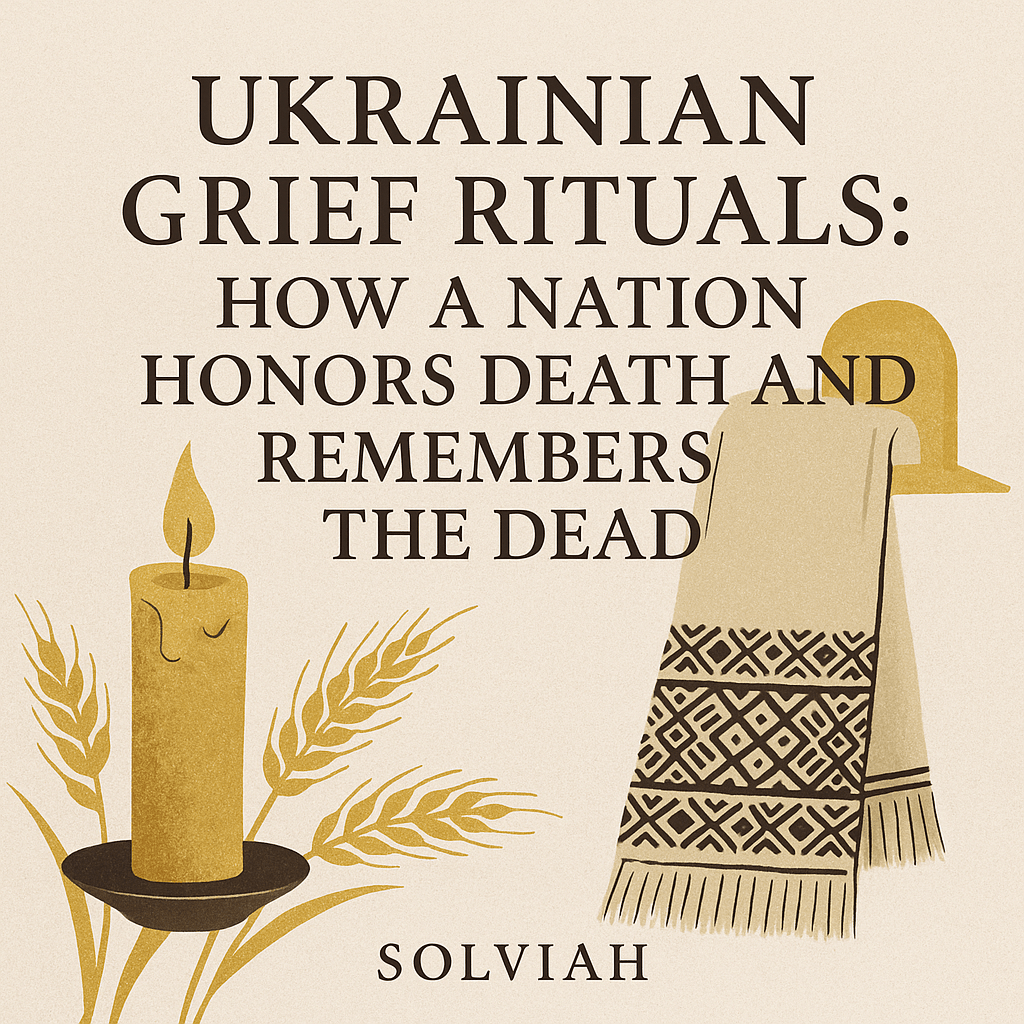
  • Ukrainian Grief Rituals: How a Nation Honors Death and Remembers the Dead

    Ukrainian Grief Rituals: How a Nation Honors Death and Remembers the Dead

    “The soul does not die; it just changes its house.”
    — Ukrainian proverb

    📘 Table of Contents

    🕯️ A Candle in the Window

    In a small apartment overlooking the golden domes of Lviv, a grandmother ties a black headscarf under her chin. The air smells of beeswax and dill. A single candle flickers by the window—its light a beacon for the soul of her departed son, lost to war. Beside her, a child stirs honey into a bowl of kutia. The forty-day vigil has begun.

    This is not just mourning. This is memory as resistance. This is grief woven into ritual.

    ↑ Back to top


    🌾 Mourning the Ukrainian Way

    Ukraine’s grief traditions blend Orthodox Christianity, pre-Christian folklore, and family-based practices into a slow, reverent process. Death is not abrupt—it is a passage, and the soul must be cared for and remembered.

    Grief unfolds through all five senses in Ukraine:

    • Winter funerals: often take place in frozen soil, where mourners stamp their boots in silence.
    • Summer burials: may involve open-air memorials with blooming wildflowers laid across fresh graves.
    • Food: comforts the living and honors the dead. Kutia—sweet, nutty, and laced with symbolism—is always the first dish served (Pavlyshyn, 2021).

    Every element—from embroidered rushnyk cloths draped over icons to the solemn ring of church bells—grounds the experience of loss in culture and continuity.

    ↑ Back to top


    🧵 Traditional Mourning Practices

    What the Body Wears: The deceased is dressed in their best clothes—often white or embroidered, symbolizing purity. Women mourners wear dark clothing and a black kerchief for up to a year. Jewelry and bright colors are avoided out of respect.

    Funeral Rites: A priest offers the Panakhyda (memorial service), reciting Psalms and prayers (Wikipedia, n.d.). The body may remain in the home for up to three days with mirrors covered and candles burning beside the coffin. At the grave, earth is placed in the sign of the cross on the casket before final prayers.

    Memorial Meals – Pomynky: After burial, families gather to share ritual foods like kutia, cabbage rolls, rye bread, and vodka. Additional meals and prayers are held on the 3rd, 9th, and 40th days (Wikipedia, n.d.).

    ↑ Back to top


    ⏳ The Forty Days

    In Orthodox belief, the soul wanders Earth for forty days after death:

    • On Day 3: The soul is shown Heaven.
    • On Day 9: It sees the torments of Hell.
    • On Day 40: It stands before the throne of judgment (Wikipedia, n.d.).

    But the forty days are not just theological. They are emotional. Candles are lit every evening. A rushnyk cloth may be placed near a photo of the deceased. Children watch. Elders repeat. And slowly, grief begins to find shape.

    ↑ Back to top


    🫂 Communal Grief and Collective Memory

    To grieve in Ukraine today is to do so not alone, but as part of a people who understand loss as shared history. When a child loses a parent to war, the village mourns. When a soldier is buried, strangers attend. When air raid sirens pierce a funeral, mourners hold hands and keep praying.

    In Kyiv, walls bear the faces of fallen heroes (Kulyk, 2020). In the Hutsul highlands, the “Provody” tradition continues—centuries-old and now revived during war (The Guardian, 2024). Along highways, communities kneel to honor passing funeral processions (War.ukraine.ua, 2023). These are not customs. They are collective acts of dignity and memory.

    ↑ Back to top

    From collective mourning to personal support, the next section explores how we can stand beside those grieving across cultures.

    🤝 For Supporters and Friends

    Grief makes many feel unsure of what to say. Silence can feel safer—but also like abandonment. Instead, offer presence, understanding, and respect for Ukrainian mourning customs (INTO, 2019).

    What You Can Say:

    • “I lit a candle for them today.”
    • “Would you like to share a memory?”
    • “Is there a ritual I can honor with you?”

    What to Avoid:

    • “They’re in a better place now.”
    • “Everything happens for a reason.”
    • “At least they died for something.”

    Other Gestures: Bring symbolic food. Offer to help mark the 40th day. Say their name weeks later. Presence often matters more than words.

    ↑ Back to top


    ⚖️ Comparison with Western Traditions

    Aspect Ukraine Western Traditions
    Mourning Period 40 days + annual rituals 1 week or less
    Food Traditions Kutia, pomynky feasts Buffets or potlucks
    Public Grief High—community kneeling, murals Often private

    ↑ Back to top


    🪞 What Ukraine Teaches Us

    Ukraine shows us that grief is not a detour from life—it is a sacred road through it. Rituals remind us:

    • Love does not vanish with death.
    • Memory is a collective inheritance.
    • Grief can be slow, beautiful, and shared.

    Reflection Prompt: Have you ever participated in a grief ritual that felt deeply healing—or one that left you wanting more? Share your story in the comments—we’d be honored to learn from you.

    ↑ Back to top


    📚 Glossary

    • Kutia: Sweet wheat-based funeral dish.
    • Pomynky: Communal meal after a funeral.
    • Radonitsa: Joyful remembrance day held at cemeteries in spring.
    • Panakhyda: Orthodox memorial service for the dead.
    • Rushnyk: Traditional embroidered cloth used in rites of passage.

    ↑ Back to top


    🔗 References

    • Hrytsak, Y. (2019). Historical memory and mourning rituals in Ukraine.
    • Kulyk, V. (2020). Public mourning and national identity in Ukraine.
    • Pavlyshyn, M. (2021). Food and funeral: Ukrainian rituals of remembrance.
    • Wikipedia. (n.d.). Memorial service in the Eastern Orthodox Church.
    • War.ukraine.ua. (2023). How Ukraine honors its fallen defenders.
    • The Guardian. (2024). The Hutsul “Provody”.
    • INTO. (2019). Supporting young people and children from Ukraine.

    ↑ Back to top

  • Still a Mother: For the Ones Missing a Child on Mother’s Day

    Still a Mother: For the Ones Missing a Child on Mother’s Day

    A quiet space for the ones missing a child today. You are not alone here.

    🌿 Table of Contents


    💔 Still a Mother

    You felt it before you opened your eyes.
    That quiet heaviness. That ache beneath your ribs.

    Today is Mother’s Day.

    You stood in the kitchen this morning and didn’t know what to do with your hands.
    You scrolled past the posts.
    You smiled when someone said it—just to survive the moment.

    You haven’t forgotten.
    Your body hasn’t forgotten.
    And love like that doesn’t disappear.

    Even if no one says their name.
    Even if no one says yours.

    You are still a mother.
    You don’t have to be okay today.
    And you are not alone.

    Back to Top ↑


    🫁 To the Mother Who Can’t Breathe Today

    You’ve already made it through hours.
    Maybe you answered messages.
    Maybe you stayed silent.

    Underneath it all, you’re holding something sharp.
    The ache. The anger. The emptiness.
    The weight of what should have been.

    You might feel jealous. Then guilty.
    You might feel nothing at all.

    That doesn’t make you weak.
    It makes you human.

    Mother’s Day can feel like salt in a wound.

    And still—here you are.
    Breathing.
    That’s enough.

    Back to Top ↑


    🕊️ You Are Still a Mother

    Even if no one says it.
    Even if your arms are empty.
    Even if your motherhood looks nothing like theirs.

    You carried love—and you still do.
    You show up for a child the world can’t see.
    You keep going with a heart that has been torn open.

    That’s not weakness.
    That’s a different kind of strength.

    You are still a mother.
    Not in spite of the grief.
    Because of the love that never left.

    Back to Top ↑


    🤍 If You Love a Mother Who’s Grieving Today

    Don’t just tell her she’s strong.
    See her pain, too.

    See the part of her that’s smiling and screaming at the same time.
    The part that showed up to the party, but hasn’t breathed since she walked in.
    The part that’s quiet—but carrying the weight of a lifetime.

    You don’t need to fix it.
    You don’t need the right words.
    You just need to show up. And stay.

    Say her child’s name.
    Say you remember.
    Say nothing, if that’s what the moment calls for.
    But be there.

    Her strength isn’t in pretending she’s fine.
    It’s in feeling everything and still finding a way to move through the day.

    Grief doesn’t need a rescue.
    It needs a witness.

    Back to Top ↑


    💬 From Mothers Who’ve Been There

    “The world moved on. But I never stopped being her mom.”
    —Mother of a stillborn daughter

    “I mother in memories now. And in love that never left.”
    —Mother of a son gone too soon

    “Grief didn’t end. But neither did my love.”
    —Anonymous

    Back to Top ↑


    📩 If You’re Not Sure What to Say

    It’s okay if you don’t have the perfect words.
    You don’t have to fix her day.
    But your message might be the one thing that reminds her she’s not alone.

    Try this:

    “I know today might be painful. I’m thinking of you and your baby. You’re still a mother. I see you.”

    “No words—just love. I’m here.”

    One honest message means more than a thousand silent scrolls.

    Back to Top ↑


    🔁 Before You Go

    If this met you in the quiet,
    if it reminded you of something true—

    share it with someone who should see it.

    With someone who’s grieving.
    With someone who wants to support but doesn’t know how.

    No one should carry this kind of love alone.

    Back to Top ↑

    📚 Suggested Reading

    • Bonanno, G. A. (2009). The Other Side of Sadness: What the New Science of Bereavement Tells Us About Life After Loss. Basic Books.
    • American Psychological Association. (2020). Grief: Coping with the loss of your loved one
    • Worden, J. W. (2018). Grief Counseling and Grief Therapy (5th ed.). Springer Publishing.
  • Infertility, Miscarriage, and Mother’s Day: Coping with Guilt, Grief, and Invisible Loss

    Infertility, Miscarriage, and Mother’s Day: Coping with Guilt, Grief, and Invisible Loss

    🌸 Table of Contents


    “I wanted to stay home. But I went to brunch for my mother. I smiled for the photo. I toasted with mimosas. I didn’t cry until the car ride home.”

    This is what Mother’s Day looks like for many women who are grieving infertility or pregnancy loss.

    Sometimes, it’s sitting through church as they hand out flowers to moms. Sometimes, it’s dodging group texts about brunch. Sometimes, it’s scrolling past photo after photo of handmade cards and families you wanted to be part of.

    💔 The Ache That Has No Name

    You might not have a name for what you’re feeling. But what you might really be feeling is grief—the grief of someone you never got to meet. Of a future you imagined but couldn’t hold.

    This kind of grief is called ambiguous grief. And on a day like Mother’s Day, when the world turns glittery and loud, it can feel unbearable.

    😔 What Guilt Feels Like When You Can’t Have a Baby

    You might think:

    • “Maybe if I had started sooner…”
    • “Maybe this is punishment.”

    But guilt is a liar. It shows up when we feel powerless. Dr. George Bonanno explains that guilt often masks helplessness and loss of control (Bonanno, 2009).

    🕊️ A Special Kind of Guilt: When You Did Do Something

    Maybe you delayed motherhood. Maybe you had an abortion, or lived through addiction, or something that still feels like your fault.

    “You made the best decision you could with what you had, who you were, and what you knew at the time.”

    ✍️ Journal Prompt

    What decision have I been punishing myself for?
    What does Mother’s Day bring up about this choice?
    What would someone who loved me say back?

    🌿 If You’ve Lost a Pregnancy

    Miscarriage grief is not the same as infertility, but it walks beside it. Some women carry both stories—and both deserve space.

    “You are a mother. Even if your arms are empty.” — SHARE Pregnancy & Infant Loss Support

    ✍️ Journal Prompt

    What would I say to the baby I carried, even for a short time?
    What do I want them to know about how loved they were?

    Ritual: Light a candle and whisper their name—or simply say “my little one.” Let that be enough today.

    🛑 Surviving Mother’s Day

    You can be kind and still say no—to the brunch, the church service, the school event. Protecting your heart is not selfish. It’s sacred.

    🌬️ Breathing Mantra

    Inhale: My love is real.
    Exhale: I release blame.

    Repeat five times. Let this be your breath prayer when words are too much.

    🤝 What You Wish Others Knew

    Yes—it’s okay to reach out. Even if it’s been months. Even if you’re not sure what to say. Especially on Mother’s Day.

    Say:
    “I know today might be hard. No need to respond—I just want you to know I’m thinking of you.”

    Avoid:
    Advice. Comparisons. Or saying “Happy Mother’s Day” unless you’re sure it’s welcome.

    🪶 A Different Kind of Ending

    There’s no bow to tie around this grief. But there can be room.

    On a day like Mother’s Day, when the world feels loud and full, you deserve a quiet space to grieve what never was—or what didn’t last. Or what you hoped might still be.

    You can still be seen. You can still be heard. You can still be held.

    Leave a comment if this spoke to you. You don’t have to explain everything. Just say you were here. That matters.

    📚 References

    • American Psychological Association. (2020). Infertility and mental health.
      View Source
    • Bonanno, G. A. (2009). The Other Side of Sadness. Basic Books.
    • Doka, K. J. (2002). Disenfranchised Grief. Lexington Books.
    • Devine, M. (2017). It’s OK That You’re Not OK. Sounds True.
    • Samuel, J. (2017). Grief Works. Scribner.
    • SHARE Pregnancy & Infant Loss Support. (2023).
      Visit Website
    • Centers for Disease Control and Prevention. (2022). Infertility.
      CDC Infertility Page
  • Feeling Off in 2025? What Grief, Burnout, and Shifting Seasons Might Be Saying

    Feeling Off in 2025? What Grief, Burnout, and Shifting Seasons Might Be Saying

    ✯ Table of Contents

    🌿 A Note Before We Begin

    This isn’t just another article about grief or burnout. It’s a gentle, grounded guide for anyone going through loss, transition, or emotional unraveling—especially when life is already shaky.

    You might be grieving a death. Or maybe you’re grieving something harder to name—your career path, your sense of purpose, the version of yourself that used to feel whole. Lately, it seems more and more of us are carrying invisible weights we don’t know how to talk about.

    This guide offers language for what you’re feeling, space to breathe, and spiritual insight that doesn’t rush to fix you. It doesn’t pretend to hold all the answers—but it hopes to walk with you toward steadier ground.

    Along the way, we’ll also explore what Christian prophets are saying—because strangely, and profoundly, their words have been aligning with what many of us are living through. Whether or not you consider yourself religious, it might be worth paying attention.

    Each section unpacks a layer of what you may be carrying: emotional weariness, cultural upheaval, spiritual shaking, personal loss—and how to begin again in a world that no longer feels familiar.

    Wherever you are in your process, may this meet you there.

    Back to Top

    🕊️ Invisible Grief: Why So Many Feel Emotionally Exhausted Right Now

    You’re not imagining it.

    There’s a heaviness in the air—one that words like “stress” or “tired” don’t fully capture. Even those who haven’t lost someone recently are grieving something: who they used to be, what they thought life would become, the safety they assumed would last.

    And if you have lost someone—especially while juggling the fragile pieces of everything else—then it’s more than sorrow. It’s disorientation. A sense that the ground itself has shifted, and you can’t find the horizon.

    This is invisible grief.

    Not always the kind with funerals or condolences—but the kind that lingers when your identity, security, or story is quietly slipping through your fingers. It’s the ache of becoming someone new without meaning to. Psychologist Kenneth Doka calls this disenfranchised grief—the kind society doesn’t always recognize, but that lives in us all the same (Doka, 2002).

    And according to trauma researcher Bessel van der Kolk, this kind of invisible loss doesn’t just affect the mind—it leaves an imprint on the body, too. We carry the stress physically, often without knowing why (van der Kolk, 2014).

    What makes it harder is how strangely collective it feels. So many people are unraveling in parallel. So many are whispering, “Something is off,” without knowing why.

    Could there be something beneath it all?

    We’ll name the griefs that don’t often get named. We’ll explore what prophetic voices have been saying for years, and why their words are echoing loudly now. We’ll also look to the skies—literally—and consider whether what’s happening above us might help us make sense of what’s happening within us.

    Because if this ache is shared… maybe so is the hope.

    Back to Top

    🔥 What’s Causing Emotional Burnout in 2025 (And Why It’s Not Just You)

    Even if you haven’t lost someone, you may still feel like something is slipping: your sense of purpose, your drive, your belief that life should feel more stable by now.

    It’s not just burnout. It’s something deeper—emotional fatigue, spiritual burnout, a quiet unraveling happening across industries, relationships, and identities. A sense that the ground has shifted, and no one handed you a new map.

    So what’s really behind this collective weariness?

    • Economic anxiety isn’t just about dollars—it’s about fear. Even those with good jobs worry they’re one layoff away from chaos (APA, 2023).
    • Success has changed shape. It’s no longer enough to be good at your job. You’re expected to have a calling, a brand, a clear purpose—and that pressure can be paralyzing (Pratt et al., 2006).
    • Work-life balance has eroded. Devices keep us half-working even while resting. We’re always reachable, never truly restored (Maslach & Leiter, 2016).
    • Comparison culture floods us with curated images of other people’s wins, leaving us unsure whether we’re behind—or just invisible (Huang, 2017).
    • Corporate trust is fading. Layoffs, pivots, and instability have made people question if any role is truly secure (APA, 2023).
    • And under it all, a quiet ache. A question few dare to say aloud: What if I don’t want this life anymore?

    Layer these pressures on top of personal grief, family stress, or spiritual fatigue—and it’s more than stress. It’s a slow unraveling of identity, security, and clarity all at once.

    And if all of this feels bigger than personal stress—maybe it is.

    Maybe something spiritual is stirring underneath the unraveling.

    Back to Top

    📖 What Christian Prophets Are Saying About This Season of Change

    Is this discomfort spiritual? What prophetic voices are noticing—and why it might matter.

    Maybe you’ve had this thought lately:

    “Everything feels off—but I can’t tell if it’s me… or something bigger.”

    That sense isn’t new—and it’s not just yours.

    In many Christian traditions, prophetic voices are people who listen closely for God’s heart—not to predict headlines, but to help interpret the times. And for years now, some of these voices have been pointing to a season just like this.

    They call it a divine repositioning.

    Prophets like Kris Vallotton, Lana Vawser, and others have described this as a global shaking—one that reaches into both personal lives and public systems. Not to destroy, but to shift. To break the illusion of control. To prepare people for what’s next. And what they’ve said feels strangely aligned with what many are now living.

    1. Shaking before repositioning

    That sense that your old rhythm no longer fits? It may not be failure—it may be spiritual movement. Prophetic voices suggest that God often allows discomfort to dislodge us from what’s too small. What feels like chaos might be permission to let go.

    “God offends the mind to reveal the heart.” — Kris Vallotton

    2. Transfer of influence

    Many have spoken about a “Joseph and Daniel moment”—a season where those who’ve been faithful in hidden places are being quietly prepared for influence. Not for fame, but for fruitfulness. You may not feel ready. But maybe your readiness isn’t the point.

    3. Marketplace revival

    This isn’t just happening in churches. Prophetic voices believe God is moving in business, education, tech, media—in the middle of everyday work. If your job has felt strangely unsettled, it might not be punishment. It might be preparation.

    4. Refinement of identity

    Perhaps most deeply, this shift is about identity. God may be stripping away false metrics—“I’m only valuable if I’m productive,” “If I’m not thriving, I’m failing.” What’s left isn’t emptiness—it’s truth. Who you are when nothing performs.

    5. The unveiling of the hidden ones

    Prophets like Lana Vawser have described this season as one where God is bringing His “hidden ones” into view—not through striving, but through divine timing. Whether you’ve been healing, raising children, serving quietly, or simply holding things together behind the scenes—this may be your unveiling.

    “The ones who have felt unseen, forgotten, and hidden—this is the hour where the Lord is bringing them into greater visibility for His glory.” — Lana Vawser

    This isn’t performance. It’s permission. A holy release into the next thing—just as you are.

    Some call this a shift. Others call it a calling. But either way, it’s a pattern too consistent to ignore.

    Even if you’re not sure what you believe, maybe part of you has already felt it:

    • The old way doesn’t fit.
    • You’re between stories.
    • And something sacred is stirring beneath the surface.

    It’s the moment midair—after releasing one trapeze bar, before catching the next.

    You’re not falling. You’re just between.

    Could it be that what feels like obscurity… was always preparation?

    Back to Top

    ✨ Celestial Signs in May 2025: Biblical Meaning and Prophetic Insight

    What if the sky isn’t just beautiful—but intentional?

    Maybe you’ve looked up recently—at the moon, the stars, or a flash of meteor light—and felt something you couldn’t explain. A stirring. A pause. A sense that the timing of it all means more than we think.

    Throughout scripture, the heavens are more than backdrop—they’re message-bearers.

    “The heavens declare the glory of God, and the sky above proclaims His handiwork.” — Psalm 19:1

    From the star over Bethlehem to the apocalyptic signs in Revelation, the biblical narrative uses celestial movement not for fortune-telling—but for timing. Divine moments often echo in the skies. And in May 2025, many believe we’re standing beneath one of those echoes.

    What May 2025 Is Revealing

    • May 3–4: Eta Aquariid Meteor Shower

      Formed from remnants of Halley’s Comet, these meteors streak the sky before dawn. In prophetic imagery, meteors often represent sudden insight—divine interruptions that illuminate what’s been there all along.

    • May 12: Full Flower Micromoon

      This distant full moon symbolizes hidden growth. It may not look large, but its presence reminds us: not all flourishing is loud. Some of the most sacred change happens in quiet places.

    • May 14: Pesach Sheni (Second Passover)

      A biblical “do-over” date. In Numbers 9, God allowed those who missed Passover the first time to celebrate a month later. It’s a reminder: you haven’t missed your moment. Redemption still reaches.

    • May 15–16: Lag BaOmer

      Traditionally a break in a season of mourning, this Jewish holiday brings light and joy into heavy times. It represents breakthrough in the middle of grief.

    • May 26: New Moon

      In ancient Israel, new moons marked the beginning of sacred cycles. It was a moment to pause, reset, and step forward into what’s next (Numbers 28:11–15).

    • May 29: Ascension Day

      Honoring the moment Jesus was taken into heaven, Ascension is not about endings—it’s about commissioning. The moment where waiting turns into movement. “Go.”

    These dates may seem unrelated—but they trace a clear arc: from divine interruption… to hidden growth… to second chances… to joy… to renewal… to release.

    This Isn’t Prediction. It’s Invitation.

    You don’t have to believe in signs. But you’re allowed to wonder.

    Maybe you’ve felt it already—something stirring in you. A direction. A question. A truth you’ve known for a while but haven’t yet moved toward.

    Christian prophets aren’t saying to look for fireworks. They’re saying: notice the alignment. Let the sky remind you that God’s timing is never random. And neither is yours.

    Some believe what May 2025 is saying is this:

    The shaking has done its work. The delay has had its meaning. Now… it’s time to begin.

    You don’t need full clarity. You just need one true step.

    “There will be signs in the sun, moon, and stars… When these things begin to take place, stand up and lift your heads, because your redemption is drawing near.” — Luke 21:25–28

    Even if all you have is a flicker of faith, even if all you feel is tired—look up anyway.

    Look up. Breathe. Begin.

    Back to Top

    💔 Grieving When the Loss Is Personal

    What if the thing that broke wasn’t your job… but your heart?

    We’ve just explored the idea that this season of shaking might be spiritual—that perhaps God is allowing certain things to fall away so that something more eternal can take root.

    But what if what fell wasn’t your schedule, your plans, or your sense of direction?

    • What if it was your mother?
    • Your spouse?
    • Your child?
    • Your only friend?
    • Your anchor in this world?

    What if the shaking took your person?

    Grief can already feel like spiritual whiplash. And the thought that God allowed it—that He stood by while it happened—can feel less like mercy and more like cruelty.

    And if someone dared to tell you, “It’s all part of a bigger plan,” you might want to walk away from that kind of God altogether.

    You wouldn’t be wrong to feel that way.

    Because when you lose someone you love—especially in a season when you were already barely holding it together—it doesn’t feel redemptive.

    It feels like betrayal.

    Like abandonment.

    Like being dropped while you were already drowning.

    “I don’t care about spiritual shaking,” one reader said. “I just want my dad back. He was the only one who understood me.”

    And still—this much we know:

    “When Jesus saw her weeping… He was deeply moved in spirit and troubled… Jesus wept.” — John 11:33–35

    He knew resurrection was coming. And He still wept.

    He didn’t offer explanations. He didn’t say, “This had to happen.”

    He stood beside Mary in her grief. He felt the injustice. And He cried.

    Maybe that’s what He’s doing with you now.

    Not fixing it. Not skipping it. Just sitting in the silence—with you.

    Maybe He didn’t cause the loss. Maybe He didn’t will the death. But He knew it would come.

    And instead of rushing you toward resolution, He’s walking through this part with you—at your pace, in your pain.

    Maybe the shaking didn’t take your anchor so you’d become stronger.

    Maybe it took your anchor… so He could be the one to hold you through the storm.

    “The Lord is close to the brokenhearted and saves those who are crushed in spirit.” — Psalm 34:18

    You don’t have to make sense of this. Not now.

    You don’t have to move on.

    But maybe—just for today—you let yourself be held.

    Back to Top

    🏗️ Rebuilding in the Rubble

    You may not be rebuilding the same life. But you’re not building alone.

    By now, you may feel like your world has been stripped down to studs. What once defined you—your roles, your plans, your relationships—may be gone or unrecognizable. And the person you were before this season? She might feel just as lost.

    But if you’re still breathing, still asking questions, still reading this—That means something remains. And that something can become the foundation for a different kind of future.

    The Healing Will Look Nothing Like the Old Life

    You’re not going back to “normal.” There is no going back. But there may be something better ahead—not because it erases your grief, but because it honors it.

    “You don’t move on. You move with it. The grief walks beside you. But so does grace.”

    This isn’t toxic positivity. This is sacred rebuilding.

    “Though the fig tree does not bud and there are no grapes on the vines… yet I will rejoice in the Lord.” — Habakkuk 3:17–18

    What Rebuilding Might Look Like

    • You wake up one morning and don’t feel dread.
    • You go for a walk and notice the trees again.
    • You remember something about your loved one—and smile instead of cry.
    • You say no to something you used to say yes to—because now you know your limits.
    • You start making plans—not because you’re fully healed, but because you’re still here.

    You’re not starting from scratch—you’re starting from sacred debris.

    “They will rebuild the ancient ruins and restore the places long devastated.” — Isaiah 61:4

    Biblical Anchors for What Feels Unstable

    • When finances are uncertain: “The Lord is my shepherd, I lack nothing.” — Psalm 23:1
    • When your identity feels lost: “You are mine. I have called you by name.” — Isaiah 43:1
    • When you are tired and stretched thin: “Come to me… and I will give you rest.” — Matthew 11:28
    • When the future feels terrifying: “Do not fear, for I am with you.” — Isaiah 41:10
    • When you feel deeply alone: “Even if my father and mother forsake me, the Lord will receive me.” — Psalm 27:10

    What Remains Is Still Alive. And That Means Something.

    Maybe you don’t feel strong. Maybe you feel buried.

    But seeds aren’t lost when they’re in the dark. They’re preparing to break open. Preparing to rise.

    Even if no one sees it—especially when no one sees it—something in you is still here. Breathing. Noticing. Reaching.

    That’s not nothing. That’s the beginning of strength.

    You don’t have to bloom today. You don’t have to fix everything by tomorrow. But if you’re still breathing, there’s more to come.

    The ones who rise slowly often rise strongest. Not because they pushed through—but because they grew through. Deep. Quiet. Fierce.

    You may feel buried. But maybe… you’re rooted.

    And that is not the end of the story.

    Back to Top

    🌱 A Final Blessing

    Maybe this hasn’t answered every question.

    Maybe it didn’t fix what still feels broken.

    But if you’ve made it this far, it’s because something in you is still reaching for light.

    Maybe it’s not fire. Maybe it’s not fierce.

    But it’s alive. And that matters.

    There’s a kind of strength that doesn’t shout. It roots. Deep and unseen. Quiet and sure.

    And when it finally rises, it doesn’t just survive. It shelters others, too.

    So even if your grief still aches… even if your future feels dim… even if today is more silence than clarity—

    May you carry forward something real.

    Not because it’s all okay.

    But because something in you still is.

    So here’s to what remains.

    To what is still alive in you, however quiet.

    To the sacred rebuilding happening in silence.

    And to the person you are becoming—braver, deeper, more whole than ever before.

    A Blessing for the Journey

    May your grief give way to gentleness.

    May your questions stretch into something sacred.

    May you find strength not in perfection, but in quiet resilience.

    May you carry forward what mattered most—not by force, but by becoming.

    And as your roots grow deep in this broken soil,

    May something bloom in you that honors the life you lost,

    And the legacy you’re still living.

    Whatever your path, whatever your pace,

    May you know: you are not alone.

    Back to Top

    💬 Share What Resonated With You

    If something in this article stirred something in you—a phrase, a truth, a quiet strength—would you be willing to share it below?

    Scroll down and leave a comment. Let’s make this more than a page. Let’s make it a place to feel seen.

    📚 References

    • Doka, K. J. (2002). Disenfranchised Grief: Recognizing Hidden Sorrow. Lexington Books.
    • van der Kolk, B. (2014). The Body Keeps the Score: Brain, Mind, and Body in the Healing of Trauma. Viking.
    • American Psychological Association. (2023). Stress in America™ Report. View Report
    • Maslach, C., & Leiter, M. P. (2016). Understanding the burnout experience. World Psychiatry, 15(2), 103–111.
    • Pratt, M. G., Rockmann, K. W., & Kaufmann, J. B. (2006). Constructing professional identity. Academy of Management Journal, 49(2), 235–262.
    • Huang, C. (2017). Time on social networks and psychological well-being. Cyberpsychology, Behavior, and Social Networking, 20(6), 346–354.
    • Vallotton, K. (2020). Spiritual Intelligence. Chosen Books.
    • Vawser, L. (2021–2024). Prophetic Words. www.lanavawser.com
    • Genesis 37–50 – The story of Joseph and divine repositioning.
    • Daniel 1–2 – Influence through faithfulness in exile.
    • Isaiah 45:3 – “Treasures of darkness and hidden riches.”
    • 1 Samuel 16:11–13 – David’s anointing from hiddenness.
    • Neimeyer, R. A. (2001). Meaning Reconstruction & the Experience of Loss.
    • Park, C. L. (2010). Meaning-making and adjustment to life stress. Psychological Bulletin.

    Back to Top

  • How to Write a Sympathy Card That Comforts: What to Say (and What to Avoid)

    How to Write a Sympathy Card That Comforts: What to Say (and What to Avoid)


    You want to help, but everything you say feels wrong.

    You hold a blank card. Or maybe your phone hovers over the keyboard. The person you care about just lost someone they loved—and the pressure to say something helpful feels heavier than expected.

    Grief rearranges language. The right words often feel like they’ve gone missing.

    If you’ve ever second-guessed what to write—or stayed silent because you were afraid of saying the wrong thing—you’re not alone. And you’re not unkind. You’re human.

    But silence can leave the grieving feeling even more isolated. Words, even imperfect ones, can become anchors in a storm.

    This guide will help you write a sympathy message that brings real comfort, even when you feel unsure. It’s rooted in psychology, grounded in etiquette, and infused with compassion.


    📘 Contents


    🤍 What Helps (According to Grief Psychology & Etiquette)

    Writing a sympathy card or message doesn’t require eloquence. It requires presence. A moment of care, written down, can become a thread of light in someone’s darkest hour.

    Psychologist insight: Even brief messages that validate the pain—rather than avoid it—help grieving people feel less alone (Neimeyer et al., 2014).

    1. Be Present, Not Perfect

    You don’t need to sound poetic. Just be sincere.

    “You’ve been on my heart. I’m so sorry for your loss.”
    “I don’t know what to say, but I do care deeply.”

    Tip ✉️: A message sent even weeks later can still become a soft place to land. Grief lingers. So should compassion.

    2. Validate Their Pain

    Don’t try to fix it. Just name it.

    “This must be so hard.”
    “I can’t imagine what you’re going through, but I’m with you.”

    3. Say Their Loved One’s Name

    Don’t be afraid to name the person who died. It matters.

    “I’ll never forget how your mom made everyone feel so welcome at your wedding.”
    “Your brother always brought laughter exactly when it was needed.”

    Worden (2018) found that messages with personal memories are often remembered for years.

    4. Respect Their Culture or Faith

    Grief is expressed differently in every tradition. When in doubt, mirror the language used in any public announcement—or choose gentle, inclusive language.

    Explore more at Solviah’s Culture & Spirituality section.

    5. Give Permission to Feel

    “You don’t owe anyone strength right now.”
    “Crying, resting, remembering—it’s all grief. Let yourself feel it.”

    ↩️ Back to Top

    🚫 What Hurts (Even with Good Intentions)

    Grief is a raw nerve. Even gentle touches can sting—but silence cuts deeper.

    Most of us mean well when we reach out. But sometimes, we say things meant to comfort that unintentionally isolate or diminish someone’s pain.

    Understanding common missteps can help you offer support that actually soothes—without adding weight.

    “People will forget what you said—but they will never forget how you made them feel.”
    — Maya Angelou

    1. Don’t Try to Make It Better

    Trying to explain the loss can feel like erasing it.

    “It was her time.”
    “Everything happens for a reason.”
    “Heaven needed another angel.”
    “God’s plan is greater than ours.”

    Instead, try: “I’m so sorry. I wish I could ease your pain. You’re not alone.”

    2. Don’t Make It About You

    “When my dad died…”
    “I know how you feel.”
    “Here’s what helped me…”

    Instead, try: “If you ever want to talk or share, I’m here to listen with no agenda.”

    3. Avoid Grief Timelines and Fixes

    “You’ll feel better soon.”
    “Stay strong.”
    “Time heals everything.”
    “You just have to keep going.”

    Instead, try: “Take whatever time you need. There’s no right way to grieve.”

    4. Don’t Compare or Minimize

    “At least you had time to say goodbye.”
    “It could have been worse.”
    “At least you have other children.”

    Instead, try: “This loss matters. I can’t imagine how painful it is, and I won’t try to explain it away.”

    If You’ve Already Said the Wrong Thing

    We’ve all said the wrong thing. What matters is being willing to repair it with care.

    “I’ve been thinking about what I said earlier, and I realize it may not have come across how I meant it. I’m sorry if it hurt. I care deeply and want to be here for you.”

    The most hurtful messages aren’t cruel—they’re rushed. Grief doesn’t need fixing. It needs witnessing.

    ↩️ Back to Top


    💬 What to Say When You Don’t Know What to Say

    Grief is a language of silence. And when someone you love is hurting, words can feel like strangers in your mouth.

    It’s okay to not know what to say. What matters is that you care enough to try.

    Start with Truth, Not Poetry

    “I don’t have the right words, but I want you to know I care.”
    “I’m so sorry. I wish I could take away your pain.”
    “I’ve been thinking about you every day.”

    If You’re Afraid of Saying the Wrong Thing

    Say something anyway. Even a clumsy message can be a lifeline.

    “I wish I knew what to say. I just didn’t want to stay silent.”
    “You don’t need to respond—I just wanted to reach out.”
    “You matter. Your grief matters.”

    Let Silence Be Part of the Message

    “You don’t have to respond. I just wanted you to know I’m thinking of you.”
    “No pressure. I’ll check in again next week if that’s okay.”
    “You’re not expected to explain or hold it together. I’m just here.”

    ↩️ Back to Top


    📝 Before You Choose the Words: A Note About “I” Statements

    You may wonder: Should I even say “I’m sorry”? Doesn’t that make it about me?

    The answer is balance. Some “I” phrases show care and humility. Others, like “I’m devastated,” may unintentionally shift the attention to the sender.

    Be present, but don’t take up space. Be real, but keep the focus on them.

    If your words sound like you’re asking for comfort—or asking to be noticed—they may be better unsaid. But if they express care and witness their pain, they’re likely just right.

    ↩️ Back to Top

    💡 Phrases to Say (By Relationship Type)

    Choose what fits your voice and relationship. These aren’t scripts—just starting points.

    For Close Friends

    • “There’s no pressure to be okay. You’re allowed to break. I’m still here.”
    • “This loss is deep. You don’t have to go through it alone.”
    • “I’ll walk beside you. No fixing. Just presence.”

    For Coworkers

    • “Wishing you space to grieve however you need.”
    • “Thinking of you and your family with care.”
    • “Please take all the time you need. Your well-being matters.”

    For Acquaintances or Distant Relatives

    • “Sending quiet support during this time.”
    • “Even from afar, your loss is acknowledged and honored.”
    • “Thinking of you. Wishing you gentle days ahead.”

    For Faith-Based Families

    • “Praying that peace and comfort meet you each day.”
    • “May the One who heals the brokenhearted hold you close.”
    • “Lifting you in prayer, with love and grace.”

    For Secular or Interfaith Families

    • “This is a profound loss. You don’t have to carry it alone.”
    • “Hoping you have the space and care you need right now.”
    • “You matter. This grief matters.”

    For Sudden, Traumatic, or Complex Losses

    • “There are no words for this. I won’t pretend otherwise.”
    • “No answers. Just presence. And care.”
    • “Grief this heavy deserves space. I’m here if you need someone to sit with you in it.”

    Follow-Up Phrases (Weeks or Months Later)

    • “You came to mind today. Still holding you in care.”
    • “It’s been a while, but the care hasn’t faded.”
    • “If this week feels heavy, I’m quietly here.”

    ↩️ Back to Top


    ✅ Before You Text or Visit: A Gentle Checklist

    Use this to pause, reflect, and show up with thoughtful care.

    Before You Send a Message:

    • Have I acknowledged their loss directly?
    • Is this about comforting them—or making me feel better?
    • Is there emotional pressure or expectation in my tone?
    • Am I offering space, not advice?
    • Have I made it clear they don’t need to respond?

    If You’re Visiting or Following Up:

    • Do I know they’re open to visitors?
    • Am I checking in gently—not rushing closure?
    • Am I okay if they don’t want to talk?
    • Could I offer quiet company, not conversation?
    • Have I followed up weeks or months later?
    “You crossed my mind today. No pressure to respond—I just wanted you to know you’re not forgotten.” ✉️

    ↩️ Back to Top


    🕯️ Mini Case Study: The Letter That Stayed

    After her mother died, Maria received dozens of sympathy cards. Most were kind, but forgettable.

    Except one.

    “I still remember how your mom danced at your wedding. She had so much joy in her. That joy changed the room. I imagine it still does.”

    Maria cried—not from grief, but from relief. “It didn’t try to fix anything. It just saw her. And saw me.”

    Why it mattered:

    • It mentioned her mother by name
    • It shared a memory
    • It didn’t rush comfort—it witnessed grief

    ↩️ Back to Top


    🌍 Cultural and Faith-Based Sympathy Phrases

    Comfort looks different across cultures. When in doubt, ask or follow the mourner’s lead. These phrases offer a starting point—always with respect.

    Tradition Phrase or Gesture
    Jewish “May their memory be a blessing.”
    Attending shiva or sending food
    Muslim “Inna lillahi wa inna ilayhi raji’un.”
    (To God we belong and to Him we return)
    Hindu “May their soul find peace.”
    Offer flowers or light a candle
    Christian “Praying for peace and comfort.”
    “May God carry you through this.”
    Buddhist “May they be free from suffering.”
    Silent presence or meditation
    Secular / Interfaith “Honoring your loss.”
    “Wishing you strength and quiet support.”

    See more in Culture & Spirituality

    ↩️ Back to Top


    🕊️ Conclusion: Say Something Real

    You don’t have to be eloquent to offer comfort. You just have to be willing to try.

    The most comforting words aren’t poetic. They’re honest. The kind that say: “I see your pain. I won’t look away.”

    Even a short note—sent days or months later—can become part of someone’s healing.

    🗣️ What Helped You Most?

    Have you ever received a message that truly helped—or one that hurt? Share your story or favorite phrase in the comments.

    Your words might help someone else find the courage to say something real.

    📖 Glossary

    • Grief-Informed: Care that acknowledges the emotional complexity of grief
    • Holding Space: Being present without pressure or judgment
    • Disenfranchised Grief: Grief that isn’t socially recognized (e.g., miscarriage, estranged relationships)
    • Spiritual Bypassing: Using religious language to avoid sitting with real pain

    References

    Neimeyer, R. A., Harris, D. L., Winokuer, H. R., & Thornton, G. F. (2014). Grief and bereavement in contemporary society. Routledge.

    Worden, J. W. (2018). Grief Counseling and Grief Therapy (5th ed.). Springer Publishing Company.

    Cashwell, C. S., Bentley, P. B., & Yarborough, P. (2007). The only way out is through. Counseling Today.

  • Meaningful Keepsake Ideas for Funeral Guests: Treasured Ways to Remember a Loved One

    Meaningful Keepsake Ideas for Funeral Guests: Treasured Ways to Remember a Loved One

    Table of Contents


    “Carve your name on hearts, not tombstones. A legacy is etched into the minds of others and the stories they share about you.”
    — Shannon L. Alder

    When Sarah lost her father, she didn’t want a keychain or a magnet to hand out at his funeral. Instead, she invited friends and family to gather at dawn for a coffee ceremony—an Ethiopian tradition he loved. Each guest received a small linen pouch filled with roasted beans, tied with twine and stamped with the words: “Strong, warm, and remembered.”

    Keepsakes have long held a quiet, powerful place in the grieving process. According to Klass, Silverman, & Nickman (1996), tangible items help create continuing bonds—the deeply human need to stay connected to those we’ve lost. These gifts are more than mementos. They’re tools for healing, identity, and honoring a life lived.

    Whether you’re planning a service now or just want to explore meaningful traditions, this article offers practical and heart-centered keepsake ideas guests will treasure—grounded in culture, psychology, and beauty.

    Back to Top


    🌿 Symbolism: The Language of the Heart

    Small gestures that speak louder than words.

    • Light: Hand-poured candles with personalized scents or messages.
    • 🌸 Nature: Seed packets or pressed flowers to plant in remembrance.
    • 💧 Water: River stones with written blessings for ceremonial release.
    • 🕊️ Other symbols: Olive branches, wind chimes, feathers, or sand jars.

    “In a Greek Orthodox ceremony, Yiayia Maria’s family handed out small olive branches—symbols of peace and her homeland’s enduring strength.”

    Symbolic actions like these serve as transitional objects that help anchor memory and identity during grief (Bowlby, 1980).

    Back to Top


    📚 Personalized Keepsakes That Tell a Story

    Every story deserves to be remembered beautifully.

    • 📝 Mini booklets of recipes, life lessons, or letters
    • 📱 QR code cards linking to a private tribute video
    • 🎨 Art prints of handwriting, poems, or prayers
    • 🧘 Scented sachets, journals with memory prompts

    “For her brother Elias, a forest ranger, Maya gave each guest a wood-burned compass token etched with: ‘You’ll find me in the wild.’”

    Studies show that touch and smell are powerful grief anchors, activating emotional memory far more than sight or sound (Herz & Schooler, 2002).

    Back to Top


    🌍 Cultural Traditions: Remembering Through Ritual

    • 🇯🇵 Japan: Kotsuage bone-picking with ceremonial chopsticks
    • 🇲🇽 Mexico: Decorated sugar skulls and marigold candles
    • 🇬🇭 Ghana: Woven memorial textiles
    • 🇮🇳 India: Jasmine, sandalwood, and pinda rice offerings
    • 🇼🇸 Samoa: Woven mats and gifts representing legacy

    “Priya created small sachets of jasmine and sandalwood… ‘Let this scent carry her memory home.’”

    These practices ground remembrance in community and sacred tradition (Rosenblatt, 2008).

    Back to Top


    🏞️ Living Memorials: Keepsakes That Keep Giving

    • 💼 Legacy scholarships and charitable donations
    • 🪑 Community benches or trail markers
    • 📍 Memory capsules with guest letters
    • 🏃‍♂️ Memorial hikes or community service projects

    “Mateo’s memorial hike ended at his favorite cliff… letters were placed in a sealed capsule, marked to open in 10 years.”

    Interactive memorials help mourners regain agency, especially after sudden or traumatic losses (Neimeyer, 2001).

    Back to Top


    ⚡ Holding Space for Complex Grief

    Not every loss comes wrapped in peace. Some are shaped by estrangement, trauma, or sudden tragedy. In these cases, a keepsake might be less about celebration and more about release, honesty, or healing.

    A letter you never got to send. A candle lit in silence. A photo finally framed. These acts may be private but profoundly meaningful.

    “I didn’t know what to say at her funeral,” one man shared. “But when I lit that candle in silence, it was like I finally said goodbye.”

    Back to Top

    💖 Conclusion: Gifts of the Heart

    The most powerful keepsakes don’t have to be expensive. They have to be true—true to the person you’ve lost, true to those who loved them, and true to the story you now carry forward.

    “What we have once enjoyed, we can never lose. All that we love deeply becomes a part of us.”
    — Helen Keller

    📣 Join the Conversation: Have you created or received a keepsake that helped you heal? Share your ideas in the comments. Your story could inspire someone else to honor a loved one meaningfully.

    If you’re not ready to share, that’s okay too. Sit with the memories. Breathe. Let love take its time.

    Back to Top

    📄 Glossary

    • Continuing Bonds Theory: A grief model where we maintain emotional connection with the deceased.
    • Eulogy: A speech or tribute written in memory of someone who has died.
    • Living Memorial: A lasting action or tribute (e.g., scholarship) created in someone’s honor.
    • Memory Capsule: A sealed container of messages or items to be opened in the future.
    • Kotsuage: Japanese cremation ritual involving bone collection.
    • Pinda: Rice offerings used in Hindu mourning rituals.

    Back to Top

    📜 References

    • Bowlby, J. (1980). Attachment and loss: Vol. 3. Loss, sadness and depression. Basic Books.
    • Herz, R. S., & Schooler, J. W. (2002). A naturalistic study of autobiographical memories evoked by olfactory and visual cues: Testing the Proustian hypothesis. American Journal of Psychology, 115(1), 21–32.
    • Klass, D., Silverman, P. R., & Nickman, S. (1996). Continuing bonds: New understandings of grief. Taylor & Francis.
    • Neimeyer, R. A. (2001). Meaning reconstruction & the experience of loss. American Psychological Association.
    • Rosenblatt, P. C. (2008). Grief across cultures: A review and research agenda. In M. S. Stroebe, R. O. Hansson, H. Schut, & W. Stroebe (Eds.), Handbook of bereavement research and practice: Advances in theory and intervention (pp. 207–222). American Psychological Association.

    Back to Top

  • How to Settle an Estate After Death: A Compassionate Legal and Emotional Guide

    How to Settle an Estate After Death: A Compassionate Legal and Emotional Guide

    <!– Centered Layout –>

    Because legal documents can’t hold your hand—but this guide can.


    When Grief and Paperwork Collide: Michael’s Story

    Michael was devastated when his sister passed away unexpectedly. In the days following the funeral, he found a will—dated ten years earlier—and assumed it was the right one. He began carrying out its instructions, distributing assets and notifying relatives.

    Weeks later, a more recent will was discovered. It named a new guardian for her daughter and included a donation to a cause she had come to care deeply about. But by then, money had been transferred. Legal battles ensued. Relationships were strained. Michael had meant well, but a lack of information created lasting consequences.

    This guide is here to help you avoid that outcome.

    You may feel like you’re handling cold paperwork while your heart is still broken. That’s okay. Go slow. You’re allowed to pause, breathe, and begin again.

    1. Get the Death Certificate

    You’ll need multiple certified copies—usually 5 to 10—for banks, government agencies, insurance companies, and the probate court.

    • Where to get it: Funeral home, hospital, or state’s vital records office
    • Why it matters: It’s the legal proof required for every step ahead

    Back to Top

    2. Locate the Will or Trust

    This step determines everything that follows—and it’s where many estates go off track.

    What to Look For

    • Signed, dated will (preferably notarized)
    • Living trust document
    • Codicils (official updates)
    • Letter of instruction (informal but helpful)
    • Digital copies (only if no original exists)

    What Can Go Wrong (and How to Avoid It)

    1. Multiple wills: Use the most recent legal version
    2. Unsigned draft: Cannot be enforced
    3. Outdated will: Seek legal interpretation
    4. No will (intestate): State law governs distribution
    5. Disinherited heir challenge: Document everything
    6. Out-of-state/country will: May need legal validation
    7. Handwritten will: May not be accepted

    Executor Wisdom

    “I’ve been named executor, and I’m committed to following their wishes with care and transparency.”

    “I’ll be leaning on the attorney’s guidance—please know I’m doing this with fairness in mind.”

    Back to Top

    3. Understand Probate

    Probate is the court-supervised process that validates the will, manages debts, and distributes assets. Not every estate requires it—but many do. It typically takes 6 to 12 months, depending on complexity.

    • Submit will and death certificate
    • Receive Letters Testamentary from the court
    • Notify heirs and creditors
    • Inventory estate assets and debts

    Back to Top

    4. Notify Institutions

    Use the death certificate to contact:

    • Banks and credit unions
    • Insurance providers
    • Social Security
    • Utility companies and subscription services

    Request final balances and close or transfer accounts. Don’t forget digital assets like email and cloud storage.

    Back to Top

    5. Pay Debts and Taxes

    The estate is responsible for paying all final debts and taxes—not you personally, unless you co-signed.

    • Medical bills
    • Credit card balances
    • Mortgages
    • Final income tax return (IRS Form 1040)
    • Estate tax return (Form 706, if applicable)

    Back to Top

    6. Distribute Assets

    After debts are cleared and court approval is granted, distribute the remaining assets to beneficiaries as outlined in the will or trust.

    • Real estate
    • Bank and investment accounts
    • Heirlooms and personal items

    Have each beneficiary sign a Receipt and Release Form to protect yourself from liability.

    Back to Top

    7. When Estates Stay Open for Years

    While most estates close within a year, some remain open longer—sometimes by necessity, sometimes by choice.

    • Unresolved debts or lawsuits
    • Family business involved
    • Unsold real estate
    • Tax planning
    • Beneficiary disputes

    In some cases, keeping an estate open allows assets to be preserved while resolving debts wisely.

    Back to Top

    8. Protect Their Legacy

    Honor their life by preserving their memory:

    • Write down family stories
    • Create a memorial scrapbook or photo album
    • Establish a charitable donation in their name

    Visit our Grief & Healing section for more support.

    Back to Top

    9. Glossary + Estate Checklist

    Glossary

    • Probate: Court process for settling an estate
    • Executor: Person in charge of the estate
    • Beneficiary: Person receiving assets
    • Letters Testamentary: Court permission to act as executor
    • Intestate: Dying without a will

    Estate Checklist

    • ☐ Order 5–10 death certificates
    • ☐ Locate and verify will or trust
    • ☐ Contact an estate attorney
    • ☐ Start probate or trust administration
    • ☐ Notify financial institutions and government agencies
    • ☐ Settle debts and taxes
    • ☐ Distribute assets and obtain signed releases

    Looking for clarity as you go?

    Access the Estate Glossary & Checklist


    Final Thoughts: You’re Not Alone

    This process can feel impossibly heavy. But thousands walk this path with you—carrying grief in one hand and a file folder in the other.

    You’re doing your best. That’s enough.

    Have you walked through this before? Share your experience in the comments—your words may comfort someone else.

    Back to Top


    Sources