Honoring Life, Embracing Memories

Tag: Mourning Rituals

  • German Grief Culture: Comforting Quotes and Rituals for Healing After Loss

    German Grief Culture: Comforting Quotes and Rituals for Healing After Loss

    Wrestling with Loss through German Culture

    Grief crosses every border, but how we move through it is shaped by the place we call home. In German culture, mourning is steeped in silence, ritual, and poetry. While outward expressions of grief may seem controlled, they cloak a powerful emotional depth that’s rooted in both Christian and philosophical traditions. In the German experience, loss is met with both solemnity and structure—a quiet respect for death that offers comfort through order, memory, and sacred stillness.

    This article explores how quotes, traditions, and psychology in German culture shape the grieving process. Whether you’re grieving a loved one or walking with someone who is, German wisdom may offer a surprising pathway to healing.

    “Der Tod ist groß…” — Rainer Maria Rilke

    “Death is great. We are his when our mouths laugh. When we think we are in the midst of life, he dares to weep in our midst.”

    Rainer Maria Rilke, one of Germany’s most profound poets, gives us a glimpse into the duality of joy and sorrow. His words illustrate that grief is not just for cemeteries—it lives alongside laughter. In German grief culture, this is embodied in the phrase “Mein herzliches Beileid” (“My heartfelt condolences”): formal, understated, but rich in compassion.

    The funeral itself—die Trauerfeier—is a reflective ceremony, often structured and poetic. Rituals matter here. Black dress. Grave visits. Handwritten obituaries. Every act, quiet as it may be, affirms that grief is not chaos. It is sacred ground.

    Devotional Reflection: The Strength of Stillness

    “Seid stille und erkennet, dass ich Gott bin.” – Psalm 46:10

    Translated: “Be still and know that I am God.”

    German Protestant traditions (particularly Lutheran) have long emphasized Stille—holy silence—as a spiritual practice. In grief, stillness becomes a sanctuary. It allows the pain to surface slowly, without judgment. As Dr. Liane Dahlem (2021) observes, “Structured silence in German mourning is not passive. It’s active containment—emotional safeguarding.”

    This theological grounding transforms grief into a spiritual apprenticeship. To sit with sorrow in stillness is to meet God, not in noise or productivity, but in breath and being.

    Reflective Question: In what still places of your life have you encountered your grief most honestly?

    Cultural Psychology of German Grief: Ordnung, Sehnsucht, and Lament

    German culture holds Ordnung (order) and Besinnung (reflection) as central values. Even in death, there is form: the design of the cemetery, the layout of an obituary, the cadence of a condolence card. These aren’t cold or impersonal; they are protective frames that allow grief to unfold safely.

    Dr. Robert Neimeyer (2020) identifies meaning-making as a key to healing. In German mourning, language is one of the primary vehicles for this. Words like:

    • Vergänglichkeit – a poetic word for impermanence, gently reminding us all things fade
    • Sehnsucht – an untranslatable longing that aches with hope
    • Heimat – not just a place, but a soul-home, something (or someone) you yearn to return to

    These words don’t merely describe grief; they guide it.

    Prof. Anja Zwingenberger’s (2022) research shows that Germans who participate in mourning rituals (grave tending, memorial gatherings, Totensonntag) experience lower levels of unresolved grief. “Rituals allow the bereaved to reestablish control, meaning, and connection,” she writes.

    Modern German Mourning: Tradition Meets Transformation

    While older generations uphold traditional rituals, younger Germans are adapting. Urban memorial cafes, biodegradable urn forests (Friedwälder), and personalized grave art are modern responses to ancient needs.

    Some still find comfort in the Lutheran funeral liturgy; others blend mindfulness, philosophy, or humanist readings. Yet the cultural threads remain: space, structure, and reflection. And always, the language.

    Comforting German Quotes on Grief and Healing

    • “Was man tief in seinem Herzen besitzt, kann man nicht durch den Tod verlieren.”
      “What one holds deep in the heart, cannot be lost to death.”
    • “Die Erinnerung ist ein Fenster, durch das wir dich sehen können, wann immer wir wollen.”
      “Memory is a window through which we can see you whenever we wish.”
    • “Jeder Mensch geht durch denselben Tod. Doch das Leben, das er gelebt hat, bleibt einzigartig.”
      “Each person passes through the same death. But the life they lived remains unique.”

    These quotes offer more than words; they hold space for sorrow.

    Faith and Culture: Bonhoeffer’s Quiet Courage

    “Nothing can make up for the absence of someone we love… but this gap, as long as it remains unfilled, preserves the bond between us.” – Dietrich Bonhoeffer

    This is a theology of presence in absence—echoed across German grief traditions. It helps mourners honor what was, not erase it.

    Totensonntag

    On the last Sunday before Advent, Protestant churches observe Totensonntag—Sunday of the Dead. Names of the departed are read aloud; families light candles at graves. It’s a cultural and spiritual rhythm that brings the dead into memory before welcoming the hope of Christ’s birth.

    It affirms: grief returns in cycles, not because we are stuck, but because love still speaks.

    Closing Tip: Bringing German Grief Comfort into Your Life

    Try incorporating these elements into your own grief practice:

    • Create a small Erinnerungsecke (memory corner) in your home with photos, quotes, and a candle.
    • Use German quotes in sympathy cards or journal entries.
    • Mark anniversaries with acts of remembrance (planting a flower, writing a letter, attending a memorial).
    • Visit a cemetery—even if not your loved one’s. Walk in stillness. Let it teach you how to mourn well.

    References (APA Style)

    • Attig, T. (2011). How We Grieve: Relearning the World. Oxford University Press.
    • Dahlem, L. (2021). Structured Silence: Emotional Regulation and Mourning in German Households. Journal of Cross-Cultural Psychology, 52(8), 721–735. https://doi.org/10.1177/00220221211014591
    • Neimeyer, R. A. (2020). Meaning Reconstruction in the Wake of Loss. Death Studies, 44(5), 269–276. https://doi.org/10.1080/07481187.2019.1644953
    • Schnabel, U. (2019). Facing Mortality: German Cultural Norms and Death Education. Zeit Wissen, 12(4), 44–51.
    • Zwingenberger, A. M. (2022). Ritual Resilience: The Psychological Impact of Grief Practices in Contemporary Germany. European Journal of Cultural Psychology, 13(1), 18–34.
  • Jewish Grief and Healing During Passover: Mourning, Memory, and the Hope of Redemption

    Jewish Grief and Healing During Passover: Mourning, Memory, and the Hope of Redemption

    Passover is a season of liberation. But for many, it arrives bearing the invisible weight of grief. As Jewish families gather to retell the story of Exodus and celebrate divine deliverance, some seats at the table remain heartbreakingly empty. For those mourning during Passover, the ancient rituals of redemption offer both a mirror to their sorrow and a gentle invitation toward spiritual comfort.

    Solviah explores the experience of grief during Passover through the lens of Jewish theology, cultural practice, and sacred memory. We honor the pain of loss, reflect on the eternal hope embedded in Jewish faith, and aim to illuminate the pathways to healing offered by prayer, ritual, and communal remembrance. Even in mourning, Jewish tradition whispers a deeper truth: redemption is not only about history—it is also about healing.


    🕯️ The Sacred Weight of Loss in a Time of Joy

    Passover occurs in the Hebrew month of Nissan—a time traditionally designated for joy. Yet the Torah and Jewish tradition make room for sorrow even within celebration. As Ecclesiastes teaches, “There is a time to mourn and a time to dance” (Ecclesiastes 3:4). The two may live side by side, especially in a faith that has long held paradox as sacred.

    Grieving during Passover can feel isolating. While others rejoice in songs of deliverance, a mourner may feel trapped in their own Egypt—a personal exile of absence and longing. Yet Judaism, unlike many modern cultures, does not shy away from grief. The Psalms cry openly, prophets mourn publicly, and Jewish law upholds a comprehensive system of mourning that dignifies sorrow.


    📜 Jewish Theology on Death, Memory, and Redemption

    Within Jewish theology, death is not an end but a transformation. While beliefs vary across denominations, many Jews affirm the existence of olam ha-ba (the world to come), and techiyat ha-metim (resurrection of the dead). These concepts are not mere doctrines but expressions of a deeper truth: that the soul remains tethered to the divine and to those who love it.

    “The soul of a person is the lamp of God,” writes Proverbs (20:27). This spiritual imagery illuminates the Jewish view of the afterlife—not as distant, but as near, flickering gently in the spaces we remember. Rabbi Jonathan Sacks (2010) reminds us, “Memory in Judaism is a form of redemption. It transforms the past into a source of strength and blessing.”

    The phrase zikhrono livrakha—“may their memory be a blessing”—is not simply a sentiment; it is a theological declaration. It implies that the deceased continues to act in the world through memory, legacy, and love.


    ✡️ Mourning Rituals and Passover Adaptations

    Jewish mourning rituals guide the mourner through phases of grief: aninut (pre-burial grief), shiva (seven days of deep mourning), shloshim (thirty days), and the twelve-month mourning for a parent. During Passover, some elements of mourning are modified—eulogies are often shortened, and public displays of mourning are softened out of respect for the season’s joy (Shulchan Aruch, Orach Chaim 429:1).

    Yet the inner world of grief remains, and the traditions continue to offer structure and support. The recitation of Kaddish during the holiday is a powerful expression of faith in the midst of loss. It affirms God’s greatness, not in spite of death, but through it. As Rabbi Eliezer Berkovits (1983) noted, “To recite Kaddish is to proclaim that life has meaning—even in the face of death.”

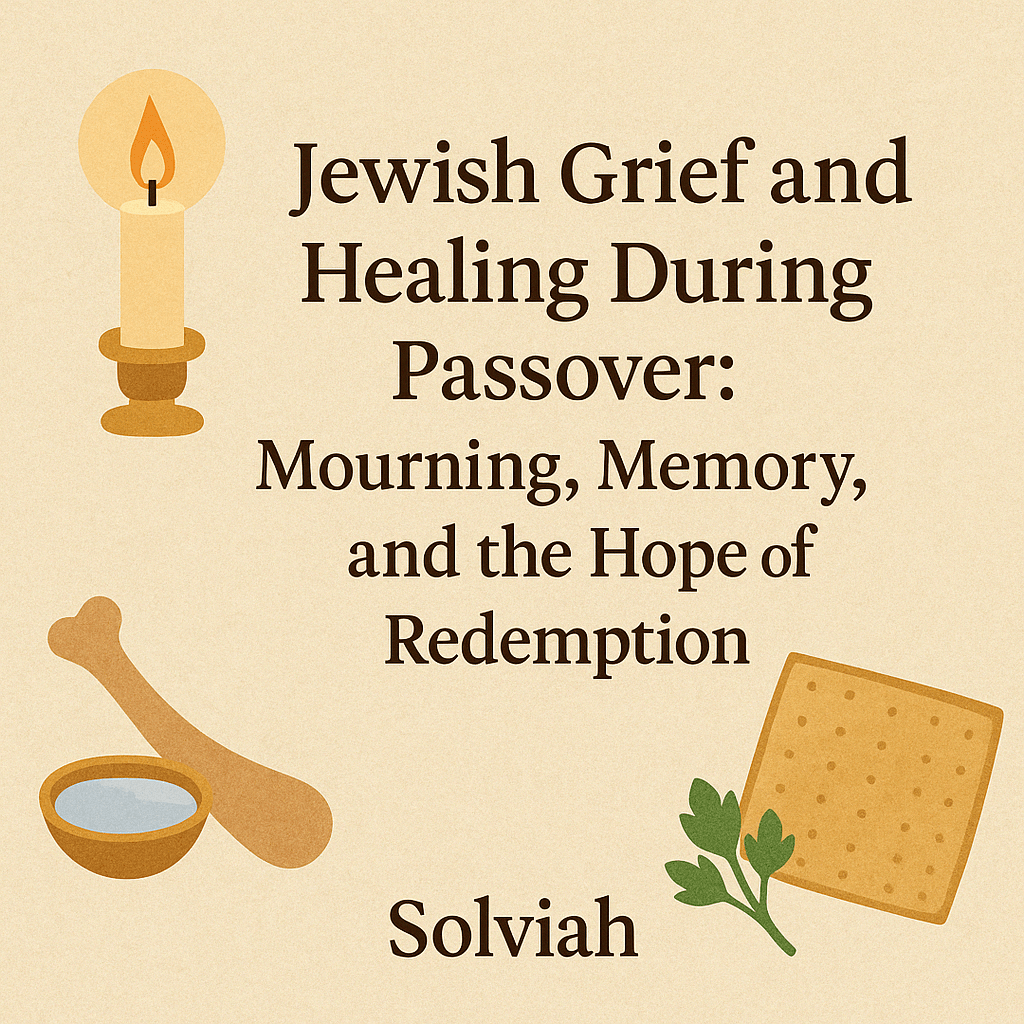
    Some mourners may find particular meaning in the bitter herbs of the Seder plate, which recall the pain of slavery in Egypt. These herbs also evoke the sharpness of grief—a visceral reminder that healing does not require forgetting. The symbolic foods of Passover offer a sacred vocabulary for sorrow: the shank bone (loss), the salt water (tears), the matzah (fragility). Together, they form a ritual language that allows grief to be felt and honored.


    🤝 The Healing Power of Community and Ritual

    Grief isolates. Ritual reconnects. Jewish mourning practices emphasize the power of community. From bringing meals during shiva to standing together for the Kaddish, the community holds space for the mourner to be broken—and to begin to heal.

    Passover, with its family-centered structure, may intensify grief, but it can also provide gentle re-entry into communal life. Many families leave an empty chair or say a blessing in memory of the deceased. Others incorporate personal stories, photos, or favorite foods of the departed into the Seder meal. These small acts keep memory alive and sanctify grief as part of the celebration, not an interruption to it.

    Jewish psychologist David Pelcovitz (2020) writes that rituals are crucial for grief recovery. They “create predictability, provide comfort, and offer the bereaved a sense of agency during disorienting times.” The rituals of Passover, from searching for the afikomen to pouring Elijah’s cup, provide sacred structure even for the heart that aches.


    🧠 Psychological Insights and Grief Theory in Jewish Practice

    Modern grief theory—particularly the dual-process model—emphasizes oscillation between loss-oriented and restoration-oriented activities (Stroebe & Schut, 1999). Jewish mourning mirrors this beautifully. During Passover, one may mourn during private prayer but also engage in songs, storytelling, and food preparation. The balance is not only permissible—it is healing.

    Moreover, Judaism embraces the concept of continuing bonds—maintaining a relationship with the deceased through memory, ritual, and shared values. These practices align with contemporary bereavement psychology and offer profound spiritual reinforcement: the love continues.


    🌿 A Blessing for the Grieving During Passover

    If you are grieving during Passover, you are not alone. You walk the ancient path of those who mourned in the wilderness, whose cries rose with the smoke of burnt offerings, whose tears mingled with salt water on the table. There is space for you at the Seder. There is room for grief in the story of redemption.

    May the God who delivered Israel from bondage draw near to your sorrow. May the memory of your loved one shine like the pillar of fire that guided our ancestors through the night. And may you, in time, come to feel again the joy of spring—the whisper of freedom, the promise of renewal.


    📖 References (APA Style)

    Berkovits, E. (1983). Faith After the Holocaust. KTAV Publishing House.

    Kaplan, A. (1997). Jewish Meditation: A Practical Guide. Schocken Books.

    Lamm, M. (1969). The Jewish Way in Death and Mourning. Jonathan David Publishers.

    Pelcovitz, D. (2020). Rituals and resilience in Jewish mourning. Jewish Psychology Journal, 12(1), 42–57.

    Sacks, J. (2010). Future Tense: Jews, Judaism, and Israel in the Twenty-First Century. Schocken Books.

    Shulchan Aruch, Orach Chaim 429:1. (Code of Jewish Law)

    Stroebe, M., & Schut, H. (1999). The dual process model of coping with bereavement: Rationale and description. Death Studies, 23(3), 197–224.

  • Finding Peace In Loss: A Jewish Perspective

    When Faith Meets Grief

    Grief often takes us to the edge of our understanding—of ourselves, of the world, and even of God. It’s a spiritual crossroads where the questions become louder than the answers. In Jewish tradition, that tension is not shunned; it’s sanctified.

    Whether you are newly grieving or supporting someone who is, Judaism offers both space to mourn and a path toward peace. Jewish grief is not linear, and healing through faith doesn’t mean forgetting. Instead, it’s a journey of holding pain and promise together—of remembering, mourning, and eventually, rebuilding.

    In this post, we explore how ancient Jewish traditions and modern faith practices can help offer spiritual comfort after death. Even if you are not Jewish, there is wisdom in this rhythm of lament, ritual, and renewal.


    “The Lord is close to the brokenhearted” (Psalm 34:18)

    “The Lord is close to the brokenhearted and saves those who are crushed in spirit.” (Psalm 34:18, NIV)

    This verse is more than poetic—it’s an anchor. The Hebrew word for “close” (karov) implies intimacy, like the nearness of a parent comforting a child. In times of grief, it can feel like God is silent. But the psalm insists otherwise: God draws near in our heartbreak.

    Psalm 34 is a deeply vulnerable text. It doesn’t offer false hope—it offers presence. In Jewish mourning, that divine closeness is mirrored in the communal embrace of rituals like shiva (seven days of mourning), where the bereaved are surrounded by others and relieved from daily responsibilities. The grief is not hidden—it is held.


    Mourning as a Form of Faith

    One of the most compassionate aspects of Jewish grief tradition is its permission to feel fully. Pain is not a failure of faith—it is part of it.

    The book of Job illustrates this beautifully. After unimaginable loss, Job doesn’t pretend everything is fine. He cries out. He questions. And unlike his well-meaning friends, who try to make sense of his suffering, God honors Job’s honesty. As Rabbi Harold Kushner writes in When Bad Things Happen to Good People, “God does not send us the problem; He gives us the strength to deal with it” (Kushner, 2001).

    That strength comes, in part, through ritual. The Mourner’s Kaddish—recited daily, often for eleven months after a parent’s death—is a surprising prayer. It doesn’t mention death at all. Instead, it praises God. In doing so, it helps the mourner reframe their loss in the context of eternity and connection.


    Why Jewish Mourning Heals: Faith and Psychology

    Modern psychology affirms what Judaism has practiced for millennia: grief needs structure. It needs time. It needs meaning.

    Jewish mourning has a natural progression:

    • Shiva: A week of intense mourning, usually at home, where visitors bring food, prayers, and presence.
    • Shloshim: A 30-day period of adjustment, where the mourner begins to return to life’s routine but still observes certain restrictions.
    • Avelut: For a parent’s loss, mourning continues for a full year, during which Kaddish is said daily.

    These stages give the mourner both space and scaffolding. They don’t rush grief, nor do they leave the mourner alone.

    Psychologically, such rituals help the brain integrate trauma. Acts like lighting a yahrzeit candle, tearing one’s garment (keriah), or visiting the grave on anniversaries serve as physical expressions of inner sorrow. According to grief therapist David Kessler, ritual “gives grief a container and helps us metabolize pain” (Kessler, 2020).

    Even lament is healing. A third of the Psalms are laments—raw, unfiltered cries to God. The Talmud says, “Even when the gates of prayer are closed, the gates of tears are never closed” (Bava Metzia 59b). In other words: God always hears grief, even when we can’t find the words.


    For the Broader Soul: Interfaith and Inclusive Reflections

    You don’t need to be deeply religious—or even Jewish—to find meaning in these practices. Many interfaith and secular families adapt Jewish grief rituals, lighting candles or saying personal versions of Kaddish. The goal isn’t perfection; it’s connection.

    Other traditions echo these rhythms. Christian liturgy honors lament in the Psalms and All Saints’ Day. Islamic funerals emphasize both submission to God and communal mourning. In Buddhism, rituals guide the soul’s journey and help loved ones release attachment. What these have in common is a spiritual framework for remembering and honoring, not just letting go.

    Jewish grief rituals remind us that healing through faith is not about forgetting—but about sanctifying the bond that remains.


    The Mystery of the Soul’s Ascent

    One lesser-known but deeply beautiful Jewish teaching is the idea that the soul continues to grow after death. Every yahrzeit (death anniversary), it is believed the soul ascends further toward the Divine.

    How do we help? Through mitzvot—acts of kindness done in their name. You can donate to a charity they loved, feed the hungry, or light a candle in prayer. These acts don’t just honor their memory—they bless their journey.

    As Rabbi Adin Steinsaltz explains, “The soul is a divine spark… eternal and boundless” (Steinsaltz, 1989). In this way, love doesn’t end—it transforms.


    Take a Step Toward Healing

    Grief may never fully leave us, but it can become a sacred companion. If you are in mourning, know that your pain is part of something ancient, recognized, and held by a greater story. Jewish grief is not only about mourning a death—it is about remembering a life and lifting a soul.


    References

    • Brueggemann, W. (1984). The Message of the Psalms: A Theological Commentary. Augsburg Publishing House.
    • Kessler, D. (2020). Finding Meaning: The Sixth Stage of Grief. Scribner.
    • Kushner, H. S. (2001). When Bad Things Happen to Good People. Anchor Books.
    • Steinsaltz, A. (1989). The Thirteen Petalled Rose: A Discourse on the Essence of Jewish Existence and Belief. Basic Books.
    • The Holy Bible, New International Version. (1984). Zondervan.