Passover is a season of liberation. But for many, it arrives bearing the invisible weight of grief. As Jewish families gather to retell the story of Exodus and celebrate divine deliverance, some seats at the table remain heartbreakingly empty. For those mourning during Passover, the ancient rituals of redemption offer both a mirror to their sorrow and a gentle invitation toward spiritual comfort.
Solviah explores the experience of grief during Passover through the lens of Jewish theology, cultural practice, and sacred memory. We honor the pain of loss, reflect on the eternal hope embedded in Jewish faith, and aim to illuminate the pathways to healing offered by prayer, ritual, and communal remembrance. Even in mourning, Jewish tradition whispers a deeper truth: redemption is not only about history—it is also about healing.
🕯️ The Sacred Weight of Loss in a Time of Joy
Passover occurs in the Hebrew month of Nissan—a time traditionally designated for joy. Yet the Torah and Jewish tradition make room for sorrow even within celebration. As Ecclesiastes teaches, “There is a time to mourn and a time to dance” (Ecclesiastes 3:4). The two may live side by side, especially in a faith that has long held paradox as sacred.
Grieving during Passover can feel isolating. While others rejoice in songs of deliverance, a mourner may feel trapped in their own Egypt—a personal exile of absence and longing. Yet Judaism, unlike many modern cultures, does not shy away from grief. The Psalms cry openly, prophets mourn publicly, and Jewish law upholds a comprehensive system of mourning that dignifies sorrow.
📜 Jewish Theology on Death, Memory, and Redemption
Within Jewish theology, death is not an end but a transformation. While beliefs vary across denominations, many Jews affirm the existence of olam ha-ba (the world to come), and techiyat ha-metim (resurrection of the dead). These concepts are not mere doctrines but expressions of a deeper truth: that the soul remains tethered to the divine and to those who love it.
“The soul of a person is the lamp of God,” writes Proverbs (20:27). This spiritual imagery illuminates the Jewish view of the afterlife—not as distant, but as near, flickering gently in the spaces we remember. Rabbi Jonathan Sacks (2010) reminds us, “Memory in Judaism is a form of redemption. It transforms the past into a source of strength and blessing.”
The phrase zikhrono livrakha—“may their memory be a blessing”—is not simply a sentiment; it is a theological declaration. It implies that the deceased continues to act in the world through memory, legacy, and love.
✡️ Mourning Rituals and Passover Adaptations
Jewish mourning rituals guide the mourner through phases of grief: aninut (pre-burial grief), shiva (seven days of deep mourning), shloshim (thirty days), and the twelve-month mourning for a parent. During Passover, some elements of mourning are modified—eulogies are often shortened, and public displays of mourning are softened out of respect for the season’s joy (Shulchan Aruch, Orach Chaim 429:1).
Yet the inner world of grief remains, and the traditions continue to offer structure and support. The recitation of Kaddish during the holiday is a powerful expression of faith in the midst of loss. It affirms God’s greatness, not in spite of death, but through it. As Rabbi Eliezer Berkovits (1983) noted, “To recite Kaddish is to proclaim that life has meaning—even in the face of death.”
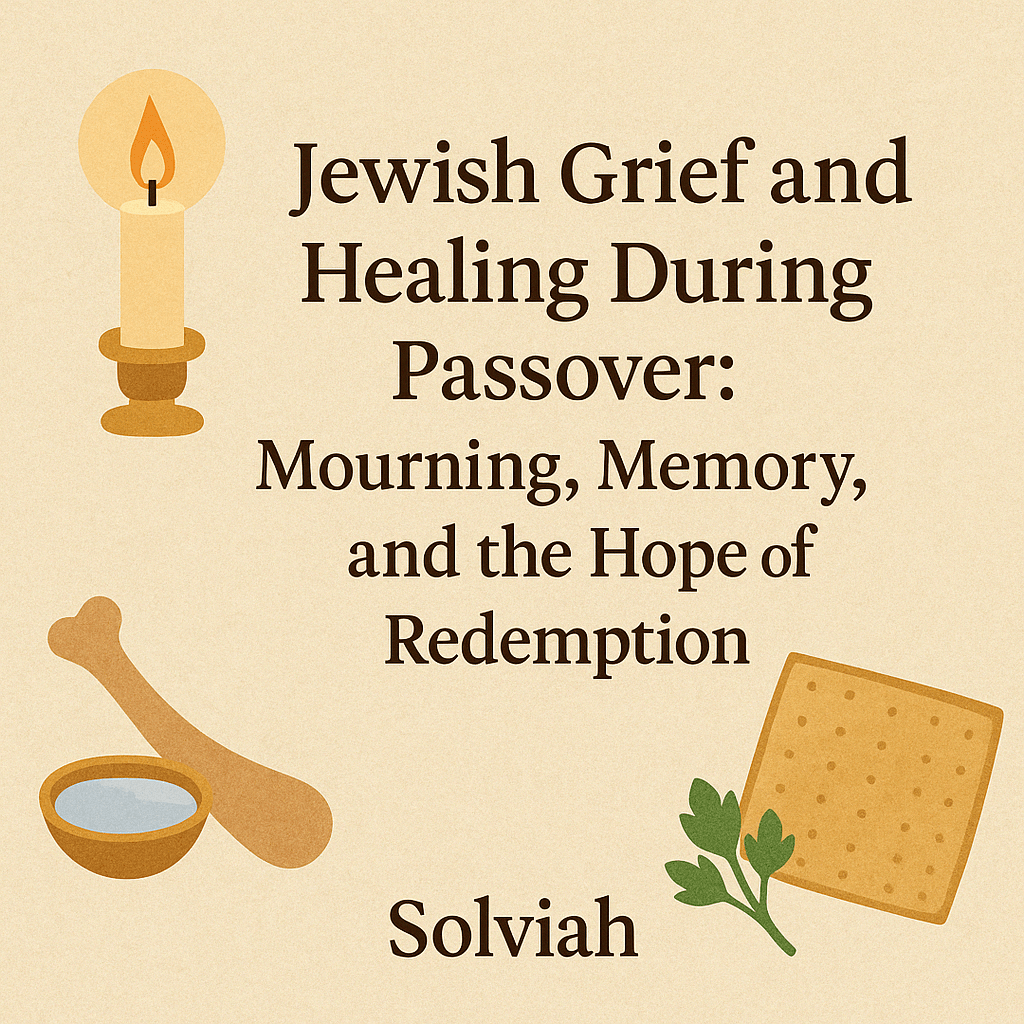
Some mourners may find particular meaning in the bitter herbs of the Seder plate, which recall the pain of slavery in Egypt. These herbs also evoke the sharpness of grief—a visceral reminder that healing does not require forgetting. The symbolic foods of Passover offer a sacred vocabulary for sorrow: the shank bone (loss), the salt water (tears), the matzah (fragility). Together, they form a ritual language that allows grief to be felt and honored.
🤝 The Healing Power of Community and Ritual
Grief isolates. Ritual reconnects. Jewish mourning practices emphasize the power of community. From bringing meals during shiva to standing together for the Kaddish, the community holds space for the mourner to be broken—and to begin to heal.
Passover, with its family-centered structure, may intensify grief, but it can also provide gentle re-entry into communal life. Many families leave an empty chair or say a blessing in memory of the deceased. Others incorporate personal stories, photos, or favorite foods of the departed into the Seder meal. These small acts keep memory alive and sanctify grief as part of the celebration, not an interruption to it.
Jewish psychologist David Pelcovitz (2020) writes that rituals are crucial for grief recovery. They “create predictability, provide comfort, and offer the bereaved a sense of agency during disorienting times.” The rituals of Passover, from searching for the afikomen to pouring Elijah’s cup, provide sacred structure even for the heart that aches.
🧠 Psychological Insights and Grief Theory in Jewish Practice
Modern grief theory—particularly the dual-process model—emphasizes oscillation between loss-oriented and restoration-oriented activities (Stroebe & Schut, 1999). Jewish mourning mirrors this beautifully. During Passover, one may mourn during private prayer but also engage in songs, storytelling, and food preparation. The balance is not only permissible—it is healing.
Moreover, Judaism embraces the concept of continuing bonds—maintaining a relationship with the deceased through memory, ritual, and shared values. These practices align with contemporary bereavement psychology and offer profound spiritual reinforcement: the love continues.
🌿 A Blessing for the Grieving During Passover
If you are grieving during Passover, you are not alone. You walk the ancient path of those who mourned in the wilderness, whose cries rose with the smoke of burnt offerings, whose tears mingled with salt water on the table. There is space for you at the Seder. There is room for grief in the story of redemption.
May the God who delivered Israel from bondage draw near to your sorrow. May the memory of your loved one shine like the pillar of fire that guided our ancestors through the night. And may you, in time, come to feel again the joy of spring—the whisper of freedom, the promise of renewal.
📖 References (APA Style)
Berkovits, E. (1983). Faith After the Holocaust. KTAV Publishing House.
Kaplan, A. (1997). Jewish Meditation: A Practical Guide. Schocken Books.
Lamm, M. (1969). The Jewish Way in Death and Mourning. Jonathan David Publishers.
Pelcovitz, D. (2020). Rituals and resilience in Jewish mourning. Jewish Psychology Journal, 12(1), 42–57.
Sacks, J. (2010). Future Tense: Jews, Judaism, and Israel in the Twenty-First Century. Schocken Books.
Shulchan Aruch, Orach Chaim 429:1. (Code of Jewish Law)
Stroebe, M., & Schut, H. (1999). The dual process model of coping with bereavement: Rationale and description. Death Studies, 23(3), 197–224.
 Solviah