Honoring Life, Embracing Memories

Tag: Interfaith Grief Support

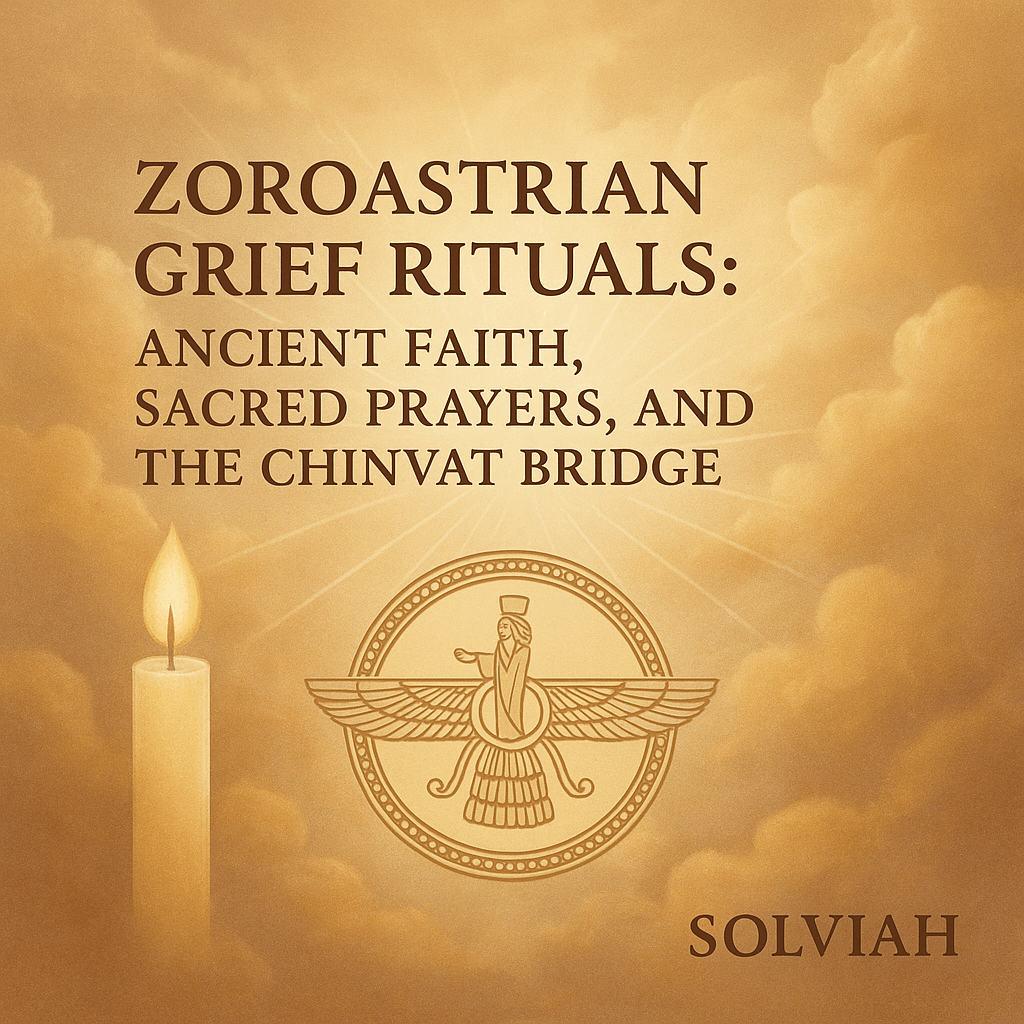
  • Zoroastrian Grief Rituals: Ancient Faith, Sacred Prayers, and the Chinvat Bridge

    Zoroastrian Grief Rituals: Ancient Faith, Sacred Prayers, and the Chinvat Bridge


    “As thou dost desire, O holy one! so shalt thou be; holy shalt thou cause thy soul to pass over the Chinvat Bridge; holy shalt thou come into Heaven.”
    — Yasna 71, Avesta

    When someone beloved dies, Zoroastrians do not simply mourn—they prepare the soul for its most sacred journey. Rooted in the world’s oldest known monotheistic tradition, this journey leads across the Chinvat Bridge, guided by prayers, rituals, and a legacy of good deeds.


    🕯️ A Sacred Story of Life After Death

    An old tale tells of a kind-hearted man who gave shelter to the poor and refused to gossip. When he died, his soul lingered three days near his home. On the dawn of the fourth, he stood before the Chinvat Bridge—where three divine judges weighed his deeds. The bridge widened, and a radiant maiden, the embodiment of his own good actions, walked beside him into the House of Song. There, light never dimmed, and music never ceased.

    This story expresses the Zoroastrian belief: the soul is judged not by belief alone, but by the harmony it created through thoughts, words, and deeds.

    ↑ Back to Top

    ⚖️ What Zoroastrians Believe About Death

    Zoroastrianism teaches that life is a moral struggle between asha (truth) and druj (falsehood). When someone dies, the soul (urvan) stays near the body for three days. On the fourth, it crosses the Chinvat Bridge, where three divine judges await:

    • Mithra — Covenant and Witness
    • Sraosha — Conscience and Protector
    • Rashnu — Justice and Weighing of Deeds

    Those who lived in asha are welcomed into Garo Demana (the House of Song). Those who served druj fall into Druj Demana, a place of darkness.

    ↑ Back to Top

    📿 Sacred Prayers and Mourning Rituals

    Zoroastrians honor the dead through rituals designed to protect both the soul and the elements. Traditionally, bodies are placed in a dakhma (Tower of Silence). Today, cremation or burial may be used, with adapted rites.

    Key prayers and ceremonies:

    • Geh Sarnu — comforting hymns
    • Patet Pashemani — confessional prayer
    • Sraosh Hadokht — prayer for protection
    • Uthamna — fourth-day soul release ceremony
    • Dahmah — charity done in the name of the deceased

    These rituals affirm that love continues beyond life and offer structure to support those who grieve.

    ↑ Back to Top

    🧠 Ancient Wisdom Meets Modern Healing

    Psychologists note that ritual, repetition, and meaning-making ease the pain of loss. Zoroastrian grief practices align closely with this wisdom:

    • Structured mourning rituals create safety and continuity
    • The soul’s journey provides spiritual purpose and meaning
    • Community prayers build connection and memory

    Grief becomes not just pain, but a sacred transformation of presence into legacy.

    ↑ Back to Top

    🤝 Across Faiths: Threads of Common Ground

    Zoroastrianism is often compared to Christianity due to its belief in a final judgment and heaven. In Yasna 30:9 we read:

    “Let good thoughts prevail in the world and evil thoughts perish. Let good words be spoken and evil ones be silenced. Let good deeds increase and evil ones fade away.”

    This mirrors the Christian principle to “overcome evil with good” (Romans 12:21).

    Other faiths also echo this sacred rhythm:

    • Judaism: Sitting shiva honors memory with community presence
    • Islam: Mourning includes prayer and charity for the soul’s peace
    • Buddhism: Grief is eased through acceptance of impermanence

    Such reflections reveal that in grief, we are not divided by belief—but connected by love.

    ↑ Back to Top

    💞 For Supporters and Friends

    If someone you love is grieving within the Zoroastrian faith, your compassion can be a bridge of comfort. Here are gentle ways to support:

    • Honor the first three days: These are sacred for the soul’s transition. Presence, not pressure, matters most.
    • Use spiritual language: Words like “May their soul cross in light” or “May their deeds lead them to peace” align with their beliefs.
    • Respect the rituals: Ask before bringing food, gifts, or flowers—some families observe specific customs around purity and space.
    • Offer to help with Dahmah: Assist in charitable acts made in memory of the deceased.
    • Share good memories: Speaking of the person’s kindness or courage honors their legacy.

    Kindness, even quiet kindness, is a sacred act.

    ↑ Back to Top

    🌟 Heaven, But Not As You Know It

    Garo Demana, the House of Song, is Zoroastrianism’s vision of heaven. It is a place of eternal light, music, and unity with Ahura Mazda. Entry is not earned by belief alone—but by how one lives.

    When the soul approaches the Chinvat Bridge, three divine entities weigh their life:

    • Mithra (truthfulness)
    • Sraosha (obedience to conscience)
    • Rashnu (justice)

    If the soul lived in asha, the bridge widens and leads them across into joy. This belief invites every Zoroastrian to live with moral courage, knowing eternity awaits.

    ↑ Back to Top

    📘 Glossary

    • Asha — Truth, righteousness, divine order
    • Druj — Falsehood, deceit, disorder
    • Urvan — The soul of the deceased
    • Chinvat Bridge — Bridge of judgment after death
    • Garo Demana — House of Song (Zoroastrian heaven)
    • Druj Demana — House of Lies (place of sorrow)
    • Dakhma — Tower of Silence for traditional sky burial
    • Uthamna — Fourth-day soul release ceremony
    • Patet Pashemani — Confessional prayer
    • Sraosh Hadokht — Prayer for soul’s journey
    • Dahmah — Acts of charity in memory of the deceased

    ↑ Back to Top

    💨 A Breath Prayer for the Grieving

    Inhale: I walk with truth
    Exhale: My soul is not alone

    Reflection:
    What good words or deeds can I speak in their memory today?
    ↑ Back to Top

    🗣️ Share Your Story

    Have you experienced grief through the lens of faith—Zoroastrian or otherwise?

    Leave a comment to honor your loved one, share your tradition, or ask a question. Your voice may be the bridge someone else needs today.

    Continue exploring:

    ↑ Back to Top

    Written for Solviah, where grief is met with gentleness, wisdom, and sacred remembering.
  • Finding Peace In Loss: A Jewish Perspective

    When Faith Meets Grief

    Grief often takes us to the edge of our understanding—of ourselves, of the world, and even of God. It’s a spiritual crossroads where the questions become louder than the answers. In Jewish tradition, that tension is not shunned; it’s sanctified.

    Whether you are newly grieving or supporting someone who is, Judaism offers both space to mourn and a path toward peace. Jewish grief is not linear, and healing through faith doesn’t mean forgetting. Instead, it’s a journey of holding pain and promise together—of remembering, mourning, and eventually, rebuilding.

    In this post, we explore how ancient Jewish traditions and modern faith practices can help offer spiritual comfort after death. Even if you are not Jewish, there is wisdom in this rhythm of lament, ritual, and renewal.


    “The Lord is close to the brokenhearted” (Psalm 34:18)

    “The Lord is close to the brokenhearted and saves those who are crushed in spirit.” (Psalm 34:18, NIV)

    This verse is more than poetic—it’s an anchor. The Hebrew word for “close” (karov) implies intimacy, like the nearness of a parent comforting a child. In times of grief, it can feel like God is silent. But the psalm insists otherwise: God draws near in our heartbreak.

    Psalm 34 is a deeply vulnerable text. It doesn’t offer false hope—it offers presence. In Jewish mourning, that divine closeness is mirrored in the communal embrace of rituals like shiva (seven days of mourning), where the bereaved are surrounded by others and relieved from daily responsibilities. The grief is not hidden—it is held.


    Mourning as a Form of Faith

    One of the most compassionate aspects of Jewish grief tradition is its permission to feel fully. Pain is not a failure of faith—it is part of it.

    The book of Job illustrates this beautifully. After unimaginable loss, Job doesn’t pretend everything is fine. He cries out. He questions. And unlike his well-meaning friends, who try to make sense of his suffering, God honors Job’s honesty. As Rabbi Harold Kushner writes in When Bad Things Happen to Good People, “God does not send us the problem; He gives us the strength to deal with it” (Kushner, 2001).

    That strength comes, in part, through ritual. The Mourner’s Kaddish—recited daily, often for eleven months after a parent’s death—is a surprising prayer. It doesn’t mention death at all. Instead, it praises God. In doing so, it helps the mourner reframe their loss in the context of eternity and connection.


    Why Jewish Mourning Heals: Faith and Psychology

    Modern psychology affirms what Judaism has practiced for millennia: grief needs structure. It needs time. It needs meaning.

    Jewish mourning has a natural progression:

    • Shiva: A week of intense mourning, usually at home, where visitors bring food, prayers, and presence.
    • Shloshim: A 30-day period of adjustment, where the mourner begins to return to life’s routine but still observes certain restrictions.
    • Avelut: For a parent’s loss, mourning continues for a full year, during which Kaddish is said daily.

    These stages give the mourner both space and scaffolding. They don’t rush grief, nor do they leave the mourner alone.

    Psychologically, such rituals help the brain integrate trauma. Acts like lighting a yahrzeit candle, tearing one’s garment (keriah), or visiting the grave on anniversaries serve as physical expressions of inner sorrow. According to grief therapist David Kessler, ritual “gives grief a container and helps us metabolize pain” (Kessler, 2020).

    Even lament is healing. A third of the Psalms are laments—raw, unfiltered cries to God. The Talmud says, “Even when the gates of prayer are closed, the gates of tears are never closed” (Bava Metzia 59b). In other words: God always hears grief, even when we can’t find the words.


    For the Broader Soul: Interfaith and Inclusive Reflections

    You don’t need to be deeply religious—or even Jewish—to find meaning in these practices. Many interfaith and secular families adapt Jewish grief rituals, lighting candles or saying personal versions of Kaddish. The goal isn’t perfection; it’s connection.

    Other traditions echo these rhythms. Christian liturgy honors lament in the Psalms and All Saints’ Day. Islamic funerals emphasize both submission to God and communal mourning. In Buddhism, rituals guide the soul’s journey and help loved ones release attachment. What these have in common is a spiritual framework for remembering and honoring, not just letting go.

    Jewish grief rituals remind us that healing through faith is not about forgetting—but about sanctifying the bond that remains.


    The Mystery of the Soul’s Ascent

    One lesser-known but deeply beautiful Jewish teaching is the idea that the soul continues to grow after death. Every yahrzeit (death anniversary), it is believed the soul ascends further toward the Divine.

    How do we help? Through mitzvot—acts of kindness done in their name. You can donate to a charity they loved, feed the hungry, or light a candle in prayer. These acts don’t just honor their memory—they bless their journey.

    As Rabbi Adin Steinsaltz explains, “The soul is a divine spark… eternal and boundless” (Steinsaltz, 1989). In this way, love doesn’t end—it transforms.


    Take a Step Toward Healing

    Grief may never fully leave us, but it can become a sacred companion. If you are in mourning, know that your pain is part of something ancient, recognized, and held by a greater story. Jewish grief is not only about mourning a death—it is about remembering a life and lifting a soul.


    References

    • Brueggemann, W. (1984). The Message of the Psalms: A Theological Commentary. Augsburg Publishing House.
    • Kessler, D. (2020). Finding Meaning: The Sixth Stage of Grief. Scribner.
    • Kushner, H. S. (2001). When Bad Things Happen to Good People. Anchor Books.
    • Steinsaltz, A. (1989). The Thirteen Petalled Rose: A Discourse on the Essence of Jewish Existence and Belief. Basic Books.
    • The Holy Bible, New International Version. (1984). Zondervan.