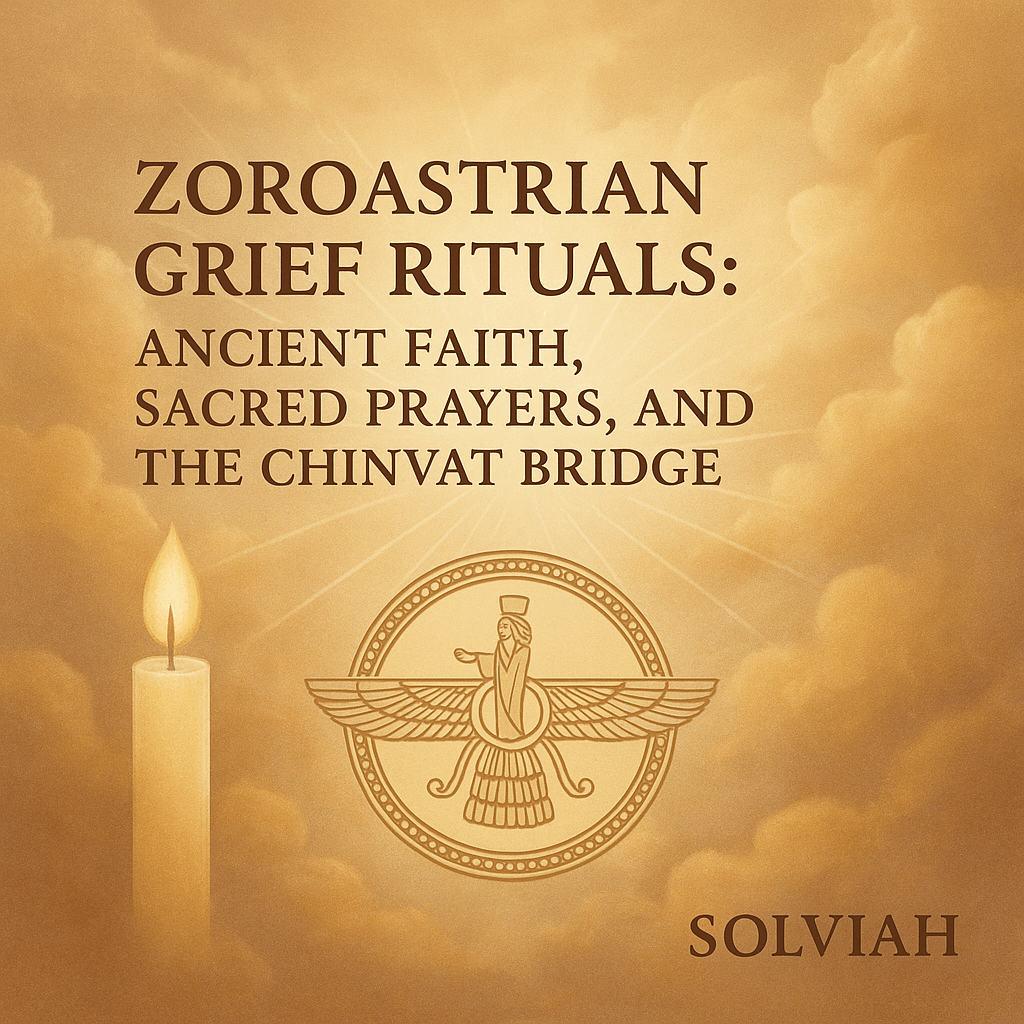
“As thou dost desire, O holy one! so shalt thou be; holy shalt thou cause thy soul to pass over the Chinvat Bridge; holy shalt thou come into Heaven.”
— Yasna 71, Avesta
When someone beloved dies, Zoroastrians do not simply mourn—they prepare the soul for its most sacred journey. Rooted in the world’s oldest known monotheistic tradition, this journey leads across the Chinvat Bridge, guided by prayers, rituals, and a legacy of good deeds.
Table of Contents
- 🕯️ A Sacred Story of Life After Death
- ⚖️ What Zoroastrians Believe About Death
- 📿 Sacred Prayers and Mourning Rituals
- 🧠 Ancient Wisdom Meets Modern Healing
- 🤝 Across Faiths: Threads of Common Ground
- 💞 For Supporters and Friends
- 🌟 Heaven, But Not As You Know It
- 📘 Glossary
- 💨 A Breath Prayer for the Grieving
- 🗣️ Share Your Story
🕯️ A Sacred Story of Life After Death
An old tale tells of a kind-hearted man who gave shelter to the poor and refused to gossip. When he died, his soul lingered three days near his home. On the dawn of the fourth, he stood before the Chinvat Bridge—where three divine judges weighed his deeds. The bridge widened, and a radiant maiden, the embodiment of his own good actions, walked beside him into the House of Song. There, light never dimmed, and music never ceased.
This story expresses the Zoroastrian belief: the soul is judged not by belief alone, but by the harmony it created through thoughts, words, and deeds.
⚖️ What Zoroastrians Believe About Death
Zoroastrianism teaches that life is a moral struggle between asha (truth) and druj (falsehood). When someone dies, the soul (urvan) stays near the body for three days. On the fourth, it crosses the Chinvat Bridge, where three divine judges await:
- Mithra — Covenant and Witness
- Sraosha — Conscience and Protector
- Rashnu — Justice and Weighing of Deeds
Those who lived in asha are welcomed into Garo Demana (the House of Song). Those who served druj fall into Druj Demana, a place of darkness.
📿 Sacred Prayers and Mourning Rituals
Zoroastrians honor the dead through rituals designed to protect both the soul and the elements. Traditionally, bodies are placed in a dakhma (Tower of Silence). Today, cremation or burial may be used, with adapted rites.
Key prayers and ceremonies:
- Geh Sarnu — comforting hymns
- Patet Pashemani — confessional prayer
- Sraosh Hadokht — prayer for protection
- Uthamna — fourth-day soul release ceremony
- Dahmah — charity done in the name of the deceased
These rituals affirm that love continues beyond life and offer structure to support those who grieve.
🧠 Ancient Wisdom Meets Modern Healing
Psychologists note that ritual, repetition, and meaning-making ease the pain of loss. Zoroastrian grief practices align closely with this wisdom:
- Structured mourning rituals create safety and continuity
- The soul’s journey provides spiritual purpose and meaning
- Community prayers build connection and memory
Grief becomes not just pain, but a sacred transformation of presence into legacy.
🤝 Across Faiths: Threads of Common Ground
Zoroastrianism is often compared to Christianity due to its belief in a final judgment and heaven. In Yasna 30:9 we read:
“Let good thoughts prevail in the world and evil thoughts perish. Let good words be spoken and evil ones be silenced. Let good deeds increase and evil ones fade away.”
This mirrors the Christian principle to “overcome evil with good” (Romans 12:21).
Other faiths also echo this sacred rhythm:
- Judaism: Sitting shiva honors memory with community presence
- Islam: Mourning includes prayer and charity for the soul’s peace
- Buddhism: Grief is eased through acceptance of impermanence
Such reflections reveal that in grief, we are not divided by belief—but connected by love.
💞 For Supporters and Friends
If someone you love is grieving within the Zoroastrian faith, your compassion can be a bridge of comfort. Here are gentle ways to support:
- Honor the first three days: These are sacred for the soul’s transition. Presence, not pressure, matters most.
- Use spiritual language: Words like “May their soul cross in light” or “May their deeds lead them to peace” align with their beliefs.
- Respect the rituals: Ask before bringing food, gifts, or flowers—some families observe specific customs around purity and space.
- Offer to help with Dahmah: Assist in charitable acts made in memory of the deceased.
- Share good memories: Speaking of the person’s kindness or courage honors their legacy.
Kindness, even quiet kindness, is a sacred act.
🌟 Heaven, But Not As You Know It
Garo Demana, the House of Song, is Zoroastrianism’s vision of heaven. It is a place of eternal light, music, and unity with Ahura Mazda. Entry is not earned by belief alone—but by how one lives.
When the soul approaches the Chinvat Bridge, three divine entities weigh their life:
- Mithra (truthfulness)
- Sraosha (obedience to conscience)
- Rashnu (justice)
If the soul lived in asha, the bridge widens and leads them across into joy. This belief invites every Zoroastrian to live with moral courage, knowing eternity awaits.
📘 Glossary
- Asha — Truth, righteousness, divine order
- Druj — Falsehood, deceit, disorder
- Urvan — The soul of the deceased
- Chinvat Bridge — Bridge of judgment after death
- Garo Demana — House of Song (Zoroastrian heaven)
- Druj Demana — House of Lies (place of sorrow)
- Dakhma — Tower of Silence for traditional sky burial
- Uthamna — Fourth-day soul release ceremony
- Patet Pashemani — Confessional prayer
- Sraosh Hadokht — Prayer for soul’s journey
- Dahmah — Acts of charity in memory of the deceased
💨 A Breath Prayer for the Grieving
Inhale: I walk with truth
Exhale: My soul is not alone
Reflection:
What good words or deeds can I speak in their memory today?
 Solviah