“They tried to bury us. They didn’t know we were seeds.” – Mexican Proverb
Table of Contents
- Roots in Life and Legacy
- What Grief Feels Like in Mexico
- Diverse Traditions Across Mexico
- Communal Grief
- Mexican vs. Western Mourning
- An Evening of Remembrance
- A Personal Story of Grief
- Anthropological Insights
- For Mexican Readers
- How to Support Grieving Mexicans
- Reflection
- Share Your Experience
- Glossary
- Explore More on Solviah
- References
Roots in Life and Legacy
Mexico’s relationship with death comes from a deeply spiritual blend of pre-Columbian and Catholic beliefs. Long before the Spanish arrived, Aztecs, Mayans, Zapotecs, and other Indigenous peoples believed death was merely another stage of life. The goddess Mictecacihuatl ruled over the afterlife, safeguarding ancestors and ensuring they could revisit the living world once a year.
Today, the Day of the Dead (Día de los Muertos) carries this ancient worldview into modern life. Families believe ancestors return, guided by trails of marigolds (cempasúchil), the flower whose scent leads spirits home.
What Grief Feels Like in Mexico
Late October weather in Mexico is crisp and inviting, cooling evenings offset by warm, vibrant days. At home, families prepare pan de muerto, spicy tamales, cinnamon-laced atole, and complex mole sauces—a flavorful tribute to the complexity of grief itself.
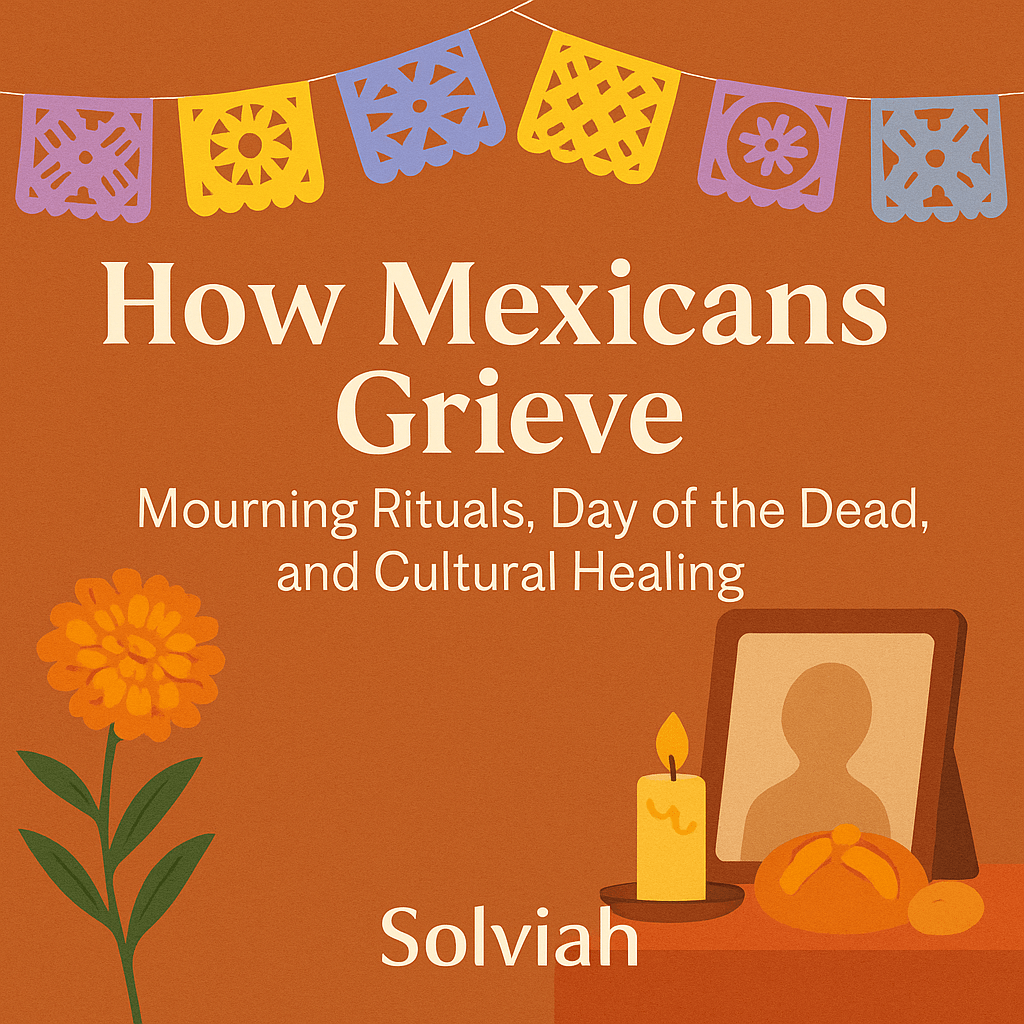
Colorful paper banners (papel picado) flutter in cemeteries. Candles and marigolds guide spirits, while mariachi music echoes familiar songs of remembrance. Grief in Mexico is felt, seen, tasted, and shared.
Diverse Traditions Across Mexico
From the candlelit cemeteries of Oaxaca to the urban neighborhoods of Mexico City, traditions vary widely. Indigenous Zapotec communities may hold all-night vigils filled with prayer, while modern families create elaborate ofrendas with photos, food, and personal items.
Formal mourning can last nine to forty days. Women may wear black or traditional embroidered huipiles, and remembrance culminates annually on Día de los Muertos—a day of reunion, not separation.
Communal Grief: Shared Stories and Healing Together
During a velorio (wake), homes fill with neighbors offering prayers, tamales, and presence. People cry, laugh, share stories, and honor the person’s life in community. Humor softens pain—through stories, memories, and calaveras literarias, witty poetic tributes to the dead.
Grief in Mexico is not meant to be carried alone.
The Mexican Way vs. Western Mourning
Where Western cultures often silence grief, Mexico gives it music, ritual, and space. Funerals aren’t just endings—they’re invitations to keep remembering. Rather than moving on, Mexicans move forward with their loved ones in memory.
Grief here evolves into relationship—not resolution.
A Glimpse Inside: An Evening of Remembrance
Inside a family home, a glowing altar holds photos, favorite snacks, marigolds, and handwritten notes. Children place sugar skulls beside glasses of water. A soft hymn plays, and the air is thick with memory.
Guests are greeted with warmth. Everyone is welcome. Grief is witnessed, not rushed.
A Personal Story of Grief
Gardenia Rangel, a Mexican-American woman, shared her experience of honoring her parents who both passed away from COVID-19. She keeps their memory alive by maintaining an altar in her home adorned with their wedding portrait, electric candles, and mariachi music they loved. “I think about them every single day,” Rangel said. “But I never want to stop missing them because they say that people only die the day you forget them.” This personal ritual exemplifies how Mexican traditions provide comfort and a continuous connection to loved ones who have passed. Source
Anthropological Insights
Dr. Beatriz Reyes-Foster, an anthropologist specializing in Mexican cultural practices, emphasizes the importance of Día de los Muertos in maintaining family bonds and cultural identity. She notes that the celebration allows for a communal space where grief is expressed openly and joyfully, reinforcing the idea that death is a natural part of life. This perspective challenges Western notions of mourning and highlights the value of embracing death as a continuation of relationships rather than an end. Source
If You’re Mexican and Grieving
Your traditions are sacred. If those around you don’t understand, know that your grief matters deeply. You carry centuries of wisdom—grief through food, music, and memory. Your way of remembering is powerful, beautiful, and healing.
We honor you, your loved ones, and the stories you keep alive.
For Non-Mexican Readers: How You Can Support
- Be present. Offer help, meals, and listening ears.
- Learn key phrases. Say “Te acompaño en tu dolor” — “I’m with you in your sorrow.”
- Respect traditions. Ask questions, and participate if invited to rituals.
- Be aware of sacred timing. Understand that grief resurfaces every year around Día de los Muertos.
Your humility can become someone else’s comfort.
Reflection: What Mexico Teaches Us About Grief
Mexico teaches us that grief isn’t meant to be erased. It is an invitation—to remember, to honor, and to reconnect. In embracing both joy and loss, we find that healing doesn’t come from forgetting, but from remembering together.
Share Your Experience
Have you experienced a grief tradition that touched your heart? Or supported someone from another culture through loss?
We invite you to reflect or journal:
- How do I keep my loved ones alive in memory?
- What can I learn from cultures that grieve differently?
- Who around me might need my support today?
Share your thoughts in the comments below.
Glossary
- Día de los Muertos: A Mexican holiday honoring the dead with altars, offerings, and celebration.
- Ofrenda: A home altar with food, photos, candles, and personal mementos for the deceased.
- Cempasúchil: Bright orange marigold flowers believed to guide spirits home.
- Velorio: A wake or prayer vigil before the funeral.
- Papel Picado: Colorful cut-paper banners symbolizing the fragility of life.
- Huipil: Traditional embroidered blouse worn by Indigenous women.
- Calaveras Literarias: Humorous poems honoring the dead, often shared during Day of the Dead.
References
- Brandes, S. (1998). The Day of the Dead, Halloween, and the quest for Mexican national identity. Journal of American Folklore, 111(442), 359-380.
- Lomnitz, C. (2005). Death and the Idea of Mexico. Zone Books.
- García, A. (2010). The Pastoral Clinic: Addiction and Dispossession Along the Rio Grande. University of California Press.
- AfterTalk. (2021). Day of the Dead and Mexican-American funeral service rituals. Retrieved from AfterTalk.com
- Orange County Library System. (2022). Día de los Muertos: Q&A with Dr. Beatriz Reyes-Foster. Retrieved from ocls.org
 Solviah