Honoring Life, Embracing Memories

Tag: Healing Through Faith

  • Zoroastrian Grief Traditions and Scriptures: Spiritual Comfort After Death and Loss

    Zoroastrian Grief Traditions and Scriptures: Spiritual Comfort After Death and Loss

    Exploring sacred wisdom for healing and hope through the lens of Zoroastrianism


    Wrestling with Death and the Sacred Fire of Grief

    Grief is both universal and deeply personal. Whether anticipated or sudden, the loss of a loved one disrupts not only our routines but our worldview. Many of us, in our search for comfort, return to our spiritual foundations. For followers of Zoroastrianism—one of the world’s oldest faiths—loss is not something to escape but something to walk through, supported by light, truth, and divine order.

    Rooted in the teachings of the prophet Zarathustra and preserved in scriptures known as the Gathas, Zoroastrianism offers profound insight into the soul’s immortality, the rituals of mourning, and the nature of divine justice. During times of loss, these ancient truths offer more than comfort—they offer transformation.


    “Let Wisdom Come to the Soul”

    “Let wisdom come into the soul through the righteous order, and let the understanding of truth bring comfort to the heart.”
    — Yasna 30.9, The Gathas

    This verse centers Zoroastrian grief traditions around asha—divine order, truth, and righteousness. In the Zoroastrian worldview, the soul (urvan) continues after death, embarking on a three-day journey to the Chinvat Bridge, where it is judged based on thoughts, words, and deeds. The righteous cross into the House of Song, a peaceful spiritual realm of light and harmony.

    Grief, then, is a sacred time of honoring that journey. Through rituals and prayers, mourners reaffirm their trust in divine justice and the enduring connection with the deceased.


    Reflection: Light and the Soul’s Journey

    In Zoroastrianism, fire is not merely symbolic—it is sacred. It represents the eternal presence of Ahura Mazda (the Wise Lord) and the spiritual illumination that guides the soul. Rather than extinguishing light in mourning, Zoroastrians elevate it. Candles are lit, fires are tended, and prayers like the Ahunavaiti Gatha are recited to hold vigil for the departed soul.

    One common prayer echoes the cosmic rhythm of light over darkness:

    “Truth is the best of all good; it blesses those who seek it with good thoughts, words, and deeds.”

    Modern priest and scholar Dr. Farrokh Mistree (2021) emphasizes that fire in grief is more than a ritual—it is a divine companion, reminding us that even in sorrow, light endures.


    Faith and Psychology: Rituals of Remembrance and Renewal

    From a psychological perspective, rituals help give structure to grief. Dr. Sameet Kumar (2005) notes that spiritually rooted mourning practices offer a container for emotion, helping mourners process loss with intention and resilience.

    Zoroastrian mourning practices include:

    • The Three-Day Vigil: Loved ones keep watch while the soul journeys to the Chinvat Bridge.
    • Sodabeh Ceremonies: Held on the 4th, 10th, and 30th days to honor the soul’s transition.
    • Farvardigan Festival: An annual remembrance of ancestors, where the living connect with the fravashis (guardian spirits).

    The hope of frashokereti—a future resurrection and the final purification of all creation—sustains the Zoroastrian vision of life after death. The soul’s journey is not a lonely one. It is part of a greater cosmic restoration.

    This resonates with Dr. George Bonanno’s (2009) concept of “meaning-centered grief,” where rituals serve to build spiritual resilience and maintain emotional bonds with those who have passed.


    Hidden Gem: The Mystery of the Fravashi

    One of the most beautiful and often overlooked beliefs in Zoroastrianism is that of the fravashi—a guardian spirit or eternal essence of each soul. Unlike the urvan, which journeys after death, the fravashi remains with the family, offering protection and moral guidance.

    During the Farvardigan, offerings are made to the fravashis of the dead, affirming that love and presence endure beyond the grave. Scholar Dr. Jenny Rose (2011) explains:

    “The fravashi represents the eternal blueprint of goodness. In moments of sorrow, we call upon it not to change the past, but to walk faithfully in the present.”

    Even in death, we are never truly disconnected.


    A Home Ritual for Zoroastrian-Inspired Grief Healing

    You do not have to be Zoroastrian to find comfort in its sacred traditions. Below is a gentle, spiritually meaningful ritual that can be done at home.

    Five-Step Grief Reflection:

    1. Create a Sacred Space: Set aside a small table with a candle, flower, or photo.
    2. Light a Flame: Symbolize the eternal fire and the journey of the soul.
    3. Recite Yasna 43.1: Or use this line: “Truth is the path to peace. May we walk it with those we love.”
    4. Speak Their Name: Say one memory aloud.
    5. Close with the phrase: Hama Zor Hama Asho Bed (May we be united in righteousness).

    Even for those outside the Zoroastrian tradition, this practice offers spiritual comfort after loss, helping you honor grief with light and meaning.


    Conclusion: Truth, Fire, and the Journey Beyond

    Zoroastrianism does not promise a life without suffering—but it offers a life filled with meaning, light, and sacred order. In the face of death, Zoroastrian scriptures assure us that truth endures, the soul journeys on, and love transcends time.

    Whether you are grieving personally or supporting someone who is, the Zoroastrian path of comfort offers profound spiritual tools for reflection, connection, and healing.

    Let the light of asha guide you through loss, and may the fravashi of your loved ones walk with you.


    References (APA Style)

    Bonanno, G. A. (2009). The Other Side of Sadness: What the New Science of Bereavement Tells Us About Life After Loss. Basic Books.

    Kumar, S. (2005). Grieving Mindfully: A Compassionate and Spiritual Guide to Coping with Loss. New Harbinger Publications.

    Mistree, F. (2021). The Eternal Flame: Zoroastrianism in the Modern World. Zoroastrian Heritage Series.

    Rose, J. (2011). Zoroastrianism: An Introduction. I.B. Tauris.

    Yasna (The Gathas of Zarathustra). Retrieved from https://www.sacred-texts.com/zor/index.htm

  • Faith and Loss: Easter, Christian Grief, and the Comfort of Resurrection

    Faith and Loss: Easter, Christian Grief, and the Comfort of Resurrection

    Wrestling with Death During the Season of Life

    Easter trumpets life while many hearts quietly ache with death. It is the season of “He is risen!”—but also of empty chairs and silent tears. In the stillness after loss, Christian grief carries a distinct tension: we believe in resurrection, yet we feel the sting of death. Christianity invites us to hold both at once. It teaches us not to rush past grief in the name of faith, but to meet God inside it—to find Him in the tomb before we see Him in the garden.

    John 11:25–26 – Resurrection, Now and Forever

    “I am the resurrection and the life,” Jesus tells Martha, “He who believes in Me, though he may die, he shall live. And whoever lives and believes in Me shall never die. Do you believe this?” (John 11:25–26, NKJV)

    This isn’t just a promise of heaven—it’s a present-tense invitation to believe in Christ’s authority over death today. Christianity reveals Jesus not only as future hope but as current resurrection. His question to Martha is His question to us: “Do you believe this?” Not with your head, but with your heart—especially when it breaks.

    Jesus Weeps Before He Raises

    Before raising Lazarus, Jesus pauses to mourn. “Jesus wept” (John 11:35) is not divine sentimentality. It is incarnate empathy. He cries with us and for us—not because He is powerless, but because He is love. His tears were prophetic: showing us that grief is not weakness but worship. He sanctified sorrow, not as a temporary feeling to bypass, but a place to meet the Father in intimacy.

    Grieving as a Christian isn’t doubting God’s power—it’s trusting Him enough to cry in front of Him.

    The Spiritual Work of Mourning: Christian Grief as Prophetic Witness

    Grief is not passive. It’s spiritual work. We are not merely waiting to “feel better”—we are bearing witness to resurrection in the making. As theologian Jürgen Moltmann said, “Faith, wherever it develops into hope, causes not rest but unrest.” This unrest is sacred.

    The Bible calls this groaning. “We ourselves groan within ourselves, eagerly waiting for the adoption, the redemption of our body” (Romans 8:23). Grief is groaning. And the Spirit intercedes with groans too deep for words (Romans 8:26). The prophetic dimension here is clear: our mourning becomes an intercession that shakes the heavens.

    Faith and Psychology: Lament, Hope, and Emotional Healing

    Psychologically, lament is one of the healthiest tools of recovery. The Psalms are filled with it—songs of protest, of grief, of complaint. Modern Christianity too often prizes praise and suppresses sorrow. But lament is biblical praise. It’s worship that bleeds.

    Theologian Walter Brueggemann argued that lament provides structure to our grief, keeping it from becoming chaos. We move from lament to declaration. From “How long, O Lord?” to “But I will yet praise You.”

    Diane Langberg affirms that when trauma is met with silence, healing halts. But when pain is named—in prayer, in journaling, in Spirit-filled community—healing begins. The Comforter is not only present to dry tears but to help us transform them.

    The Resurrection Body and the Cloud of Witnesses

    Our hope is not merely spiritual comfort, but bodily resurrection. “So also is the resurrection of the dead. The body is sown in corruption, it is raised in incorruption” (1 Corinthians 15:42). Apostolic teaching goes further: the glory of the resurrection body far outweighs the pain of loss.

    Hebrews 12 speaks of the “great cloud of witnesses”—those who have gone before us and still surround us. Grieving believers are never alone. The veil is thin. Your mother, your child, your spouse—though gone, they are not absent in the Spirit.

    One Extra: Prophetic Remembrance through Yahrzeit

    Borrowing from the Jewish tradition of yahrzeit—the yearly remembrance of a loved one’s passing—we can create rituals of spiritual memory. Light a candle. Speak a Scripture. Share a testimony of how their life still bears fruit.

    This transforms grief into testimony. We become prophets of remembrance, declaring, “Death is not the end. They live in Christ, and we will see them again.”

    The Empty Tomb Is a Message to the Grieving

    Easter’s empty tomb doesn’t deny death—it defeats it. For those grieving, this is the hardest and holiest part of faith: to mourn what is gone and still proclaim that Christ is risen. Resurrection doesn’t cancel sorrow—it transforms it.

    The work of grief is holy. And as we walk through it, the Spirit groans with us, Jesus weeps with us, and the Father prepares a table for us—in the presence of our enemies, even death.

References (APA Style)

  • Brueggemann, W. (1984). The Message of the Psalms: A Theological Commentary. Augsburg Fortress.
  • Deere, J. (2020). Even in Our Darkness: A Story of Beauty in a Broken Life. Zondervan.
  • Langberg, D. (2020). Suffering and the Heart of God: How Trauma Destroys and Christ Restores. New Growth Press.
  • Moltmann, J. (2004). The Coming of God: Christian Eschatology. Fortress Press.
  • Wright, N. T. (2003). The Resurrection of the Son of God. Fortress Press.
  • Healing Through Faith: 10 Bible Verses for Comfort After Loss

    Healing Through Faith: 10 Bible Verses for Comfort After Loss

    Spiritually nourishing, theologically rich, and prophetically honest

    When Faith Meets Grief

    Grief doesn’t wait for convenience—it arrives like a storm, disrupting our plans and unsettling our souls.
    In a culture that often treats grief as a detour or weakness, Christians are called to wrestle with loss through the lens of eternity.
    But how?

    In the Christian tradition, grief isn’t minimized—it’s met with power. God doesn’t only comfort—He rebuilds.
    He transforms ashes into beauty and mourning into purpose.
    This post explores how Christians can find deep comfort and healing through faith, blending biblical scriptures, and Christian psychological insights to walk through grief with both honesty and hope.

    Isaiah 61:1–3 — Beauty for Ashes

    “The Spirit of the Sovereign Lord is upon me… to comfort all who mourn… to bestow on them a crown of beauty instead of ashes…” (Isaiah 61:1–3, NIV)

    Isaiah 61 is a foundational text in Christianity. It not only predicts the coming of Christ but outlines His mission:
    to bring holistic healing to the soul, especially through grief. This isn’t a passive comfort—it’s an impartation.
    When Jesus quotes this in Luke 4:18, He declares that He is the fulfillment of comfort itself.

    The Hebrew word for “beauty” in verse 3 refers to a turban or crown, a royal adornment.
    This means God doesn’t just take away grief—He replaces it with honor, identity, and purpose.

    Devotional Reflection: The Grieving God

    “Jesus wept.” (John 11:35)

    When Jesus encountered Mary and Martha mourning the death of Lazarus, He did not jump to resurrection. He wept.
    Though He knew joy was coming, He allowed Himself to feel the sting of loss. This is the God who grieves with us—
    not from a distance, but eye to eye, shoulder to shoulder.

    In the prophetic worldview, Jesus’ tears were not only empathetic—they were intercessory.
    He joined their pain and shifted the spiritual atmosphere before performing the miracle.
    Your tears, too, carry prophetic power.

    Faith & Psychology: Lament, Hope, and the Sacred Role of Prayer

    Lament is a forgotten language in many Christian circles. But biblically, lament is not a sign of weakness—it is a form of worship.
    Over one-third of the Psalms are laments. They model how to cry out, question God, and still cling to Him.

    Christian psychologist and trauma expert Dr. Diane Langberg writes,
    “Trauma sufferers need to know that their cries do not exclude them from God’s presence. In fact, they are a door to it.” (Langberg, 2015).

    Modern neuroscience supports this. Dr. Harold Koenig found that prayer during grief decreases cortisol (stress hormone) levels and rewires the brain toward resilience (Koenig, 2012).
    This science aligns with spiritual truth: when we speak out our grief in prayer, heaven responds.

    10 Bible Verses for Christian Grief and Spiritual Comfort After Death

    1. Psalm 34:18 — “The Lord is close to the brokenhearted and saves those who are crushed in spirit.”
    2. Matthew 5:4 — “Blessed are those who mourn, for they will be comforted.”
    3. 2 Corinthians 1:3–4 — “The God of all comfort… comforts us in all our troubles.”
    4. Isaiah 41:10 — “Do not fear, for I am with you… I will strengthen you and help you.”
    5. Revelation 21:4 — “He will wipe every tear… there will be no more death.”
    6. John 14:1–3 — “Do not let your hearts be troubled… I am preparing a place for you.”
    7. Psalm 147:3 — “He heals the brokenhearted and binds up their wounds.”
    8. Romans 8:18 — “Our present sufferings are not worth comparing…”
    9. 1 Thessalonians 4:13–14 — “We do not grieve like the rest… for we believe Jesus died and rose again.”
    10. Lamentations 3:22–23 — “His mercies are new every morning.”

    These are not just comforting verses—they are divine declarations of God’s eternal plan to restore all things.

    One Extra Tip: Anointing as an Act of Healing

    Few Christians realize how powerful it is to anoint themselves or others with oil in grief.
    James 5:14 invites the elders to anoint the sick. But this sacred act also applies to emotional wounds.

    Try this:

    • Light a candle.
    • Anoint your head or heart with oil.
    • Read Isaiah 61.
    • Declare: “Beauty for ashes is my portion.”

    This practice anchors your soul in divine truth and invites the Holy Spirit to minister directly to the places where words fail.

    Conclusion: The Grief-Walking God

    Loss is real. The pain is sharp. But so is the promise. We grieve—but we do not grieve without hope (1 Thess. 4:13).
    Through Jesus, mourning becomes sacred ground. God doesn’t only meet you in the valley—He walks through it with you.

    In Christianity, we don’t merely survive grief—we declare resurrection through it.

    References (APA Style)

    • Koenig, H. G. (2012). Religion, spirituality, and health: The research and clinical implications. ISRN Psychiatry, 2012, 278730. https://doi.org/10.5402/2012/278730
    • Langberg, D. (2015). Suffering and the Heart of God: How Trauma Destroys and Christ Restores. New Growth Press.
    • The Holy Bible, New International Version. (2011). Biblica.
    • Wright, N. T. (2008). Surprised by Hope: Rethinking Heaven, the Resurrection, and the Mission of the Church. HarperOne.
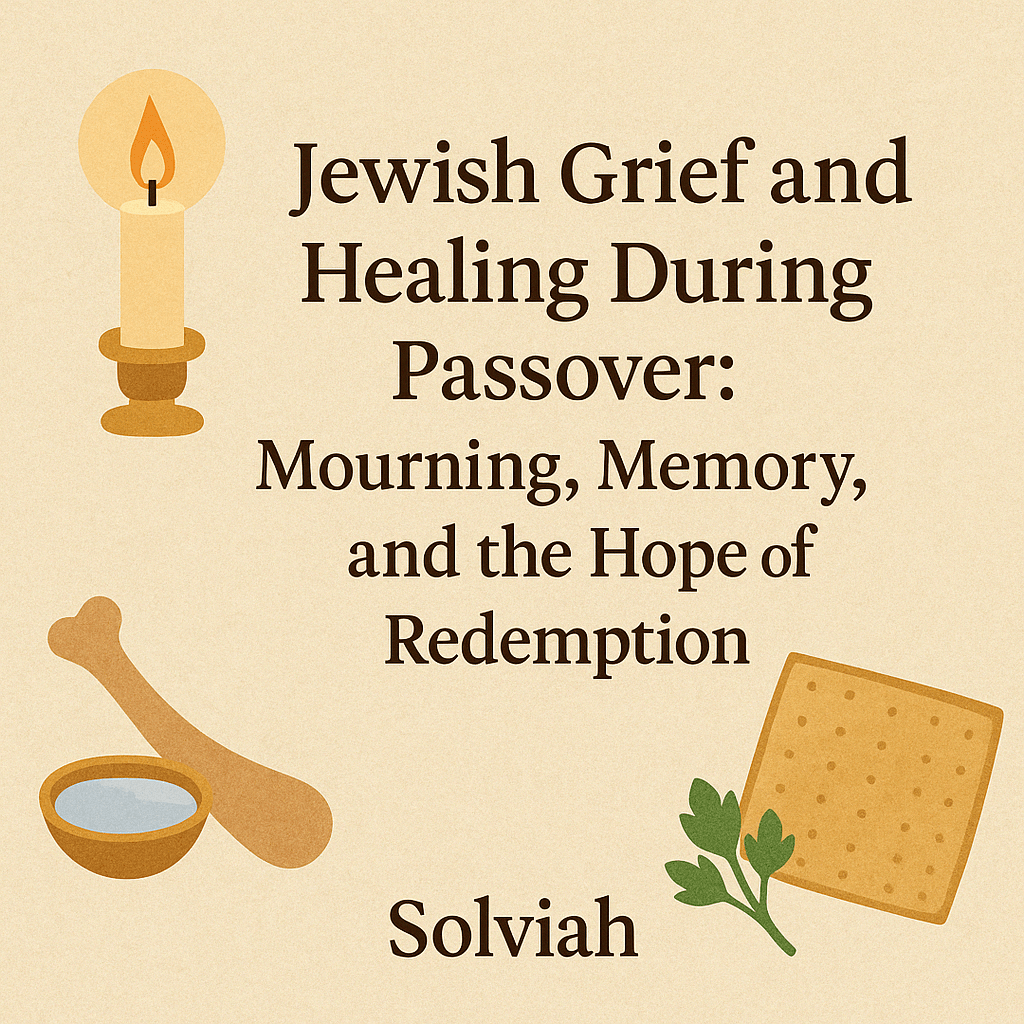
  • Jewish Grief and Healing During Passover: Mourning, Memory, and the Hope of Redemption

    Jewish Grief and Healing During Passover: Mourning, Memory, and the Hope of Redemption

    Passover is a season of liberation. But for many, it arrives bearing the invisible weight of grief. As Jewish families gather to retell the story of Exodus and celebrate divine deliverance, some seats at the table remain heartbreakingly empty. For those mourning during Passover, the ancient rituals of redemption offer both a mirror to their sorrow and a gentle invitation toward spiritual comfort.

    Solviah explores the experience of grief during Passover through the lens of Jewish theology, cultural practice, and sacred memory. We honor the pain of loss, reflect on the eternal hope embedded in Jewish faith, and aim to illuminate the pathways to healing offered by prayer, ritual, and communal remembrance. Even in mourning, Jewish tradition whispers a deeper truth: redemption is not only about history—it is also about healing.


    🕯️ The Sacred Weight of Loss in a Time of Joy

    Passover occurs in the Hebrew month of Nissan—a time traditionally designated for joy. Yet the Torah and Jewish tradition make room for sorrow even within celebration. As Ecclesiastes teaches, “There is a time to mourn and a time to dance” (Ecclesiastes 3:4). The two may live side by side, especially in a faith that has long held paradox as sacred.

    Grieving during Passover can feel isolating. While others rejoice in songs of deliverance, a mourner may feel trapped in their own Egypt—a personal exile of absence and longing. Yet Judaism, unlike many modern cultures, does not shy away from grief. The Psalms cry openly, prophets mourn publicly, and Jewish law upholds a comprehensive system of mourning that dignifies sorrow.


    📜 Jewish Theology on Death, Memory, and Redemption

    Within Jewish theology, death is not an end but a transformation. While beliefs vary across denominations, many Jews affirm the existence of olam ha-ba (the world to come), and techiyat ha-metim (resurrection of the dead). These concepts are not mere doctrines but expressions of a deeper truth: that the soul remains tethered to the divine and to those who love it.

    “The soul of a person is the lamp of God,” writes Proverbs (20:27). This spiritual imagery illuminates the Jewish view of the afterlife—not as distant, but as near, flickering gently in the spaces we remember. Rabbi Jonathan Sacks (2010) reminds us, “Memory in Judaism is a form of redemption. It transforms the past into a source of strength and blessing.”

    The phrase zikhrono livrakha—“may their memory be a blessing”—is not simply a sentiment; it is a theological declaration. It implies that the deceased continues to act in the world through memory, legacy, and love.


    ✡️ Mourning Rituals and Passover Adaptations

    Jewish mourning rituals guide the mourner through phases of grief: aninut (pre-burial grief), shiva (seven days of deep mourning), shloshim (thirty days), and the twelve-month mourning for a parent. During Passover, some elements of mourning are modified—eulogies are often shortened, and public displays of mourning are softened out of respect for the season’s joy (Shulchan Aruch, Orach Chaim 429:1).

    Yet the inner world of grief remains, and the traditions continue to offer structure and support. The recitation of Kaddish during the holiday is a powerful expression of faith in the midst of loss. It affirms God’s greatness, not in spite of death, but through it. As Rabbi Eliezer Berkovits (1983) noted, “To recite Kaddish is to proclaim that life has meaning—even in the face of death.”

    Some mourners may find particular meaning in the bitter herbs of the Seder plate, which recall the pain of slavery in Egypt. These herbs also evoke the sharpness of grief—a visceral reminder that healing does not require forgetting. The symbolic foods of Passover offer a sacred vocabulary for sorrow: the shank bone (loss), the salt water (tears), the matzah (fragility). Together, they form a ritual language that allows grief to be felt and honored.


    🤝 The Healing Power of Community and Ritual

    Grief isolates. Ritual reconnects. Jewish mourning practices emphasize the power of community. From bringing meals during shiva to standing together for the Kaddish, the community holds space for the mourner to be broken—and to begin to heal.

    Passover, with its family-centered structure, may intensify grief, but it can also provide gentle re-entry into communal life. Many families leave an empty chair or say a blessing in memory of the deceased. Others incorporate personal stories, photos, or favorite foods of the departed into the Seder meal. These small acts keep memory alive and sanctify grief as part of the celebration, not an interruption to it.

    Jewish psychologist David Pelcovitz (2020) writes that rituals are crucial for grief recovery. They “create predictability, provide comfort, and offer the bereaved a sense of agency during disorienting times.” The rituals of Passover, from searching for the afikomen to pouring Elijah’s cup, provide sacred structure even for the heart that aches.


    🧠 Psychological Insights and Grief Theory in Jewish Practice

    Modern grief theory—particularly the dual-process model—emphasizes oscillation between loss-oriented and restoration-oriented activities (Stroebe & Schut, 1999). Jewish mourning mirrors this beautifully. During Passover, one may mourn during private prayer but also engage in songs, storytelling, and food preparation. The balance is not only permissible—it is healing.

    Moreover, Judaism embraces the concept of continuing bonds—maintaining a relationship with the deceased through memory, ritual, and shared values. These practices align with contemporary bereavement psychology and offer profound spiritual reinforcement: the love continues.


    🌿 A Blessing for the Grieving During Passover

    If you are grieving during Passover, you are not alone. You walk the ancient path of those who mourned in the wilderness, whose cries rose with the smoke of burnt offerings, whose tears mingled with salt water on the table. There is space for you at the Seder. There is room for grief in the story of redemption.

    May the God who delivered Israel from bondage draw near to your sorrow. May the memory of your loved one shine like the pillar of fire that guided our ancestors through the night. And may you, in time, come to feel again the joy of spring—the whisper of freedom, the promise of renewal.


    📖 References (APA Style)

    Berkovits, E. (1983). Faith After the Holocaust. KTAV Publishing House.

    Kaplan, A. (1997). Jewish Meditation: A Practical Guide. Schocken Books.

    Lamm, M. (1969). The Jewish Way in Death and Mourning. Jonathan David Publishers.

    Pelcovitz, D. (2020). Rituals and resilience in Jewish mourning. Jewish Psychology Journal, 12(1), 42–57.

    Sacks, J. (2010). Future Tense: Jews, Judaism, and Israel in the Twenty-First Century. Schocken Books.

    Shulchan Aruch, Orach Chaim 429:1. (Code of Jewish Law)

    Stroebe, M., & Schut, H. (1999). The dual process model of coping with bereavement: Rationale and description. Death Studies, 23(3), 197–224.

  • The Role of Christian Communities in the Mourning Process

    The Role of Christian Communities in the Mourning Process

    Loss profoundly challenges our faith, pushing us into an emotional and spiritual wrestle that can feel overwhelming. In Christianity, grief isn’t merely endured—it becomes a pathway toward spiritual growth and deeper communal bonds. Christian communities play an essential role, offering practical and spiritual comfort after death, and facilitating healing through faith.

    2 Corinthians 1:3-4 (NIV)

    “Praise be to the God and Father of our Lord Jesus Christ, the Father of compassion and the God of all comfort, who comforts us in all our troubles, so that we can comfort those in any trouble with the comfort we ourselves receive from God.”

    Paul writes this letter to the Corinthians in a period of significant hardship, emphasizing the reciprocal nature of comfort—God comforts believers so they, in turn, comfort others. This exchange captures the essence of Christian communities, where members prophetically embody and declare God’s compassionate presence during mourning.

    Devotional Reflection

    Experiencing grief often raises challenging spiritual questions, prompting authentic expressions of lament. Biblical examples like Job’s unfiltered anguish, David’s poignant psalms, and even Christ’s cry, “My God, my God, why have you forsaken me?” (Matthew 27:46), reveal how intimately intertwined faith and loss truly are. Christian communities recognize lament as spiritually authentic, validating this emotional honesty as part of healing.

    Within this spiritual tradition, grief is approached prophetically—as part of God’s ongoing narrative of redemption. Prophetic insight acknowledges pain but underscores a powerful message of hope. This perspective reframes mourning, viewing it not as a solitary struggle but as a community experience where God’s restorative plans unfold.

    Integrating Faith and Psychology in Mourning

    Psychologically, grief involves phases such as denial, anger, bargaining, depression, and eventual acceptance (Kubler-Ross & Kessler, 2005). Christianity enriches these stages with spiritual dimensions—prayer, prophetic declarations, and rituals that foster community support. Apostle Paul’s call to bear one another’s burdens (Galatians 6:2) mirrors psychological insights, emphasizing the essential role of communal empathy and spiritual intervention.

    Dr. Alan Wolfelt, a leading grief expert, emphasizes communal rituals and spiritual practices in managing grief (Wolfelt, 2004). Christian communities actively practice these rituals, such as collective prayer vigils, prophetic encouragement sessions, and communal worship gatherings. These practices integrate psychological healing with spiritual nourishment, creating holistic comfort for those grieving.

    Additionally, theologian N.T. Wright (2011) highlights the power of resurrection hope, not as distant consolation but active encouragement in present sufferings. Christian communities echo this perspective, prophetically declaring resurrection hope in Heaven, thereby reinforcing psychological resilience and spiritual comfort through tangible community actions.

    Community as Practical Conduits of Comfort

    Christian communities embody God’s comfort practically through compassionate listening, collective prayer, and shared mourning rituals. Jesus exemplified communal empathy when He mourned with Mary and Martha at Lazarus’s tomb (John 11:35), affirming the profound power of shared grief.

    In Christianity, prophetic acts—including scripture declarations, targeted prayers for emotional healing, and sharing revelatory insights—bring spiritual comfort to life. For instance, communities may organize prayer nights specifically dedicated to grieving individuals or families, offering personalized comfort and hope through prophetic and encouraging words. Such practical demonstrations confirm the presence and active compassion of God, aiding significantly in the grieving process.

    Closing Tip: The Power of Remembrance

    One underutilized yet profoundly impactful practice is the act of remembrance—intentionally recalling and sharing testimonies of God’s faithfulness through the departed individual’s life. Hosting storytelling events, creating memorial keepsakes, or conducting remembrance services can powerfully affirm God’s ongoing narrative of redemption, providing deep spiritual healing through shared memories and prophetic declarations.

    Conclusion

    Navigating grief within Christian communities involves acknowledging spiritual wrestle, prophetic insight, and intentional communal support. Embracing these biblical, theological, and psychological insights enhances the effectiveness of Christian grief support, offering authentic coping strategies through faith and loss.

    Explore more on grief support through faith and practical coping resources at Solviah’s Resources on Grief and Faith.

    References

    • Kubler-Ross, E., & Kessler, D. (2005). On Grief and Grieving: Finding the Meaning of Grief Through the Five Stages of Loss. Scribner.
    • Wolfelt, A. D. (2004). Understanding Your Grief: Ten Essential Touchstones for Finding Hope and Healing Your Heart. Companion Press.
    • Wright, N.T. (2011). Surprised by Hope: Rethinking Heaven, the Resurrection, and the Mission of the Church. HarperOne.


  • The Role of Hindu Communities in the Mourning Process: Finding Comfort After Death in Hinduism

    The Role of Hindu Communities in the Mourning Process: Finding Comfort After Death in Hinduism

    Grieving in Hinduism: Wrestling with Loss, Finding Spiritual Comfort

    Loss shakes every human heart — and while grief is universal, the way we move through it often depends on our faith. Hindu grief traditions offer a deeply spiritual, community-centered pathway for honoring the dead and comforting the living.

    For Hindus, mourning is both personal and cosmic. Death is seen not as an end, but as a soul’s next step in its eternal journey. This worldview shapes Hindu death rituals, family customs, and emotional healing — creating a sacred rhythm for grief that spans generations.

    The Eternal Soul in Hindu Thought: Scripture’s Anchor in Grief

    Central to Hindu beliefs about death is the immortality of the soul (Atman). The Bhagavad Gita (2:20) offers enduring comfort:

    “The soul is neither born, nor does it ever die… it is eternal, unborn, and imperishable. It is not slain when the body is slain.”

    This assurance transforms mourning. Grief remains — but despair does not rule. Instead, Hindu death rituals become a spiritual act of love: helping the departed soul move forward, while soothing the living heart left behind.

    Mourning Rituals: How Hindus Grieve and Heal

    1. Antyesti (The Last Sacrifice)

    Known as the Hindu funeral rite, Antyesti involves cremation of the body, considered essential for releasing the soul from the physical world. Family members — often the eldest son — light the funeral pyre or press the cremation button in modern settings.

    2. Pinda Daan (Offering Nourishment)

    Rice balls (pinda) are offered to nourish the departing soul on its journey. This reflects the ancient belief that the dead remain connected to the living for a time, needing support to reach their next state.

    3. Shraddha (Honoring the Ancestors)

    On the 10th or 13th day after death, Shraddha rituals invite priests and family to pray, offer food, and sometimes feed the poor in honor of the departed. This marks a shift from intense mourning to peaceful remembrance.

    4. Terahvin (The 13th Day Ceremony)

    A communal meal, often involving the wider community, marks the formal end of mourning. Friends and neighbors gather to support the grieving family and to affirm life moving forward.

    References: Basham, A. L., 1954; Narayanan, V., 1992; Sukham.org, 2020

    The Psychological Wisdom of Hindu Mourning Rituals

    Modern grief psychology affirms what Hindu traditions have long practiced:

    • Grief needs structure.
    • Ritual gives meaning to pain.
    • Community prevents isolation.
    • Hope anchors healing.

    Psychologist Sameet Kumar, author of Grieving Mindfully (2005), notes that mindfulness and ritual help mourners stay present, process pain, and eventually release sorrow without forgetting love.

    Hindu mourning rituals naturally offer this mindfulness. The presence of chanting, prayers, offerings, and community touchstones creates a gentle progression through grief — recognizing sorrow without getting trapped in it.

    How Hindu Communities Comfort Grievers

    • Daily prayers or chants for the deceased
    • Practical support: Meals, errands, sitting in silence
    • Storytelling: Sharing memories to keep the person alive in heart
    • Temple services or pujas in the name of the departed
    • Long-term remembrance: Annual Shraddha ceremonies forever

    Grief Support Extends Beyond Family in Hinduism

    Many Hindu communities encourage friends, neighbors, and even distant relatives to actively support mourners — even if they didn’t know the deceased well.

    In Indian tradition, this concept is called saha-shok — literally “sharing grief.” It’s not just the family’s burden. Grief belongs to the whole community.

    Final Thought: Comfort After Death is a Communal Gift

    Hindu grief rituals remind us: Healing is not rushed. Comfort is not silent. And love does not end at death.

    Whether lighting a lamp, reciting prayers, or simply sitting beside the grieving — Hindu traditions show us that presence is the most sacred comfort of all.

    Explore More:

    SEO Keywords used: Hindu grief rituals, Hindu mourning traditions, Hindu death rituals explained, comfort after death in Hinduism, how Hindus grieve, Hindu funeral traditions, healing through Hindu faith, spiritual comfort after loss

  • Finding Peace in Loss: A Biblical Perspective

    Finding Peace in Loss: A Biblical Perspective

    Christian grief, faith and loss, and spiritual comfort after death

    When Grief Shakes the Foundations

    Loss can be disorienting—emotionally, spiritually, and culturally. Whether the pain of losing a loved one, watching a dream fall apart, or walking through unexpected transition, we find ourselves asking, Where is God in this?

    In Christianity, the journey through grief isn’t a detour from faith—it’s a sacred invitation into a deeper encounter. Unlike secular models that often encourage numbing or distraction, Christian grief makes space for tears, questions, worship, and even silence. Through prayer, lament, prophetic insight, and communal healing, faith doesn’t bypass loss—it walks through it.

    Psalm 34:18 in Context

    “The Lord is close to the brokenhearted and saves those who are crushed in spirit.” – Psalm 34:18 (NIV)

    This verse was written by David as he fled persecution and lived in caves, hiding from Saul. His heart was crushed, his future unclear. Yet amid uncertainty, David penned a declaration: God is near. In Hebrew, the word qarov means more than “close”—it speaks of deep, personal intimacy. God leans in, breathes near, when we are at our lowest.

    This verse becomes a prophetic declaration. God doesn’t just “see” our pain—He comes near to redeem it.

    Jesus Weeps With Us

    In John 11:35, Jesus arrives at the tomb of Lazarus and weeps. This isn’t just a sentimental detail; it’s a revelation. Jesus, knowing He would raise Lazarus, still stopped to feel the moment.

    His grief was not weakness—it was empathy. In prophetic terms, Jesus modeled spiritual authority through compassion. He entered the pain of others, affirming that Christian grief is not something to escape but something to encounter in the presence of God.

    Faith & Psychology: The Sacred Role of Lament, Prayer, and Hope

    Modern psychology acknowledges the complexity of grief—stages like denial, anger, and acceptance (Kübler-Ross & Kessler, 2005). But biblical grief includes one more stage: renewed purpose through hope.

    The Book of Lamentations teaches us that sorrow and hope coexist:

    “Yet this I call to mind and therefore I have hope: Because of the Lord’s great love we are not consumed.” – Lamentations 3:21–22 (NIV)

    Faith provides what psychology alone cannot: meaning in the storm. Prayer, lament, and prophecy become tools for healing. Studies show prayer changes brain patterns related to stress and emotional processing (Newberg & Waldman, 2009).

    In practice, lament is active—it includes journaling, speaking declarations, and seeking a word from God. Lament isn’t hopeless wailing; it’s honest worship.

    What You Can Do: Tools for Spiritual Comfort After Death

    • Prayer Journaling: Write your honest thoughts to God. Don’t edit. Let grief pour out, and then write what you sense God is speaking back.
    • Declaration: Begin each day with a phrase like, “God is with me in this valley. I will see His goodness again.”
    • Soaking Worship: Play peaceful worship music and simply rest. Let God minister to you without needing to “do” anything.
    • Communion at Home: Take a small piece of bread and juice. As you remember Christ’s body and blood, ask for healing in the places grief has torn. Invite the resurrection power into your sorrow.

    Faith in Community: Grieving Together, Not Alone

    2 Corinthians 1:3–4 reminds us that God comforts us so we can comfort others. Community is not just helpful—it’s essential. Believers often form prayer circles, prophetic encouragement groups, or grief mentoring partnerships.

    Being seen, prayed for, and encouraged provides not only emotional relief but spiritual clarity. Research confirms that communal support greatly improves grief outcomes (Wortmann & Park, 2009).

    Don’t isolate. Invite others in—even if you don’t know what to say.

    Bonus Insight: The Hidden Power of Communion in Grief

    Many don’t realize how healing Communion can be during grief. You don’t need to be in a church service. Even a quiet moment with bread and juice at home can become sacred. It reconnects you with the body of Christ, reminds you of His suffering, and draws you into His victory.

    As you partake, whisper a simple prayer: “Jesus, be with me in this pain. I remember You. I trust Your nearness.” Many report that consistent Communion brought peace they could not explain—just as Jesus promised (John 14:27).

    Final Encouragement: God’s Nearness Is Not a Metaphor

    If you’re grieving today, you are not forgotten. The Lord is not distant. He is intimately close, especially when your heart is heavy. Faith and loss do not cancel each other—they call each other deeper.

    Take time to weep. Take time to pray. Take time to hope again.

    References

    • Capps, D. (2008). The Decades of Life: A Guide to Human Development. Westminster John Knox Press.
    • Kübler-Ross, E., & Kessler, D. (2005). On Grief and Grieving: Finding the Meaning of Grief Through the Five Stages of Loss. Scribner.
    • Newberg, A., & Waldman, M. R. (2009). How God Changes Your Brain: Breakthrough Findings from a Leading Neuroscientist. Ballantine Books.
    • Wortmann, J. H., & Park, C. L. (2009). Religion/spirituality and change in meaning after bereavement: Qualitative evidence for the meaning-making model. Journal of Loss and Trauma, 14(1), 17–34. https://doi.org/10.1080/15325020802537090
  • Finding Peace in Loss: An Islamic Perspective

    Finding Peace in Loss: An Islamic Perspective

    Exploring Muslim grief, spiritual comfort after death, and healing through faith

    Introduction: When Loss Feels Too Heavy to Bear

    Grief is a universal human experience, but for many Muslims, it’s also deeply spiritual. Whether mourning the death of a parent, spouse, friend, or child, the ache is real—but so is the potential for healing through faith. In Islamic tradition, grief is not something to hide or rush through. It is a time for reflection, connection, and remembering that behind every hardship is divine wisdom.

    This article explores Muslim grief through Islamic scripture, theology, and culture—offering comfort, practical tools, and spiritual reminders for those seeking peace after death.

    Anchor Verse: “To Allah We Belong”

    “Indeed, we belong to Allah, and indeed to Him we will return.”
    (Qur’an 2:156)

    This verse is known as istirjā’, recited at the moment of loss. It’s not just a religious phrase—it’s a powerful worldview. In context, it appears during verses addressing trials and tests, reminding believers that loss is part of life’s divine design. The following verse promises mercy and guidance to those who respond with patience (Qur’an 2:157).

    Saying Inna lillāhi wa inna ilayhi rājiʿūn is an act of surrender. It affirms that every soul has a place with its Creator and that death is not an end—but a return.

    Devotional Reflection: The Prophet Grieved Too

    The Prophet Muhammad (peace be upon him) lost his children, his beloved wife Khadijah, and many companions. He wept for them. At the death of his son Ibrāhīm, he said:

    “The eyes shed tears and the heart grieves, but we do not say anything except what pleases our Lord.”
    (Ṣaḥīḥ al-Bukhārī, 1303)

    In that statement, we learn that sorrow does not oppose faith. Instead, expressing grief with sincerity and God-consciousness is a form of worship.

    Muslim grief practices like duʿā’, ṣabr (patience), and dhikr (remembrance) give space for emotional expression while turning the heart toward God. These practices become spiritual lifelines in mourning.

    Faith and Psychology: Healing Through Faith

    Modern psychology confirms that naming, expressing, and processing grief is essential to healing. Islamic teachings complement this by encouraging duʿā’, prayer, and tawakkul—placing trust in Allah.

    “I only complain of my suffering and my grief to Allah.”
    (Qur’an 12:86)

    This verse, spoken by Prophet Ya‘qūb (Jacob) when grieving his lost son, reminds us that we can turn our deepest sorrow into conversation with the Divine.

    Dr. Rania Awaad, a clinical psychiatrist and Islamic scholar, advocates for grief support that integrates faith and mental health. She notes that Islamic values like sabr, community support, and consistent remembrance create pathways to psychological resilience (Awaad, 2020).

    For many, grief is isolating—but Islam emphasizes that the ummah (community) must surround the grieving, comfort them, and help them carry their sorrow.

    Practical Comforts: Rituals That Help

    Here are some simple but powerful Islamic practices to support you or a loved one through grief:

    • Say the Istirjā’: Inna lillāhi wa inna ilayhi rājiʿūn
    • Make Duʿā’ for the Deceased:

      “O Allah, forgive [Name], elevate their rank among the guided, and raise them in status.”
    • Give Charity (Sadaqah) on Their Behalf
    • Recite Surah Yā Sīn (often referred to as the “heart of the Qur’an”)

    Grieving families also host Qur’an recitations, cook and distribute food, and support one another in remembrance. These acts bring healing, unity, and spiritual comfort after death.

    Interfaith Insight: Grief Shared Across Traditions

    Grief is not unique to any one religion. In Christianity, Jesus weeps at the death of Lazarus (John 11:35), showing the sanctity of human sorrow. In Judaism, mourners sit shiva, sharing stories and prayer for seven days. In Islam, mourning is often communal, with gatherings for duʿā’, food, and remembrance.

    All these traditions emphasize that grief, when held in faith, becomes sacred space. Healing through faith is not about forgetting the dead—it’s about remembering that love, like the soul, is eternal.

    Did You Know? Sadaqah Jāriyah Brings Ongoing Rewards

    Many Muslims know they can make duʿā’ for the deceased—but few realize the spiritual power of ongoing charity in their name.

    “When a person dies, all their deeds end except three: a continuing charity, knowledge that benefits others, or a righteous child who prays for them.”
    (Ṣaḥīḥ Muslim, 1631)

    Here are some ideas for sadaqah jāriyah:

    • Sponsor an orphan’s education
    • Fund a water well
    • Donate Qur’ans to a mosque
    • Plant a tree or garden
    • Support a mental health program

    Each of these turns grief into goodness. It’s a way to honor our loved ones and bring light into the world in their memory.

    Final Thoughts: Letting Faith Hold You

    Grief does not mean you lack faith. It means you loved deeply. In Islam, mourning is not rushed; it is lived. And through remembrance, prayer, patience, and community, Muslims find a way not just to survive loss—but to grow through it.

    You don’t have to walk this path alone. Let faith hold you. Let remembrance lift you. And when you are ready, let legacy become your comfort.

    References

    • Awaad, R. (2020). Faith and Mental Health: Addressing Grief in Muslim Communities. Stanford Muslim Mental Health Lab.
    • The Qur’an. (2:156–157, 12:86).
    • Ṣaḥīḥ al-Bukhārī. (Hadith 1303).
    • Ṣaḥīḥ Muslim. (Hadith 1631).
    • John 11:35. (New Testament, Holy Bible).
  • Finding Peace In Loss: A Jewish Perspective

    When Faith Meets Grief

    Grief often takes us to the edge of our understanding—of ourselves, of the world, and even of God. It’s a spiritual crossroads where the questions become louder than the answers. In Jewish tradition, that tension is not shunned; it’s sanctified.

    Whether you are newly grieving or supporting someone who is, Judaism offers both space to mourn and a path toward peace. Jewish grief is not linear, and healing through faith doesn’t mean forgetting. Instead, it’s a journey of holding pain and promise together—of remembering, mourning, and eventually, rebuilding.

    In this post, we explore how ancient Jewish traditions and modern faith practices can help offer spiritual comfort after death. Even if you are not Jewish, there is wisdom in this rhythm of lament, ritual, and renewal.


    “The Lord is close to the brokenhearted” (Psalm 34:18)

    “The Lord is close to the brokenhearted and saves those who are crushed in spirit.” (Psalm 34:18, NIV)

    This verse is more than poetic—it’s an anchor. The Hebrew word for “close” (karov) implies intimacy, like the nearness of a parent comforting a child. In times of grief, it can feel like God is silent. But the psalm insists otherwise: God draws near in our heartbreak.

    Psalm 34 is a deeply vulnerable text. It doesn’t offer false hope—it offers presence. In Jewish mourning, that divine closeness is mirrored in the communal embrace of rituals like shiva (seven days of mourning), where the bereaved are surrounded by others and relieved from daily responsibilities. The grief is not hidden—it is held.


    Mourning as a Form of Faith

    One of the most compassionate aspects of Jewish grief tradition is its permission to feel fully. Pain is not a failure of faith—it is part of it.

    The book of Job illustrates this beautifully. After unimaginable loss, Job doesn’t pretend everything is fine. He cries out. He questions. And unlike his well-meaning friends, who try to make sense of his suffering, God honors Job’s honesty. As Rabbi Harold Kushner writes in When Bad Things Happen to Good People, “God does not send us the problem; He gives us the strength to deal with it” (Kushner, 2001).

    That strength comes, in part, through ritual. The Mourner’s Kaddish—recited daily, often for eleven months after a parent’s death—is a surprising prayer. It doesn’t mention death at all. Instead, it praises God. In doing so, it helps the mourner reframe their loss in the context of eternity and connection.


    Why Jewish Mourning Heals: Faith and Psychology

    Modern psychology affirms what Judaism has practiced for millennia: grief needs structure. It needs time. It needs meaning.

    Jewish mourning has a natural progression:

    • Shiva: A week of intense mourning, usually at home, where visitors bring food, prayers, and presence.
    • Shloshim: A 30-day period of adjustment, where the mourner begins to return to life’s routine but still observes certain restrictions.
    • Avelut: For a parent’s loss, mourning continues for a full year, during which Kaddish is said daily.

    These stages give the mourner both space and scaffolding. They don’t rush grief, nor do they leave the mourner alone.

    Psychologically, such rituals help the brain integrate trauma. Acts like lighting a yahrzeit candle, tearing one’s garment (keriah), or visiting the grave on anniversaries serve as physical expressions of inner sorrow. According to grief therapist David Kessler, ritual “gives grief a container and helps us metabolize pain” (Kessler, 2020).

    Even lament is healing. A third of the Psalms are laments—raw, unfiltered cries to God. The Talmud says, “Even when the gates of prayer are closed, the gates of tears are never closed” (Bava Metzia 59b). In other words: God always hears grief, even when we can’t find the words.


    For the Broader Soul: Interfaith and Inclusive Reflections

    You don’t need to be deeply religious—or even Jewish—to find meaning in these practices. Many interfaith and secular families adapt Jewish grief rituals, lighting candles or saying personal versions of Kaddish. The goal isn’t perfection; it’s connection.

    Other traditions echo these rhythms. Christian liturgy honors lament in the Psalms and All Saints’ Day. Islamic funerals emphasize both submission to God and communal mourning. In Buddhism, rituals guide the soul’s journey and help loved ones release attachment. What these have in common is a spiritual framework for remembering and honoring, not just letting go.

    Jewish grief rituals remind us that healing through faith is not about forgetting—but about sanctifying the bond that remains.


    The Mystery of the Soul’s Ascent

    One lesser-known but deeply beautiful Jewish teaching is the idea that the soul continues to grow after death. Every yahrzeit (death anniversary), it is believed the soul ascends further toward the Divine.

    How do we help? Through mitzvot—acts of kindness done in their name. You can donate to a charity they loved, feed the hungry, or light a candle in prayer. These acts don’t just honor their memory—they bless their journey.

    As Rabbi Adin Steinsaltz explains, “The soul is a divine spark… eternal and boundless” (Steinsaltz, 1989). In this way, love doesn’t end—it transforms.


    Take a Step Toward Healing

    Grief may never fully leave us, but it can become a sacred companion. If you are in mourning, know that your pain is part of something ancient, recognized, and held by a greater story. Jewish grief is not only about mourning a death—it is about remembering a life and lifting a soul.


    References

    • Brueggemann, W. (1984). The Message of the Psalms: A Theological Commentary. Augsburg Publishing House.
    • Kessler, D. (2020). Finding Meaning: The Sixth Stage of Grief. Scribner.
    • Kushner, H. S. (2001). When Bad Things Happen to Good People. Anchor Books.
    • Steinsaltz, A. (1989). The Thirteen Petalled Rose: A Discourse on the Essence of Jewish Existence and Belief. Basic Books.
    • The Holy Bible, New International Version. (1984). Zondervan.