Wrestling with Death During the Season of Life
Easter trumpets life while many hearts quietly ache with death. It is the season of “He is risen!”—but also of empty chairs and silent tears. In the stillness after loss, Christian grief carries a distinct tension: we believe in resurrection, yet we feel the sting of death. Christianity invites us to hold both at once. It teaches us not to rush past grief in the name of faith, but to meet God inside it—to find Him in the tomb before we see Him in the garden.
John 11:25–26 – Resurrection, Now and Forever
“I am the resurrection and the life,” Jesus tells Martha, “He who believes in Me, though he may die, he shall live. And whoever lives and believes in Me shall never die. Do you believe this?” (John 11:25–26, NKJV)
This isn’t just a promise of heaven—it’s a present-tense invitation to believe in Christ’s authority over death today. Christianity reveals Jesus not only as future hope but as current resurrection. His question to Martha is His question to us: “Do you believe this?” Not with your head, but with your heart—especially when it breaks.
Jesus Weeps Before He Raises
Before raising Lazarus, Jesus pauses to mourn. “Jesus wept” (John 11:35) is not divine sentimentality. It is incarnate empathy. He cries with us and for us—not because He is powerless, but because He is love. His tears were prophetic: showing us that grief is not weakness but worship. He sanctified sorrow, not as a temporary feeling to bypass, but a place to meet the Father in intimacy.
Grieving as a Christian isn’t doubting God’s power—it’s trusting Him enough to cry in front of Him.
The Spiritual Work of Mourning: Christian Grief as Prophetic Witness
Grief is not passive. It’s spiritual work. We are not merely waiting to “feel better”—we are bearing witness to resurrection in the making. As theologian Jürgen Moltmann said, “Faith, wherever it develops into hope, causes not rest but unrest.” This unrest is sacred.
The Bible calls this groaning. “We ourselves groan within ourselves, eagerly waiting for the adoption, the redemption of our body” (Romans 8:23). Grief is groaning. And the Spirit intercedes with groans too deep for words (Romans 8:26). The prophetic dimension here is clear: our mourning becomes an intercession that shakes the heavens.
Faith and Psychology: Lament, Hope, and Emotional Healing
Psychologically, lament is one of the healthiest tools of recovery. The Psalms are filled with it—songs of protest, of grief, of complaint. Modern Christianity too often prizes praise and suppresses sorrow. But lament is biblical praise. It’s worship that bleeds.
Theologian Walter Brueggemann argued that lament provides structure to our grief, keeping it from becoming chaos. We move from lament to declaration. From “How long, O Lord?” to “But I will yet praise You.”
Diane Langberg affirms that when trauma is met with silence, healing halts. But when pain is named—in prayer, in journaling, in Spirit-filled community—healing begins. The Comforter is not only present to dry tears but to help us transform them.
The Resurrection Body and the Cloud of Witnesses
Our hope is not merely spiritual comfort, but bodily resurrection. “So also is the resurrection of the dead. The body is sown in corruption, it is raised in incorruption” (1 Corinthians 15:42). Apostolic teaching goes further: the glory of the resurrection body far outweighs the pain of loss.
Hebrews 12 speaks of the “great cloud of witnesses”—those who have gone before us and still surround us. Grieving believers are never alone. The veil is thin. Your mother, your child, your spouse—though gone, they are not absent in the Spirit.
One Extra: Prophetic Remembrance through Yahrzeit
Borrowing from the Jewish tradition of yahrzeit—the yearly remembrance of a loved one’s passing—we can create rituals of spiritual memory. Light a candle. Speak a Scripture. Share a testimony of how their life still bears fruit.
This transforms grief into testimony. We become prophets of remembrance, declaring, “Death is not the end. They live in Christ, and we will see them again.”
The Empty Tomb Is a Message to the Grieving
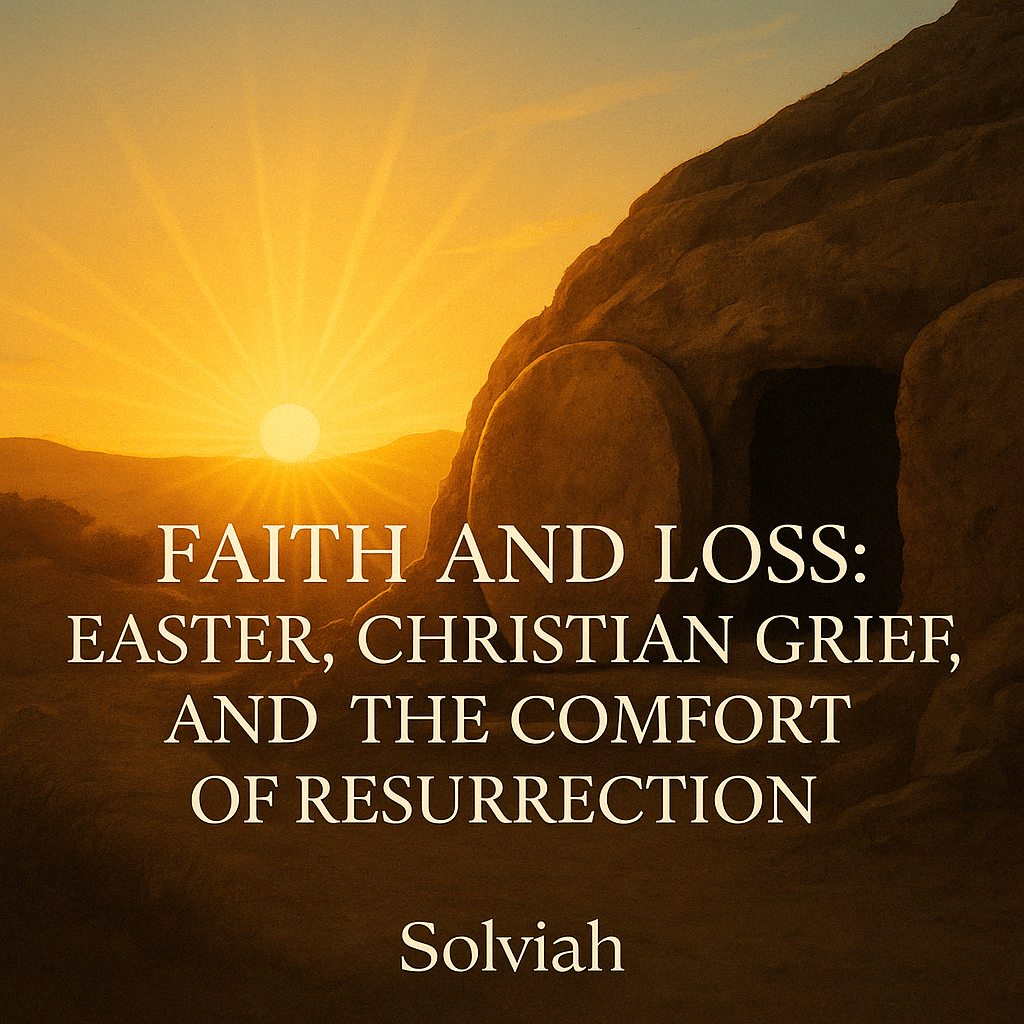
Easter’s empty tomb doesn’t deny death—it defeats it. For those grieving, this is the hardest and holiest part of faith: to mourn what is gone and still proclaim that Christ is risen. Resurrection doesn’t cancel sorrow—it transforms it.
The work of grief is holy. And as we walk through it, the Spirit groans with us, Jesus weeps with us, and the Father prepares a table for us—in the presence of our enemies, even death.
References (APA Style)
- Brueggemann, W. (1984). The Message of the Psalms: A Theological Commentary. Augsburg Fortress.
- Deere, J. (2020). Even in Our Darkness: A Story of Beauty in a Broken Life. Zondervan.
- Langberg, D. (2020). Suffering and the Heart of God: How Trauma Destroys and Christ Restores. New Growth Press.
- Moltmann, J. (2004). The Coming of God: Christian Eschatology. Fortress Press.
- Wright, N. T. (2003). The Resurrection of the Son of God. Fortress Press.
 Solviah