Honoring Life, Embracing Memories

Tag: cultural mourning practices

  • Buddhist Mourning Rituals and the Afterlife: How Buddhism Approaches Death and Grieving

    Buddhist Mourning Rituals and the Afterlife: How Buddhism Approaches Death and Grieving

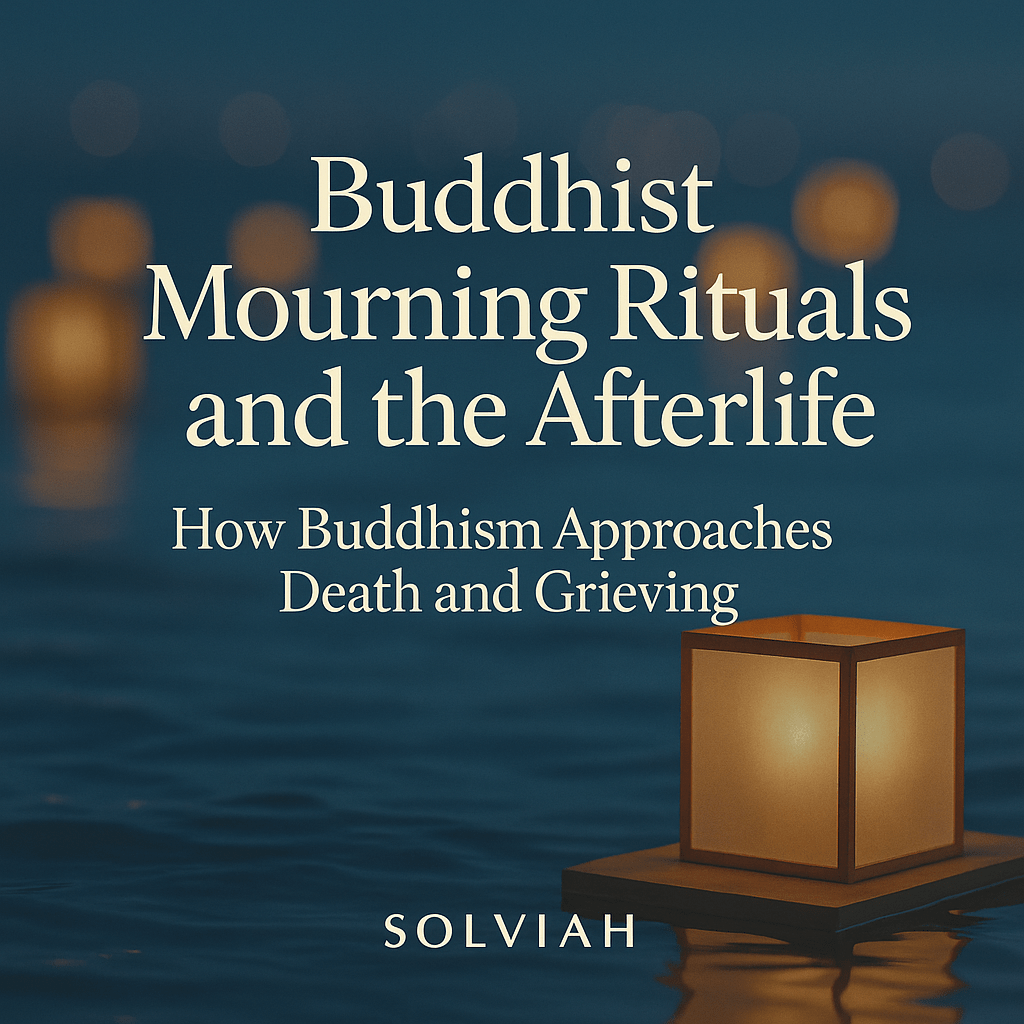
    As dusk falls on the Obon Festival in Japan, hundreds of paper lanterns float across rivers and seas. Each small light carries the memory of a loved one — a glowing symbol of love, loss, and hope guiding the spirits home.

    In Buddhism, death is not seen as a final ending, but as a natural transformation — a continuation of life’s ever-changing flow. While Buddhist cultures often speak of rebirth, it’s important to know: Buddhism doesn’t demand blind belief. Instead, it focuses on truths every grieving person understands — that life is fragile, change is constant, and compassion eases sorrow. Whether or not we believe in reincarnation, Buddhist traditions offer something profoundly human: a way to honor grief without rushing it, and a way to remember with love instead of despair.


    Mourning Rituals in Buddhist Cultures

    Across Buddhist societies — from Thailand to Tibet to Japan — mourning is woven into daily life with rituals that honor both the dead and the living.

    Clothing: Mourners traditionally wear white garments, symbolizing purity and peace. In Tibetan and Japanese customs, darker or muted clothing expresses humility and respect without deepening sorrow.

    Food and Offerings: Families prepare vegetarian meals and present them at family altars or temples. In Tibetan Buddhism, butter lamps are lit, and prayers are recited from the Bardo Thodol (Tibetan Book of the Dead), a guide for the soul navigating the bardo — the 49-day transition between death and rebirth.

    Time Frames: Mourning often spans 49 days, during which families gather regularly to chant, meditate, and offer merit. Compassionate remembrance supports both the departed and those left behind.


    How Buddhist Cultures Embrace Grief Differently

    In many Western cultures, grieving tends to be private and time-limited. There is often an unspoken expectation to “move on” quickly and return to normalcy.

    Grieving in Buddhism is sacred. Mourning is communal, open, and welcomed. Rituals extend over weeks, offering mourners a way to stay connected to their loss, not push it away.

    “Grief is not a problem to fix; it is a sacred path to walk.”

    Instead of “getting over it,” Buddhist traditions teach people to move with grief — carrying sorrow with compassion as a natural part of life’s journey.


    Buddhist Teachings That Offer Comfort

    At the heart of Buddhist grieving practices are timeless teachings that speak to all who mourn:

    • Impermanence (Anicca): Everything changes — life, sorrow, seasons of the heart.
    • Compassion (Karuna): Loving-kindness softens even the sharpest pain.
    • Mindfulness (Sati): Presence with grief — without judgment — allows healing to emerge naturally.

    “Even sorrow changes. Even sorrow blooms.”

    Whether or not we embrace samsara (the cycle of rebirth), grieving in Buddhism shows that compassionate remembrance transforms suffering into sacred memory.


    Reflection: What We Can Learn About Grief, Healing, and Legacy

    Buddhist traditions remind us that grief is not weakness. It is the echo of love.

    By embracing impermanence, making space for memory, and trusting compassion, we create legacies that outlast sorrow — legacies built on love, remembrance, and hope.


    Gentle Ways to Remember Loved Ones, Inspired by Buddhist Traditions

    • Light a candle daily and offer a simple blessing of peace.
    • Create a small remembrance space at home — a photo, a flower, a keepsake.
    • Spend five minutes each day reflecting with gratitude and gentleness.
    • Write a letter or prayer and place it near water, a tree, or a favorite natural place.

    We’d Love to Hear From You

    Your story matters. Your memories matter. Share your reflections in the comments — because together, we carry love forward.

    For further reading, see the references listed at the end of this article.


    Explore More

    References

    • Karma-glin-pa. (2006). The Tibetan Book of the Dead: The Great Liberation Through Hearing in the Bardo. Shambhala Publications.
    • Becker, C. B. (1992). Buddhist Views of Death and Their Implications for Contemporary Society. Death Studies, 16(2), 181–191.
    • Rosenblatt, P. C. (2008). Grieving Across Cultures: A Review and Research Agenda. Bereavement Care, 27(3), 47–50.
    • Thera, N. (1998). The Heart of Buddhist Meditation. Samuel Weiser, Inc.

    Note: Buddhist mourning practices vary across traditions (Theravāda, Mahāyāna, Vajrayāna) and regions. This article reflects widely practiced cultural approaches but may not represent all sects or communities.

  • Finding Peace in Loss: A Chinese Perspective on Healing After Death

    Finding Peace in Loss: A Chinese Perspective on Healing After Death

    Introduction: Wrestling with Loss Through Culture and Tradition

    Grieving is a deeply personal experience, but how we mourn is often shaped by the culture we come from. For those connected to Chinese heritage, the process of loss is both spiritual and communal, ancient and evolving. Unlike Western grief traditions that often emphasize private reflection, Chinese grief practices are grounded in family, ritual, and a worldview that extends beyond the individual to include ancestors and the unseen spiritual realm.

    Yet modern life complicates this. For many younger generations or those in multicultural families, Chinese grief traditions may feel unfamiliar or even inaccessible. Others may struggle to balance traditional customs with emotional needs in today’s fast-paced, globalized world. This tension invites an important question: Can we still find peace in loss through culture and spirituality? The answer is yes—but it requires understanding, intention, and grace.

    “Filial Piety is the Root of Virtue” (孝为德之本)

    This Confucian principle remains a cornerstone of Chinese culture. Xiao (孝)—filial piety—demands that children honor their parents in life and in death. This sense of duty shapes every aspect of Chinese mourning, from funeral customs to annual memorial rituals.

    In Chinese grief, honoring the dead is not merely symbolic. It is seen as necessary to maintain harmony between the realms of the living and the departed. Offerings are made not out of superstition but of devotion. Through these acts—whether burning incense or preparing favorite foods—we affirm a continuous bond. In grief, we fulfill virtue.

    Devotional Reflection: A Spiritual Dialogue with the Departed

    In homes across China and among diaspora families, ancestral altars serve as quiet sanctuaries of connection. A photo, a bowl of fruit, a stick of incense—these simple acts form a language of love that transcends death.

    Taoist philosophy teaches that life and death are part of the same cosmic cycle, like the flowing of a river. Buddhism, so influential in Chinese religious life, frames suffering and impermanence as opportunities for growth and release. And while Confucianism focuses on moral order, all three traditions converge on this point: the dead are never truly gone. They live on in memory, in ritual, and in the moral fabric of the family.

    These beliefs create space for healing. Instead of fearing death, culture teaches us to walk through it with reverence. Instead of suppressing grief, it is channeled into ritual and remembrance.

    Culture and Psychology Blend: Lament and Hope in Harmony

    Modern psychology recognizes that grief needs to be expressed, but expression looks different across cultures. In Western traditions, verbalizing feelings is often emphasized. In Chinese grief, ritual is the language of mourning.

    • Wailing at funerals allows for unfiltered emotion.
    • Wearing white signals mourning and purity.
    • Burning joss paper or “hell money” offers support for ancestors in the afterlife.
    • Qingming Festival invites families to clean tombs, reflect, and reunite through remembrance.

    According to Rosenblatt (2008), cultures that offer communal, symbolic expressions of grief can ease the psychological burden of mourning. These rituals offer a sense of control, meaning, and continuity—what Paul Wong (2014) calls “meaning-making,” a key part of emotional recovery.

    Younger generations may question these practices—but they are bridges, not burdens. Rituals offer psychological safety in the unknown. They carry the weight of grief when words cannot.

    A Friend’s Personal Reflection: My Grandmother’s Bowl of Oranges

    When my grandmother died, I didn’t know how to mourn her in a way that felt “right.” I had grown up between cultures—Christian in belief, Chinese in blood. At her memorial, my mother placed a bowl of oranges and a cup of tea by her photo. I remember asking, “Will she really drink it?”

    My mother smiled: “No. But we will. And we’ll remember her favorite things.”

    That act—simple, sacred, and communal—taught me something about grief. It’s not about fixing pain, but finding a rhythm to carry it. One shaped by faith, by memory, and by love.

    One Extra You Might Not Know: The 49-Day Ritual

    In Buddhist-influenced Chinese mourning, there is a belief that the soul transitions for 49 days after death. Families may hold weekly ceremonies or chant sutras during this time to guide the soul and offer peace.

    Even in modern cities, this ritual is practiced quietly in homes, temples, or even online. It is a profound gesture of care—not only for the departed but also for the grieving. The 49-day ritual gives structure to chaos, offering mourners a spiritual timeline for lament, hope, and eventual healing.

    If you’re grieving and looking for a way to honor someone Chinese or of Chinese descent, consider observing even one of these seven-week rituals. It can be profoundly healing.

    Closing Thought: Let Culture Be Your Comfort

    Grief is universal, but comfort is cultural. Whether you light incense, cook their favorite dish, or simply sit in silence with their photo, let your heritage speak healing into your loss.

    Let your mourning be a tribute to your roots—and a bridge to peace.

    References

    • Rosenblatt, P. C. (2008). Grief across cultures: A review and research agenda. In M. S. Stroebe, R. O. Hansson, H. Schut, & W. Stroebe (Eds.), Handbook of bereavement research and practice: Advances in theory and intervention (pp. 207–222). American Psychological Association. https://doi.org/10.1037/14498-010
    • Wong, P. T. P. (2014). Viktor Frankl’s meaning-seeking model and positive psychology. In A. Batthyany & P. Russo-Netzer (Eds.), Meaning in Positive and Existential Psychology (pp. 149–184). Springer. https://doi.org/10.1007/978-1-4939-0308-5_9
    • Yang, C. K. (1961). Religion in Chinese Society: A Study of Contemporary Social Functions of Religion and Some of Their Historical Factors. University of California Press.
    • Chan, W. (1963). A Source Book in Chinese Philosophy. Princeton University Press.