Honoring Life, Embracing Memories

Tag: Coping With Grief

  • How to Keep the Peace After a Death: Gentle First Steps When Family Conflict Erupts

    How to Keep the Peace After a Death: Gentle First Steps When Family Conflict Erupts

    (This article was written with enough gentleness to be shared with family.)

    When the call comes — “They’re gone” — the world tilts.
    Time bends strangely.
    Maybe the coffee you made sits untouched. Maybe your phone buzzes with messages you can’t yet answer.
    Grief moves in waves: shock, sadness, anger — sometimes all at once.

    And almost immediately, tensions with family can begin to rise.

    If you’re here, you’re already doing something brave.
    You are reaching for peace — even while your heart is breaking.
    There’s no perfect roadmap for grief. But there is a way to move forward with grace.

    This guide was created tenderly, with the hope that it could serve not just you — but your whole family, if you wish to share it.


    Table of Contents

    • First, A Quiet Moment

    • First 48 Hours After Death: A Gentle Step-by-Step

    • When Family Conflict Erupts — Finding Calm in the Storm

    • If You’re Feeling Lost: A Gentle Timeline

    • Additional Support for You

    • A Final Word


    First, A Quiet Moment

    When Anna’s mother died suddenly, she expected heartbreak.
    She didn’t expect how quickly family arguments would start:

    • Which funeral home?
    • Who gets the jewelry?
    • Why wasn’t I called sooner?

    Through the noise, Anna made a choice:
    She paused.
    She breathed.
    She focused on honoring her mother through peace.

    You can too — one breath, one choice at a time.

    ↩️ Back to Top


    First 48 Hours After Death: A Gentle Step-by-Step

    Step 1: Pause. Breathe. You’re Already Doing Something Good. 🌿

    Right now, you might feel broken, overwhelmed, even paralyzed.
    Please hear this: You are not doing it wrong.

    There’s no “correct” way to grieve.
    There is only loving your loved one — moment by moment — as best you can.

    Tip: Carry a small notebook or use your phone’s Notes app. In grief fog, writing things down can be a lifeline.

    Step 2: Confirm the Death

    Wherever your loved one passed — at home, in a hospital, in a public place — an official pronouncement is needed.

    • Medical staff, if present, will handle this.
    • Otherwise, call emergency services. They will guide you.

    You’ll need a Pronouncement of Death for the next steps.
    (Source: Hospice Foundation of America, 2023)

    Step 3: Quietly Secure Personal Spaces

    Gently and respectfully:

    • Collect important documents
    • Secure small valuables
    • Arrange care for pets, plants, dependents

    (Source: Hospital Bereavement Protocol, Johns Hopkins Medicine, 2022)

    Step 4: Notify Close Family and Friends

    You do not have to notify everyone right now. Focus on a few key people first.

    “I’m heartbroken to share that [Name] has passed. We’re still gathering details. Thank you for your patience as we find our way.”

    Step 5: If You’re Ready, Contact a Funeral Home

    There’s no rush.
    When you feel ready, call a funeral home or mortuary to arrange transport and initial care.

    Important:
    – You do not need all paperwork ready immediately.
    – It’s okay to simply say: “I need help. I’m still gathering information.”

    For more guidance, visit Funeral Planning 101.

    Step 6: Begin Collecting Key Information

    In the coming days, you’ll be asked for:

    • Full legal name
    • Date and place of birth
    • Social Security number
    • Veteran status

    ↩️ Back to Top


    When Family Conflict Erupts — Finding Calm in the Storm

    Grief can magnify everything:

    • Old resentments
    • Disagreements about funeral choices
    • Tension over money, wills, or possessions
    • Different ideas of “what [Name] would have wanted”

    You are not alone.
    And you are not responsible for everyone’s emotions.

    A Message from Solviah to Your Family ✨

    Dear Family,

    This is a sacred moment.
    It is not a time for rushing, blaming, or clinging to old wounds.

    It is a time to honor [Name] by walking with gentleness, respect, and unity — even when it’s hard.

    Every act of patience, every word of kindness, every choice to listen instead of argue becomes part of [Name]’s final legacy.

    Together, you can offer a gift that will last longer than any inheritance: Peace.

    Walk slowly. Walk kindly. Walk in love.

    With compassion,
    Solviah

    If Someone Pushes or Acts Out of Greed

    Some family members may:

    • Push for quick decisions
    • Argue over belongings
    • Dismiss the need for tenderness
    • Reveal old bitterness

    Soft response:

    “I understand everyone is grieving differently. Right now, I want to honor [Name] by moving thoughtfully. Let’s not rush important decisions.”

    Or simply:

    “This isn’t the time for that conversation. Let’s focus on honoring [Name] first.”

    ↩️ Back to Top


    If You’re Feeling Lost: A Gentle Timeline 🕊️

    If you’re wondering what to expect or when to act, here’s a soft outline to guide you through:

    TimeframeTasks
    Hours 0–6Confirm death. Secure belongings. Pause and breathe.
    Hours 6–24Notify immediate family. Contact a funeral home (if ready).
    Day 2Meet with funeral director (if ready). Begin gathering basic information.
    Day 3Focus on emotional support. Delay non-urgent disputes. Rest when you can.

    Crisis Checklist: First 3 Days

    • Confirm official pronouncement of death
    • Secure valuables and documents
    • Notify key family and friends
    • (If ready) Contact a funeral home
    • Begin gathering necessary paperwork
    • Protect your peace during tensions
    • Eat, drink water, and sleep
    • Give yourself permission to move slowly

    ↩️ Back to Top


    Additional Support for You

    When you’re ready, you can explore gentle resources to help you plan, heal, and honor your loved one:

    ↩️ Back to Top


    A Final Word ❤️

    You might feel overwhelmed.
    You might feel angry, guilty, exhausted, numb — or all of these at once.
    You might worry you’re not doing enough, or doing it wrong.

    Please hear this: you are grieving exactly the way you need to.

    There is no perfect way to lose someone you love.
    There is only the next breath.
    The next step.
    The next small act of love.

    You are enough. You are brave. And you are not alone.

    ↩️ Back to Top

    Share Your Story

    If you’ve walked this road — or are walking it now — your voice could be a light for someone else in the dark.
    Please share your thoughts or experiences in the comments below.
    Your story matters here.

    Written with love by Solviah.
  • What to Do When Someone Dies: First 48 Hours and Creative Guest Book Alternatives for Funerals

    What to Do When Someone Dies: First 48 Hours and Creative Guest Book Alternatives for Funerals


    When the World Changes in an Instant

    The call came at 2:13 a.m.
    “They’re gone.”

    You hear it, but the world around you remains strangely intact. The toothbrush still sits by the sink. The coffee mug remains on the counter.

    Everything looks the same, but nothing feels the same.

    If you’re reading this, you are already doing something brave.
    Pause. Breathe. ❤️
    You are not doing this wrong.

    This guide walks gently with you through the emotional fog and the small first steps after loss — offering comfort, clarity, and remembrance.


    First Steps After Death: What Happens in the First 48 Hours

    (based on Social Security Administration, hospital bereavement protocols, and hospice guidelines)

    No matter where death occurs — at home, in a hospital, at work, or in public — the first steps stay rooted in respect, small actions, and breathing space.

    If expected, hospital or hospice staff will assist with paperwork.
    If sudden or public, emergency services and often the coroner will step in first.

    First 24 Hours

    • Obtain a Legal Pronouncement of Death — Needed for all steps that follow (Centers for Medicare & Medicaid Services, 2022).
    • Notify Immediate Family or Trusted Friends — Start small. You don’t have to tell everyone at once.
    • Secure Property and Pets — Lock the home, collect mail, arrange temporary care if needed.

    Learn more about Funeral Planning 101 here.


    The “First 3 Days” Checklist ✅

    • ✅ Obtain legal death pronouncement
    • ✅ Contact close family and friends
    • ✅ Choose and contact a funeral home or cremation provider
    • ✅ Gather documents (passport, birth certificate, will)
    • ✅ Request multiple death certificates
    • ✅ Secure the home, mail, pets, and valuables

    Tip: If you can only complete one thing today, that is enough. You are not behind.

    Visit Grief & Healing | Visit For Supporters & Friends


    Case Study: Her Mom Passed Unexpectedly. Here’s What Happened Next

    Anna’s mom died suddenly during a routine surgery.

    At 4 a.m., Anna sat frozen in the kitchen, staring at the refrigerator, paralyzed.

    “Let’s start with just one thing,” a family friend said.
    “We’ll call the hospital together.”

    That first call was enough. Later, they secured her mother’s home, contacted a funeral provider, and sent a group message: “Anna needs time. We’ll update you soon.”

    There is no perfect way to move through this. Only your way.


    Timeline: When to Do What ⏳

    Timeframe Actions
    First 12 Hours Obtain legal death pronouncement
    First 24 Hours Contact immediate family/friends
    24–48 Hours Arrange funeral home or cremation provider
    By Day 2 Notify Social Security Administration, employer, insurance
    By Day 3 Secure documents, finalize service or memorial plans

    Explore Culture & Spirituality


    ✨ Pause Here: A Moment to Breathe

    Place your hand over your heart.
    Take one slow breath in. Hold. Release.
    ✨ You are doing enough. ✨


    Organizing Affairs After Death: Honoring Memories

    Choosing how guests share their memories is a tender decision.

    A traditional guest book is a beautiful, time-honored choice.
    Many families also explore creative alternatives for more personal storytelling.
    Here are a few ideas — and remember, you can create whatever feels most meaningful to you.


    Creative Guest Book Alternatives for Funerals and Memorials

    • Memory Stones — Guests write short blessings on smooth stones to keep or plant in a memorial garden.
    • Video Memory Booth — Short recorded messages collected on a simple tablet or phone.
    • Fingerprint Tree — Guests add ink “leaf” fingerprints to a tree illustration for framing later.
    • Memory Cards — Prompts like “I’ll always remember…” collected into a keepsake book.
    • Scrapbook Station — Creative pages guests decorate with drawings, photos, or memories.

    ❤️ Gentle Reminder

    There is no wrong way to grieve.
    There is no wrong way to honor them.
    Every breath you take forward weaves their memory into life.


    ✨ A Blessing for the Journey

    May your hands find small tasks to ground you.
    May your heart find small mercies to sustain you.
    And may you always remember:
    Love does not end here.
    It carries on — through memory, through legacy, through you.


    Share Your Heart

    What helped you during your first days after a loss?
    We invite you to share your story in the comments below.
    Your words may become the light someone else needs today.


    Sources and Gratitude

    • Centers for Medicare & Medicaid Services. (2022). Hospice care and the end of life. cms.gov
    • National Hospice and Palliative Care Organization. (2023). After a loved one dies: Helping with practical and emotional needs. nhpco.org
    • Social Security Administration. (2024). What to do when a loved one dies. ssa.gov

  • Healing After Loss: Recognizing When Anger Becomes Complicated Grief

    Healing After Loss: Recognizing When Anger Becomes Complicated Grief

    “There is no grief like the grief that does not speak.” — Henry Wadsworth Longfellow

    When Sarah lost her husband unexpectedly, sadness was predictable. Yet, she found herself blindsided by something else entirely: intense, persistent anger. She felt angry at him for leaving, angry at herself for not preventing it, and angry at others simply for their well-meaning condolences. It wasn’t until she began therapy that she realized her anger was a profound expression of grief itself—a response that, left unaddressed, was beginning to overshadow every aspect of her life.

    Grief is deeply personal, unpredictable, and often overwhelming. Among its complex emotions, anger stands out for its intensity and capacity to disrupt lives. While feeling anger after losing someone is normal, persistent and destructive anger might signal something deeper: complicated or prolonged grief.

    In this article, we’ll explore the specific theme of anger during grief, outline signs that indicate when professional help is essential, and offer practical tools for emotional healing after loss.


    Understanding the Complexity of Grief-Related Anger

    Psychologist George Bonanno, renowned for his research on grief, explains that grief does not follow a predictable linear path. His work identifies various “grief trajectories,” such as resilience, chronic grief, and delayed grief. Anger often surfaces across these trajectories, triggered by unresolved emotions, perceived injustices, and deep feelings of loss and helplessness.

    Common scenarios where grief-related anger may arise include:

    • Feeling abandoned or betrayed by the person who passed.
    • Resentment toward others for perceived insensitivity or misunderstanding.
    • Frustration at oneself, often accompanied by guilt or regret.

    These feelings, though painful, are common. But when anger becomes prolonged, unmanageable, or disrupts daily functioning, it may indicate a transition into complicated grief.


    ⚠️ Signs Your Anger Has Become Complicated Grief

    Recognizing when grief-related anger requires professional intervention can be life-changing. Signs include:

    • Persistent Irritability: Constant irritability or quickness to anger that affects relationships or work.
    • Deep, Unresolved Anger: Anger that intensifies over time, becoming self-destructive or interfering with healing.
    • Avoidance of Reminders: Avoiding people, places, or situations tied to the loss, increasing isolation.
    • Intense Emotional Reactions: Overreacting to minor stressors or feeling emotionally “stuck.”
    • Functional Impairment: Difficulty maintaining routines, relationships, or personal care.

    According to the American Psychiatric Association, these symptoms, when lasting beyond 6–12 months, may indicate Prolonged Grief Disorder and warrant professional care.


    ❤️ Validating Your Experience of Grief

    It’s important to remember: Grief is not weakness. It is the natural response to love and attachment. The presence of anger—no matter how overwhelming—is a valid and deeply human reaction to profound loss.

    Recognizing that your experience is valid can offer a powerful foundation for healing after loss.


    🛠️ Tools for Emotional Healing After Death

    1. Mindful Breathing

    Use this technique when anger spikes:

    • Inhale slowly for 4 counts
    • Hold for 4 counts
    • Exhale for 4 counts
    • Repeat for 5–10 cycles

    2. Reflective Journaling

    Write freely about your anger. Describe its shape, its roots, and its triggers. Journaling allows you to externalize emotions and begin making sense of them.

    3. Personal Rituals of Remembrance

    Light a candle at the same time each evening. Visit a meaningful location. Read a poem aloud. Small, consistent rituals turn grief into memory, and memory into meaning.

    4. Join a Support Group

    Whether in person or online, groups normalize grief and reduce the isolation that often intensifies anger. Shared experiences can be incredibly healing.


    🧠 Seeking Professional Help Is Strength

    If anger continues to dominate your emotions, professional help can be transformative. Evidence-based therapies such as CBT, narrative therapy, and grief-specific counseling are effective in addressing complicated grief.

    Therapists can help you process unresolved emotions, reframe unhelpful thoughts, and develop coping tools for the long journey of healing.


    ✍ Reflective Prompt

    Find a quiet moment today to write a letter to the person you’ve lost. Focus specifically on the anger you’ve felt:

    “What is my anger trying to protect me from?”


    🔍 References

    • Bonanno, G. A. (2009). The Other Side of Sadness: What the New Science of Bereavement Tells Us About Life After Loss. Basic Books.
    • American Psychiatric Association. (n.d.). Prolonged Grief Disorder. Retrieved from psychiatry.org
    • Mayo Clinic. (n.d.). Complicated Grief. Retrieved from mayoclinic.org
    • Verywell Mind. (2023). Prolonged Grief Disorder: What to Know. Retrieved from verywellmind.com
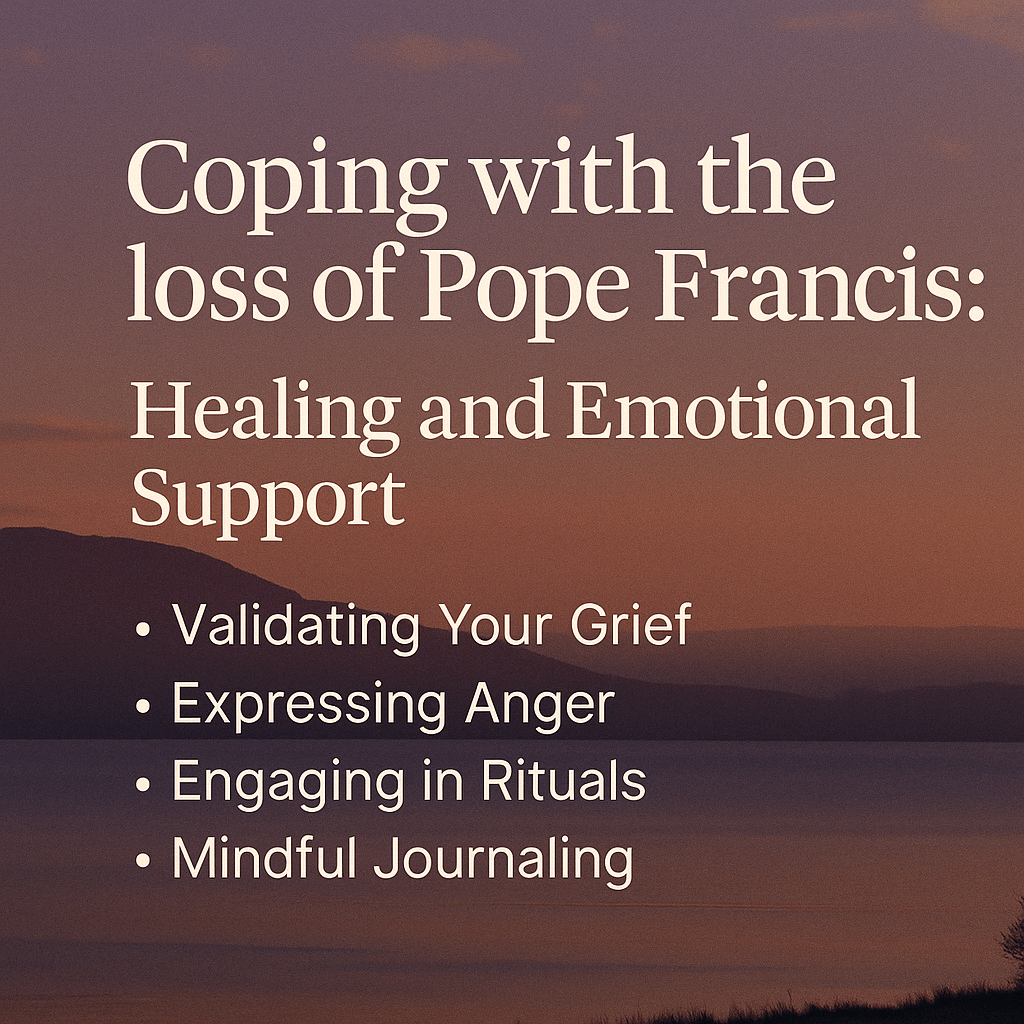
  • To Those Grieving the Passing of Pope Francis: How the Catholic Church Offers Comfort and Encouragement

    To Those Grieving the Passing of Pope Francis: How the Catholic Church Offers Comfort and Encouragement


    🕊️ On Easter Monday, April 21, 2025, the world awoke to the somber news that Pope Francis had passed away at age 88, in his residence at the Vatican’s Casa Santa Marta. Just a day earlier, he had delivered his final Easter blessing from a wheelchair, a symbol of his unwavering devotion to the Church and the faithful.

    For many, Pope Francis was more than a religious leader. He was a beacon of mercy, humility, and justice—reaching beyond denominational lines to serve as a global voice of conscience. His passing has left millions mourning deeply, not just the man, but what he stood for.


    💔 Validating Grief: A Natural Response to Loss

    Grieving a spiritual leader like Pope Francis is both personal and collective. According to the Catechism of the Catholic Church, mourning is not only natural—it’s sacred. It is a sign of the love we carry and the loss we now endure.

    Psychologist George Bonanno explains that grief is not a set of steps but a highly individual process. Some may cry; others feel numb. Some may grow angry; others experience peace. All responses are valid (Bonanno, 2004).

    “Grief is the price we pay for love, and its shape will look different in every life it touches.”
    – George A. Bonanno, American Psychologist


    🔥 Navigating Grief Through the Lens of Anger

    One common but often misunderstood emotion during grief is anger. It can manifest as frustration with the timing of the loss, with God, with the Church, or even with ourselves. This is a human reaction, and the Church provides space for that honesty.

    ✝️ The Catholic Approach to Anger

    Pope Francis himself addressed this in his book The Name of God is Mercy:

    “Speak openly to God about your anger—He understands and listens.”
    – Pope Francis, 2015

    Faith invites us not to suppress anger but to express it prayerfully. In doing so, we invite grace into our healing process.

    🛠️ Tools to Cope with Anger in Grief

    • Prayer: Talk to God honestly. Express your confusion, hurt, or frustration.
    • Journaling: Use written words to name your emotions and patterns.
    • Breathwork: Try calming techniques like box breathing or breath prayers.
    • Community: Lean on friends, priests, or grief support groups.
    • Professional Counseling: Seek licensed grief counselors or pastoral care ministers.

    🕯️ Catholic Traditions: Pathways to Healing

    From funerals to novenas, the Catholic Church offers spiritual and symbolic rituals that help the faithful process loss while drawing closer to hope.

    • Funeral Mass: Celebrates the life of the deceased while reminding us of resurrection.
    • Novenas: Nine-day devotional prayers for the soul of the departed.
    • Lighting Candles: A tangible sign of prayer and remembrance.
    • Holy Communion: A reminder of our unity with the saints and the departed.
    • All Souls’ Day: A sacred tradition of remembering the dead in prayer each year.

    Dr. Alan Wolfelt, a noted grief expert, writes:

    “Rituals help mourners not only remember those they love but transform the pain of grief into meaning.”
    – Wolfelt, A.D., 2016


    🧘 Emotional Healing After Death

    Grief affects the body, mind, and spirit. The Catholic Church encourages balance between spiritual nourishment and emotional wellness.

    Spiritual Tools:

    • Daily Rosary: A grounding prayer rhythm for peace.
    • Silent Retreats: Opportunities to be still and listen for God.
    • Scripture Reflection: Reading Psalms or verses on comfort (e.g., Psalm 34:18, Matthew 5:4).

    Psychological Tools:

    • Mindfulness Meditation: Accept your feelings without judgment.
    • CBT: Challenge distorted thoughts that prolong guilt or hopelessness.
    • Support Groups: Seek local or online Catholic grief circles (like GriefShare).

    👧 Supporting Children Through the Grief of a Public Loss

    Children often sense collective sorrow but may not understand it. Help them process Pope Francis’s death gently.

    • Explain Simply: “Pope Francis died. He was very old and sick. He is now with God.”
    • Allow Questions: Let them ask what they need to.
    • Creative Expression: Drawing, music, or lighting candles in prayer.
    • Read Together: Use children’s books on death and Heaven.
    • Stick to Routines: Predictability offers comfort.

    🌱 Growing Through Grief: A Legacy of Compassion

    Pope Francis believed that suffering can deepen our compassion. He reminded us that grief should move us toward mercy—not away from it.

    “From pain, we learn compassion; from loss, we learn deeper love.”
    – Pope Francis, 2019

    As we mourn him, let us embody his legacy: to be people of peace, humility, and love.


    📝 Reflective Journal Prompt

    Prompt: “Which quality of Pope Francis—his kindness, courage, or humility—do you want to carry forward in your own life? Write about a memory, story, or teaching that brings you peace.”


    🔍 References

    • Bonanno, G. A. (2004). Loss, Trauma, and Human Resilience. American Psychologist, 59(1), 20–28.
    • Francis, Pope. (2015). The Name of God is Mercy. Random House.
    • Francis, Pope. (2019). Christus Vivit. Vatican Publishing House.
    • Kübler-Ross, E., & Kessler, D. (2005). On Grief and Grieving. Scribner.
    • Wolfelt, A. D. (2016). Understanding Your Grief. Companion Press.

  • Grieving Alone While Others Celebrate: Coping with Grief During Christian Holidays as a Non-Christian

    Grieving Alone While Others Celebrate: Coping with Grief During Christian Holidays as a Non-Christian

    “There is no greater agony than bearing an untold story inside you.”Maya Angelou


    She closed the door with a soft click. Outside, voices laughed down the hallway, echoing like ghosts who’d forgotten to say goodbye. The scent of cinnamon and roasted lamb clung to the air. Inside her apartment, it was quiet—too quiet. The chair across from her was empty. A year ago, her brother had sat there. A year ago, everything had changed.

    If you’re grieving and not part of the Christian faith, holidays like Easter or Christmas can stir up a special kind of loneliness. You’re not just mourning a loved one—you’re watching the world sing while you sit in silence. Even those who promised to stand beside you may be swept up in celebration, leaving you feeling like your grief has an expiration date the world already passed.

    This article is for you—the one feeling forgotten in your sorrow. We’ll explore the often-hidden experience of grief outside dominant faith traditions, focusing on the emotion of anger. Along the way, you’ll find grounding practices, soulful rituals, and one vital reminder: you are not alone, and your pain still matters deeply.


    🎄 When Celebration Feels Like a Closed Door

    Christian holidays shape more than churches—they influence school calendars, public schedules, and social expectations. Even in secular spaces, the air is thick with carols, brunches, and “He is Risen.” For someone mourning a loved one, this cultural rhythm can feel like a sharp turn in the wrong direction.

    You may be Jewish, Muslim, Hindu, Buddhist, spiritual but not religious—or simply still grieving—and find yourself excluded from the dominant tradition of hope and light. Meanwhile, your own traditions—Shiva, Ramadan, Diwali, or silent remembrance—are overlooked or unknown.

    “I’m Jewish. My mom died two weeks before Easter. My coworkers sent flowers, then disappeared for holiday travel. I wasn’t angry at them. I was angry at the silence.”David R., New York

    Grief expert Stroebe, Schut, and Boerner (2017) affirm that social connection is vital to healing. But during religious holidays, that connection may feel out of reach, especially for those outside the dominant faith. Grief doesn’t take a holiday—but too often, support does.


    🔥 The Hidden Anger in Grief

    Grief wears many faces. One of them is rage.

    Anger may rise when your messages go unanswered. When your calendar is empty while others gather. When your faith—or lack of faith—is not even part of the conversation.

    Elisabeth Kübler-Ross & David Kessler (2005) wrote that anger is not a detour from grief—it is part of it. It’s not only anger at the loss. It’s anger at being unseen.

    Dr. Robert Neimeyer (2012) explains that grief involves rebuilding identity in a world that feels off-axis. When grief is unacknowledged, this rebuilding becomes even harder. Anger becomes the voice of your invisible pain.

    “Anger is the guard dog of forgotten sorrow.”


    ⛔ When Grief Doesn’t Match the Season

    Christian holidays are often framed around light, joy, and resurrection. But what if your grief still lives in shadow? The world may be celebrating renewal—while you’re mourning what will never return.

    This mismatch can feel like spiritual exile. The American Psychological Association (2023) warns that when grief rituals do not align with a mourner’s worldview, the result can be alienation, depression, and delayed healing.

    What You May Wish They Knew:

    • My grief didn’t end just because it’s Easter or Christmas.
    • I still need support, even if you’re busy with family.
    • Silence doesn’t feel like space—it feels like forgetting.
    • I don’t need fixing—I just need to feel remembered.

    🛠️ Gentle Tools for Heavy Days

    1. Sacred Breathing

    When emotions surge, use this grounding breath:

    • 🫁 Inhale for 4 counts — invite warmth to fill your lungs
    • ✋ Hold for 4 counts — feel the pause
    • 🌬️ Exhale slowly for 6 counts — release tension
    • Repeat 5–10 times

    This activates the parasympathetic nervous system, bringing calm (Siegel, 2010).

    2. Make a Personal Ritual

    Whether or not you follow a religion, your grief deserves reverence.

    Light a candle. Whisper their name. Make their favorite dish. Write a letter and bury it in the garden. These small acts ground your sorrow in sacred meaning (Romanoff & Terenzio, 1998).

    3. Let the Anger Speak

    Try these normal prompts:

    • “What feels unfair about this season?”
    • “What do I wish I could say to others—or to the person I lost?”
    • “Where does my anger live in my body today?”

    4. Micro-Connections Matter

    Your large circle may be unavailable—but even two people can hold space for your grief. Text a friend: “I’m struggling this week. Can we talk for 10 minutes?”

    Or form a “grief thread”—a private group message with 2–3 safe people to check in during holidays.


    🕯️ A Sacred Moment, No Religion Required

    Hold something of theirs—a note, a photo, a piece of clothing. Say their name three times. Speak a memory. Let silence follow.

    This silence is not absence. It is a presence. Your grief just became sacred.


    🌿 Closing Reflection

    You don’t need to pretend. Not today. Not this season.

    Your grief is real. Your story is still unfolding. And your sorrow is not less important just because others are celebrating.

    “If I could honor my grief in one true way this week, what would I do?”

    Write your truth. Breathe. Repeat. You are not alone—even if today feels like it.


    📚 References

    • American Psychological Association. (2023). APA guidelines on religion and spirituality. Retrieved from https://www.apa.org
    • Bonanno, G. A. (2004). Loss, trauma, and human resilience. American Psychologist, 59(1), 20–28.
    • Kübler-Ross, E., & Kessler, D. (2005). On grief and grieving. Scribner.
    • Neimeyer, R. A. (2012). Techniques of grief therapy. Routledge.
    • Romanoff, B. D., & Terenzio, M. (1998). Rituals and the grieving process. Death Studies, 22(8), 697–711.
    • Siegel, D. J. (2010). The mindful therapist. W. W. Norton & Company.
    • Stroebe, M., Schut, H., & Boerner, K. (2017). Cautioning health-care professionals. Omega: Journal of Death and Dying, 74(4), 455–473.
  • Why Grief Looks Different for Everyone: Understanding Unique Grief Responses and Finding Your Path to Healing

    Why Grief Looks Different for Everyone: Understanding Unique Grief Responses and Finding Your Path to Healing

    “Grief, I’ve learned, is really just love. It’s all the love you want to give but cannot. All that unspent love gathers in the corners of your eyes, the lump in your throat, and the hollow part of your chest.” — Jamie Anderson

    Grief is universal, yet deeply personal. It weaves itself into the fabric of our lives differently for everyone. Whether it’s the loss of a loved one, a life-altering diagnosis, or the end of a cherished relationship, grief shows up in unexpected ways. Some cry daily, others become numb. Some dive into work, others can’t get out of bed. And that’s okay.

    Why Everyone Grieves Differently

    Grief is shaped by a constellation of factors: the nature of the loss, personality, attachment style, mental health history, support systems, spiritual beliefs, and even cultural upbringing.

    Even within families, two siblings mourning the same parent may have entirely different emotional reactions based on their role in the family, closeness with the deceased, and previous life experiences.

    Grief also varies across time. Someone may feel like they’re coping well, only to be blindsided by a wave of sadness months—or years—later.

    Breaking the Myth of the “Five Stages”

    Modern grief psychology urges us to reject the idea of neat, sequential stages. Instead, grief is nonlinear. You may bounce between emotions, revisit some, or never experience others. And that doesn’t mean you’re grieving wrong.

    Psychological Insights: What the Research Says

    • Resilience is more common than we think. Bonanno and Kaltman (2001) found that many bereaved individuals maintain stable mental health and functioning, experiencing moments of grief without becoming incapacitated by it.
    • We oscillate between loss and restoration. Stroebe, Schut, and Boerner (2017) describe the Dual Process Model, in which grievers alternate between confronting their loss and focusing on everyday life.
    • Making meaning supports healing. Neimeyer, Klass, and Dennis (2014) emphasized that those who engage in meaning-making—like creating rituals, journaling, or telling stories about the deceased—experience deeper, more integrated healing.
    • Grief is not an illness. Therapist Megan Devine reminds us, “Grief is not a problem to be solved; it’s an experience to be carried.”

    Therapeutic Coping Strategies That Honor Individual Grief

    1. Try Expressive Writing

    Backed by: Pennebaker & Beall, 1986

    Writing about your emotions helps process trauma, reduce rumination, and regulate your nervous system.

    Journal Prompt: What would you say to your loved one if you had one more day with them? Write without editing, judgment, or worrying about grammar.

    2. Practice Mindful Breathing

    Mindfulness helps anchor you during moments of emotional overwhelm and physical distress.

    Box Breathing Technique:

    • Inhale for 4 counts
    • Hold for 4 counts
    • Exhale for 4 counts
    • Hold for 4 counts

    Repeat for 3–5 minutes.

    3. Join a Grief Support Group

    Support groups normalize your experience and offer empathy from those who understand.

    Try:

    • GriefShare.org
    • Local hospice or spiritual centers
    • Online forums like Reddit’s r/griefsupport

    4. Engage in Meaning-Making Activities

    Creating something that honors your loss can transform grief into legacy.

    Ideas:

    • Start a memory garden
    • Create an annual tradition
    • Make a scrapbook or photo album
    • Volunteer in your loved one’s name

    Recommended Reading: Kessler, D. (2019). Finding Meaning: The Sixth Stage of Grief

    Honoring Grief’s Diversity

    There’s no “right way” to mourn. Some people cry every morning. Others throw themselves into work. Some need quiet. Others need company. All of it is valid.

    A Deeper Kind of Healing

    Grief doesn’t end—it evolves. It becomes part of your story, your strength, your soul. Healing after loss means creating space for sorrow and joy to coexist.

    References

    • Bonanno, G. A., & Kaltman, S. (2001). The varieties of grief experience. Clinical Psychology Review, 21(5), 705–734.
    • Jordan, J. R., & Neimeyer, R. A. (2003). Does grief counseling work?. Death Studies, 27(9), 765–786.
    • Neimeyer, R. A., Klass, D., & Dennis, M. R. (2014). A social constructionist account of grief: Loss and the narration of meaning. Death Studies, 38(6), 485–498.
    • Pennebaker, J. W., & Beall, S. K. (1986). Confronting a traumatic event: Toward an understanding of inhibition and disease. Journal of Abnormal Psychology, 95(3), 274–281.
    • Stroebe, M., Schut, H., & Boerner, K. (2017). Cautioning health-care professionals: Bereaved persons are misguided through the stages of grief. Omega: Journal of Death and Dying, 74(4), 455–473.
  • Coping with Grief in the Workplace: How to Heal While Navigating Work Responsibilities

    Coping with Grief in the Workplace: How to Heal While Navigating Work Responsibilities

    “Grief, I’ve learned, is really just love. It’s all the love you want to give but cannot.” — Jamie Anderson

    Grief doesn’t follow a schedule—and it certainly doesn’t stay at home when you return to work. Whether you’re grieving the death of a loved one, a miscarriage, or another profound loss, the emotional weight can show up in your job in unexpected and difficult ways. If you’re trying to cope with grief while working, you’re not alone—and there is support.

    According to the American Hospice Foundation, grief-related productivity loss in U.S. workplaces amounts to over $75 billion per year. But this figure isn’t just economic—it reflects the human cost of working through loss without proper grief support.

    This article explores how grief manifests in professional life and offers research-based, therapeutic strategies for healing after loss—without sacrificing your emotional wellness or job stability.

    What Grief Looks Like at Work

    Grief affects your body, brain, and behaviors—and this often shows up at work as:

    • Mental fog, forgetfulness, or difficulty concentrating
    • Fatigue or lack of motivation
    • Increased emotional sensitivity or irritability
    • Withdrawal from coworkers or social settings
    • Dread toward tasks you previously enjoyed

    These symptoms are part of the normal grieving process. However, many work environments aren’t designed to support emotional healing. You may feel pressure to “be okay” quickly or fear that vulnerability could harm your performance or reputation.

    What the Research Says: Grief and the Brain

    Grieving isn’t just emotional—it’s neurological. According to neuroscientist Mary-Frances O’Connor (2019), grief activates the brain’s pain and attachment centers, impacting memory, decision-making, and mood regulation. That’s why tasks that used to feel easy can suddenly feel overwhelming.

    Long-term grief that goes unacknowledged can lead to Prolonged Grief Disorder, a clinical condition affecting around 10% of bereaved individuals (Prigerson et al., 2009). Symptoms can include persistent yearning, detachment, and difficulty resuming normal activities.

    Your Rights: Understanding Bereavement Leave

    Bereavement leave policies vary. In the U.S., most companies are not legally required to offer paid leave unless it’s specified in a benefits plan. However, some states (like Oregon or California) do mandate short bereavement leaves.

    Action Tip:

    • Check your employee handbook or talk to HR.
    • Ask about Employee Assistance Programs (EAPs) which often include counseling.
    • If you’re uncomfortable sharing details, you can simply say, “I’m grieving a personal loss and would like to request flexible time or support.”

    Therapeutic Coping Strategies for the Workplace

    These strategies, rooted in psychology and grief counseling, can help you cope with grief at work in healthy ways:

    1. Name Your Needs

    Instead of pushing through silently, give your grief space. You can journal before work or text a trusted friend:

    “Today I’m feeling heavy. I need to take it slow.”

    Naming your emotional state activates self-awareness and self-compassion—essential tools for healing (Bonanno & Kaltman, 2001).

    2. Anchor Your Day with Micro-Rituals

    Even in grief, small routines can ground you. Try:

    • Drinking tea from a mug that reminds you of your loved one
    • Taking a walk during your break
    • Lighting a candle when you return home to symbolize reflection

    3. Use Box Breathing to Reset Emotionally

    Inhale (4 seconds) – Hold (4) – Exhale (4) – Hold (4)

    This evidence-based stress technique helps calm anxiety and increase focus. Use it before meetings, emails, or moments of overwhelm.

    4. Journal Prompt for Processing Grief

    Try this after your workday:

    “Right now, I feel… because…”

    Let yourself express the raw truth, without judgment. Writing helps shift emotions from the subconscious to conscious awareness (Pennebaker & Seagal, 1999).

    5. Talk to Someone You Trust

    Consider grief counseling, especially if you’re struggling to function. Therapy can help unpack emotional patterns and reduce the risk of isolation or burnout.

    What About Coworkers? How to Ask for Support (or Space)

    You don’t owe anyone your story—but gentle communication helps avoid misunderstandings. You might say:

    • “I’m managing a personal loss and may be a bit quieter than usual.”
    • “I appreciate your support—I’ll let you know if I need anything.”

    For Employers and Colleagues: Supporting a Grieving Team Member

    If you’re a leader or peer, here’s how you can help someone dealing with grief at work:

    • Acknowledge the loss without forcing conversation
    • Offer flexibility (deadlines, meetings, time off)
    • Avoid clichés like “everything happens for a reason”
    • Provide practical help—take on a task, check in later
    • Encourage use of EAPs or grief resources

    Recommended Resources for Healing After Loss

    • The Grieving Brain – Mary-Frances O’Connor, Ph.D.
    • Bearing the Unbearable – Joanne Cacciatore, Ph.D.
    • Option B – Sheryl Sandberg & Adam Grant
    • It’s OK That You’re Not OK – Megan Devine

    You Deserve Time to Grieve—Even at Work

    Grief is not weakness. It is love in transition. And love deserves room to breathe—even in boardrooms and break rooms.

    Whether you’re just returning to work or months into navigating loss in the workplace, know this: you’re not broken, you’re not alone, and with the right support, healing is possible.

References

  • Bonanno, G. A., & Kaltman, S. (2001). The varieties of grief experience. Clinical Psychology Review, 21(5), 705–734. https://doi.org/10.1016/S0272-7358(00)00062-3
  • O’Connor, M.-F. (2019). Grief: A Brief History of Research on How Body, Mind, and Brain Adapt. Psychosomatic Medicine, 81(8), 731–738. https://doi.org/10.1097/PSY.0000000000000717
  • Pennebaker, J. W., & Seagal, J. D. (1999). Forming a story: The health benefits of narrative. Journal of Clinical Psychology, 55(10), 1243–1254.
  • Prigerson, H. G., et al. (2009). Prolonged Grief Disorder: Psychometric Validation of Criteria. PLoS Medicine, 6(8), e1000121. https://doi.org/10.1371/journal.pmed.1000121
  • Understanding The First Waves Of Grief: Navigating The Initial Emotional Storms

    Grief is unique to each individual, but the initial waves often leave people feeling overwhelmed, confused, and emotionally raw. Author Anne Lamott beautifully summarizes early grief: “You will lose someone you can’t live without, and your heart will be badly broken. But eventually, you will find your feet again” (Lamott, 2013). While grief is a universal experience, its personal nuances can feel isolating and perplexing. Gaining clarity about these early responses is crucial to effectively coping with grief and fostering healing after loss.


    Recognizing the Early Emotional Responses

    Initially, grief can arrive abruptly, causing a whirlwind of unexpected emotions. Many people report feelings of profound sadness, disbelief, anger, anxiety, guilt, or even numbness. It’s common to oscillate between emotions unpredictably, making it challenging to anticipate or manage emotional responses (Stroebe & Schut, 2010). Such unpredictability can heighten distress, especially if external pressures suggest a “right way” to grieve.

    Dr. Alan Wolfelt, a clinical psychologist specializing in grief counseling, notes that early grief often resembles emotional shock, temporarily destabilizing one’s perception of reality. Wolfelt reassures that experiencing these intense emotions is not only normal but vital to the grieving process (Wolfelt, 2016).


    Dispelling Common Grief Myths

    Misconceptions about grief can compound emotional distress. Common myths include beliefs that grief gradually and predictably diminishes over time or that emotional strength equates to suppressing feelings. Research suggests, however, that emotional suppression or attempts to hasten the grieving process can lead to prolonged grief and emotional complications (Neimeyer & Sands, 2011).

    Grief should instead be viewed as a natural process, where permitting oneself the freedom to authentically experience pain and sadness leads to deeper emotional healing. Effective grief support emphasizes honesty in emotional expression, whether through conversation, tears, or creative pursuits.


    Research Insight: Emotional Oscillation

    The Dual Process Model, developed by Stroebe and Schut (2010), provides essential insight into how people naturally handle grief. This model describes how individuals oscillate between directly addressing their loss (loss-oriented coping) and engaging in practical tasks or distractions (restoration-oriented coping). Both coping mechanisms are equally valuable and necessary during the early stages of grief. Shifting back and forth between deep emotional experiences and everyday tasks is normal and beneficial.

    Therapist Megan Devine reinforces this understanding: “Grief is not linear, nor does it follow clear stages. Allowing yourself to experience fluctuating emotional states without judgment or pressure significantly contributes to long-term healing” (Devine, 2017).


    Coping Strategies for Navigating Early Grief

    Journaling Your Journey

    Expressive writing is a widely endorsed therapeutic tool for processing grief. Journaling allows for the safe exploration and release of complicated emotions, fostering greater emotional clarity. You might start journaling with prompts such as:

    • Right now, I am feeling…
    • One of my favorite memories with my loved one is…
    • Something left unsaid that I wish I could communicate is…

    Grounding Breathing Technique

    Grounding exercises help manage anxiety and overwhelming emotions. Here’s a simple breathing exercise to try:

    1. Sit comfortably and close your eyes.
    2. Inhale slowly for a count of four.
    3. Hold your breath for four counts.
    4. Exhale gently over six counts.
    5. Repeat several times until you feel calmer and more centered.

    Recommended Reading for Early Grief Support

    • “It’s OK That You’re Not OK: Meeting Grief and Loss in a Culture That Doesn’t Understand” by Megan Devine: This insightful book challenges traditional notions about grief, validating complex emotions and advocating for authentic expression in the grieving process.
    • “Healing After Loss: Daily Meditations for Working Through Grief” by Martha Whitmore Hickman: This comforting collection of daily meditations offers brief reflections that gently support you through each step of your grief journey.

    Solviah specifically highlights these two books because they emphasize compassionate understanding, emotional authenticity, and practical strategies aligned with our mission. However, numerous other impactful resources exist that might resonate differently based on individual preferences and needs.


    Finding Strength in Community

    Building connections with others who share similar grief experiences can significantly ease feelings of isolation. While grief is inherently personal, engaging with supportive communities offers emotional validation and understanding that many grievers find profoundly healing. Support groups, online forums, professional counseling, or simply speaking openly with friends and family can provide powerful comfort, practical coping strategies, and meaningful companionship. These relationships often transform grief from a solitary burden into a shared experience of mutual strength, resilience, and ongoing support.

    Additionally, community involvement offers opportunities to honor your loved one’s memory through collective activities or shared rituals, creating meaningful connections that extend beyond immediate grief.


    Actionable Takeaway

    Commit to journaling your emotional experiences daily for one week. Allow yourself to observe emotional patterns without self-criticism. Combining journaling with grounding exercises or short readings from grief-focused literature can further enhance emotional understanding and provide steady guidance during the unpredictable early stages of grief.

    Ultimately, grief is a profoundly personal journey without predetermined timelines or rules. Understanding your emotional reactions and employing empathetic, evidence-based strategies can help you gradually move toward peace and healing.

    For additional support and further exploration, browse our extensive collection of articles and resources dedicated to grief support and healing after loss.


    References

    Devine, M. (2017). It’s OK That You’re Not OK: Meeting Grief and Loss in a Culture That Doesn’t Understand. Sounds True.

    Lamott, A. (2013). Stitches: A Handbook on Meaning, Hope, and Repair. Riverhead Books.

    Neimeyer, R. A., & Sands, D. C. (2011). Meaning reconstruction in bereavement: From principles to practice. In R. A. Neimeyer, D. L. Harris, H. R. Winokuer, & G. F. Thornton (Eds.), Grief and Bereavement in Contemporary Society: Bridging Research and Practice (pp. 9-22). Routledge.

    Stroebe, M., & Schut, H. (2010). The dual process model of coping with bereavement: A decade on. OMEGA – Journal of Death and Dying, 61(4), 273–289. https://doi.org/10.2190/OM.61.4.b

    Wolfelt, A. D. (2016). Understanding Your Grief: Ten Essential Touchstones for Finding Hope and Healing Your Heart. Companion Press.