Honoring Life, Embracing Memories

Tag: continuing bonds

  • Legacy Celebration Ideas: Honoring a Loved One Meaningfully

    Legacy Celebration Ideas: Honoring a Loved One Meaningfully

    When someone we love dies, we’re left holding fragments of their life—stories, scents, phrases, favorite songs, and silent moments. These are the raw materials of legacy. And while grief may feel like an ending, it’s also a beginning: an invitation to honor their life through creative, symbolic, and deeply personal acts.

    🕯️ Symbolism in Grief: Memory That Moves

    Symbolic acts help integrate loss into our life story (Walter, 1996). These rituals create “continuing bonds,” helping the mourner stay connected (Klass, Silverman, & Nickman, 2014).

    • Planting a tree from their childhood yard
    • Lighting a candle during family meals
    • Creating an altar with objects that tell their story

    Example: For her father, Sarah held a coffee ceremony at dawn, inviting friends to sip from cups printed with his favorite quotes as they watched the sunrise.

    Back to top of legacy ideas

    📦 Personalized Keepsakes: Holding Love in Your Hands

    Keepsakes are physical echoes of presence. According to Neimeyer (2016), tangible memory objects reduce despair and help form a post-loss identity.

    • Memory Boxes with letters and scent vials
    • Handwriting Jewelry made from notes
    • Legacy Books with photos, quotes, and reflections

    “We framed her signature from an old birthday card and now it’s the last thing I see before I go to sleep.” – Ava, 33

    “Writing a letter every year has helped me feel like she still hears me.” – Mark, 42

    Back to top of legacy ideas

    🧸 Honoring a Child or Young Sibling: Carrying Light Forward

    Legacy for a child or sibling focuses on innocence, joy, and what could have been.

    • Birthday Balloon or Butterfly Releases
    • Memory drawings by siblings
    • Children’s book donations in their honor

    Example: Elena hosted a “Kindness Parade” on her son’s birthday. Children wore bracelets that read, “Be Bright Like Ben.”

    Back to top of legacy ideas

    🌍 Cultural & Faith-Based Memorial Practices

    • Hindu Shraddha: food/water offerings
    • Islamic Du’a: prayer and charity
    • Buddhist Merit-making: good deeds
    • Jewish Yahrzeit candle
    • Ghanaian fantasy coffins
    • Orthodox Koliva (sweet wheat)

    Back to top of legacy ideas

    🌱 Legacy Projects: Acts That Echo

    • Annual Memorial Hikes
    • Scholarships in their name
    • Volunteer service on their birthday

    Mini-Case Study: Priya created a gardening club and plants seedlings on her grandfather’s birthday, ending with cardamom cake.

    Back to top of legacy ideas

    ⏳ Honoring Now, Honoring Later

    Legacy work evolves. Here’s how to honor early and later in grief:

    Early Grief:

    • Light a candle
    • Write a journal
    • Create a quiet space

    Ongoing Legacy:

    • Start a nonprofit
    • Design a memorial bench
    • Share their story with others

    Back to top of legacy ideas

    🫥 Quiet & Complicated Losses

    Some losses are invisible or socially unacknowledged. These still matter deeply.

    • Write them a private letter
    • Create art in their memory
    • Speak their name when you see beauty

    “Even if others don’t understand the depth of your grief, your remembrance is still sacred.”

    Back to top of legacy ideas

    💻 Digital & Modern Memorial Tools

    • Online tribute pages
    • QR-linked headstones
    • Digital time capsules
    • Memorial NFTs or videos

    Back to top of legacy ideas

    📝 Reflection Prompts for Creating Legacy

    • What values did your loved one live by?
    • What stories would you want others to know?
    • What places or songs bring them to mind?
    • How did they make others feel?
    • What can you do this week to honor them?

    Back to top of legacy ideas

    💖 Final Reflection & Blessing

    “Legacy is how we say, you mattered.”

    Blessing:
    May your remembrance be a seed of healing. May your grief bloom into goodness. May love echo through everything you do in their name.

    Back to top of legacy ideas

    We’d Love to Hear From You

    What has brought you comfort? What legacy did you help create? Share your experience in the comments, or visit our grief resources.

    📚 Glossary

    • Legacy Project: A meaningful act done in memory of someone who has passed.
    • Symbolic Mourning: A ritual or item that expresses connection to a deceased loved one.
    • Narrative Integration: Weaving loss into one’s personal life story.
    • Continuing Bonds: Maintaining emotional connections with a loved one after death.

    Back to top of legacy ideas

    📖 References

    • Bonanno, G. A. (2009). The Other Side of Sadness. Basic Books.
    • Klass, D., Silverman, P. R., & Nickman, S. L. (2014). Continuing Bonds. Routledge.
    • Neimeyer, R. A. (2016). Techniques of Grief Therapy. Routledge.
    • Rosenblatt, P. C. (2017). In Stroebe et al. Complicated Grief. Routledge.
    • Walter, T. (1996). Mortality, 1(1), 7–25.
    Back to top of legacy ideas

  • Jewish Grief and Healing During Passover: Mourning, Memory, and the Hope of Redemption

    Jewish Grief and Healing During Passover: Mourning, Memory, and the Hope of Redemption

    Passover is a season of liberation. But for many, it arrives bearing the invisible weight of grief. As Jewish families gather to retell the story of Exodus and celebrate divine deliverance, some seats at the table remain heartbreakingly empty. For those mourning during Passover, the ancient rituals of redemption offer both a mirror to their sorrow and a gentle invitation toward spiritual comfort.

    Solviah explores the experience of grief during Passover through the lens of Jewish theology, cultural practice, and sacred memory. We honor the pain of loss, reflect on the eternal hope embedded in Jewish faith, and aim to illuminate the pathways to healing offered by prayer, ritual, and communal remembrance. Even in mourning, Jewish tradition whispers a deeper truth: redemption is not only about history—it is also about healing.


    🕯️ The Sacred Weight of Loss in a Time of Joy

    Passover occurs in the Hebrew month of Nissan—a time traditionally designated for joy. Yet the Torah and Jewish tradition make room for sorrow even within celebration. As Ecclesiastes teaches, “There is a time to mourn and a time to dance” (Ecclesiastes 3:4). The two may live side by side, especially in a faith that has long held paradox as sacred.

    Grieving during Passover can feel isolating. While others rejoice in songs of deliverance, a mourner may feel trapped in their own Egypt—a personal exile of absence and longing. Yet Judaism, unlike many modern cultures, does not shy away from grief. The Psalms cry openly, prophets mourn publicly, and Jewish law upholds a comprehensive system of mourning that dignifies sorrow.


    📜 Jewish Theology on Death, Memory, and Redemption

    Within Jewish theology, death is not an end but a transformation. While beliefs vary across denominations, many Jews affirm the existence of olam ha-ba (the world to come), and techiyat ha-metim (resurrection of the dead). These concepts are not mere doctrines but expressions of a deeper truth: that the soul remains tethered to the divine and to those who love it.

    “The soul of a person is the lamp of God,” writes Proverbs (20:27). This spiritual imagery illuminates the Jewish view of the afterlife—not as distant, but as near, flickering gently in the spaces we remember. Rabbi Jonathan Sacks (2010) reminds us, “Memory in Judaism is a form of redemption. It transforms the past into a source of strength and blessing.”

    The phrase zikhrono livrakha—“may their memory be a blessing”—is not simply a sentiment; it is a theological declaration. It implies that the deceased continues to act in the world through memory, legacy, and love.


    ✡️ Mourning Rituals and Passover Adaptations

    Jewish mourning rituals guide the mourner through phases of grief: aninut (pre-burial grief), shiva (seven days of deep mourning), shloshim (thirty days), and the twelve-month mourning for a parent. During Passover, some elements of mourning are modified—eulogies are often shortened, and public displays of mourning are softened out of respect for the season’s joy (Shulchan Aruch, Orach Chaim 429:1).

    Yet the inner world of grief remains, and the traditions continue to offer structure and support. The recitation of Kaddish during the holiday is a powerful expression of faith in the midst of loss. It affirms God’s greatness, not in spite of death, but through it. As Rabbi Eliezer Berkovits (1983) noted, “To recite Kaddish is to proclaim that life has meaning—even in the face of death.”

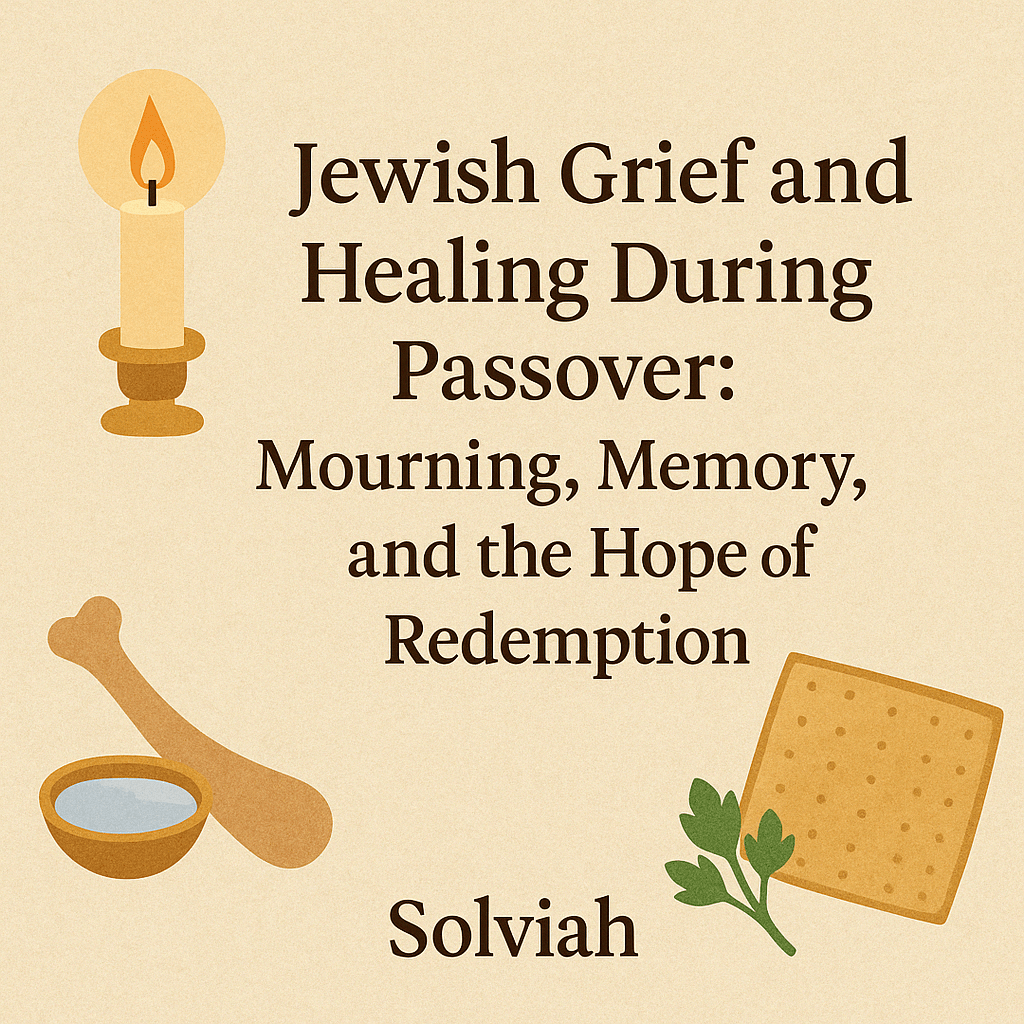
    Some mourners may find particular meaning in the bitter herbs of the Seder plate, which recall the pain of slavery in Egypt. These herbs also evoke the sharpness of grief—a visceral reminder that healing does not require forgetting. The symbolic foods of Passover offer a sacred vocabulary for sorrow: the shank bone (loss), the salt water (tears), the matzah (fragility). Together, they form a ritual language that allows grief to be felt and honored.


    🤝 The Healing Power of Community and Ritual

    Grief isolates. Ritual reconnects. Jewish mourning practices emphasize the power of community. From bringing meals during shiva to standing together for the Kaddish, the community holds space for the mourner to be broken—and to begin to heal.

    Passover, with its family-centered structure, may intensify grief, but it can also provide gentle re-entry into communal life. Many families leave an empty chair or say a blessing in memory of the deceased. Others incorporate personal stories, photos, or favorite foods of the departed into the Seder meal. These small acts keep memory alive and sanctify grief as part of the celebration, not an interruption to it.

    Jewish psychologist David Pelcovitz (2020) writes that rituals are crucial for grief recovery. They “create predictability, provide comfort, and offer the bereaved a sense of agency during disorienting times.” The rituals of Passover, from searching for the afikomen to pouring Elijah’s cup, provide sacred structure even for the heart that aches.


    🧠 Psychological Insights and Grief Theory in Jewish Practice

    Modern grief theory—particularly the dual-process model—emphasizes oscillation between loss-oriented and restoration-oriented activities (Stroebe & Schut, 1999). Jewish mourning mirrors this beautifully. During Passover, one may mourn during private prayer but also engage in songs, storytelling, and food preparation. The balance is not only permissible—it is healing.

    Moreover, Judaism embraces the concept of continuing bonds—maintaining a relationship with the deceased through memory, ritual, and shared values. These practices align with contemporary bereavement psychology and offer profound spiritual reinforcement: the love continues.


    🌿 A Blessing for the Grieving During Passover

    If you are grieving during Passover, you are not alone. You walk the ancient path of those who mourned in the wilderness, whose cries rose with the smoke of burnt offerings, whose tears mingled with salt water on the table. There is space for you at the Seder. There is room for grief in the story of redemption.

    May the God who delivered Israel from bondage draw near to your sorrow. May the memory of your loved one shine like the pillar of fire that guided our ancestors through the night. And may you, in time, come to feel again the joy of spring—the whisper of freedom, the promise of renewal.


    📖 References (APA Style)

    Berkovits, E. (1983). Faith After the Holocaust. KTAV Publishing House.

    Kaplan, A. (1997). Jewish Meditation: A Practical Guide. Schocken Books.

    Lamm, M. (1969). The Jewish Way in Death and Mourning. Jonathan David Publishers.

    Pelcovitz, D. (2020). Rituals and resilience in Jewish mourning. Jewish Psychology Journal, 12(1), 42–57.

    Sacks, J. (2010). Future Tense: Jews, Judaism, and Israel in the Twenty-First Century. Schocken Books.

    Shulchan Aruch, Orach Chaim 429:1. (Code of Jewish Law)

    Stroebe, M., & Schut, H. (1999). The dual process model of coping with bereavement: Rationale and description. Death Studies, 23(3), 197–224.