Honoring Life, Embracing Memories

Tag: Chinvat Bridge

  • Zoroastrian Grief Rituals: Ancient Faith, Sacred Prayers, and the Chinvat Bridge

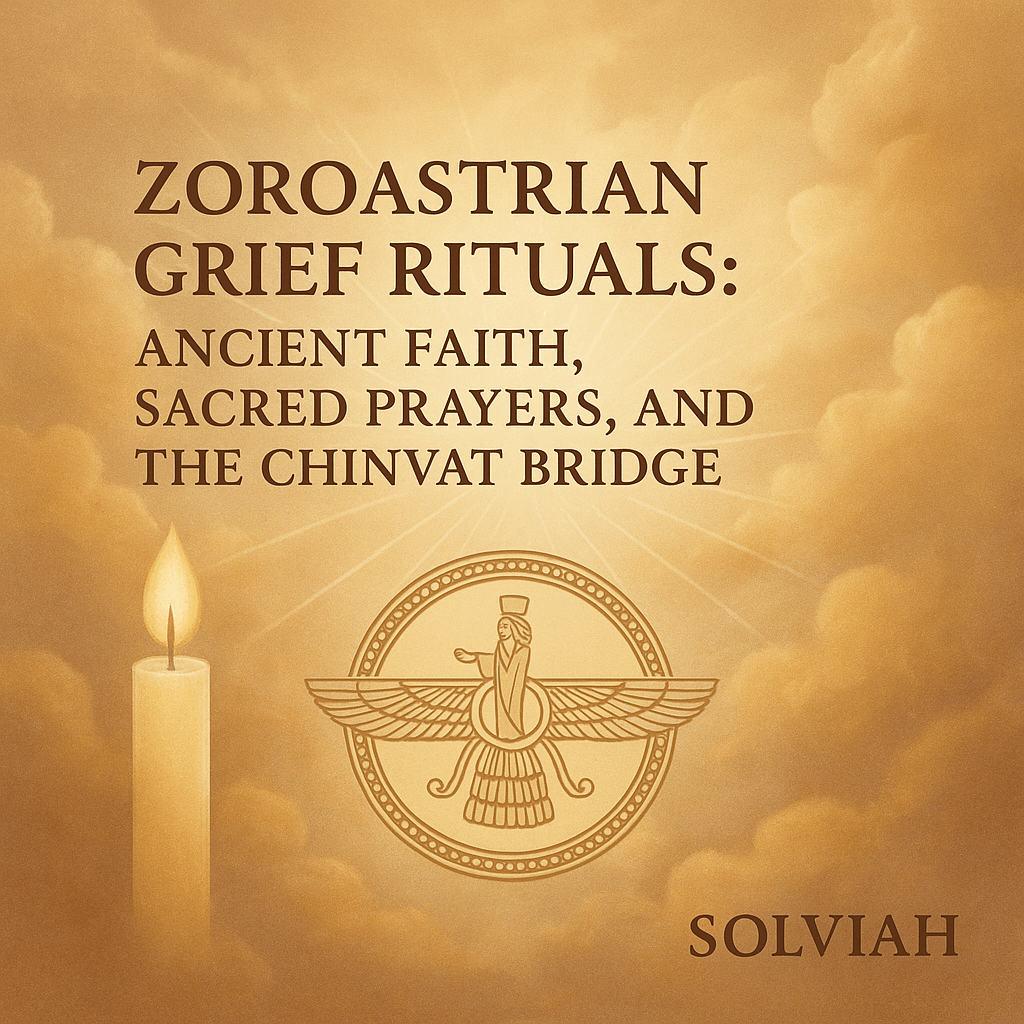
    Zoroastrian Grief Rituals: Ancient Faith, Sacred Prayers, and the Chinvat Bridge


    “As thou dost desire, O holy one! so shalt thou be; holy shalt thou cause thy soul to pass over the Chinvat Bridge; holy shalt thou come into Heaven.”
    — Yasna 71, Avesta

    When someone beloved dies, Zoroastrians do not simply mourn—they prepare the soul for its most sacred journey. Rooted in the world’s oldest known monotheistic tradition, this journey leads across the Chinvat Bridge, guided by prayers, rituals, and a legacy of good deeds.


    🕯️ A Sacred Story of Life After Death

    An old tale tells of a kind-hearted man who gave shelter to the poor and refused to gossip. When he died, his soul lingered three days near his home. On the dawn of the fourth, he stood before the Chinvat Bridge—where three divine judges weighed his deeds. The bridge widened, and a radiant maiden, the embodiment of his own good actions, walked beside him into the House of Song. There, light never dimmed, and music never ceased.

    This story expresses the Zoroastrian belief: the soul is judged not by belief alone, but by the harmony it created through thoughts, words, and deeds.

    ↑ Back to Top

    ⚖️ What Zoroastrians Believe About Death

    Zoroastrianism teaches that life is a moral struggle between asha (truth) and druj (falsehood). When someone dies, the soul (urvan) stays near the body for three days. On the fourth, it crosses the Chinvat Bridge, where three divine judges await:

    • Mithra — Covenant and Witness
    • Sraosha — Conscience and Protector
    • Rashnu — Justice and Weighing of Deeds

    Those who lived in asha are welcomed into Garo Demana (the House of Song). Those who served druj fall into Druj Demana, a place of darkness.

    ↑ Back to Top

    📿 Sacred Prayers and Mourning Rituals

    Zoroastrians honor the dead through rituals designed to protect both the soul and the elements. Traditionally, bodies are placed in a dakhma (Tower of Silence). Today, cremation or burial may be used, with adapted rites.

    Key prayers and ceremonies:

    • Geh Sarnu — comforting hymns
    • Patet Pashemani — confessional prayer
    • Sraosh Hadokht — prayer for protection
    • Uthamna — fourth-day soul release ceremony
    • Dahmah — charity done in the name of the deceased

    These rituals affirm that love continues beyond life and offer structure to support those who grieve.

    ↑ Back to Top

    🧠 Ancient Wisdom Meets Modern Healing

    Psychologists note that ritual, repetition, and meaning-making ease the pain of loss. Zoroastrian grief practices align closely with this wisdom:

    • Structured mourning rituals create safety and continuity
    • The soul’s journey provides spiritual purpose and meaning
    • Community prayers build connection and memory

    Grief becomes not just pain, but a sacred transformation of presence into legacy.

    ↑ Back to Top

    🤝 Across Faiths: Threads of Common Ground

    Zoroastrianism is often compared to Christianity due to its belief in a final judgment and heaven. In Yasna 30:9 we read:

    “Let good thoughts prevail in the world and evil thoughts perish. Let good words be spoken and evil ones be silenced. Let good deeds increase and evil ones fade away.”

    This mirrors the Christian principle to “overcome evil with good” (Romans 12:21).

    Other faiths also echo this sacred rhythm:

    • Judaism: Sitting shiva honors memory with community presence
    • Islam: Mourning includes prayer and charity for the soul’s peace
    • Buddhism: Grief is eased through acceptance of impermanence

    Such reflections reveal that in grief, we are not divided by belief—but connected by love.

    ↑ Back to Top

    💞 For Supporters and Friends

    If someone you love is grieving within the Zoroastrian faith, your compassion can be a bridge of comfort. Here are gentle ways to support:

    • Honor the first three days: These are sacred for the soul’s transition. Presence, not pressure, matters most.
    • Use spiritual language: Words like “May their soul cross in light” or “May their deeds lead them to peace” align with their beliefs.
    • Respect the rituals: Ask before bringing food, gifts, or flowers—some families observe specific customs around purity and space.
    • Offer to help with Dahmah: Assist in charitable acts made in memory of the deceased.
    • Share good memories: Speaking of the person’s kindness or courage honors their legacy.

    Kindness, even quiet kindness, is a sacred act.

    ↑ Back to Top

    🌟 Heaven, But Not As You Know It

    Garo Demana, the House of Song, is Zoroastrianism’s vision of heaven. It is a place of eternal light, music, and unity with Ahura Mazda. Entry is not earned by belief alone—but by how one lives.

    When the soul approaches the Chinvat Bridge, three divine entities weigh their life:

    • Mithra (truthfulness)
    • Sraosha (obedience to conscience)
    • Rashnu (justice)

    If the soul lived in asha, the bridge widens and leads them across into joy. This belief invites every Zoroastrian to live with moral courage, knowing eternity awaits.

    ↑ Back to Top

    📘 Glossary

    • Asha — Truth, righteousness, divine order
    • Druj — Falsehood, deceit, disorder
    • Urvan — The soul of the deceased
    • Chinvat Bridge — Bridge of judgment after death
    • Garo Demana — House of Song (Zoroastrian heaven)
    • Druj Demana — House of Lies (place of sorrow)
    • Dakhma — Tower of Silence for traditional sky burial
    • Uthamna — Fourth-day soul release ceremony
    • Patet Pashemani — Confessional prayer
    • Sraosh Hadokht — Prayer for soul’s journey
    • Dahmah — Acts of charity in memory of the deceased

    ↑ Back to Top

    💨 A Breath Prayer for the Grieving

    Inhale: I walk with truth
    Exhale: My soul is not alone

    Reflection:
    What good words or deeds can I speak in their memory today?

    ↑ Back to Top

    🗣️ Share Your Story

    Have you experienced grief through the lens of faith—Zoroastrian or otherwise?

    Leave a comment to honor your loved one, share your tradition, or ask a question. Your voice may be the bridge someone else needs today.

    Continue exploring:

    ↑ Back to Top

    Written for Solviah, where grief is met with gentleness, wisdom, and sacred remembering.
  • Zoroastrian Grief Traditions and Scriptures: Spiritual Comfort After Death and Loss

    Zoroastrian Grief Traditions and Scriptures: Spiritual Comfort After Death and Loss

    Exploring sacred wisdom for healing and hope through the lens of Zoroastrianism


    Wrestling with Death and the Sacred Fire of Grief

    Grief is both universal and deeply personal. Whether anticipated or sudden, the loss of a loved one disrupts not only our routines but our worldview. Many of us, in our search for comfort, return to our spiritual foundations. For followers of Zoroastrianism—one of the world’s oldest faiths—loss is not something to escape but something to walk through, supported by light, truth, and divine order.

    Rooted in the teachings of the prophet Zarathustra and preserved in scriptures known as the Gathas, Zoroastrianism offers profound insight into the soul’s immortality, the rituals of mourning, and the nature of divine justice. During times of loss, these ancient truths offer more than comfort—they offer transformation.


    “Let Wisdom Come to the Soul”

    “Let wisdom come into the soul through the righteous order, and let the understanding of truth bring comfort to the heart.”
    — Yasna 30.9, The Gathas

    This verse centers Zoroastrian grief traditions around asha—divine order, truth, and righteousness. In the Zoroastrian worldview, the soul (urvan) continues after death, embarking on a three-day journey to the Chinvat Bridge, where it is judged based on thoughts, words, and deeds. The righteous cross into the House of Song, a peaceful spiritual realm of light and harmony.

    Grief, then, is a sacred time of honoring that journey. Through rituals and prayers, mourners reaffirm their trust in divine justice and the enduring connection with the deceased.


    Reflection: Light and the Soul’s Journey

    In Zoroastrianism, fire is not merely symbolic—it is sacred. It represents the eternal presence of Ahura Mazda (the Wise Lord) and the spiritual illumination that guides the soul. Rather than extinguishing light in mourning, Zoroastrians elevate it. Candles are lit, fires are tended, and prayers like the Ahunavaiti Gatha are recited to hold vigil for the departed soul.

    One common prayer echoes the cosmic rhythm of light over darkness:

    “Truth is the best of all good; it blesses those who seek it with good thoughts, words, and deeds.”

    Modern priest and scholar Dr. Farrokh Mistree (2021) emphasizes that fire in grief is more than a ritual—it is a divine companion, reminding us that even in sorrow, light endures.


    Faith and Psychology: Rituals of Remembrance and Renewal

    From a psychological perspective, rituals help give structure to grief. Dr. Sameet Kumar (2005) notes that spiritually rooted mourning practices offer a container for emotion, helping mourners process loss with intention and resilience.

    Zoroastrian mourning practices include:

    • The Three-Day Vigil: Loved ones keep watch while the soul journeys to the Chinvat Bridge.
    • Sodabeh Ceremonies: Held on the 4th, 10th, and 30th days to honor the soul’s transition.
    • Farvardigan Festival: An annual remembrance of ancestors, where the living connect with the fravashis (guardian spirits).

    The hope of frashokereti—a future resurrection and the final purification of all creation—sustains the Zoroastrian vision of life after death. The soul’s journey is not a lonely one. It is part of a greater cosmic restoration.

    This resonates with Dr. George Bonanno’s (2009) concept of “meaning-centered grief,” where rituals serve to build spiritual resilience and maintain emotional bonds with those who have passed.


    Hidden Gem: The Mystery of the Fravashi

    One of the most beautiful and often overlooked beliefs in Zoroastrianism is that of the fravashi—a guardian spirit or eternal essence of each soul. Unlike the urvan, which journeys after death, the fravashi remains with the family, offering protection and moral guidance.

    During the Farvardigan, offerings are made to the fravashis of the dead, affirming that love and presence endure beyond the grave. Scholar Dr. Jenny Rose (2011) explains:

    “The fravashi represents the eternal blueprint of goodness. In moments of sorrow, we call upon it not to change the past, but to walk faithfully in the present.”

    Even in death, we are never truly disconnected.


    A Home Ritual for Zoroastrian-Inspired Grief Healing

    You do not have to be Zoroastrian to find comfort in its sacred traditions. Below is a gentle, spiritually meaningful ritual that can be done at home.

    Five-Step Grief Reflection:

    1. Create a Sacred Space: Set aside a small table with a candle, flower, or photo.
    2. Light a Flame: Symbolize the eternal fire and the journey of the soul.
    3. Recite Yasna 43.1: Or use this line: “Truth is the path to peace. May we walk it with those we love.”
    4. Speak Their Name: Say one memory aloud.
    5. Close with the phrase: Hama Zor Hama Asho Bed (May we be united in righteousness).

    Even for those outside the Zoroastrian tradition, this practice offers spiritual comfort after loss, helping you honor grief with light and meaning.


    Conclusion: Truth, Fire, and the Journey Beyond

    Zoroastrianism does not promise a life without suffering—but it offers a life filled with meaning, light, and sacred order. In the face of death, Zoroastrian scriptures assure us that truth endures, the soul journeys on, and love transcends time.

    Whether you are grieving personally or supporting someone who is, the Zoroastrian path of comfort offers profound spiritual tools for reflection, connection, and healing.

    Let the light of asha guide you through loss, and may the fravashi of your loved ones walk with you.


    References (APA Style)

    Bonanno, G. A. (2009). The Other Side of Sadness: What the New Science of Bereavement Tells Us About Life After Loss. Basic Books.

    Kumar, S. (2005). Grieving Mindfully: A Compassionate and Spiritual Guide to Coping with Loss. New Harbinger Publications.

    Mistree, F. (2021). The Eternal Flame: Zoroastrianism in the Modern World. Zoroastrian Heritage Series.

    Rose, J. (2011). Zoroastrianism: An Introduction. I.B. Tauris.

    Yasna (The Gathas of Zarathustra). Retrieved from https://www.sacred-texts.com/zor/index.htm