Honoring Life, Embracing Memories

Category: Library

  • Grieving Alone While Others Celebrate: Coping with Grief During Christian Holidays as a Non-Christian

    Grieving Alone While Others Celebrate: Coping with Grief During Christian Holidays as a Non-Christian

    “There is no greater agony than bearing an untold story inside you.”Maya Angelou


    She closed the door with a soft click. Outside, voices laughed down the hallway, echoing like ghosts who’d forgotten to say goodbye. The scent of cinnamon and roasted lamb clung to the air. Inside her apartment, it was quiet—too quiet. The chair across from her was empty. A year ago, her brother had sat there. A year ago, everything had changed.

    If you’re grieving and not part of the Christian faith, holidays like Easter or Christmas can stir up a special kind of loneliness. You’re not just mourning a loved one—you’re watching the world sing while you sit in silence. Even those who promised to stand beside you may be swept up in celebration, leaving you feeling like your grief has an expiration date the world already passed.

    This article is for you—the one feeling forgotten in your sorrow. We’ll explore the often-hidden experience of grief outside dominant faith traditions, focusing on the emotion of anger. Along the way, you’ll find grounding practices, soulful rituals, and one vital reminder: you are not alone, and your pain still matters deeply.


    🎄 When Celebration Feels Like a Closed Door

    Christian holidays shape more than churches—they influence school calendars, public schedules, and social expectations. Even in secular spaces, the air is thick with carols, brunches, and “He is Risen.” For someone mourning a loved one, this cultural rhythm can feel like a sharp turn in the wrong direction.

    You may be Jewish, Muslim, Hindu, Buddhist, spiritual but not religious—or simply still grieving—and find yourself excluded from the dominant tradition of hope and light. Meanwhile, your own traditions—Shiva, Ramadan, Diwali, or silent remembrance—are overlooked or unknown.

    “I’m Jewish. My mom died two weeks before Easter. My coworkers sent flowers, then disappeared for holiday travel. I wasn’t angry at them. I was angry at the silence.”David R., New York

    Grief expert Stroebe, Schut, and Boerner (2017) affirm that social connection is vital to healing. But during religious holidays, that connection may feel out of reach, especially for those outside the dominant faith. Grief doesn’t take a holiday—but too often, support does.


    🔥 The Hidden Anger in Grief

    Grief wears many faces. One of them is rage.

    Anger may rise when your messages go unanswered. When your calendar is empty while others gather. When your faith—or lack of faith—is not even part of the conversation.

    Elisabeth Kübler-Ross & David Kessler (2005) wrote that anger is not a detour from grief—it is part of it. It’s not only anger at the loss. It’s anger at being unseen.

    Dr. Robert Neimeyer (2012) explains that grief involves rebuilding identity in a world that feels off-axis. When grief is unacknowledged, this rebuilding becomes even harder. Anger becomes the voice of your invisible pain.

    “Anger is the guard dog of forgotten sorrow.”


    ⛔ When Grief Doesn’t Match the Season

    Christian holidays are often framed around light, joy, and resurrection. But what if your grief still lives in shadow? The world may be celebrating renewal—while you’re mourning what will never return.

    This mismatch can feel like spiritual exile. The American Psychological Association (2023) warns that when grief rituals do not align with a mourner’s worldview, the result can be alienation, depression, and delayed healing.

    What You May Wish They Knew:

    • My grief didn’t end just because it’s Easter or Christmas.
    • I still need support, even if you’re busy with family.
    • Silence doesn’t feel like space—it feels like forgetting.
    • I don’t need fixing—I just need to feel remembered.

    🛠️ Gentle Tools for Heavy Days

    1. Sacred Breathing

    When emotions surge, use this grounding breath:

    • 🫁 Inhale for 4 counts — invite warmth to fill your lungs
    • ✋ Hold for 4 counts — feel the pause
    • 🌬️ Exhale slowly for 6 counts — release tension
    • Repeat 5–10 times

    This activates the parasympathetic nervous system, bringing calm (Siegel, 2010).

    2. Make a Personal Ritual

    Whether or not you follow a religion, your grief deserves reverence.

    Light a candle. Whisper their name. Make their favorite dish. Write a letter and bury it in the garden. These small acts ground your sorrow in sacred meaning (Romanoff & Terenzio, 1998).

    3. Let the Anger Speak

    Try these normal prompts:

    • “What feels unfair about this season?”
    • “What do I wish I could say to others—or to the person I lost?”
    • “Where does my anger live in my body today?”

    4. Micro-Connections Matter

    Your large circle may be unavailable—but even two people can hold space for your grief. Text a friend: “I’m struggling this week. Can we talk for 10 minutes?”

    Or form a “grief thread”—a private group message with 2–3 safe people to check in during holidays.


    🕯️ A Sacred Moment, No Religion Required

    Hold something of theirs—a note, a photo, a piece of clothing. Say their name three times. Speak a memory. Let silence follow.

    This silence is not absence. It is a presence. Your grief just became sacred.


    🌿 Closing Reflection

    You don’t need to pretend. Not today. Not this season.

    Your grief is real. Your story is still unfolding. And your sorrow is not less important just because others are celebrating.

    “If I could honor my grief in one true way this week, what would I do?”

    Write your truth. Breathe. Repeat. You are not alone—even if today feels like it.

    📚 References

    • American Psychological Association. (2023). APA guidelines on religion and spirituality. Retrieved from https://www.apa.org
    • Bonanno, G. A. (2004). Loss, trauma, and human resilience. American Psychologist, 59(1), 20–28.
    • Kübler-Ross, E., & Kessler, D. (2005). On grief and grieving. Scribner.
    • Neimeyer, R. A. (2012). Techniques of grief therapy. Routledge.
    • Romanoff, B. D., & Terenzio, M. (1998). Rituals and the grieving process. Death Studies, 22(8), 697–711.
    • Siegel, D. J. (2010). The mindful therapist. W. W. Norton & Company.
    • Stroebe, M., Schut, H., & Boerner, K. (2017). Cautioning health-care professionals. Omega: Journal of Death and Dying, 74(4), 455–473.
  • Faith and Loss: Easter, Christian Grief, and the Comfort of Resurrection

    Faith and Loss: Easter, Christian Grief, and the Comfort of Resurrection

    Wrestling with Death During the Season of Life

    Easter trumpets life while many hearts quietly ache with death. It is the season of “He is risen!”—but also of empty chairs and silent tears. In the stillness after loss, Christian grief carries a distinct tension: we believe in resurrection, yet we feel the sting of death. Christianity invites us to hold both at once. It teaches us not to rush past grief in the name of faith, but to meet God inside it—to find Him in the tomb before we see Him in the garden.

    John 11:25–26 – Resurrection, Now and Forever

    “I am the resurrection and the life,” Jesus tells Martha, “He who believes in Me, though he may die, he shall live. And whoever lives and believes in Me shall never die. Do you believe this?” (John 11:25–26, NKJV)

    This isn’t just a promise of heaven—it’s a present-tense invitation to believe in Christ’s authority over death today. Christianity reveals Jesus not only as future hope but as current resurrection. His question to Martha is His question to us: “Do you believe this?” Not with your head, but with your heart—especially when it breaks.

    Jesus Weeps Before He Raises

    Before raising Lazarus, Jesus pauses to mourn. “Jesus wept” (John 11:35) is not divine sentimentality. It is incarnate empathy. He cries with us and for us—not because He is powerless, but because He is love. His tears were prophetic: showing us that grief is not weakness but worship. He sanctified sorrow, not as a temporary feeling to bypass, but a place to meet the Father in intimacy.

    Grieving as a Christian isn’t doubting God’s power—it’s trusting Him enough to cry in front of Him.

    The Spiritual Work of Mourning: Christian Grief as Prophetic Witness

    Grief is not passive. It’s spiritual work. We are not merely waiting to “feel better”—we are bearing witness to resurrection in the making. As theologian Jürgen Moltmann said, “Faith, wherever it develops into hope, causes not rest but unrest.” This unrest is sacred.

    The Bible calls this groaning. “We ourselves groan within ourselves, eagerly waiting for the adoption, the redemption of our body” (Romans 8:23). Grief is groaning. And the Spirit intercedes with groans too deep for words (Romans 8:26). The prophetic dimension here is clear: our mourning becomes an intercession that shakes the heavens.

    Faith and Psychology: Lament, Hope, and Emotional Healing

    Psychologically, lament is one of the healthiest tools of recovery. The Psalms are filled with it—songs of protest, of grief, of complaint. Modern Christianity too often prizes praise and suppresses sorrow. But lament is biblical praise. It’s worship that bleeds.

    Theologian Walter Brueggemann argued that lament provides structure to our grief, keeping it from becoming chaos. We move from lament to declaration. From “How long, O Lord?” to “But I will yet praise You.”

    Diane Langberg affirms that when trauma is met with silence, healing halts. But when pain is named—in prayer, in journaling, in Spirit-filled community—healing begins. The Comforter is not only present to dry tears but to help us transform them.

    The Resurrection Body and the Cloud of Witnesses

    Our hope is not merely spiritual comfort, but bodily resurrection. “So also is the resurrection of the dead. The body is sown in corruption, it is raised in incorruption” (1 Corinthians 15:42). Apostolic teaching goes further: the glory of the resurrection body far outweighs the pain of loss.

    Hebrews 12 speaks of the “great cloud of witnesses”—those who have gone before us and still surround us. Grieving believers are never alone. The veil is thin. Your mother, your child, your spouse—though gone, they are not absent in the Spirit.

    One Extra: Prophetic Remembrance through Yahrzeit

    Borrowing from the Jewish tradition of yahrzeit—the yearly remembrance of a loved one’s passing—we can create rituals of spiritual memory. Light a candle. Speak a Scripture. Share a testimony of how their life still bears fruit.

    This transforms grief into testimony. We become prophets of remembrance, declaring, “Death is not the end. They live in Christ, and we will see them again.”

    The Empty Tomb Is a Message to the Grieving

    Easter’s empty tomb doesn’t deny death—it defeats it. For those grieving, this is the hardest and holiest part of faith: to mourn what is gone and still proclaim that Christ is risen. Resurrection doesn’t cancel sorrow—it transforms it.

    The work of grief is holy. And as we walk through it, the Spirit groans with us, Jesus weeps with us, and the Father prepares a table for us—in the presence of our enemies, even death.

References (APA Style)

  • Brueggemann, W. (1984). The Message of the Psalms: A Theological Commentary. Augsburg Fortress.
  • Deere, J. (2020). Even in Our Darkness: A Story of Beauty in a Broken Life. Zondervan.
  • Langberg, D. (2020). Suffering and the Heart of God: How Trauma Destroys and Christ Restores. New Growth Press.
  • Moltmann, J. (2004). The Coming of God: Christian Eschatology. Fortress Press.
  • Wright, N. T. (2003). The Resurrection of the Son of God. Fortress Press.
  • Healing Through Faith: 10 Bible Verses for Comfort After Loss

    Healing Through Faith: 10 Bible Verses for Comfort After Loss

    Spiritually nourishing, theologically rich, and prophetically honest

    When Faith Meets Grief

    Grief doesn’t wait for convenience—it arrives like a storm, disrupting our plans and unsettling our souls.
    In a culture that often treats grief as a detour or weakness, Christians are called to wrestle with loss through the lens of eternity.
    But how?

    In the Christian tradition, grief isn’t minimized—it’s met with power. God doesn’t only comfort—He rebuilds.
    He transforms ashes into beauty and mourning into purpose.
    This post explores how Christians can find deep comfort and healing through faith, blending biblical scriptures, and Christian psychological insights to walk through grief with both honesty and hope.

    Isaiah 61:1–3 — Beauty for Ashes

    “The Spirit of the Sovereign Lord is upon me… to comfort all who mourn… to bestow on them a crown of beauty instead of ashes…” (Isaiah 61:1–3, NIV)

    Isaiah 61 is a foundational text in Christianity. It not only predicts the coming of Christ but outlines His mission:
    to bring holistic healing to the soul, especially through grief. This isn’t a passive comfort—it’s an impartation.
    When Jesus quotes this in Luke 4:18, He declares that He is the fulfillment of comfort itself.

    The Hebrew word for “beauty” in verse 3 refers to a turban or crown, a royal adornment.
    This means God doesn’t just take away grief—He replaces it with honor, identity, and purpose.

    Devotional Reflection: The Grieving God

    “Jesus wept.” (John 11:35)

    When Jesus encountered Mary and Martha mourning the death of Lazarus, He did not jump to resurrection. He wept.
    Though He knew joy was coming, He allowed Himself to feel the sting of loss. This is the God who grieves with us—
    not from a distance, but eye to eye, shoulder to shoulder.

    In the prophetic worldview, Jesus’ tears were not only empathetic—they were intercessory.
    He joined their pain and shifted the spiritual atmosphere before performing the miracle.
    Your tears, too, carry prophetic power.

    Faith & Psychology: Lament, Hope, and the Sacred Role of Prayer

    Lament is a forgotten language in many Christian circles. But biblically, lament is not a sign of weakness—it is a form of worship.
    Over one-third of the Psalms are laments. They model how to cry out, question God, and still cling to Him.

    Christian psychologist and trauma expert Dr. Diane Langberg writes,
    “Trauma sufferers need to know that their cries do not exclude them from God’s presence. In fact, they are a door to it.” (Langberg, 2015).

    Modern neuroscience supports this. Dr. Harold Koenig found that prayer during grief decreases cortisol (stress hormone) levels and rewires the brain toward resilience (Koenig, 2012).
    This science aligns with spiritual truth: when we speak out our grief in prayer, heaven responds.

    10 Bible Verses for Christian Grief and Spiritual Comfort After Death

    1. Psalm 34:18 — “The Lord is close to the brokenhearted and saves those who are crushed in spirit.”
    2. Matthew 5:4 — “Blessed are those who mourn, for they will be comforted.”
    3. 2 Corinthians 1:3–4 — “The God of all comfort… comforts us in all our troubles.”
    4. Isaiah 41:10 — “Do not fear, for I am with you… I will strengthen you and help you.”
    5. Revelation 21:4 — “He will wipe every tear… there will be no more death.”
    6. John 14:1–3 — “Do not let your hearts be troubled… I am preparing a place for you.”
    7. Psalm 147:3 — “He heals the brokenhearted and binds up their wounds.”
    8. Romans 8:18 — “Our present sufferings are not worth comparing…”
    9. 1 Thessalonians 4:13–14 — “We do not grieve like the rest… for we believe Jesus died and rose again.”
    10. Lamentations 3:22–23 — “His mercies are new every morning.”

    These are not just comforting verses—they are divine declarations of God’s eternal plan to restore all things.

    One Extra Tip: Anointing as an Act of Healing

    Few Christians realize how powerful it is to anoint themselves or others with oil in grief.
    James 5:14 invites the elders to anoint the sick. But this sacred act also applies to emotional wounds.

    Try this:

    • Light a candle.
    • Anoint your head or heart with oil.
    • Read Isaiah 61.
    • Declare: “Beauty for ashes is my portion.”

    This practice anchors your soul in divine truth and invites the Holy Spirit to minister directly to the places where words fail.

    Conclusion: The Grief-Walking God

    Loss is real. The pain is sharp. But so is the promise. We grieve—but we do not grieve without hope (1 Thess. 4:13).
    Through Jesus, mourning becomes sacred ground. God doesn’t only meet you in the valley—He walks through it with you.

    In Christianity, we don’t merely survive grief—we declare resurrection through it.

    References (APA Style)

    • Koenig, H. G. (2012). Religion, spirituality, and health: The research and clinical implications. ISRN Psychiatry, 2012, 278730. https://doi.org/10.5402/2012/278730
    • Langberg, D. (2015). Suffering and the Heart of God: How Trauma Destroys and Christ Restores. New Growth Press.
    • The Holy Bible, New International Version. (2011). Biblica.
    • Wright, N. T. (2008). Surprised by Hope: Rethinking Heaven, the Resurrection, and the Mission of the Church. HarperOne.
  • 🌌 Biblical Signs in the Heavens: What the Stars Reveal During Holy Week and Easter (April 2025)

    🌌 Biblical Signs in the Heavens: What the Stars Reveal During Holy Week and Easter (April 2025)


    🌠 Do the Stars Speak?

    This Easter—falling on April 20, 2025—the skies are filled with light and mystery. The Lyrid meteor shower will streak across the heavens. Venus, Saturn, and the crescent moon will form a rare “smiley face” in the sky. But perhaps most striking of all: for the first time in many years, both Eastern (Orthodox) and Western (Catholic and Protestant) Easter are celebrated on the same day.

    This alignment is not merely calendrical—it is cosmological. The Orthodox Church calculates Easter based on the Jewish lunar calendar, as Jesus was crucified during Passover. The Western Church follows a solar calendar with different criteria. These calendars rarely coincide. When they do—and the heavens echo their unity with radiant signs—we should pause and listen.

    So what does it mean when the heavens, the Christian Church, and the Jewish calendar converge?
    What is God saying through the stars?


    🔭 Biblical Astronomy vs. Astrology: A Crucial Distinction

    To understand this moment, we must begin by distinguishing Biblical Astronomy from astrology.

    • Astrology seeks hidden meanings in the stars to guide individual fate. It is self-focused and often superstitious.
    • Biblical Astronomy is God-focused. It studies the heavens as God’s timepiece and message board, created to reflect His will, not ours.

    “Let there be lights… and let them be for signs and for seasons” — Genesis 1:14 (ESV)

    “The heavens declare the glory of God” — Psalm 19:1 (ESV)

    “A great sign appeared in heaven…” — Revelation 12:1 (ESV)

    From Genesis to Revelation, Scripture reveals that God uses the heavens to mark divine moments in history. The stars are not silent—they proclaim.


    🌌 What’s Happening in April 2025? Celestial Events and Sacred Timing

    • Passover (April 12–20) – Celebrating God’s deliverance of Israel.
    • Easter (April 20) – Marking Jesus’ resurrection from death.
    • Orthodox and Western Easter Together – A rare occurrence rooted in the Jewish lunar calendar and now reflected in unified celebration.
    • Lyrid Meteor Shower (April 21–22) – One of the oldest known meteor showers, lighting the sky just after Resurrection Sunday.
    • Planetary Alignment (April 25) – A “smiley face” appears in the sky, composed of Venus (the bright morning star), Saturn (the judge), and the crescent moon (biblically symbolic of cycles and renewal).

    These are not coincidences. When God aligns calendars, feasts, and constellations, it’s an invitation to look up and remember His faithfulness.


    🪐 What Is God Saying Through the Stars?

    To those wondering—what does it all mean?—here’s a clear and reassuring message:

    God is reminding us that He is still sovereign. He is still near. He is still redeeming.

    1. God is calling His people to unity.

    The alignment of Orthodox and Western Easter is more than rare—it’s prophetic. Jesus prayed in John 17:21, “that they may all be one.” This shared Easter reminds us that, despite denominational lines, we serve one Risen King.

    2. God is honoring His covenantal rhythm.

    By following the Jewish lunar calendar, Orthodox Easter ties us to God’s ancient promises. When both Easter dates align, it signals a bridge between Old and New Covenants—a fulfillment echoed in the cosmos.

    3. God is comforting those in grief.

    The Lyrid meteors and planetary smile are gentle reminders: even in sorrow, there is light. If you are walking through Christian grief, know this—you are seen. The heavens are not empty; they are full of divine reassurance.

    4. God is inviting the world to joy.

    The “smiley face” in the heavens is childlike, tender, and filled with delight. It tells us: hope is not dead. Death was defeated. Christ is risen. The cosmos rejoices—and so should we.


    🔎 Discerning the Message: How Do We Know?

    “To the law and to the testimony! If they do not speak according to this word, they have no light.” — Isaiah 8:20 (ESV)

    We discern God’s voice in the stars by confirming it through:

    • Scripture – Does it align with God’s Word?
    • Community – Are other believers sensing the same message?
    • Spirit – Does it bring peace, truth, conviction, or comfort?

    Biblical Astronomy is not about predictions. It’s about recognition—recognizing God’s movement, timing, and care through His creation.


    💔 Stars and Suffering: A Cosmic Comfort

    In the weariness of grief or daily overwhelm, many people don’t have time to ponder heavenly mysteries. That’s okay.
    Let the stars do the speaking.

    “He heals the brokenhearted and binds up their wounds. He determines the number of the stars; He gives to all of them their names.” — Psalm 147:3-4 (ESV)

    Every star has a name. And so do you. You are not forgotten in your grief.
    If God upholds the galaxies, He can uphold you.


    🙏 Receive the Morning Star

    The stars don’t point to fate. They point to faith.

    “I, Jesus… am the bright Morning Star.” — Revelation 22:16 (ESV)

    What is salvation?

    Salvation means being rescued—from sin, from death, from eternal separation from God. It’s a free gift through faith in Jesus Christ, who died for your sins and rose again so you could live forever.

    Pray this aloud or in your heart:

    Jesus, I believe You are the Son of God.
    I believe You died for my sins and rose again.
    I confess I need You. Please forgive me, heal me, and lead me.
    I surrender my life to You.
    Be my Savior. Be my Light. Be my Morning Star.
    In Your name, Amen.

    Next Steps:

    • Find a Church Community – Look for a Bible-based church near you. Don’t walk this road alone.
    • Get Baptized – Baptism is a public declaration of your faith.
    • Start Reading Scripture – Begin with the Book of John.

    ✨ Conclusion: Look Up—He Is Speaking

    April 2025 is not just another month. It is a divine convergence of calendars, creation, and covenant.
    The stars are aligned. The feasts are aligned.
    The Church is aligned.

    God is calling us into unity, joy, and holy awe. Don’t miss the message.

    Lift your eyes. Lift your heart. The heavens are declaring: He is risen. He is coming. And He has never stopped speaking.


    📚 References (APA Style)

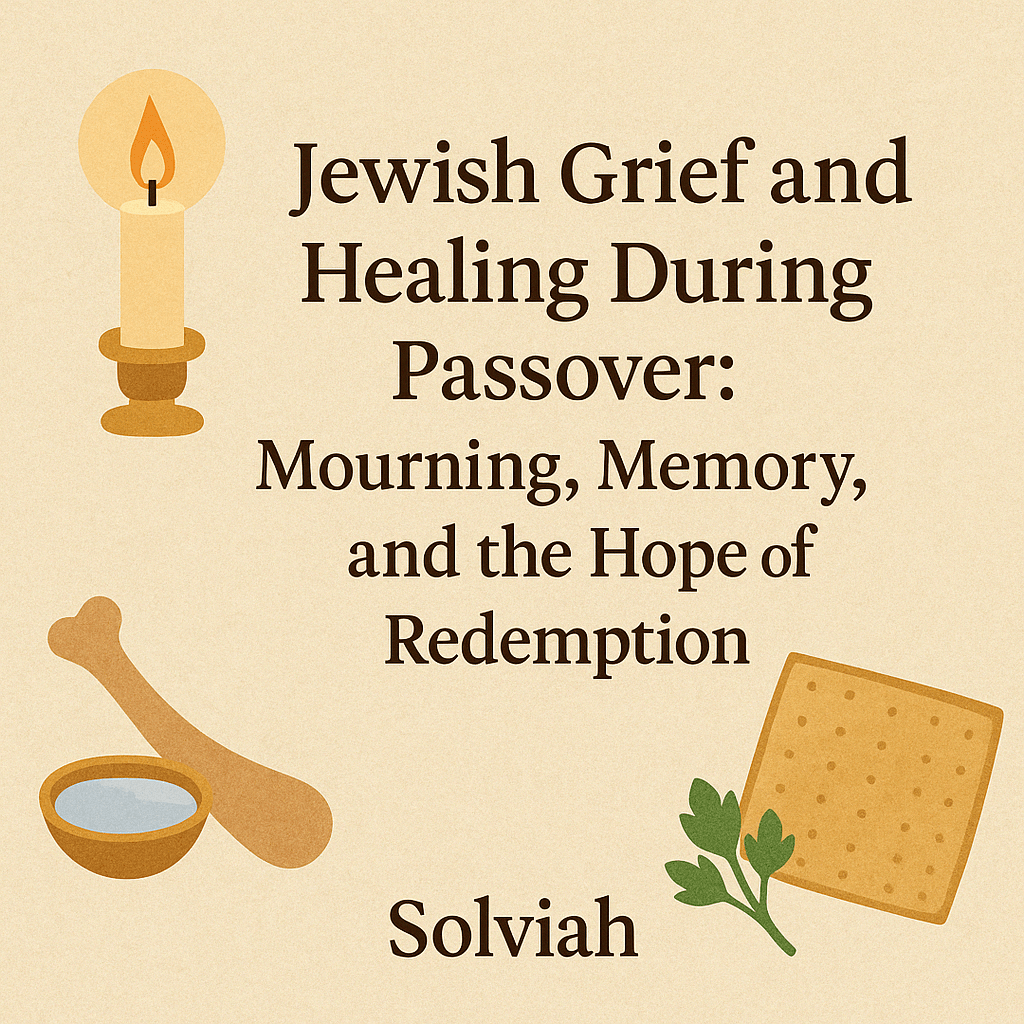
  • Jewish Grief and Healing During Passover: Mourning, Memory, and the Hope of Redemption

    Jewish Grief and Healing During Passover: Mourning, Memory, and the Hope of Redemption

    Passover is a season of liberation. But for many, it arrives bearing the invisible weight of grief. As Jewish families gather to retell the story of Exodus and celebrate divine deliverance, some seats at the table remain heartbreakingly empty. For those mourning during Passover, the ancient rituals of redemption offer both a mirror to their sorrow and a gentle invitation toward spiritual comfort.

    Solviah explores the experience of grief during Passover through the lens of Jewish theology, cultural practice, and sacred memory. We honor the pain of loss, reflect on the eternal hope embedded in Jewish faith, and aim to illuminate the pathways to healing offered by prayer, ritual, and communal remembrance. Even in mourning, Jewish tradition whispers a deeper truth: redemption is not only about history—it is also about healing.


    🕯️ The Sacred Weight of Loss in a Time of Joy

    Passover occurs in the Hebrew month of Nissan—a time traditionally designated for joy. Yet the Torah and Jewish tradition make room for sorrow even within celebration. As Ecclesiastes teaches, “There is a time to mourn and a time to dance” (Ecclesiastes 3:4). The two may live side by side, especially in a faith that has long held paradox as sacred.

    Grieving during Passover can feel isolating. While others rejoice in songs of deliverance, a mourner may feel trapped in their own Egypt—a personal exile of absence and longing. Yet Judaism, unlike many modern cultures, does not shy away from grief. The Psalms cry openly, prophets mourn publicly, and Jewish law upholds a comprehensive system of mourning that dignifies sorrow.


    📜 Jewish Theology on Death, Memory, and Redemption

    Within Jewish theology, death is not an end but a transformation. While beliefs vary across denominations, many Jews affirm the existence of olam ha-ba (the world to come), and techiyat ha-metim (resurrection of the dead). These concepts are not mere doctrines but expressions of a deeper truth: that the soul remains tethered to the divine and to those who love it.

    “The soul of a person is the lamp of God,” writes Proverbs (20:27). This spiritual imagery illuminates the Jewish view of the afterlife—not as distant, but as near, flickering gently in the spaces we remember. Rabbi Jonathan Sacks (2010) reminds us, “Memory in Judaism is a form of redemption. It transforms the past into a source of strength and blessing.”

    The phrase zikhrono livrakha—“may their memory be a blessing”—is not simply a sentiment; it is a theological declaration. It implies that the deceased continues to act in the world through memory, legacy, and love.


    ✡️ Mourning Rituals and Passover Adaptations

    Jewish mourning rituals guide the mourner through phases of grief: aninut (pre-burial grief), shiva (seven days of deep mourning), shloshim (thirty days), and the twelve-month mourning for a parent. During Passover, some elements of mourning are modified—eulogies are often shortened, and public displays of mourning are softened out of respect for the season’s joy (Shulchan Aruch, Orach Chaim 429:1).

    Yet the inner world of grief remains, and the traditions continue to offer structure and support. The recitation of Kaddish during the holiday is a powerful expression of faith in the midst of loss. It affirms God’s greatness, not in spite of death, but through it. As Rabbi Eliezer Berkovits (1983) noted, “To recite Kaddish is to proclaim that life has meaning—even in the face of death.”

    Some mourners may find particular meaning in the bitter herbs of the Seder plate, which recall the pain of slavery in Egypt. These herbs also evoke the sharpness of grief—a visceral reminder that healing does not require forgetting. The symbolic foods of Passover offer a sacred vocabulary for sorrow: the shank bone (loss), the salt water (tears), the matzah (fragility). Together, they form a ritual language that allows grief to be felt and honored.


    🤝 The Healing Power of Community and Ritual

    Grief isolates. Ritual reconnects. Jewish mourning practices emphasize the power of community. From bringing meals during shiva to standing together for the Kaddish, the community holds space for the mourner to be broken—and to begin to heal.

    Passover, with its family-centered structure, may intensify grief, but it can also provide gentle re-entry into communal life. Many families leave an empty chair or say a blessing in memory of the deceased. Others incorporate personal stories, photos, or favorite foods of the departed into the Seder meal. These small acts keep memory alive and sanctify grief as part of the celebration, not an interruption to it.

    Jewish psychologist David Pelcovitz (2020) writes that rituals are crucial for grief recovery. They “create predictability, provide comfort, and offer the bereaved a sense of agency during disorienting times.” The rituals of Passover, from searching for the afikomen to pouring Elijah’s cup, provide sacred structure even for the heart that aches.


    🧠 Psychological Insights and Grief Theory in Jewish Practice

    Modern grief theory—particularly the dual-process model—emphasizes oscillation between loss-oriented and restoration-oriented activities (Stroebe & Schut, 1999). Jewish mourning mirrors this beautifully. During Passover, one may mourn during private prayer but also engage in songs, storytelling, and food preparation. The balance is not only permissible—it is healing.

    Moreover, Judaism embraces the concept of continuing bonds—maintaining a relationship with the deceased through memory, ritual, and shared values. These practices align with contemporary bereavement psychology and offer profound spiritual reinforcement: the love continues.


    🌿 A Blessing for the Grieving During Passover

    If you are grieving during Passover, you are not alone. You walk the ancient path of those who mourned in the wilderness, whose cries rose with the smoke of burnt offerings, whose tears mingled with salt water on the table. There is space for you at the Seder. There is room for grief in the story of redemption.

    May the God who delivered Israel from bondage draw near to your sorrow. May the memory of your loved one shine like the pillar of fire that guided our ancestors through the night. And may you, in time, come to feel again the joy of spring—the whisper of freedom, the promise of renewal.


    📖 References (APA Style)

    Berkovits, E. (1983). Faith After the Holocaust. KTAV Publishing House.

    Kaplan, A. (1997). Jewish Meditation: A Practical Guide. Schocken Books.

    Lamm, M. (1969). The Jewish Way in Death and Mourning. Jonathan David Publishers.

    Pelcovitz, D. (2020). Rituals and resilience in Jewish mourning. Jewish Psychology Journal, 12(1), 42–57.

    Sacks, J. (2010). Future Tense: Jews, Judaism, and Israel in the Twenty-First Century. Schocken Books.

    Shulchan Aruch, Orach Chaim 429:1. (Code of Jewish Law)

    Stroebe, M., & Schut, H. (1999). The dual process model of coping with bereavement: Rationale and description. Death Studies, 23(3), 197–224.

  • How to Organize a Meal Train or Support Circle: Transforming Compassion Into Action After Loss

    How to Organize a Meal Train or Support Circle: Transforming Compassion Into Action After Loss

    When someone you love is grieving, the ache you feel alongside them can be paralyzing. You want to do something—but what? The fear of saying the wrong thing or intruding often leads many to say, “Let me know if you need anything,” and leave it at that. But grief is heavy, disorienting, and isolating. It requires not just good intentions but a circle of care.

    This guide is here to empower you with practical, kind, and profound ways to help. Whether you’re organizing a meal train, gathering support for daily tasks, or simply showing up, your love can become a lifeline.

    Why This Matters: The Sacred Power of Showing Up

    Grief doesn’t just hurt—it deconstructs. Basic tasks like eating, answering texts, or making decisions feel impossible. According to Worden (2018), one of the most healing influences during bereavement is consistent, compassionate support—especially from a trusted circle.

    Organizing a meal train or support circle helps answer one essential need: “You are not alone.”

    “Grief needs a witness, not a solution.”

    Step-by-Step: How to Organize a Meal Train or Support Circle

    Step 1: Ask First. Always.

    • Before launching into action, gently ask the grieving person if they’re open to receiving help.
    • Ask about dietary preferences, allergies, cultural practices, and delivery timing.
    • Clarify drop-off preferences (in-person vs. contactless).
    • Offer the option for anonymity if they feel embarrassed to receive help.

    Step 2: Choose a Grounded Coordinator

    • Choose someone empathetic and organized to manage schedules and communication.
    • Use tools like MealTrain.com or Lotsa Helping Hands.
    • Ensure the coordinator is prepared to adjust plans as needed.

    Step 3: Create Gentle Structure

    • Include drop-off instructions, meal sizes, labeling guidelines, and calendar visibility.
    • Set up a communication channel for reminders and gratitude updates.
    • Keep the structure flexible, but consistent.

    Step 4: Support Beyond the Plate

    • Include options for childcare, pet care, errands, and house tasks.
    • Offer spiritual or emotional support, if welcome, like prayers or peaceful companionship.
    • Prepare for long-term needs—support doesn’t end after the first month.

    Do’s and Don’ts for Helping a Grieving Friend

    Do:

    • Show up consistently (even months later).
    • Listen without judgment or solutions.
    • Be specific in what you offer.
    • Respect their need for privacy and space.

    Don’t:

    • Say “I know how you feel.”
    • Offer quick-fix advice or platitudes.
    • Disappear after the funeral.
    • Forget important milestones, like holidays or anniversaries.

    What to Say Instead of “Let Me Know”

    Grieving people often feel emotionally and mentally exhausted. Offer help in concrete ways:

    “I’m bringing dinner on Thursday. Is lasagna okay, or would you prefer something lighter?”

    “Can I take your trash cans to the curb on Fridays for the next month?”

    “Would it help if I handled school drop-offs next week?”

    What If They Say No? How to Respect Space and Still Offer Love

    If they decline help, that’s okay. Respect their space while keeping the door open:

    “I completely understand. I’ll check back next week, just in case anything shifts. I’m here whenever you’re ready.”

    Drop off a note or card that says, “You don’t have to respond. Just know you’re loved.”

    Going Deeper: Grief Is a Marathon, Not a Sprint

    Mark these key dates to check in again:

    • One month after the death
    • First holidays and birthdays without the loved one
    • Three-month and six-month marks

    Send a message or small token that says:

    “Still holding you in my heart today.”

    The Quiet Presence Gesture

    Sometimes, silence is the kindest offering. Offer to simply sit with them:

    “I can come by and just sit with you for a while. No talking needed—unless you want to.”

    Studies show that shared quiet presence can ease loneliness and reduce stress responses (Bonanno & Burton, 2013).

    Conclusion: Your Hands Can Hold More Than You Think

    Grief is too heavy for one person to carry alone. By organizing a meal train or support circle, you become part of something sacred: a community of presence.

    You don’t need the perfect words or fancy meals. Just show up with love, follow through with intention, and remember—your kindness echoes longer than you know.

    “Love is a verb. Grief responds to action.”

    Share This With Others

    Know someone who wants to help but doesn’t know how? Share this guide with them and remind them: even small gestures matter. Let’s build circles of care, one meal at a time.


    References

    • Bonanno, G. A., & Burton, C. L. (2013). Regulatory flexibility: An individual differences perspective on coping and emotion regulation. Perspectives on Psychological Science, 8(6), 591–612. https://doi.org/10.1177/1745691613504116
    • Neimeyer, R. A., Klass, D., & Dennis, M. R. (2014). Toward a social constructionist account of grief: Loss and the narration of meaning. Death Studies, 38(8), 485–498. https://doi.org/10.1080/07481187.2014.913454
    • Worden, J. W. (2018). Grief Counseling and Grief Therapy: A Handbook for the Mental Health Practitioner (5th ed.). Springer Publishing Company.
  • When the Heavens Speak (April 2025): Biblical Signs, Good Friday, and Christian Comfort in Grief

    When the Heavens Speak (April 2025): Biblical Signs, Good Friday, and Christian Comfort in Grief

    On this Good Friday, April 18, 2025, many will look to the Cross in remembrance of Christ’s suffering. But fewer may look to the sky. And yet the sky is telling a story too—a story not of fate, but of divine timing. For those walking through grief, loss, or spiritual disorientation, the heavens offer not superstition, but sacred affirmation: God sees, God speaks, and God saves.

    This article explores Biblical Astronomy, not astrology, as a way for grieving hearts to witness how the cosmos declares not just God’s glory—but also His comfort.


    What Is Biblical Astronomy (and What It’s Not)

    Biblical Astronomy is the theological reflection on celestial signs (sun, moon, stars, constellations, and seasons) as recorded and affirmed in Scripture. It is rooted in passages like Genesis 1:14:

    “Let there be lights in the expanse of the heavens… and let them be for signs and for seasons.”

    Importantly, Biblical Astronomy is not astrology. Scripture prohibits using the stars to control, predict, or manipulate outcomes (Isaiah 47:13-14; Deuteronomy 18:10-12). Astrology centers on self. Biblical Astronomy centers on God’s revelation.


    Biblical Justification for Signs in the Heavens

    Throughout Scripture, God uses the heavens as a clock, a calendar, and a cosmic choir to announce His movements. Consider:

    • Psalm 19:1: “The heavens declare the glory of God; the skies proclaim the work of his hands.”
    • Joel 2:31: “The sun will be turned to darkness and the moon to blood before the coming of the great and dreadful day of the LORD.”
    • Matthew 2: The Magi followed a star to find Jesus.
    • Luke 23:44-45: At the death of Jesus, “darkness came over the whole land… for the sun stopped shining.”

    Even Jesus tells us in Luke 21:25:

    “There will be signs in the sun, moon and stars.”

    God doesn’t just speak through Scripture—He synchronizes His messages with creation.


    Good Friday 2025: What the Sky Is Saying

    This year, Good Friday coincides with a partial lunar eclipse visible across parts of the world. The moon, often a symbol of the Church and the reflection of God’s light, will be partially shadowed—a poignant image for a day remembering Christ’s death.

    More notably, Jupiter (symbolic of kingship), Mars (sacrifice), and Saturn (testing) converge in Pisces—the ancient Christian constellation long associated with the early Church.

    As Dr. Michael Heiser explains, “Ancient peoples saw the heavens as a divine map, pointing toward the authority and activity of the unseen God.” (The Unseen Realm, 2015)


    Grief and the Stars: Spiritual Comfort After Death

    When someone dies, it often feels as if time stands still. The stars, however, remind us: God’s time is eternal and we are part of a larger narrative.

    “He heals the brokenhearted and binds up their wounds. He determines the number of the stars and calls them each by name.” —Psalm 147:3–4

    For the grieving parent, widow, friend, or child, the sky offers this whisper: You are not forgotten. Your pain is not wasted.

    Theologian Thomas Long describes Christian funerals not as endings, but transitions: “In grief, we tell the truth—death is real. But so is resurrection. So is Christ. So is reunion.”

    We do not look to the sky for signs of fate, but to remember the faithfulness of God.


    Christian Cosmology: A Theological Universe

    From Job’s cries to Revelation’s visions, the Bible paints the cosmos not as cold space, but a sacred space filled with worship and wonder. Stars are not impersonal—they’re part of God’s created liturgy.

    • Job 38:7: “When the morning stars sang together.”
    • Revelation 22:16: “I, Jesus… am the bright Morning Star.”
    • Isaiah 40:26: “Lift up your eyes on high and see: who created these?”

    Even the Magi, who weren’t Jewish, recognized the birth of Jesus through celestial observation—a reminder that God draws all people through His creation.


    A Call to Trust—and to Jesus

    For those grieving, it can feel as if God is silent. But creation still speaks.

    Look at the moon on this Good Friday—it darkens, just as the world darkened when Christ died. But that same moon will shine again, just as Christ rose again.

    “I am the resurrection and the life. The one who believes in me will live, even though they die.” —John 11:25

    If you are grieving today and don’t yet know Jesus, let this be your invitation—not into religion, but into relationship. The God who placed the stars also knows your name, your sorrow, and your story.

    Jesus died not only to comfort the broken—but to heal them and welcome them into eternal life.


    Practices for Grievers Looking Upward

    Try one of these grief-aligned spiritual practices under the stars tonight:

    • Stargazing in Prayer: Bring your questions. Ask God to reveal His comfort.
    • Grief Journal Entry: “What do I feel when I see the stars? Where is God in my loss?”
    • Psalm 8 Meditation: “When I look at the heavens… what is man that you are mindful of him?”
    • Make a Covenant: As Abraham did—mark this Good Friday with a promise to trust God again.

    Conclusion: A Soul-Nourishing Reflection

    This Good Friday, look to the Cross—but also look to the sky.

    “There is a time for everything… a time to be born and a time to die.” —Ecclesiastes 3:1
    “But our citizenship is in heaven. And we eagerly await a Savior from there.” —Philippians 3:20

    To the grieving: You are not alone in this loss. The God who commands the stars still commands time—and you are held in His hands.

    To the questioning: Jesus not only died for your sins—He rose to give you eternity. Receive Him. Trust Him.

    To all: See the stars not as fate, but as reminders of God’s eternal promises.


    References (AMA Style):

    1. Ross H. The Creator and the Cosmos. 4th ed. NavPress; 2018.
    2. Heiser M. The Unseen Realm. Lexham Press; 2015.
    3. Lisle J. Taking Back Astronomy. Master Books; 2006.
    4. Long T. Accompany Them with Singing. Westminster John Knox Press; 2009.
    5. Root A. The Grace of Dogs. Convergent Books; 2017.
  • Crafting Meaningful Memorial Keepsakes: What to Consider

    Crafting Meaningful Memorial Keepsakes: What to Consider

    Creating a Lasting Legacy

    Honoring a loved one’s life through memorial keepsakes is an act of profound significance. Keepsakes encapsulate memories, preserve legacies, and provide emotional comfort to those left behind. By thoughtfully choosing or crafting personalized tributes, you celebrate unique personalities, passions, and the meaningful impact of their lives.

    1. Personalized Memorial Jewelry

    Personalized jewelry offers intimacy and daily remembrance:

    • Cremation Jewelry: Pendants or bracelets holding ashes provide closeness and comfort.
    • Fingerprint Jewelry: Rings or pendants engraved with a loved one’s fingerprint preserve individuality.
    • Birthstone Accents: Birthstone jewelry commemorates their life subtly and beautifully.

    Memorial jewelry fosters a sense of continued connection, assisting in emotional healing by providing tangible comfort during grief (Neimeyer & Thompson, 2014).

    2. Memory Books and Narrative Preservation

    Compiling stories, photos, letters, and cherished anecdotes into memory books helps retain vibrant life narratives:

    • Involve friends and family to gather diverse perspectives and stories.
    • Include significant life milestones, humorous memories, and personal achievements.

    Storytelling and narrative preservation can significantly alleviate grief by enabling mourners to integrate loss into their ongoing life narratives, enhancing emotional recovery (Bosticco & Thompson, 2005).

    3. Digital Memorials: Global Accessibility

    Modern digital memorials extend remembrance into the digital age:

    • Tribute Websites: Permanent online spaces where memories, messages, and photos can be shared.
    • Social Media Memorials: Transform existing profiles into ongoing memorial pages.
    • Interactive Digital Albums: Curate digital photo collections reflecting memorable life events.

    Digital memorials encourage communal participation, allowing geographically distant mourners to experience collective mourning and emotional validation (Walter et al., 2012).

    4. Cultural Traditions: Honoring Ancestral Roots

    Respectfully incorporating cultural customs deepens memorial experiences:

    • Qingming Festival (China): Families honor ancestors through grave cleaning, offerings, and remembrance.
    • Dia de los Muertos (Mexico): Joyful altars with symbolic offerings celebrate the deceased.
    • Bon Festival (Japan): Lantern-lighting ceremonies symbolize guiding spirits back to peace.

    Engaging in cultural traditions helps maintain communal ties, cultural identity, and provides structured emotional expression during mourning.

    5. Eco-Friendly Memorials: Sustainable Remembrance

    Environmentally-conscious memorials embody life continuation:

    • Memorial Trees: Biodegradable urns that grow into trees create living memorials.
    • Ocean Memorial Reefs: Coral reefs created from ashes help rejuvenate marine ecosystems.
    • Seed Paper Memorials: Keepsakes embedded with wildflower seeds symbolize new growth and rebirth.

    Eco-friendly memorials not only honor loved ones but also facilitate emotional healing by symbolizing renewal and ongoing life, enhancing personal and environmental wellbeing.

    6. Artistic Memorials: Visual and Tactile Remembrance

    Artistic memorials transform memories into enduring art forms:

    • Commissioned Portraits: Paintings capturing unique personal expressions.
    • Memory Quilts: Textile art made from clothing or fabrics associated with meaningful memories.
    • Glass Art Keepsakes: Ashes beautifully integrated into glass sculptures or ornaments.

    Artistic expression can greatly aid emotional processing by channeling grief creatively, offering both symbolic and therapeutic benefits (Stroebe & Schut, 2010).

    7. Community Memorial Initiatives

    Memorializing a loved one through community engagement creates impactful legacies:

    • Charitable Contributions: Organize events benefiting causes meaningful to the deceased.
    • Memorial Scholarships: Fund educational opportunities in their honor.
    • Annual Remembrance Events: Gather annually to celebrate and reflect on their life impact.

    Community-driven memorials foster collective remembrance, strengthening social support networks crucial for emotional resilience during bereavement.

    Uplifting Quote

    “The life of the dead is placed in the memory of the living.” – Marcus Tullius Cicero

    Closing Tip: Celestial Memorials

    A unique yet profoundly meaningful option is celestial memorials, launching ashes into space. This extraordinary tribute symbolizes the infinite influence and timeless legacy your loved one leaves behind.

    Read more legacy celebration ideas to continue discovering deeply personal ways to honor and celebrate your loved one’s enduring impact.

    References

    1. Bosticco, C., & Thompson, T. L. (2005). Narratives and story telling in coping with grief and bereavement. Omega-Journal of Death and Dying, 51(1), 1-16.
    2. Neimeyer, R. A., & Thompson, B. E. (2014). Meaning making and the art of grief therapy. In Grief and Bereavement in Contemporary Society (pp. 139-152). Routledge.
    3. Stroebe, M., & Schut, H. (2010). The dual process model of coping with bereavement: A decade on. Omega-Journal of Death and Dying, 61(4), 273-289.
    4. Walter, T., Hourizi, R., Moncur, W., & Pitsillides, S. (2012). Does the Internet change how we die and mourn? Overview and analysis. Omega-Journal of Death and Dying, 64(4), 275-302.

  • Understanding Death Certificates and Why They Matter: Navigating the Legal & Financial Steps After a Loved One’s Death

    Understanding Death Certificates and Why They Matter: Navigating the Legal & Financial Steps After a Loved One’s Death

    Clarity in Times of Grief

    Losing a loved one brings emotional turbulence that can leave families feeling overwhelmed and confused. Amid the grief, there’s often significant stress around unfamiliar paperwork, complex financial responsibilities, and daunting legal requirements. Among these, the death certificate is an essential yet frequently misunderstood document—crucial for settling an estate, navigating probate processes, managing funeral costs, and providing a clear legal closure to a loved one’s affairs.

    This guide empowers you to understand what death certificates are, why they matter, and how to navigate the steps that follow a loss — ensuring you can move forward with confidence and clarity.

    What Exactly is a Death Certificate?

    A death certificate is an official legal document issued by a government agency — usually the vital records department in the deceased’s state or locality. It contains key information about the person who passed, including:

    • Full legal name
    • Date, place, and cause of death
    • Date and place of birth
    • Social Security number (often partial, for security reasons)
    • Names of parents (including mother’s maiden name)
    • Occupation and marital status at the time of death
    • Certifying official (coroner, physician, or medical examiner)

    Expert Insight: The CDC highlights that death certificates are vital not just for individual families, but also for public health data, shaping healthcare policies and mortality research (Centers for Disease Control and Prevention [CDC], 2023).

    Why is a Death Certificate So Crucial?

    1. Settling an Estate and the Probate Process

    A death certificate is required by probate courts as an official confirmation of death, enabling the legal transfer of assets. Without it, beneficiaries cannot legally inherit property, money, or possessions.

    Probate Process Simplified:

    • Court validates the will or identifies heirs (if no will).
    • Assets and debts are inventoried.
    • Outstanding debts and funeral costs are paid.
    • Remaining assets distributed to heirs.

    Legal Reference: The American Bar Association confirms that a certified death certificate is mandatory to begin probate proceedings (American Bar Association, 2023).

    2. Claiming Financial Assets and Life Insurance

    Financial institutions and insurers require certified death certificates before releasing funds. This document proves the legitimacy of claims for:

    • Life insurance policies
    • Bank and retirement accounts
    • Investment portfolios and pensions

    Tip: Delay in obtaining certificates can significantly postpone these financial transactions, potentially causing hardship for dependents.

    3. Closing Accounts and Managing Debts

    You’ll need certified copies to manage the deceased’s ongoing responsibilities:

    • Closing bank accounts and credit cards
    • Transferring property titles
    • Ending utility services
    • Notifying Social Security to stop payments and prevent fraud

    Insight: Unaddressed accounts risk identity theft or financial loss.

    4. Applying for Government and Survivor Benefits

    Survivors may qualify for crucial financial assistance. A death certificate helps secure:

    • Social Security survivor benefits
    • Veteran benefits
    • Medicare and Medicaid adjustments
    • Federal and state tax filings (final tax returns)

    How to Obtain a Death Certificate

    Usually, the funeral home or mortuary assists families by requesting certified copies. However, you can independently obtain them from your local vital records office.

    Typical Requirements:

    • Proof of your relationship (ID, marriage/birth certificates)
    • Fee payment ($5-$25 per copy depending on location)
    • Processing time varies (3 days to several weeks)

    Recommended Quantity: Experts advise ordering 10-15 copies initially to avoid delays in handling various administrative tasks (National Funeral Directors Association [NFDA], 2024).

    Helpful Resource: Locate your state’s vital records office through the CDC: https://www.cdc.gov/nchs/w2w/index.htm

    Handling Errors or Corrections on a Death Certificate

    Mistakes can happen. Incorrect information (like misspellings or incorrect dates) can severely complicate or delay the estate-settling process.

    How to Correct Mistakes:

    • Contact issuing office immediately.
    • Provide required documentation proving the correct information.
    • Submit notarized affidavits if required.

    Professional Advice: Financial advisors emphasize correcting errors promptly to prevent significant delays in settling financial claims (Social Security Administration [SSA], 2023).

    Deeper Insight: Emotional Significance of Death Certificates

    Beyond legal and financial significance, a death certificate symbolizes closure—an official recognition of a loved one’s life and passing. The document becomes a tangible reminder of their legacy and the necessary, though difficult, transitions families must make.

    One Extra Insight: Digital Life and Legacy Management

    Most people overlook the necessity of managing the deceased’s digital legacy. Online profiles, financial apps, cloud storage, cryptocurrency wallets, and social media platforms often require proof of death to close or memorialize accounts.

    Key Platforms to Check:

    • Google (Inactive Account Manager)
    • Facebook (Memorialization settings)
    • Apple ID and Cloud accounts

    Conclusion: Empowerment through Understanding

    Navigating legal and financial processes after a death doesn’t have to feel overwhelming. By clearly understanding the pivotal role a death certificate plays, families can approach these tasks systematically and thoughtfully—making a complex time simpler and more manageable.

    Recognize this process as an essential part of honoring your loved one’s life, providing practical closure as you journey toward emotional healing.

    Need More Help?

    Explore our comprehensive Legal & Financial Library for practical resources, step-by-step checklists, downloadable guides, and expert articles designed to support you every step of the way.

    Visit Our Full Legal & Financial Library

    References

    1. American Bar Association. (2023). The Probate Process: Step-by-step guide. Retrieved from https://www.americanbar.org/groups/real_property_trust_estate/resources/estate_planning/the-probate-process/
    2. Centers for Disease Control and Prevention (CDC). (2023). Death Certificates. Retrieved from https://www.cdc.gov/nchs/death.htm
    3. National Funeral Directors Association (NFDA). (2024). Death Certificates: What You Need to Know. Retrieved from https://www.nfda.org/consumer-resources/planning-a-funeral/death-certificates
    4. Social Security Administration (SSA). (2023). Reporting a Death to Social Security. Retrieved from https://www.ssa.gov/benefits/survivors/
  • Why Grief Looks Different for Everyone: Understanding Unique Grief Responses and Finding Your Path to Healing

    Why Grief Looks Different for Everyone: Understanding Unique Grief Responses and Finding Your Path to Healing

    “Grief, I’ve learned, is really just love. It’s all the love you want to give but cannot. All that unspent love gathers in the corners of your eyes, the lump in your throat, and the hollow part of your chest.” — Jamie Anderson

    Grief is universal, yet deeply personal. It weaves itself into the fabric of our lives differently for everyone. Whether it’s the loss of a loved one, a life-altering diagnosis, or the end of a cherished relationship, grief shows up in unexpected ways. Some cry daily, others become numb. Some dive into work, others can’t get out of bed. And that’s okay.

    Why Everyone Grieves Differently

    Grief is shaped by a constellation of factors: the nature of the loss, personality, attachment style, mental health history, support systems, spiritual beliefs, and even cultural upbringing.

    Even within families, two siblings mourning the same parent may have entirely different emotional reactions based on their role in the family, closeness with the deceased, and previous life experiences.

    Grief also varies across time. Someone may feel like they’re coping well, only to be blindsided by a wave of sadness months—or years—later.

    Breaking the Myth of the “Five Stages”

    Modern grief psychology urges us to reject the idea of neat, sequential stages. Instead, grief is nonlinear. You may bounce between emotions, revisit some, or never experience others. And that doesn’t mean you’re grieving wrong.

    Psychological Insights: What the Research Says

    • Resilience is more common than we think. Bonanno and Kaltman (2001) found that many bereaved individuals maintain stable mental health and functioning, experiencing moments of grief without becoming incapacitated by it.
    • We oscillate between loss and restoration. Stroebe, Schut, and Boerner (2017) describe the Dual Process Model, in which grievers alternate between confronting their loss and focusing on everyday life.
    • Making meaning supports healing. Neimeyer, Klass, and Dennis (2014) emphasized that those who engage in meaning-making—like creating rituals, journaling, or telling stories about the deceased—experience deeper, more integrated healing.
    • Grief is not an illness. Therapist Megan Devine reminds us, “Grief is not a problem to be solved; it’s an experience to be carried.”

    Therapeutic Coping Strategies That Honor Individual Grief

    1. Try Expressive Writing

    Backed by: Pennebaker & Beall, 1986

    Writing about your emotions helps process trauma, reduce rumination, and regulate your nervous system.

    Journal Prompt: What would you say to your loved one if you had one more day with them? Write without editing, judgment, or worrying about grammar.

    2. Practice Mindful Breathing

    Mindfulness helps anchor you during moments of emotional overwhelm and physical distress.

    Box Breathing Technique:

    • Inhale for 4 counts
    • Hold for 4 counts
    • Exhale for 4 counts
    • Hold for 4 counts

    Repeat for 3–5 minutes.

    3. Join a Grief Support Group

    Support groups normalize your experience and offer empathy from those who understand.

    Try:

    • GriefShare.org
    • Local hospice or spiritual centers
    • Online forums like Reddit’s r/griefsupport

    4. Engage in Meaning-Making Activities

    Creating something that honors your loss can transform grief into legacy.

    Ideas:

    • Start a memory garden
    • Create an annual tradition
    • Make a scrapbook or photo album
    • Volunteer in your loved one’s name

    Recommended Reading: Kessler, D. (2019). Finding Meaning: The Sixth Stage of Grief

    Honoring Grief’s Diversity

    There’s no “right way” to mourn. Some people cry every morning. Others throw themselves into work. Some need quiet. Others need company. All of it is valid.

    A Deeper Kind of Healing

    Grief doesn’t end—it evolves. It becomes part of your story, your strength, your soul. Healing after loss means creating space for sorrow and joy to coexist.

    References

    • Bonanno, G. A., & Kaltman, S. (2001). The varieties of grief experience. Clinical Psychology Review, 21(5), 705–734.
    • Jordan, J. R., & Neimeyer, R. A. (2003). Does grief counseling work?. Death Studies, 27(9), 765–786.
    • Neimeyer, R. A., Klass, D., & Dennis, M. R. (2014). A social constructionist account of grief: Loss and the narration of meaning. Death Studies, 38(6), 485–498.
    • Pennebaker, J. W., & Beall, S. K. (1986). Confronting a traumatic event: Toward an understanding of inhibition and disease. Journal of Abnormal Psychology, 95(3), 274–281.
    • Stroebe, M., Schut, H., & Boerner, K. (2017). Cautioning health-care professionals: Bereaved persons are misguided through the stages of grief. Omega: Journal of Death and Dying, 74(4), 455–473.