Honoring Life, Embracing Memories

Category: Funeral Planning 101

Whether you’re pre-planning or navigating arrangements after a loss, this section offers clear, compassionate guidance for every step. From choosing the type of service to understanding burial options and etiquette, these articles are designed to simplify the process and help you make informed, meaningful decisions.

  • Unexpected Funeral Costs: What Most Families Forget to Budget For

    Unexpected Funeral Costs: What Most Families Forget to Budget For

    A calm, clear guide for emotionally overwhelmed first-time planners

    🌿 If You’re Overwhelmed, Breathe

    Whether you just lost a parent, partner, or child—you might be staring at a list of things to do and wondering: How am I supposed to plan a funeral when I can’t even make breakfast?

    You are not failing. You are grieving. And you’re doing your best.

    Take a deep breath. Count to five with me: one… two… three… four… five.
    Now exhale slowly. You’re not alone. Let’s take this one step at a time.

    Back to Top

    📘 Before the Funeral: Emotional Planning & Hidden Costs

    This is the phase where things move quickly—and overwhelm is common. You don’t have to do it all today. Let’s slow down and walk through the pieces together.

    Many decisions need to be made quickly, especially in the first 24–48 hours. This list will help you gently prioritize what matters most right now.

    What may come up sooner than expected:

    • Choosing a funeral home
    • Transportation of the body
    • Ordering multiple death certificates (CDC, 2022)
    • Burial vs. cremation decisions
    • Checking for pre-paid arrangements or insurance
    • Notifying next of kin, workplaces, or spiritual leaders

    Hidden Costs:

    Item Why It’s Overlooked
    Death certificates Most families need 6–10 for banks, accounts, and claims
    Clothing for the deceased Not always included or provided by the funeral home
    Immediate transport fees Often separate from full-service packages
    Translation or emergency document help Especially for international or legal cases
    “You’ll need the death certificate for everything from bank accounts to utility bills.” — CDC, 2022

    Reflection: Is there one decision you feel clear about right now? That’s your starting point. Don’t try to answer everything at once.

    ✅ Before-the-Funeral Checklist

    • Choose a funeral home & request a General Price List
    • Confirm burial or cremation
    • Request 6–10 death certificates
    • Gather insurance, ID, and essential legal papers
    • Start obituary draft or tribute materials
    • Notify family and delegate where possible

    See Legal & Financial Matters

    Back to Top

    🕯️ During the Funeral: Ceremony, Support & Holding It Together

    This is the phase where you carry the weight—of schedules, emotions, and expectations. It’s okay to feel like it’s too much. You’re not alone in this.

    If you’re reading this, you’re probably managing the whole service—while still grieving. Be gentle with yourself.

    Often-Forgotten Expenses:

    • Venue rental (if not at the funeral home)
    • Clergy or speaker honorarium
    • AV tech for music, slideshows, or livestreams
    • Printed programs or memory cards
    • Flowers, catering, and reception supplies
    “The average cost of a traditional funeral is $8,300—but can rise to $12,000+ depending on services.” — NFDA, 2023

    Reflection: Who can help with one thing—music, guest communication, printing? Let someone walk with you.

    See Honoring a Life

    Back to Top

    🕊️ After the Funeral: Quiet Moments and Lingering Tasks

    Things may settle down—but loose ends can stretch out. You don’t have to resolve them all at once.

    Post-Funeral Costs That Surprise Many:

    • Headstone or grave marker
    • Obituary printing or placement fees
    • Grief counseling (individual or family)
    • Belongings, storage units, or home downsizing
    • Memorial keepsakes, jewelry, or photo albums

    Reflection: What is one small act of peace you can offer yourself this week—a walk, a call, a bath? Even 10 minutes counts.

    See Grief & Healing

    Back to Top

    🤍 For Supporters and Friends: What to Say, Do, and How Much

    Your care matters more than your perfection. The goal is to help without overwhelming.

    Supportive Actions:

    • Offer task-based help (“Can I create the slideshow?”)
    • Volunteer to communicate on their behalf
    • Create a music playlist, gather photos, or manage RSVPs
    • Send check-ins weeks after the service ends

    Things to Avoid:

    • Taking over or giving unsolicited advice
    • Filling silence with explanations or religious phrases
    • Forcing conversations or quick replies

    Reflection: What small kindness can you offer today—with no strings attached?

    See For Supporters & Friends

    Back to Top

    Looking for a Calm Companion to Help You Plan?

    Soon, we’ll be offering free printable tools to help you navigate grief and logistics—one small step at a time.

    No downloads or email signups required right now, just peaceful support when you need it.

    💬 Share Your Voice

    You’ve made it this far—and that’s something. You’re walking through grief and logistics with strength you may not even feel yet.

    What helped you most during this process?
    What do you wish someone had told you earlier?

    Please share in the comments—your story may help someone else find light in their own dark hour.

    Explore More:
    Grief & Healing |
    Legal & Financial Matters |
    Honoring a Life |
    Culture & Spirituality
    Back to Top

  • Burial or Cremation: How to Choose What’s Right for Your Family

    Burial or Cremation: How to Choose What’s Right for Your Family

    Burial or Cremation: How to Choose What’s Right for Your Family

    A compassionate guide for families navigating funeral choices in times of loss.

    Take a Breath
    If you’ve just lost someone, your world may feel upside down.
    Before we go any further, please pause. Breathe. You don’t need to have all the answers right now.

    A Gentle Place to Begin

    You’re not just making a logistical choice. You’re honoring a life.

    Factor Burial Cremation Green Burial / Alternatives
    Spiritual Traditional faiths Flexible, simple Naturalistic, sacred
    Emotional Place to visit Portable memorial Organic, healing
    Financial Highest cost Affordable Moderate
    Environmental Embalming/caskets Moderate impact Low impact

    Reflection Prompt: What choice brings your heart the most peace—and honors theirs?

    Burial Options

    • Traditional Burial: Casketed, interred in a cemetery.
    • Direct Burial: Simpler burial without a service.
    • Green Burial: Biodegradable and chemical-free.
    • Burial at Sea: Permitted with regulation.
    • Burial of Ashes: In urn gardens or columbarium.
    • Aquamation: Water-based cremation alternative.

    Explore: Culture & Spirituality

    Cremation Options

    Cremation can be followed by a viewing, memorial, or scattering ceremony. Families often choose it for flexibility and lower cost.

    Reflection Prompt: Would flexibility help your family gather and grieve more meaningfully?

    Cost Overview

    Service Type Average Cost (USD)
    Traditional Burial (Viewing) $7,900
    Direct Burial (No Service) $2,800
    Cremation + Memorial $5,500
    Direct Cremation $2,300

    Source: National Funeral Directors Association (NFDA, 2023)

    What If Your Family Disagrees?

    Let this article open the door to a gentle conversation. Disagreement is common and natural. Everyone grieves differently.

    Reflection Prompt: Could sharing this article help open space for compassion?

    Checklist: What to Do

    • Get death certificate
    • Check legal documents or wishes
    • Choose a provider and compare quotes
    • Decide on cremation, burial, or alternative
    • Plan memorial or service
    • Notify friends and family
    • Begin paperwork and closure tasks

    Explore: Legal & Financial

    Explore: Honoring a Life

    After the Funeral

    Allow yourself time. Time to grieve. Time to process. Time to remember.

    • Create a digital tribute
    • Plant a tree or host a second gathering
    • Begin healing with others or a counselor

    Explore: Grief & Healing

    If You’re Still Unsure, This Is Enough

    You don’t have to rush. You don’t have to get it perfect. You just have to move with love and care.

    Share this article with your family. It might be the resource that helps everyone feel heard.

    Have experience with this decision? Share your thoughts in the comments. Your story may ease someone’s burden.

    You can also send this article to your family to help make the decision together.

    Need more support?
    Explore our Funeral Planning Library for gentle, step-by-step guidance and printable tools.

    References

    • National Funeral Directors Association. (2023). 2023 Cremation & Burial Report. Retrieved from nfda.org
    • Federal Trade Commission. (2023). Your Rights Under the Funeral Rule. Retrieved from consumer.ftc.gov
    • Centers for Disease Control and Prevention. (2020). FastStats: Deaths and Mortality. Retrieved from cdc.gov
  • What to Do When Someone Dies: First 48 Hours and Creative Guest Book Alternatives for Funerals

    What to Do When Someone Dies: First 48 Hours and Creative Guest Book Alternatives for Funerals


    When the World Changes in an Instant

    The call came at 2:13 a.m.
    “They’re gone.”

    You hear it, but the world around you remains strangely intact. The toothbrush still sits by the sink. The coffee mug remains on the counter.

    Everything looks the same, but nothing feels the same.

    If you’re reading this, you are already doing something brave.
    Pause. Breathe. ❤️
    You are not doing this wrong.

    This guide walks gently with you through the emotional fog and the small first steps after loss — offering comfort, clarity, and remembrance.


    First Steps After Death: What Happens in the First 48 Hours

    (based on Social Security Administration, hospital bereavement protocols, and hospice guidelines)

    No matter where death occurs — at home, in a hospital, at work, or in public — the first steps stay rooted in respect, small actions, and breathing space.

    If expected, hospital or hospice staff will assist with paperwork.
    If sudden or public, emergency services and often the coroner will step in first.

    First 24 Hours

    • Obtain a Legal Pronouncement of Death — Needed for all steps that follow (Centers for Medicare & Medicaid Services, 2022).
    • Notify Immediate Family or Trusted Friends — Start small. You don’t have to tell everyone at once.
    • Secure Property and Pets — Lock the home, collect mail, arrange temporary care if needed.

    Learn more about Funeral Planning 101 here.


    The “First 3 Days” Checklist ✅

    • ✅ Obtain legal death pronouncement
    • ✅ Contact close family and friends
    • ✅ Choose and contact a funeral home or cremation provider
    • ✅ Gather documents (passport, birth certificate, will)
    • ✅ Request multiple death certificates
    • ✅ Secure the home, mail, pets, and valuables

    Tip: If you can only complete one thing today, that is enough. You are not behind.

    Visit Grief & Healing | Visit For Supporters & Friends


    Case Study: Her Mom Passed Unexpectedly. Here’s What Happened Next

    Anna’s mom died suddenly during a routine surgery.

    At 4 a.m., Anna sat frozen in the kitchen, staring at the refrigerator, paralyzed.

    “Let’s start with just one thing,” a family friend said.
    “We’ll call the hospital together.”

    That first call was enough. Later, they secured her mother’s home, contacted a funeral provider, and sent a group message: “Anna needs time. We’ll update you soon.”

    There is no perfect way to move through this. Only your way.


    Timeline: When to Do What ⏳

    Timeframe Actions
    First 12 Hours Obtain legal death pronouncement
    First 24 Hours Contact immediate family/friends
    24–48 Hours Arrange funeral home or cremation provider
    By Day 2 Notify Social Security Administration, employer, insurance
    By Day 3 Secure documents, finalize service or memorial plans

    Explore Culture & Spirituality


    ✨ Pause Here: A Moment to Breathe

    Place your hand over your heart.
    Take one slow breath in. Hold. Release.
    ✨ You are doing enough. ✨


    Organizing Affairs After Death: Honoring Memories

    Choosing how guests share their memories is a tender decision.

    A traditional guest book is a beautiful, time-honored choice.
    Many families also explore creative alternatives for more personal storytelling.
    Here are a few ideas — and remember, you can create whatever feels most meaningful to you.


    Creative Guest Book Alternatives for Funerals and Memorials

    • Memory Stones — Guests write short blessings on smooth stones to keep or plant in a memorial garden.
    • Video Memory Booth — Short recorded messages collected on a simple tablet or phone.
    • Fingerprint Tree — Guests add ink “leaf” fingerprints to a tree illustration for framing later.
    • Memory Cards — Prompts like “I’ll always remember…” collected into a keepsake book.
    • Scrapbook Station — Creative pages guests decorate with drawings, photos, or memories.

    ❤️ Gentle Reminder

    There is no wrong way to grieve.
    There is no wrong way to honor them.
    Every breath you take forward weaves their memory into life.


    ✨ A Blessing for the Journey

    May your hands find small tasks to ground you.
    May your heart find small mercies to sustain you.
    And may you always remember:
    Love does not end here.
    It carries on — through memory, through legacy, through you.


    Share Your Heart

    What helped you during your first days after a loss?
    We invite you to share your story in the comments below.
    Your words may become the light someone else needs today.


    Sources and Gratitude

    • Centers for Medicare & Medicaid Services. (2022). Hospice care and the end of life. cms.gov
    • National Hospice and Palliative Care Organization. (2023). After a loved one dies: Helping with practical and emotional needs. nhpco.org
    • Social Security Administration. (2024). What to do when a loved one dies. ssa.gov

  • How to Plan an Eco-Friendly Funeral: A Gentle Guide to Green Burials and Sustainable Farewells

    How to Plan an Eco-Friendly Funeral: A Gentle Guide to Green Burials and Sustainable Farewells

    When Emily laid her mother to rest in a forest clearing, wrapped in a linen shroud and surrounded by birdsong, it didn’t feel like an ending—it felt like a return. There were no chemicals, no steel vaults. Just earth. Just love. Just legacy.

    In moments of loss, we often crave something that feels true. Something meaningful. Something that honors a life without harming the world it leaves behind. For a growing number of families, eco-friendly funerals offer just that—a natural, sacred, and sustainable way to say goodbye.


    🌿 What Is an Eco-Friendly Funeral?

    Eco-friendly—or “green”—funerals focus on minimizing environmental impact. They use natural materials, forgo harmful chemicals, and often take place in conservation areas. But more than that, they offer a way to let death be what it is: a return to the soil, not a rejection of it.

    “To the earth we belong, and to the earth we return.”
    —Adapted from Quran 2:156


    💚 Why Choose a Green Funeral?

    • Nature’s Peace: Many feel comforted by the beauty and simplicity of a burial surrounded by trees, not tombstones.
    • Spiritual Alignment: Most major faiths, including Judaism, Islam, and Christianity, allow natural burial—and many ancient traditions embraced it first.
    • Cost Consciousness: Without embalming, vaults, or ornate caskets, green funerals are often more affordable.
    • Legacy of Love: Some choose green funerals as a final act of stewardship—leaving behind healing, not harm.

    You don’t have to be an environmentalist to want a gentle goodbye.


    📝 Step-by-Step: How to Plan a Green Funeral

    Whether you’re pre-planning or honoring a loved one, this guide can help you take each step with confidence:

    Step Action Why It Matters
    1. Check Local Laws Contact your local health department or funeral board. Not all states allow burial without vaults or embalming—yet.
    2. Choose a Green Cemetery Use the Green Burial Council to find certified providers. Green sites protect wild spaces and prohibit harmful practices.
    3. Select a Natural Casket or Shroud Options include bamboo, wicker, pine, or cotton wraps. They biodegrade and nourish the earth—no metal, plastic, or varnish.
    4. Skip Embalming Choose refrigeration or dry ice instead for body preservation. Formaldehyde harms both human health and the environment.
    5. Plan a Meaningful Gathering Hold a service outdoors, in a meadow, at home, or under the stars. Simplicity can be sacred. Nature speaks when words fall short.

    💰 Funeral Costs: Green vs. Traditional

    Planning on a budget? Green funerals can be significantly more affordable. According to the National Funeral Directors Association (2023):

    • Traditional Burial: Median cost = $7,848
    • Green Burial: Often ranges between $1,500 – $4,500

    What makes the difference? You skip embalming, skip the vault, and simplify the process.

    “A simple farewell does not mean a lesser one—it means a quieter kind of beauty.”
    —Unknown


    ❗ What Most People Don’t Know (But Should)

    • Embalming is not required by law. Funeral homes must offer alternatives (FTC, 2021).
    • You can provide your own casket. Families can buy online or build one themselves.
    • Cremation isn’t the greenest option. Aquamation and human composting (where legal) have lower emissions.
    • Home burials are legal in many states. With proper permits, burial on private land is possible.

    📋 What to Ask Your Funeral Provider

    • “Can we skip embalming and use refrigeration?”
    • “Do you offer biodegradable caskets or shrouds?”
    • “Do you partner with green cemeteries or offer natural burial?”
    • “Can we hold a service at home or outdoors?”

    🌳 How Nature Helps Us Heal

    Grief can feel sharp and untamed. Yet many families say that a natural setting softened their pain. The rustling leaves, the shifting light, the scent of moss and soil—these things are not cures, but they are companions.

    To be laid to rest beneath the sky, rather than sealed away, is to invite grief into something bigger than ourselves. A cycle. A return. A hope.


    📚 References

    • National Funeral Directors Association. (2023). General Price List Median Costs. Retrieved from https://nfda.org
    • Federal Trade Commission. (2021). Complying with the Funeral Rule. Retrieved from https://www.ftc.gov
    • Centers for Disease Control and Prevention. (2022). Funeral and Burial Guidelines. Retrieved from https://www.cdc.gov
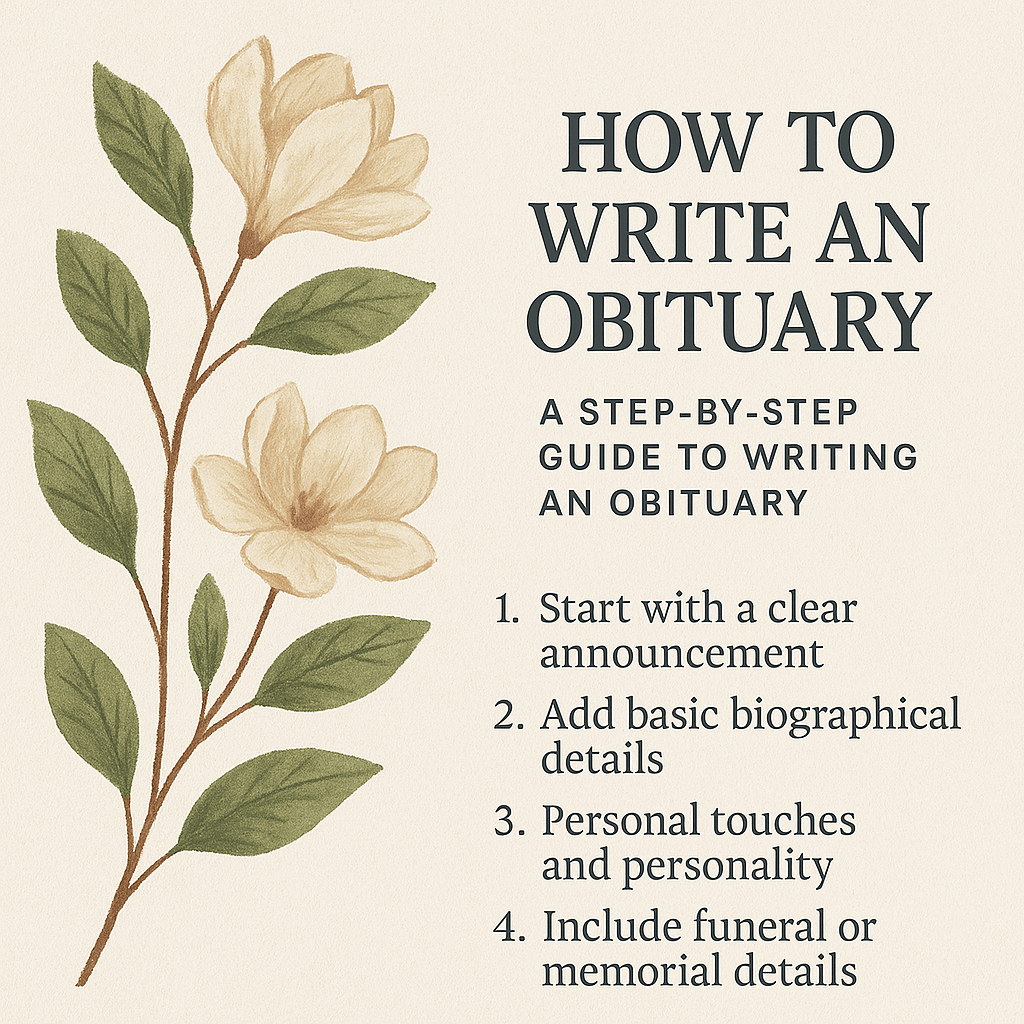
  • What to Do When Someone Dies: A Step-by-Step Guide to Writing an Obituary

    What to Do When Someone Dies: A Step-by-Step Guide to Writing an Obituary

    Calm the Panic: A Gentle Introduction

    When a loved one dies, you are suddenly faced with both grief and a long list of urgent tasks. The immediate hours and days after a death can feel like a blur. If you’re wondering what to do when someone dies, or how to write an obituary during this emotional time, you’re not alone.

    This article is your calm companion during chaos, providing a gentle, detailed walkthrough of how to write an obituary step-by-step, and offering a helpful death checklist to guide you through the first steps after death. Use it as a practical tool and share it with others who may be walking the same road.


    Immediate Death Checklist: First Steps After a Death

    Before writing the obituary, there are urgent steps you’ll need to take. Here’s a simplified death checklist:

    Step 1: Confirm and Document the Death

    • At home: Call the hospice nurse or family doctor (if expected), or emergency services (if unexpected).
    • At a hospital or care facility: Staff will typically handle this step and issue a medical certificate of death.

    Step 2: Contact a Funeral Director

    Choose a reputable funeral home or director who can help with body transportation, service planning, and publishing the obituary.

    Step 3: Inform Immediate Family

    Call or text close family members before anything goes public. Gently coordinate who else will be informed and by whom.

    Step 4: Secure the Deceased’s Property and Pets

    Lock their home, retrieve valuables, and ensure pets or plants are cared for.

    Step 5: Locate Key Documents

    Look for the will, funeral instructions, or prepaid burial/cremation agreements. You may also need access to ID, insurance, and legal documents soon.


    Writing the Obituary: Step-by-Step Instructions

    Writing an obituary is your opportunity to honor a life. It also helps notify the community and provide details about memorial services. Here’s a compassionate, step-by-step guide:

    1. Start with a Clear Announcement

    Use a respectful, direct sentence:
    “Elizabeth Mary Thompson, 78, of Denver, Colorado, passed away peacefully on March 30, 2025.”

    2. Add Basic Biographical Details

    • Date/place of birth
    • Parents’ names (if relevant)
    • Education or career highlights
    • Achievements, hobbies, or roles in the community

    3. Personal Touches and Personality

    Highlight what made them special:
    “A passionate gardener and avid storyteller, Elizabeth filled her home with laughter and lilacs. She loved mentoring young teachers and never missed a grandchild’s soccer game.”

    4. List Immediate Family Members

    Example:
    “She is survived by her daughter, Rachel; her son-in-law, Marco; two grandchildren, Liam and Ava; and her brother, James.”

    And optionally:
    “She was preceded in death by her husband, Paul, and her sister, Margaret.”

    5. Include Funeral or Memorial Details

    Add date, time, location, and whether the public is invited. Include streaming info or donation suggestions if relevant.

    6. End With Appreciation or Legacy

    Example:
    “Her strength, kindness, and humor touched everyone she met. Her family invites you to celebrate her legacy with stories, joy, and remembrance.”


    Sample Obituary Template

    John Robert Edwards, 68, passed away peacefully on April 1, 2025, surrounded by loved ones in Baltimore, Maryland. Born August 2, 1956, John was a devoted father, skilled carpenter, and Army veteran. He is survived by his wife, Dana; children, Lisa and Jared; and three grandchildren. He was preceded in death by his parents, George and Lillian. A memorial service will be held at Oak Grove Chapel, 11 a.m. on Saturday, April 6. In lieu of flowers, donations can be made to the Wounded Warrior Project.


    FAQs: Common Questions Families Ask

    Do I need a death certificate to write an obituary?

    No, but you will need the legal pronouncement of death from a doctor or coroner for funeral arrangements and death registration.

    How long should an obituary be?

    Most are 150–300 words. Newspapers often charge by length. Online obituaries can be longer and include photos.

    Should I mention cause of death?

    Only if the family is comfortable. Many families choose to say “passed away peacefully” or “after a long illness.”

    Can I publish an obituary later?

    Yes. You can also write a short public announcement first and a fuller obituary later. It’s okay to grieve and take your time.


    Resources for Help and Guidance

    United States

    United Kingdom

    Canada

    Australia


    Conclusion: Remembering with Grace

    Writing an obituary may be one of the most emotional things you’ll ever do. But it can also be a sacred moment—honoring a life, comforting others, and anchoring your own grief in meaningful reflection.

    Bookmark or share this list with someone who might need it. One day, it may bring someone comfort, clarity, and a sense of calm when they need it most.


    References

  • Understanding Different Funeral Types: A Simple Guide to Planning with Peace of Mind

    If you’re facing the loss of a loved one—or planning ahead—it’s natural to feel overwhelmed. Funeral decisions carry both emotional and practical weight. This guide is here to help. We’ll break down the most common funeral arrangements, offer clear comparisons, and walk you through what to consider. You’ll also learn how funeral costs vary by type and get step-by-step advice on how to plan a funeral that fits your needs and values.


    Quick Comparison of Common Funeral Types

    TypeIncludesBest ForEstimated Cost
    Traditional FuneralViewing, formal service, burialStructured, ceremonial goodbye$7,000–$12,000 (NFDA)
    Memorial ServiceNo body present, flexible location/timingDelayed or destination services$1,000–$5,000
    Graveside ServiceBrief ceremony at burial siteSimple, affordable, outdoors$2,000–$4,000
    Direct CremationNo service; immediate cremationBudget-conscious, minimalist option$500–$2,500
    Direct BurialImmediate burial without ceremonyFaith-based simplicity, no embalming$1,000–$3,000
    Green BurialEco-friendly, biodegradable casket or shroudEnvironmental values, natural setting$1,000–$4,000

    Step-by-Step: How to Plan a Funeral Based on Type

    1. Confirm Final Wishes (if available): Check for any pre-arrangements or stated preferences by the deceased.
    2. Choose the Type of Funeral: Use the table above to compare options. Consider emotional, cultural, and financial factors.
    3. Set a Budget: Outline how much you’re comfortable spending. Funeral homes can provide itemized cost estimates to help.
    4. Select a Funeral Home or Service Provider: Ask about services included for your chosen funeral type. Don’t be afraid to get more than one quote.
    5. Handle Legal Requirements:
      • Request multiple copies of the death certificate
      • File permits for cremation or burial
      • Notify Social Security or relevant offices
    6. Plan the Details: Customize with music, readings, speakers, photos, or religious elements. Even the simplest ceremony can be meaningful.
    7. Communicate with Loved Ones: Send out details of the service or celebration. Consider live streaming or delayed memorials for out-of-town guests.

    Expert Insights: What the Research and Industry Say

    According to the National Funeral Directors Association (2023), cremation now outpaces burial due to cost and flexibility. Meanwhile, interest in green burials is increasing as families seek environmentally conscious options (Green Burial Council, 2021).

    Studies also show that funeral rituals—no matter how simple—help with the grieving process. A direct burial or small graveside service may be just as healing as a full ceremony, depending on your values and needs (Worden, 2018).


    Legal & Logistical Tip

    Even for direct cremations, state law may require a permit or medical examiner’s approval. Always ask your provider what documentation they handle—and what falls to you.


    Bonus Tip: Consider a Delayed Memorial

    If cost or timing is a concern, you can plan a simple burial or cremation now and a memorial service later, allowing for travel or personal readiness. This flexible approach is growing in popularity.


    References

    • Funeral Consumers Alliance. (2022). Funeral prices and services explained. https://www.funerals.org
    • Green Burial Council. (2021). Guide to green burial. https://www.greenburialcouncil.org
    • National Funeral Directors Association. (2023). 2023 Cremation and Burial Report. https://www.nfda.org
    • Worden, J. W. (2018). Grief counseling and grief therapy: A handbook for the mental health practitioner (5th ed.). Springer Publishing Company.
  • 🕯️Funeral Planning Guide: 10 Steps for When You Don’t Know Where to Begin

    🕯️Funeral Planning Guide: 10 Steps for When You Don’t Know Where to Begin

    “Grief is not a project—it’s a process. And love is found in the details.”

    When Sarah’s father died unexpectedly, her mind went blank. The hospital handed her a folder. Friends asked questions. She felt the pressure to do something, but all she wanted was a moment to breathe.

    This guide is for the Sarahs of the world—for anyone quietly carrying the weight of love and loss, who needs a clear, gentle starting point.


    🫁 1. Take a Breath

    Grief clouds the mind. It’s okay—necessary, even—to pause before making decisions. It’s normal if your mind feels scattered—this is your body’s natural response to loss.

    • Try this grounding technique: Inhale 4 seconds → Hold 4 → Exhale 6.

    Even a single intentional breath can shift your body out of “crisis mode” and into a place where decisions feel less overwhelming.

    Back to Top


    📣 2. Notify Loved Ones

    Start with those who must know immediately—close family, legal representatives, and anyone who will help coordinate arrangements. Pausing to breathe between calls is perfectly okay.

    Tip: Use a shared group chat or document so everyone stays informed without repeated calls.

    Back to Top


    🧾 3. Understand Your Role

    Uncertainty about your role is common; clarity now can save heartache later.

    • Next of kin: Legally responsible for final arrangements.
    • Executor: Manages the estate and financial matters.
    • Supporting family member: Assists without legal authority.

    “You may need a death certificate before accessing accounts or making formal plans.” – Federal Trade Commission

    Back to Top


    💰 4. Set a Budget

    Discussing money during grief can feel uncomfortable; remember, budgeting is an act of stewardship, not disrespect.

    • Simple cremation: $1,000–$3,000
    • Traditional burial: $7,000–$12,000+

    These are U.S. averages; rural areas may be lower, large cities higher.

    • Life insurance: May cover part or all costs.
    • Prepaid plan: Some or all arrangements already paid.
    • Contributions: Family/friends pooling resources.

    “Under the FTC Funeral Rule, you have the right to request a detailed General Price List.” – FTC.gov

    Back to Top


    ⚱️ 5. Choose Burial or Cremation

    This decision affects cost, timing, and emotional meaning. Some cultures and faiths have strong traditions—lean on them if they bring comfort, or choose what aligns with your family’s values and finances.

    Tip: If unsure, ask your funeral director to walk through the practical and cultural implications.

    Back to Top


    🏛️ 6. Select a Funeral Home

    • Call at least 2–3 options.
    • Ask for their General Price List.
    • Notice how you’re treated—respect and patience matter.

    If this step feels intimidating, bring a trusted friend or family member to help take notes and ask questions. Choose a place where you feel heard, informed, and never rushed.

    Back to Top


    📅 7. Pick a Service Type

    • Traditional: Structured service, often with viewing.
    • Graveside: Shorter, held entirely at the burial site.
    • Memorial: Days, weeks, or months later—more flexible and personal.

    Choosing a service can stir emotions—this is a deeply personal choice with no right or wrong.

    Back to Top


    🎨 8. Personalize with Meaning

    • Favorite music or readings
    • Clothing or accessories meaningful to them
    • Symbols of faith or culture
    • Photo displays, video tributes, or keepsake tables

    Personalization can help mourners feel more connected, aiding emotional processing and healing (Worden, 2009).

    Back to Top


    📕 9. Prepare Programs & Keepsakes

    • Name and life dates
    • Favorite quotes, scripture, or poetry
    • Photos
    • Order of service

    Even a simple printed handout can become a cherished keepsake. Solviah offers templates to help you start.

    Back to Top


    🧭 10. Plan for Aftercare

    • Thank-you cards: Acknowledge kindness and support.
    • Estate tasks: Complete legal and financial responsibilities.
    • Grief support: Consider groups, therapy, or pastoral care.
    • Anniversaries/traditions: Keep meaningful rituals alive.

    It’s common to feel an emotional “crash” after the service—planning for aftercare can help you navigate that stage.

    Back to Top


    📋 Funeral Planning Checklist

    • Take a grounding breath
    • Notify close family and legal contacts
    • Confirm your role and responsibilities
    • Choose burial or cremation
    • Set a realistic budget
    • Select a funeral home
    • Pick date, time, and service type
    • Personalize details
    • Prepare program and keepsakes
    • Plan for aftercare and ongoing support

    🌼 Final Words

    There is no perfect way to plan a funeral. But there is love in every thoughtful step—and that matters. You don’t have to do it all at once. And you are not alone.

    At Solviah, we are here to walk with you—step by step—so you never have to face this alone.


    🌿 Just a Note on Heaven

    At Solviah, we respect all faiths and the many ways people find hope in loss. This space is for everyone, without pressure or persuasion.

    We simply note this because it’s unusual: in the Christian faith, Heaven is described as a guaranteed promise—not through personal effort, but as a gift of salvation through Jesus Christ. For those curious, this promise is offered freely to all who wish to receive it.

    The heart of it: Jesus is God incarnate. He lived a sinless life, died for our sins, and rose again. Through Him, forgiveness, freedom, and eternal life are offered—not by earning it, but by receiving it.

    No one is too far gone. You are already deeply loved.

    Jesus, I believe You are Lord. I receive Your forgiveness and salvation. Please lead me into new life—now and forever. Amen.

    Simple Prayer of Salvation
    • 🕊️ Speak with a Christian or pastor
    • 📖 Begin reading the Bible (start with the book of John)
    • ❓ Keep asking questions—God welcomes them

    📚 References

    • FTC. (2023). Shopping for Funeral Services. consumer.ftc.gov
    • NFDA. (2022). Median Funeral Costs Highlights. nfda.org
    • Stroebe, M., et al. (2017). Omega: Journal of Death and Dying, 74(4), 455–473.
    • Worden, J. W. (2009). Grief Counseling and Grief Therapy (4th ed.). Springer Publishing.