Honoring Life, Embracing Memories

Category: Spirituality

  • Jewish Grief and the Meaning of Second Passover (Pesach Sheni): Finding Belonging in Sacred Time

    Jewish Grief and the Meaning of Second Passover (Pesach Sheni): Finding Belonging in Sacred Time


    “Why should we be kept from bringing the Lord’s offering?”
    —Numbers 9:7

    “Even in darkness, light dawns for the upright…”
    —Psalm 112:4

    🕯️ When You Miss Both Tables

    Some people miss the first Passover because someone died. Then grief lingers—or deepens. Another death comes. And they miss Second Passover too.

    What if you’re too sad to celebrate again? What if the grief never lifted from the first loss—let alone made space for another? What if sacred time feels like it’s passing without you?

    You are not alone. Many mourners feel disoriented when holidays return too soon. Rituals arrive with songs and memory, but the heart may still be in silence. Second Passover is not a deadline. It is mercy.

    It is a whisper: “Even if you missed the feast, your place remains.”

    “Don’t rush back to the table. Sit as long as you need. I am not waiting for a ritual—I am already in your memory, your love, your life.”
    —A whisper from the ones you grieve

    Back to Top ↑

    🌸 Ways to Honor a Loved One

    • 🕯️ Light a candle and whisper their name
    • 🍽️ Share their favorite dish with someone who knew them
    • 💝 Donate to a cause they cared about
    • 📖 Recite a line from a favorite poem or psalm
    • 🧘 Sit with their memory without rushing to feel better

    Back to Top ↑

    🗣️ Voices from the Community

    “My father died the day before Passover. I couldn’t bring myself to go to the seder. Then, a month later, I lit a candle on Second Passover and just sat with his photo. It wasn’t a feast. But it was sacred.”
    —Leah S., Brooklyn, NY

    “My rabbi said God gave us Second Passover because even grief belongs in the story of freedom. That stayed with me.”
    —David R., Jerusalem

    Back to Top ↑

    🤝 Interfaith Reflection

    Even if you’re not Jewish, the concept of Pesach Sheni offers something timeless: a second chance to honor grief, to mark remembrance, to find sacred space after a missed moment. Light a candle. Share a meal in silence. Say their name. Rituals don’t need to be religious to be real.

    Back to Top ↑

    ❤️ How to Support Someone

    If someone you love has missed both Passovers due to overlapping grief, don’t pressure them to return to joy. Offer quiet presence, ongoing kindness, and thoughtful invitations without expectation.

    • 🫶 Offer a meal with no conversation required
    • 💬 Send a message weeks later: “I’m still thinking of you.”
    • 🌿 Invite them to a walk or space to just be

    Back to Top ↑

    🌅 The Path to Heaven

    In Judaism, access to the World to Come (Olam HaBa) is rooted in righteousness, memory, mercy, and community. The Talmud says: “All Israel has a share in the World to Come… and the righteous of all nations too.” Heaven is not earned by perfection—it is entered by compassion.

    Back to Top ↑

    📘 Glossary

    • Pesach Sheni – Second Passover, observed one month after the first
    • Olam HaBa – The World to Come in Jewish belief
    • Shiva – Seven-day mourning period
    • Kaddish – Mourner’s prayer praising God
    • Yahrzeit – Anniversary of a loved one’s death
    • Yizkor – Memorial prayer recited on holidays
    • Tzedakah – Charitable giving in someone’s memory
    • Aninut – Period between death and burial

    Back to Top ↑

    💬 Share Your Story

    Have you experienced grief that collided with a holiday? Please share your story or a remembrance in the comments below. Someone else may need your words today.


    Explore More:

  • Feeling Off in 2025? What Grief, Burnout, and Shifting Seasons Might Be Saying

    Feeling Off in 2025? What Grief, Burnout, and Shifting Seasons Might Be Saying

    ✯ Table of Contents

    🌿 A Note Before We Begin

    This isn’t just another article about grief or burnout. It’s a gentle, grounded guide for anyone going through loss, transition, or emotional unraveling—especially when life is already shaky.

    You might be grieving a death. Or maybe you’re grieving something harder to name—your career path, your sense of purpose, the version of yourself that used to feel whole. Lately, it seems more and more of us are carrying invisible weights we don’t know how to talk about.

    This guide offers language for what you’re feeling, space to breathe, and spiritual insight that doesn’t rush to fix you. It doesn’t pretend to hold all the answers—but it hopes to walk with you toward steadier ground.

    Along the way, we’ll also explore what Christian prophets are saying—because strangely, and profoundly, their words have been aligning with what many of us are living through. Whether or not you consider yourself religious, it might be worth paying attention.

    Each section unpacks a layer of what you may be carrying: emotional weariness, cultural upheaval, spiritual shaking, personal loss—and how to begin again in a world that no longer feels familiar.

    Wherever you are in your process, may this meet you there.

    Back to Top

    🕊️ Invisible Grief: Why So Many Feel Emotionally Exhausted Right Now

    You’re not imagining it.

    There’s a heaviness in the air—one that words like “stress” or “tired” don’t fully capture. Even those who haven’t lost someone recently are grieving something: who they used to be, what they thought life would become, the safety they assumed would last.

    And if you have lost someone—especially while juggling the fragile pieces of everything else—then it’s more than sorrow. It’s disorientation. A sense that the ground itself has shifted, and you can’t find the horizon.

    This is invisible grief.

    Not always the kind with funerals or condolences—but the kind that lingers when your identity, security, or story is quietly slipping through your fingers. It’s the ache of becoming someone new without meaning to. Psychologist Kenneth Doka calls this disenfranchised grief—the kind society doesn’t always recognize, but that lives in us all the same (Doka, 2002).

    And according to trauma researcher Bessel van der Kolk, this kind of invisible loss doesn’t just affect the mind—it leaves an imprint on the body, too. We carry the stress physically, often without knowing why (van der Kolk, 2014).

    What makes it harder is how strangely collective it feels. So many people are unraveling in parallel. So many are whispering, “Something is off,” without knowing why.

    Could there be something beneath it all?

    We’ll name the griefs that don’t often get named. We’ll explore what prophetic voices have been saying for years, and why their words are echoing loudly now. We’ll also look to the skies—literally—and consider whether what’s happening above us might help us make sense of what’s happening within us.

    Because if this ache is shared… maybe so is the hope.

    Back to Top

    🔥 What’s Causing Emotional Burnout in 2025 (And Why It’s Not Just You)

    Even if you haven’t lost someone, you may still feel like something is slipping: your sense of purpose, your drive, your belief that life should feel more stable by now.

    It’s not just burnout. It’s something deeper—emotional fatigue, spiritual burnout, a quiet unraveling happening across industries, relationships, and identities. A sense that the ground has shifted, and no one handed you a new map.

    So what’s really behind this collective weariness?

    • Economic anxiety isn’t just about dollars—it’s about fear. Even those with good jobs worry they’re one layoff away from chaos (APA, 2023).
    • Success has changed shape. It’s no longer enough to be good at your job. You’re expected to have a calling, a brand, a clear purpose—and that pressure can be paralyzing (Pratt et al., 2006).
    • Work-life balance has eroded. Devices keep us half-working even while resting. We’re always reachable, never truly restored (Maslach & Leiter, 2016).
    • Comparison culture floods us with curated images of other people’s wins, leaving us unsure whether we’re behind—or just invisible (Huang, 2017).
    • Corporate trust is fading. Layoffs, pivots, and instability have made people question if any role is truly secure (APA, 2023).
    • And under it all, a quiet ache. A question few dare to say aloud: What if I don’t want this life anymore?

    Layer these pressures on top of personal grief, family stress, or spiritual fatigue—and it’s more than stress. It’s a slow unraveling of identity, security, and clarity all at once.

    And if all of this feels bigger than personal stress—maybe it is.

    Maybe something spiritual is stirring underneath the unraveling.

    Back to Top

    📖 What Christian Prophets Are Saying About This Season of Change

    Is this discomfort spiritual? What prophetic voices are noticing—and why it might matter.

    Maybe you’ve had this thought lately:

    “Everything feels off—but I can’t tell if it’s me… or something bigger.”

    That sense isn’t new—and it’s not just yours.

    In many Christian traditions, prophetic voices are people who listen closely for God’s heart—not to predict headlines, but to help interpret the times. And for years now, some of these voices have been pointing to a season just like this.

    They call it a divine repositioning.

    Prophets like Kris Vallotton, Lana Vawser, and others have described this as a global shaking—one that reaches into both personal lives and public systems. Not to destroy, but to shift. To break the illusion of control. To prepare people for what’s next. And what they’ve said feels strangely aligned with what many are now living.

    1. Shaking before repositioning

    That sense that your old rhythm no longer fits? It may not be failure—it may be spiritual movement. Prophetic voices suggest that God often allows discomfort to dislodge us from what’s too small. What feels like chaos might be permission to let go.

    “God offends the mind to reveal the heart.” — Kris Vallotton

    2. Transfer of influence

    Many have spoken about a “Joseph and Daniel moment”—a season where those who’ve been faithful in hidden places are being quietly prepared for influence. Not for fame, but for fruitfulness. You may not feel ready. But maybe your readiness isn’t the point.

    3. Marketplace revival

    This isn’t just happening in churches. Prophetic voices believe God is moving in business, education, tech, media—in the middle of everyday work. If your job has felt strangely unsettled, it might not be punishment. It might be preparation.

    4. Refinement of identity

    Perhaps most deeply, this shift is about identity. God may be stripping away false metrics—“I’m only valuable if I’m productive,” “If I’m not thriving, I’m failing.” What’s left isn’t emptiness—it’s truth. Who you are when nothing performs.

    5. The unveiling of the hidden ones

    Prophets like Lana Vawser have described this season as one where God is bringing His “hidden ones” into view—not through striving, but through divine timing. Whether you’ve been healing, raising children, serving quietly, or simply holding things together behind the scenes—this may be your unveiling.

    “The ones who have felt unseen, forgotten, and hidden—this is the hour where the Lord is bringing them into greater visibility for His glory.” — Lana Vawser

    This isn’t performance. It’s permission. A holy release into the next thing—just as you are.

    Some call this a shift. Others call it a calling. But either way, it’s a pattern too consistent to ignore.

    Even if you’re not sure what you believe, maybe part of you has already felt it:

    • The old way doesn’t fit.
    • You’re between stories.
    • And something sacred is stirring beneath the surface.

    It’s the moment midair—after releasing one trapeze bar, before catching the next.

    You’re not falling. You’re just between.

    Could it be that what feels like obscurity… was always preparation?

    Back to Top

    ✨ Celestial Signs in May 2025: Biblical Meaning and Prophetic Insight

    What if the sky isn’t just beautiful—but intentional?

    Maybe you’ve looked up recently—at the moon, the stars, or a flash of meteor light—and felt something you couldn’t explain. A stirring. A pause. A sense that the timing of it all means more than we think.

    Throughout scripture, the heavens are more than backdrop—they’re message-bearers.

    “The heavens declare the glory of God, and the sky above proclaims His handiwork.” — Psalm 19:1

    From the star over Bethlehem to the apocalyptic signs in Revelation, the biblical narrative uses celestial movement not for fortune-telling—but for timing. Divine moments often echo in the skies. And in May 2025, many believe we’re standing beneath one of those echoes.

    What May 2025 Is Revealing

    • May 3–4: Eta Aquariid Meteor Shower

      Formed from remnants of Halley’s Comet, these meteors streak the sky before dawn. In prophetic imagery, meteors often represent sudden insight—divine interruptions that illuminate what’s been there all along.

    • May 12: Full Flower Micromoon

      This distant full moon symbolizes hidden growth. It may not look large, but its presence reminds us: not all flourishing is loud. Some of the most sacred change happens in quiet places.

    • May 14: Pesach Sheni (Second Passover)

      A biblical “do-over” date. In Numbers 9, God allowed those who missed Passover the first time to celebrate a month later. It’s a reminder: you haven’t missed your moment. Redemption still reaches.

    • May 15–16: Lag BaOmer

      Traditionally a break in a season of mourning, this Jewish holiday brings light and joy into heavy times. It represents breakthrough in the middle of grief.

    • May 26: New Moon

      In ancient Israel, new moons marked the beginning of sacred cycles. It was a moment to pause, reset, and step forward into what’s next (Numbers 28:11–15).

    • May 29: Ascension Day

      Honoring the moment Jesus was taken into heaven, Ascension is not about endings—it’s about commissioning. The moment where waiting turns into movement. “Go.”

    These dates may seem unrelated—but they trace a clear arc: from divine interruption… to hidden growth… to second chances… to joy… to renewal… to release.

    This Isn’t Prediction. It’s Invitation.

    You don’t have to believe in signs. But you’re allowed to wonder.

    Maybe you’ve felt it already—something stirring in you. A direction. A question. A truth you’ve known for a while but haven’t yet moved toward.

    Christian prophets aren’t saying to look for fireworks. They’re saying: notice the alignment. Let the sky remind you that God’s timing is never random. And neither is yours.

    Some believe what May 2025 is saying is this:

    The shaking has done its work. The delay has had its meaning. Now… it’s time to begin.

    You don’t need full clarity. You just need one true step.

    “There will be signs in the sun, moon, and stars… When these things begin to take place, stand up and lift your heads, because your redemption is drawing near.” — Luke 21:25–28

    Even if all you have is a flicker of faith, even if all you feel is tired—look up anyway.

    Look up. Breathe. Begin.

    Back to Top

    💔 Grieving When the Loss Is Personal

    What if the thing that broke wasn’t your job… but your heart?

    We’ve just explored the idea that this season of shaking might be spiritual—that perhaps God is allowing certain things to fall away so that something more eternal can take root.

    But what if what fell wasn’t your schedule, your plans, or your sense of direction?

    • What if it was your mother?
    • Your spouse?
    • Your child?
    • Your only friend?
    • Your anchor in this world?

    What if the shaking took your person?

    Grief can already feel like spiritual whiplash. And the thought that God allowed it—that He stood by while it happened—can feel less like mercy and more like cruelty.

    And if someone dared to tell you, “It’s all part of a bigger plan,” you might want to walk away from that kind of God altogether.

    You wouldn’t be wrong to feel that way.

    Because when you lose someone you love—especially in a season when you were already barely holding it together—it doesn’t feel redemptive.

    It feels like betrayal.

    Like abandonment.

    Like being dropped while you were already drowning.

    “I don’t care about spiritual shaking,” one reader said. “I just want my dad back. He was the only one who understood me.”

    And still—this much we know:

    “When Jesus saw her weeping… He was deeply moved in spirit and troubled… Jesus wept.” — John 11:33–35

    He knew resurrection was coming. And He still wept.

    He didn’t offer explanations. He didn’t say, “This had to happen.”

    He stood beside Mary in her grief. He felt the injustice. And He cried.

    Maybe that’s what He’s doing with you now.

    Not fixing it. Not skipping it. Just sitting in the silence—with you.

    Maybe He didn’t cause the loss. Maybe He didn’t will the death. But He knew it would come.

    And instead of rushing you toward resolution, He’s walking through this part with you—at your pace, in your pain.

    Maybe the shaking didn’t take your anchor so you’d become stronger.

    Maybe it took your anchor… so He could be the one to hold you through the storm.

    “The Lord is close to the brokenhearted and saves those who are crushed in spirit.” — Psalm 34:18

    You don’t have to make sense of this. Not now.

    You don’t have to move on.

    But maybe—just for today—you let yourself be held.

    Back to Top

    🏗️ Rebuilding in the Rubble

    You may not be rebuilding the same life. But you’re not building alone.

    By now, you may feel like your world has been stripped down to studs. What once defined you—your roles, your plans, your relationships—may be gone or unrecognizable. And the person you were before this season? She might feel just as lost.

    But if you’re still breathing, still asking questions, still reading this—That means something remains. And that something can become the foundation for a different kind of future.

    The Healing Will Look Nothing Like the Old Life

    You’re not going back to “normal.” There is no going back. But there may be something better ahead—not because it erases your grief, but because it honors it.

    “You don’t move on. You move with it. The grief walks beside you. But so does grace.”

    This isn’t toxic positivity. This is sacred rebuilding.

    “Though the fig tree does not bud and there are no grapes on the vines… yet I will rejoice in the Lord.” — Habakkuk 3:17–18

    What Rebuilding Might Look Like

    • You wake up one morning and don’t feel dread.
    • You go for a walk and notice the trees again.
    • You remember something about your loved one—and smile instead of cry.
    • You say no to something you used to say yes to—because now you know your limits.
    • You start making plans—not because you’re fully healed, but because you’re still here.

    You’re not starting from scratch—you’re starting from sacred debris.

    “They will rebuild the ancient ruins and restore the places long devastated.” — Isaiah 61:4

    Biblical Anchors for What Feels Unstable

    • When finances are uncertain: “The Lord is my shepherd, I lack nothing.” — Psalm 23:1
    • When your identity feels lost: “You are mine. I have called you by name.” — Isaiah 43:1
    • When you are tired and stretched thin: “Come to me… and I will give you rest.” — Matthew 11:28
    • When the future feels terrifying: “Do not fear, for I am with you.” — Isaiah 41:10
    • When you feel deeply alone: “Even if my father and mother forsake me, the Lord will receive me.” — Psalm 27:10

    What Remains Is Still Alive. And That Means Something.

    Maybe you don’t feel strong. Maybe you feel buried.

    But seeds aren’t lost when they’re in the dark. They’re preparing to break open. Preparing to rise.

    Even if no one sees it—especially when no one sees it—something in you is still here. Breathing. Noticing. Reaching.

    That’s not nothing. That’s the beginning of strength.

    You don’t have to bloom today. You don’t have to fix everything by tomorrow. But if you’re still breathing, there’s more to come.

    The ones who rise slowly often rise strongest. Not because they pushed through—but because they grew through. Deep. Quiet. Fierce.

    You may feel buried. But maybe… you’re rooted.

    And that is not the end of the story.

    Back to Top

    🌱 A Final Blessing

    Maybe this hasn’t answered every question.

    Maybe it didn’t fix what still feels broken.

    But if you’ve made it this far, it’s because something in you is still reaching for light.

    Maybe it’s not fire. Maybe it’s not fierce.

    But it’s alive. And that matters.

    There’s a kind of strength that doesn’t shout. It roots. Deep and unseen. Quiet and sure.

    And when it finally rises, it doesn’t just survive. It shelters others, too.

    So even if your grief still aches… even if your future feels dim… even if today is more silence than clarity—

    May you carry forward something real.

    Not because it’s all okay.

    But because something in you still is.

    So here’s to what remains.

    To what is still alive in you, however quiet.

    To the sacred rebuilding happening in silence.

    And to the person you are becoming—braver, deeper, more whole than ever before.

    A Blessing for the Journey

    May your grief give way to gentleness.

    May your questions stretch into something sacred.

    May you find strength not in perfection, but in quiet resilience.

    May you carry forward what mattered most—not by force, but by becoming.

    And as your roots grow deep in this broken soil,

    May something bloom in you that honors the life you lost,

    And the legacy you’re still living.

    Whatever your path, whatever your pace,

    May you know: you are not alone.

    Back to Top

    💬 Share What Resonated With You

    If something in this article stirred something in you—a phrase, a truth, a quiet strength—would you be willing to share it below?

    Scroll down and leave a comment. Let’s make this more than a page. Let’s make it a place to feel seen.

    📚 References

    • Doka, K. J. (2002). Disenfranchised Grief: Recognizing Hidden Sorrow. Lexington Books.
    • van der Kolk, B. (2014). The Body Keeps the Score: Brain, Mind, and Body in the Healing of Trauma. Viking.
    • American Psychological Association. (2023). Stress in America™ Report. View Report
    • Maslach, C., & Leiter, M. P. (2016). Understanding the burnout experience. World Psychiatry, 15(2), 103–111.
    • Pratt, M. G., Rockmann, K. W., & Kaufmann, J. B. (2006). Constructing professional identity. Academy of Management Journal, 49(2), 235–262.
    • Huang, C. (2017). Time on social networks and psychological well-being. Cyberpsychology, Behavior, and Social Networking, 20(6), 346–354.
    • Vallotton, K. (2020). Spiritual Intelligence. Chosen Books.
    • Vawser, L. (2021–2024). Prophetic Words. www.lanavawser.com
    • Genesis 37–50 – The story of Joseph and divine repositioning.
    • Daniel 1–2 – Influence through faithfulness in exile.
    • Isaiah 45:3 – “Treasures of darkness and hidden riches.”
    • 1 Samuel 16:11–13 – David’s anointing from hiddenness.
    • Neimeyer, R. A. (2001). Meaning Reconstruction & the Experience of Loss.
    • Park, C. L. (2010). Meaning-making and adjustment to life stress. Psychological Bulletin.

    Back to Top

  • May 2025: Celestial and Sacred Alignments—God’s Message to the Grieving

    May 2025: Celestial and Sacred Alignments—God’s Message to the Grieving

    May 2025: Celestial and Sacred Alignments—God’s Message to the Grieving

    “And God said, ‘Let there be lights in the expanse of the heavens to separate the day from the night. And let them be for signs and for seasons…” —Genesis 1:14

    Jump To:


    Understanding Biblical Astronomy

    Biblical astronomy recognizes celestial bodies as divine instruments marking sacred times and conveying God’s messages. Unlike astrology, which attempts to dictate human destiny through star signs, biblical astronomy sees the heavens as a canvas where God reveals His plans and promises.

    “The heavens declare the glory of God, and the sky above proclaims his handiwork.” —Psalm 19:1

    ↑ Back to Top

    Chronological Events in May 2025

    May 1: 🇮🇱 Yom HaAtzma’ut (Israeli Independence Day)

    Commemorates the modern rebirth of Israel. A sign of God’s faithfulness to restore what was scattered.

    May 3–4: ✨ Eta Aquariid Meteor Shower Peak

    From Halley’s Comet. 50 meteors/hour before dawn. A celebratory light show in Heaven? Possibly.

    May 12: Full Flower Moon (Micromoon)

    “Consider the lilies… not even Solomon in all his glory was arrayed like one of these.” —Luke 12:27

    May 14: Pesach Sheni (Second Passover)

    God offers second chances. A grace-filled provision for the late and the overlooked.

    May 15–16: Lag BaOmer

    A break in mourning. A celebration of hidden joy. A release from sorrow.

    May 26: Jerusalem Day

    Marks the reunification of Jerusalem. A sign of divine restoration and hope.

    May 27: New Moon

    When the moon disappears, God invites stillness. Something new is being birthed in the unseen.

    May 29: Ascension of Jesus

    Jesus ascends, declaring, “It is finished.” Our hope is secured. Our access is open.

    ↑ Back to Top

    April vs. May: What Is God Doing?

    April 2025 aligned Orthodox and Western Easter with Jewish Passover. It was a unified honoring of Jesus—the Lamb of God—by all His people. That moment declared that what Jesus accomplished on the cross is still enough. Hebrews 10:14 says, “For by one sacrifice He has made perfect forever those who are being made holy.”

    Now in May, we see a shift. Heaven isn’t silent. God is still speaking. May speaks of freedom. Restoration. Second chances. Beauty in bloom. And divine ascension. God is not only aligning—He’s activating.

    Read the April article →

    ↑ Back to Top

    🕊️ Prophetic Alignment: What Prophets Are Saying

    Kris Vallotton: “The Shift Has Begun”

    On April 28, 2025, Vallotton said he woke up to the voice of the Lord: “The shift has begun.” It echoes the cosmos—movement, breakthrough, freedom.

    Chuck Pierce: Grace & Conflict in Tension

    He prophesied a 30-day period of intensity from April 20–May 20. This is not just about waiting—it’s about alignment and transformation.

    Cindy Jacobs: Prayer and Israel

    She urges the Church to stand with Israel and intercede against unrest. That urgency lines up with Jerusalem Day and Yom HaAtzma’ut.

    Bill Hamon: Advance the Kingdom

    Hamon calls this a time to act. To rise. To speak. To move forward in our prophetic assignments.

    These voices are echoing Heaven: the shift has begun.

    ↑ Back to Top

    💔 A Message to the Grieving

    To the one grieving: this May is for you.

    You who feel forgotten—watch the stars dance above you. You who feel weary—let the moonlight soothe you. You who feel lost—God has never stopped arranging beauty on your behalf.

    “The Lord is near to the brokenhearted and saves the crushed in spirit.” —Psalm 34:18

    This season is not about performance. It’s about presence. God’s presence. He is not asking you to climb. He is coming down to meet you, whispering hope in the night sky.

    🌿 Gentle Grief Practices for This Season

    • Stargazing Prayer: Speak to God under the stars—no script, just soul.
    • Gratitude Journal: Note one thing each day God has held you through.
    • Light a Candle: In memory, in hope, in the silence of the sacred.
    • Scripture Meditation: Read Psalm 23 or Isaiah 61 slowly, aloud.
    • Breath Prayer: Inhale: “You are with me.” Exhale: “I trust You.”

    Let May be the month where you begin to heal—not by force, but by divine rhythm. ✨

    ↑ Back to Top

    ✝️ The Gospel Invitation: Step Into the Shift

    Jesus was sinless—holy, pure, unable to be held by death. He bore every sin of every person and used them as His key to descend into death itself. But because death had no hold on Him, He rose—and we now rise with Him.

    “God made him who had no sin to be sin for us, so that in him we might become the righteousness of God.” —2 Corinthians 5:21

    This is your invitation into eternal life, into divine freedom, into healing. The same God aligning the stars is aligning your life.

    Are you ready to receive the gift Jesus died to give you?

    🙏 Prayer of Salvation

    “Jesus, I need You. I believe You died for me and rose again. I confess my sins and turn from my old ways. Make me new. Fill me with Your Spirit. Lead me in Your truth. I give You my heart—completely. Amen.”

    Next Steps

    • 📖 Read the Word: Start with the Gospel of John.
    • Find Community: Join a Bible-believing church or home group.
    • 🚶 Walk in Truth: Live with bold love, humble obedience, and full joy.

    ↑ Back to Top

    💬 Has this stirred something in you?

    Share your thoughts in the comments. We read and respond to every story. You’re not alone.

    ↑ Back to Top

    📚 Glossary

    • Celestial: Related to objects in the sky (stars, moon, sun, planets).
    • Cosmic: Pertaining to the larger universe or spiritual atmosphere.
    • Astronomical: Based on scientific study of celestial bodies.
    • Conjunction: When planets or celestial bodies appear very close together in the sky.
    • Eclipse: When one body blocks the light of another (e.g., sun or moon).
    • Pentecost: 50 days after Easter, when the Holy Spirit was poured out on the disciples (Acts 2).

    ↑ Back to Top

    Explore More on Solviah:

  • Zoroastrian Grief Rituals: Ancient Faith, Sacred Prayers, and the Chinvat Bridge

    Zoroastrian Grief Rituals: Ancient Faith, Sacred Prayers, and the Chinvat Bridge


    “As thou dost desire, O holy one! so shalt thou be; holy shalt thou cause thy soul to pass over the Chinvat Bridge; holy shalt thou come into Heaven.”
    — Yasna 71, Avesta

    When someone beloved dies, Zoroastrians do not simply mourn—they prepare the soul for its most sacred journey. Rooted in the world’s oldest known monotheistic tradition, this journey leads across the Chinvat Bridge, guided by prayers, rituals, and a legacy of good deeds.


    Table of Contents


    🕯️ A Sacred Story of Life After Death

    An old tale tells of a kind-hearted man who gave shelter to the poor and refused to gossip. When he died, his soul lingered three days near his home. On the dawn of the fourth, he stood before the Chinvat Bridge—where three divine judges weighed his deeds. The bridge widened, and a radiant maiden, the embodiment of his own good actions, walked beside him into the House of Song. There, light never dimmed, and music never ceased.

    This story expresses the Zoroastrian belief: the soul is judged not by belief alone, but by the harmony it created through thoughts, words, and deeds.

    ↑ Back to Top

    ⚖️ What Zoroastrians Believe About Death

    Zoroastrianism teaches that life is a moral struggle between asha (truth) and druj (falsehood). When someone dies, the soul (urvan) stays near the body for three days. On the fourth, it crosses the Chinvat Bridge, where three divine judges await:

    • Mithra — Covenant and Witness
    • Sraosha — Conscience and Protector
    • Rashnu — Justice and Weighing of Deeds

    Those who lived in asha are welcomed into Garo Demana (the House of Song). Those who served druj fall into Druj Demana, a place of darkness.

    ↑ Back to Top

    📿 Sacred Prayers and Mourning Rituals

    Zoroastrians honor the dead through rituals designed to protect both the soul and the elements. Traditionally, bodies are placed in a dakhma (Tower of Silence). Today, cremation or burial may be used, with adapted rites.

    Key prayers and ceremonies:

    • Geh Sarnu — comforting hymns
    • Patet Pashemani — confessional prayer
    • Sraosh Hadokht — prayer for protection
    • Uthamna — fourth-day soul release ceremony
    • Dahmah — charity done in the name of the deceased

    These rituals affirm that love continues beyond life and offer structure to support those who grieve.

    ↑ Back to Top

    🧠 Ancient Wisdom Meets Modern Healing

    Psychologists note that ritual, repetition, and meaning-making ease the pain of loss. Zoroastrian grief practices align closely with this wisdom:

    • Structured mourning rituals create safety and continuity
    • The soul’s journey provides spiritual purpose and meaning
    • Community prayers build connection and memory

    Grief becomes not just pain, but a sacred transformation of presence into legacy.

    ↑ Back to Top

    🤝 Across Faiths: Threads of Common Ground

    Zoroastrianism is often compared to Christianity due to its belief in a final judgment and heaven. In Yasna 30:9 we read:

    “Let good thoughts prevail in the world and evil thoughts perish. Let good words be spoken and evil ones be silenced. Let good deeds increase and evil ones fade away.”

    This mirrors the Christian principle to “overcome evil with good” (Romans 12:21).

    Other faiths also echo this sacred rhythm:

    • Judaism: Sitting shiva honors memory with community presence
    • Islam: Mourning includes prayer and charity for the soul’s peace
    • Buddhism: Grief is eased through acceptance of impermanence

    Such reflections reveal that in grief, we are not divided by belief—but connected by love.

    ↑ Back to Top

    💞 For Supporters and Friends

    If someone you love is grieving within the Zoroastrian faith, your compassion can be a bridge of comfort. Here are gentle ways to support:

    • Honor the first three days: These are sacred for the soul’s transition. Presence, not pressure, matters most.
    • Use spiritual language: Words like “May their soul cross in light” or “May their deeds lead them to peace” align with their beliefs.
    • Respect the rituals: Ask before bringing food, gifts, or flowers—some families observe specific customs around purity and space.
    • Offer to help with Dahmah: Assist in charitable acts made in memory of the deceased.
    • Share good memories: Speaking of the person’s kindness or courage honors their legacy.

    Kindness, even quiet kindness, is a sacred act.

    ↑ Back to Top

    🌟 Heaven, But Not As You Know It

    Garo Demana, the House of Song, is Zoroastrianism’s vision of heaven. It is a place of eternal light, music, and unity with Ahura Mazda. Entry is not earned by belief alone—but by how one lives.

    When the soul approaches the Chinvat Bridge, three divine entities weigh their life:

    • Mithra (truthfulness)
    • Sraosha (obedience to conscience)
    • Rashnu (justice)

    If the soul lived in asha, the bridge widens and leads them across into joy. This belief invites every Zoroastrian to live with moral courage, knowing eternity awaits.

    ↑ Back to Top

    📘 Glossary

    • Asha — Truth, righteousness, divine order
    • Druj — Falsehood, deceit, disorder
    • Urvan — The soul of the deceased
    • Chinvat Bridge — Bridge of judgment after death
    • Garo Demana — House of Song (Zoroastrian heaven)
    • Druj Demana — House of Lies (place of sorrow)
    • Dakhma — Tower of Silence for traditional sky burial
    • Uthamna — Fourth-day soul release ceremony
    • Patet Pashemani — Confessional prayer
    • Sraosh Hadokht — Prayer for soul’s journey
    • Dahmah — Acts of charity in memory of the deceased

    ↑ Back to Top

    💨 A Breath Prayer for the Grieving

    Inhale: I walk with truth
    Exhale: My soul is not alone

    Reflection:
    What good words or deeds can I speak in their memory today?

    ↑ Back to Top

    🗣️ Share Your Story

    Have you experienced grief through the lens of faith—Zoroastrian or otherwise?

    Leave a comment to honor your loved one, share your tradition, or ask a question. Your voice may be the bridge someone else needs today.

    Continue exploring:

    ↑ Back to Top

    Written for Solviah, where grief is met with gentleness, wisdom, and sacred remembering.
  • Finding Christian Comfort in Grief: God’s Appointed Times, Celestial Signs, and Seasons of Healing

    Finding Christian Comfort in Grief: God’s Appointed Times, Celestial Signs, and Seasons of Healing

    Table of Contents

    When Time Fractures

    “Do not let your hearts be troubled. Trust in God; trust also in Me. In My Father’s house are many rooms… I am going there to prepare a place for you.”
    —John 14:1-3

    There are moments when grief shatters your world. Maybe it was the phone call, the empty chair, the silent room. Life moved forward, but part of you remained in that moment, caught between breaths. Yet even here—especially here—God meets you.

    ↥ Return to Top

    God’s Sacred Calendar: Finding Hope in Holy Moments

    God placed rhythms of healing and hope within His sacred calendar—special moments to remind us He is near. Christianity continues to honor these holy days as reminders of God’s nearness in all seasons:

    • Christmas: God is present in our human struggles.
    • Passover & Easter: Death is defeated.
    • Pentecost: The Spirit comes to dwell with us.
    • Rosh Hashanah: Awakens us to eternity’s promise.
    • Yom Kippur: Assures us of total forgiveness.
    • Sukkot: God makes His home with the hurting.
    • Good Friday & Ascension: God understands loss—and promises reunion.

    “The eternal kind of life we receive from God is not interrupted by death.”
    —Dallas Willard, 1998

    ↥ Return to Top

    Celestial Events: When the Heavens Whisper Comfort

    “The heavens declare the glory of God… night after night they reveal knowledge.”
    —Psalm 19:1-2

    Celestial signs—meteors, eclipses, comets—are more than astronomical phenomena. Within Christian traditions, the heavens reflect God’s nearness. Pastor and theologian Robert Alexander Portillo notes that God may use these signs to realign us with His comforting presence. “God uses celestial signs to align us—not just with His will, but with His comfort.” They aren’t messages of fear. They’re reminders that the God who holds galaxies also holds your heart.

    When grief numbs your heart, these heavenly whispers remind you: You’re seen. Held. Never forgotten.

    ↥ Return to Top

    Real-Life Comfort in Grief

    Maria, a Greek Orthodox grandmother, lost her husband just before Easter. Grief weighed heavily until the candle-lit moment at midnight when her grandson whispered, “Christ is risen, Grandma.” Hope broke through.

    God doesn’t wait until you’re ready—He gently comes to where you already are.

    ↥ Return to Top

    Gentle Encouragement: You Are Not Alone

    Your grief is sacred. God honors your pain. He never rushes your healing.

    If you’re grieving someone whose eternity feels uncertain, remember: God’s mercy surpasses our deepest fears.

    “The Lord is compassionate and gracious, slow to anger, abounding in love.”
    —Psalm 103:8

    God holds mysteries we cannot fully understand—but we can fully trust His kindness.

    ↥ Return to Top

    Breath Prayer

    • Inhale: “Jesus, You hold my grief.”
    • Exhale: “I trust Your healing love.”
    • If grieving uncertain faith:
    • Inhale: “God, I trust Your mercy.”
    • Exhale: “Hold my loved one in Your kindness.”
    ↥ Return to Top

    Salvation: Your Eternal Comfort and Hope

    Salvation means entering eternal life with God—free from guilt, sorrow, and death. Jesus lived without sin so He could take every sin ever committed, including yours. Accepting Him ensures full forgiveness and eternal life with God.

    You matter deeply to God.

    Pray:

    Jesus, I trust Your sacrifice for my sins. I invite You into my heart as Savior and Healer. Comfort me in my grief. Guide me toward eternal peace. Amen.

    ↥ Return to Top

    Next Steps in Your Journey

    • Find a Bible-teaching church in your area.
    • Join a small group or supportive community.
    • Begin reading the Gospel of John.
    ↥ Return to Top

    Journaling Prompts

    • How have I felt God’s gentle presence, even subtly?
    • What sacred calendar moments comfort me most?
    • Have I sensed God communicating through creation or celestial events?
    ↥ Return to Top

    Glossary

    • Pascha: Orthodox Easter celebration.
    • Celestial Signs: Events in the heavens often interpreted spiritually.
    • Mo’edim: Hebrew for “appointed times,” referring to God’s sacred feasts.
    ↥ Return to Top

    Join the Conversation

    Your experience matters. Have you sensed God’s comfort in grief? Share your thoughts in the comments below.

    ↥ Return to Top

    Explore More at Solviah

    ↥ Return to Top
  • Signs in the Heavens: Understanding Biblical Astronomy and God’s Voice in the Stars

    Signs in the Heavens: Understanding Biblical Astronomy and God’s Voice in the Stars


    Table of Contents


    ✨ What Is Biblical Astronomy? (And How It Differs from Astrology)

    Biblical Astronomy is the study of the heavens — stars, planets, constellations, eclipses — through the truth of Scripture. It recognizes that the heavens serve as signposts of God’s story, pointing to His glory, His appointed times, and His promises.

    Unlike astrology, which falsely teaches that stars control human destiny, Biblical Astronomy affirms that only God holds our future (Deuteronomy 18:10–12).
    The stars are not gods; they are silent heralds, proclaiming the majesty of their Creator.


    📖 Scriptural Foundations for the Heavens Speaking

    Genesis 1:14 — “And God said, ‘Let there be lights… to serve as signs to mark sacred times, and days and years.’”

    Psalm 19:1-4 — “The heavens declare the glory of God; the skies proclaim the work of His hands… Their voice goes out into all the earth.” (NIV)

    Romans 1:20 — “Since the creation of the world, God’s invisible qualities — His eternal power and divine nature — have been clearly seen, being understood from what has been made.” (NIV)

    Revelation 12:1 — “A great sign appeared in heaven: a woman clothed with the sun, with the moon under her feet and a crown of twelve stars on her head.” (NIV)

    From beginning to end, Scripture paints the heavens as a grand canvas telling God’s unfolding story.


    🌟 The Seasons and Sacred Alignments

    Throughout history, celestial events have intertwined with sacred seasons, marking divine shifts and reminders:

    • The Star of Bethlehem (Matthew 2)
    • Blood Moon Tetrads: 1493-94, 1949-50, 1967-68, 2014-15
    • The “Christmas Star” (2020)
    • Great American Eclipse (2017)
    • Smile in the Sky (2023)
    • Full Planetary Alignment (January 2025)
    • Unified Easter and Passover (April 2025)

    These are only glimpses. Across time, sacred alignments have whispered God’s faithfulness to every generation.


    🌌 2025: A Year of Alignments, Promises, and Redemption

    2025 has already been marked by astonishing signs — a full planetary alignment, a rare unifying of Christian and Jewish holy days, and a smile in the sky.

    God is speaking: “I am the God of perfect timing. My promises are sure. Redemption is unfolding.”

    As major religious seasons ended and sacred alignments appeared, heaven reminds us: Our faith rests not in earthly intermediaries, but in Christ alone.


    🌙 When Grief or Weariness Makes the Sky Feel Silent

    Maybe you’ve had nights when sorrow weighed so heavily that you stepped outside just to breathe — and looking up, the stars seemed to draw near.

    The same God who placed every star in the heavens knows your name and carries your sorrow.

    Isaiah 40:26 — “Lift up your eyes and look to the heavens: Who created all these? He who brings out the starry host one by one and calls forth each of them by name.” (NIV)

    Grief & Healing | For Supporters & Friends | Honoring A Life


    💫 God Speaks Through Wonder

    The stars sing without sound. The planets dance without words. And in every flicker across the sky, God speaks:

    “I am here. I have a plan. Trust Me.”


    🌟 The Greatest Sign: Redemption Written Across the Heavens

    The greatest sign the cosmos has ever witnessed was the Cross.

    At the crucifixion, darkness covered the land (Luke 23:44-45) — creation itself mourning as the Creator redeemed His creation.

    Jesus Christ, through whom all things were made (John 1:3), laid down His life so that we might live forever with Him.


    ✝️ A Call to Salvation

    Friend, the heavens declare it: God loves you.

    But sin separates us from Him (Romans 3:23), and its penalty is death (Romans 6:23).

    God’s love made a way through the Cross — a free gift of eternal life, available to all who believe (John 3:16).

    A Prayer to Begin Your Journey Home:

    Lord Jesus,
    I believe You are the Son of God, the Maker of heaven and earth.
    I believe You died on the cross for my sins and rose again.
    I confess my need for Your forgiveness.
    Please wash me clean and make me new.
    I surrender my heart to You.
    Thank You for loving me and calling me Your own.
    In Jesus’ name, Amen.


    🛤️ Your Next Steps

    • Find a Bible-believing community.
    • Read the Word daily (start with the Gospel of John).
    • Pray daily and listen for God’s voice.
    • Look up often — His signs still shine.

    💬 We’d Love to Hear From You!

    Have you ever felt God speaking to you through the stars?
    Has a celestial sign brought you hope during a hard season?

    Share your story in the comments below. 🌟


    📚 Glossary

    • Biblical Astronomy: The study of celestial bodies through the lens of Scripture, seeing them as signs of God’s glory and message.
    • Astrology: A forbidden practice of seeking guidance from the stars instead of from God (Deuteronomy 18:10-12).
    • Mazzaroth: The ancient Hebrew arrangement of constellations, referenced in Job 38:32.

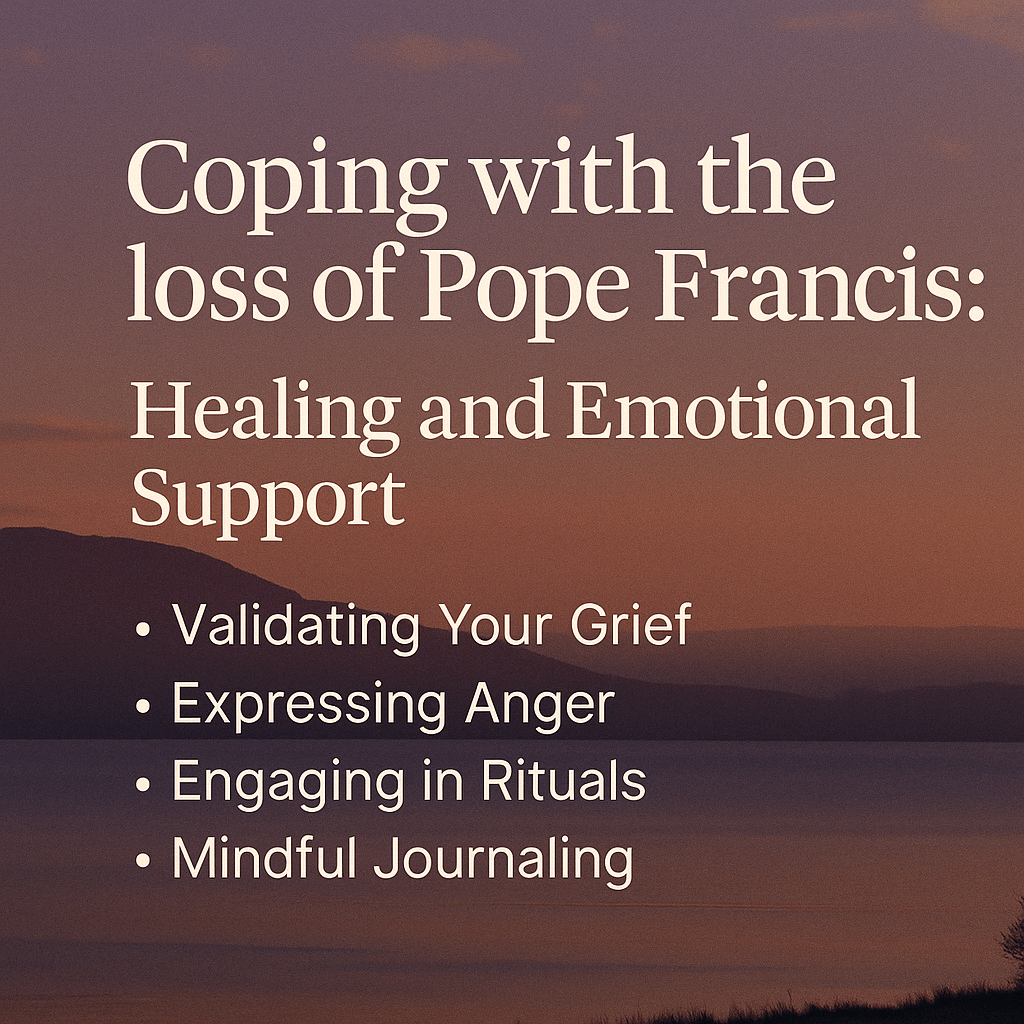
  • To Those Grieving the Passing of Pope Francis: How the Catholic Church Offers Comfort and Encouragement

    To Those Grieving the Passing of Pope Francis: How the Catholic Church Offers Comfort and Encouragement


    🕊️ On Easter Monday, April 21, 2025, the world awoke to the somber news that Pope Francis had passed away at age 88, in his residence at the Vatican’s Casa Santa Marta. Just a day earlier, he had delivered his final Easter blessing from a wheelchair, a symbol of his unwavering devotion to the Church and the faithful.

    For many, Pope Francis was more than a religious leader. He was a beacon of mercy, humility, and justice—reaching beyond denominational lines to serve as a global voice of conscience. His passing has left millions mourning deeply, not just the man, but what he stood for.


    💔 Validating Grief: A Natural Response to Loss

    Grieving a spiritual leader like Pope Francis is both personal and collective. According to the Catechism of the Catholic Church, mourning is not only natural—it’s sacred. It is a sign of the love we carry and the loss we now endure.

    Psychologist George Bonanno explains that grief is not a set of steps but a highly individual process. Some may cry; others feel numb. Some may grow angry; others experience peace. All responses are valid (Bonanno, 2004).

    “Grief is the price we pay for love, and its shape will look different in every life it touches.”
    – George A. Bonanno, American Psychologist


    🔥 Navigating Grief Through the Lens of Anger

    One common but often misunderstood emotion during grief is anger. It can manifest as frustration with the timing of the loss, with God, with the Church, or even with ourselves. This is a human reaction, and the Church provides space for that honesty.

    ✝️ The Catholic Approach to Anger

    Pope Francis himself addressed this in his book The Name of God is Mercy:

    “Speak openly to God about your anger—He understands and listens.”
    – Pope Francis, 2015

    Faith invites us not to suppress anger but to express it prayerfully. In doing so, we invite grace into our healing process.

    🛠️ Tools to Cope with Anger in Grief

    • Prayer: Talk to God honestly. Express your confusion, hurt, or frustration.
    • Journaling: Use written words to name your emotions and patterns.
    • Breathwork: Try calming techniques like box breathing or breath prayers.
    • Community: Lean on friends, priests, or grief support groups.
    • Professional Counseling: Seek licensed grief counselors or pastoral care ministers.

    🕯️ Catholic Traditions: Pathways to Healing

    From funerals to novenas, the Catholic Church offers spiritual and symbolic rituals that help the faithful process loss while drawing closer to hope.

    • Funeral Mass: Celebrates the life of the deceased while reminding us of resurrection.
    • Novenas: Nine-day devotional prayers for the soul of the departed.
    • Lighting Candles: A tangible sign of prayer and remembrance.
    • Holy Communion: A reminder of our unity with the saints and the departed.
    • All Souls’ Day: A sacred tradition of remembering the dead in prayer each year.

    Dr. Alan Wolfelt, a noted grief expert, writes:

    “Rituals help mourners not only remember those they love but transform the pain of grief into meaning.”
    – Wolfelt, A.D., 2016


    🧘 Emotional Healing After Death

    Grief affects the body, mind, and spirit. The Catholic Church encourages balance between spiritual nourishment and emotional wellness.

    Spiritual Tools:

    • Daily Rosary: A grounding prayer rhythm for peace.
    • Silent Retreats: Opportunities to be still and listen for God.
    • Scripture Reflection: Reading Psalms or verses on comfort (e.g., Psalm 34:18, Matthew 5:4).

    Psychological Tools:

    • Mindfulness Meditation: Accept your feelings without judgment.
    • CBT: Challenge distorted thoughts that prolong guilt or hopelessness.
    • Support Groups: Seek local or online Catholic grief circles (like GriefShare).

    👧 Supporting Children Through the Grief of a Public Loss

    Children often sense collective sorrow but may not understand it. Help them process Pope Francis’s death gently.

    • Explain Simply: “Pope Francis died. He was very old and sick. He is now with God.”
    • Allow Questions: Let them ask what they need to.
    • Creative Expression: Drawing, music, or lighting candles in prayer.
    • Read Together: Use children’s books on death and Heaven.
    • Stick to Routines: Predictability offers comfort.

    🌱 Growing Through Grief: A Legacy of Compassion

    Pope Francis believed that suffering can deepen our compassion. He reminded us that grief should move us toward mercy—not away from it.

    “From pain, we learn compassion; from loss, we learn deeper love.”
    – Pope Francis, 2019

    As we mourn him, let us embody his legacy: to be people of peace, humility, and love.


    📝 Reflective Journal Prompt

    Prompt: “Which quality of Pope Francis—his kindness, courage, or humility—do you want to carry forward in your own life? Write about a memory, story, or teaching that brings you peace.”


    🔍 References

    • Bonanno, G. A. (2004). Loss, Trauma, and Human Resilience. American Psychologist, 59(1), 20–28.
    • Francis, Pope. (2015). The Name of God is Mercy. Random House.
    • Francis, Pope. (2019). Christus Vivit. Vatican Publishing House.
    • Kübler-Ross, E., & Kessler, D. (2005). On Grief and Grieving. Scribner.
    • Wolfelt, A. D. (2016). Understanding Your Grief. Companion Press.

  • Zoroastrian Grief Traditions and Scriptures: Spiritual Comfort After Death and Loss

    Zoroastrian Grief Traditions and Scriptures: Spiritual Comfort After Death and Loss

    Exploring sacred wisdom for healing and hope through the lens of Zoroastrianism


    Wrestling with Death and the Sacred Fire of Grief

    Grief is both universal and deeply personal. Whether anticipated or sudden, the loss of a loved one disrupts not only our routines but our worldview. Many of us, in our search for comfort, return to our spiritual foundations. For followers of Zoroastrianism—one of the world’s oldest faiths—loss is not something to escape but something to walk through, supported by light, truth, and divine order.

    Rooted in the teachings of the prophet Zarathustra and preserved in scriptures known as the Gathas, Zoroastrianism offers profound insight into the soul’s immortality, the rituals of mourning, and the nature of divine justice. During times of loss, these ancient truths offer more than comfort—they offer transformation.


    “Let Wisdom Come to the Soul”

    “Let wisdom come into the soul through the righteous order, and let the understanding of truth bring comfort to the heart.”
    — Yasna 30.9, The Gathas

    This verse centers Zoroastrian grief traditions around asha—divine order, truth, and righteousness. In the Zoroastrian worldview, the soul (urvan) continues after death, embarking on a three-day journey to the Chinvat Bridge, where it is judged based on thoughts, words, and deeds. The righteous cross into the House of Song, a peaceful spiritual realm of light and harmony.

    Grief, then, is a sacred time of honoring that journey. Through rituals and prayers, mourners reaffirm their trust in divine justice and the enduring connection with the deceased.


    Reflection: Light and the Soul’s Journey

    In Zoroastrianism, fire is not merely symbolic—it is sacred. It represents the eternal presence of Ahura Mazda (the Wise Lord) and the spiritual illumination that guides the soul. Rather than extinguishing light in mourning, Zoroastrians elevate it. Candles are lit, fires are tended, and prayers like the Ahunavaiti Gatha are recited to hold vigil for the departed soul.

    One common prayer echoes the cosmic rhythm of light over darkness:

    “Truth is the best of all good; it blesses those who seek it with good thoughts, words, and deeds.”

    Modern priest and scholar Dr. Farrokh Mistree (2021) emphasizes that fire in grief is more than a ritual—it is a divine companion, reminding us that even in sorrow, light endures.


    Faith and Psychology: Rituals of Remembrance and Renewal

    From a psychological perspective, rituals help give structure to grief. Dr. Sameet Kumar (2005) notes that spiritually rooted mourning practices offer a container for emotion, helping mourners process loss with intention and resilience.

    Zoroastrian mourning practices include:

    • The Three-Day Vigil: Loved ones keep watch while the soul journeys to the Chinvat Bridge.
    • Sodabeh Ceremonies: Held on the 4th, 10th, and 30th days to honor the soul’s transition.
    • Farvardigan Festival: An annual remembrance of ancestors, where the living connect with the fravashis (guardian spirits).

    The hope of frashokereti—a future resurrection and the final purification of all creation—sustains the Zoroastrian vision of life after death. The soul’s journey is not a lonely one. It is part of a greater cosmic restoration.

    This resonates with Dr. George Bonanno’s (2009) concept of “meaning-centered grief,” where rituals serve to build spiritual resilience and maintain emotional bonds with those who have passed.


    Hidden Gem: The Mystery of the Fravashi

    One of the most beautiful and often overlooked beliefs in Zoroastrianism is that of the fravashi—a guardian spirit or eternal essence of each soul. Unlike the urvan, which journeys after death, the fravashi remains with the family, offering protection and moral guidance.

    During the Farvardigan, offerings are made to the fravashis of the dead, affirming that love and presence endure beyond the grave. Scholar Dr. Jenny Rose (2011) explains:

    “The fravashi represents the eternal blueprint of goodness. In moments of sorrow, we call upon it not to change the past, but to walk faithfully in the present.”

    Even in death, we are never truly disconnected.


    A Home Ritual for Zoroastrian-Inspired Grief Healing

    You do not have to be Zoroastrian to find comfort in its sacred traditions. Below is a gentle, spiritually meaningful ritual that can be done at home.

    Five-Step Grief Reflection:

    1. Create a Sacred Space: Set aside a small table with a candle, flower, or photo.
    2. Light a Flame: Symbolize the eternal fire and the journey of the soul.
    3. Recite Yasna 43.1: Or use this line: “Truth is the path to peace. May we walk it with those we love.”
    4. Speak Their Name: Say one memory aloud.
    5. Close with the phrase: Hama Zor Hama Asho Bed (May we be united in righteousness).

    Even for those outside the Zoroastrian tradition, this practice offers spiritual comfort after loss, helping you honor grief with light and meaning.


    Conclusion: Truth, Fire, and the Journey Beyond

    Zoroastrianism does not promise a life without suffering—but it offers a life filled with meaning, light, and sacred order. In the face of death, Zoroastrian scriptures assure us that truth endures, the soul journeys on, and love transcends time.

    Whether you are grieving personally or supporting someone who is, the Zoroastrian path of comfort offers profound spiritual tools for reflection, connection, and healing.

    Let the light of asha guide you through loss, and may the fravashi of your loved ones walk with you.


    References (APA Style)

    Bonanno, G. A. (2009). The Other Side of Sadness: What the New Science of Bereavement Tells Us About Life After Loss. Basic Books.

    Kumar, S. (2005). Grieving Mindfully: A Compassionate and Spiritual Guide to Coping with Loss. New Harbinger Publications.

    Mistree, F. (2021). The Eternal Flame: Zoroastrianism in the Modern World. Zoroastrian Heritage Series.

    Rose, J. (2011). Zoroastrianism: An Introduction. I.B. Tauris.

    Yasna (The Gathas of Zarathustra). Retrieved from https://www.sacred-texts.com/zor/index.htm

  • Faith and Loss: Easter, Christian Grief, and the Comfort of Resurrection

    Faith and Loss: Easter, Christian Grief, and the Comfort of Resurrection

    Wrestling with Death During the Season of Life

    Easter trumpets life while many hearts quietly ache with death. It is the season of “He is risen!”—but also of empty chairs and silent tears. In the stillness after loss, Christian grief carries a distinct tension: we believe in resurrection, yet we feel the sting of death. Christianity invites us to hold both at once. It teaches us not to rush past grief in the name of faith, but to meet God inside it—to find Him in the tomb before we see Him in the garden.

    John 11:25–26 – Resurrection, Now and Forever

    “I am the resurrection and the life,” Jesus tells Martha, “He who believes in Me, though he may die, he shall live. And whoever lives and believes in Me shall never die. Do you believe this?” (John 11:25–26, NKJV)

    This isn’t just a promise of heaven—it’s a present-tense invitation to believe in Christ’s authority over death today. Christianity reveals Jesus not only as future hope but as current resurrection. His question to Martha is His question to us: “Do you believe this?” Not with your head, but with your heart—especially when it breaks.

    Jesus Weeps Before He Raises

    Before raising Lazarus, Jesus pauses to mourn. “Jesus wept” (John 11:35) is not divine sentimentality. It is incarnate empathy. He cries with us and for us—not because He is powerless, but because He is love. His tears were prophetic: showing us that grief is not weakness but worship. He sanctified sorrow, not as a temporary feeling to bypass, but a place to meet the Father in intimacy.

    Grieving as a Christian isn’t doubting God’s power—it’s trusting Him enough to cry in front of Him.

    The Spiritual Work of Mourning: Christian Grief as Prophetic Witness

    Grief is not passive. It’s spiritual work. We are not merely waiting to “feel better”—we are bearing witness to resurrection in the making. As theologian Jürgen Moltmann said, “Faith, wherever it develops into hope, causes not rest but unrest.” This unrest is sacred.

    The Bible calls this groaning. “We ourselves groan within ourselves, eagerly waiting for the adoption, the redemption of our body” (Romans 8:23). Grief is groaning. And the Spirit intercedes with groans too deep for words (Romans 8:26). The prophetic dimension here is clear: our mourning becomes an intercession that shakes the heavens.

    Faith and Psychology: Lament, Hope, and Emotional Healing

    Psychologically, lament is one of the healthiest tools of recovery. The Psalms are filled with it—songs of protest, of grief, of complaint. Modern Christianity too often prizes praise and suppresses sorrow. But lament is biblical praise. It’s worship that bleeds.

    Theologian Walter Brueggemann argued that lament provides structure to our grief, keeping it from becoming chaos. We move from lament to declaration. From “How long, O Lord?” to “But I will yet praise You.”

    Diane Langberg affirms that when trauma is met with silence, healing halts. But when pain is named—in prayer, in journaling, in Spirit-filled community—healing begins. The Comforter is not only present to dry tears but to help us transform them.

    The Resurrection Body and the Cloud of Witnesses

    Our hope is not merely spiritual comfort, but bodily resurrection. “So also is the resurrection of the dead. The body is sown in corruption, it is raised in incorruption” (1 Corinthians 15:42). Apostolic teaching goes further: the glory of the resurrection body far outweighs the pain of loss.

    Hebrews 12 speaks of the “great cloud of witnesses”—those who have gone before us and still surround us. Grieving believers are never alone. The veil is thin. Your mother, your child, your spouse—though gone, they are not absent in the Spirit.

    One Extra: Prophetic Remembrance through Yahrzeit

    Borrowing from the Jewish tradition of yahrzeit—the yearly remembrance of a loved one’s passing—we can create rituals of spiritual memory. Light a candle. Speak a Scripture. Share a testimony of how their life still bears fruit.

    This transforms grief into testimony. We become prophets of remembrance, declaring, “Death is not the end. They live in Christ, and we will see them again.”

    The Empty Tomb Is a Message to the Grieving

    Easter’s empty tomb doesn’t deny death—it defeats it. For those grieving, this is the hardest and holiest part of faith: to mourn what is gone and still proclaim that Christ is risen. Resurrection doesn’t cancel sorrow—it transforms it.

    The work of grief is holy. And as we walk through it, the Spirit groans with us, Jesus weeps with us, and the Father prepares a table for us—in the presence of our enemies, even death.

    References (APA Style)

    • Brueggemann, W. (1984). The Message of the Psalms: A Theological Commentary. Augsburg Fortress.
    • Deere, J. (2020). Even in Our Darkness: A Story of Beauty in a Broken Life. Zondervan.
    • Langberg, D. (2020). Suffering and the Heart of God: How Trauma Destroys and Christ Restores. New Growth Press.
    • Moltmann, J. (2004). The Coming of God: Christian Eschatology. Fortress Press.
    • Wright, N. T. (2003). The Resurrection of the Son of God. Fortress Press.
  • Healing Through Faith: 10 Bible Verses for Comfort After Loss

    Healing Through Faith: 10 Bible Verses for Comfort After Loss

    Spiritually nourishing, theologically rich, and prophetically honest

    When Faith Meets Grief

    Grief doesn’t wait for convenience—it arrives like a storm, disrupting our plans and unsettling our souls.
    In a culture that often treats grief as a detour or weakness, Christians are called to wrestle with loss through the lens of eternity.
    But how?

    In the Christian tradition, grief isn’t minimized—it’s met with power. God doesn’t only comfort—He rebuilds.
    He transforms ashes into beauty and mourning into purpose.
    This post explores how Christians can find deep comfort and healing through faith, blending biblical scriptures, and Christian psychological insights to walk through grief with both honesty and hope.

    Isaiah 61:1–3 — Beauty for Ashes

    “The Spirit of the Sovereign Lord is upon me… to comfort all who mourn… to bestow on them a crown of beauty instead of ashes…” (Isaiah 61:1–3, NIV)

    Isaiah 61 is a foundational text in Christianity. It not only predicts the coming of Christ but outlines His mission:
    to bring holistic healing to the soul, especially through grief. This isn’t a passive comfort—it’s an impartation.
    When Jesus quotes this in Luke 4:18, He declares that He is the fulfillment of comfort itself.

    The Hebrew word for “beauty” in verse 3 refers to a turban or crown, a royal adornment.
    This means God doesn’t just take away grief—He replaces it with honor, identity, and purpose.

    Devotional Reflection: The Grieving God

    “Jesus wept.” (John 11:35)

    When Jesus encountered Mary and Martha mourning the death of Lazarus, He did not jump to resurrection. He wept.
    Though He knew joy was coming, He allowed Himself to feel the sting of loss. This is the God who grieves with us—
    not from a distance, but eye to eye, shoulder to shoulder.

    In the prophetic worldview, Jesus’ tears were not only empathetic—they were intercessory.
    He joined their pain and shifted the spiritual atmosphere before performing the miracle.
    Your tears, too, carry prophetic power.

    Faith & Psychology: Lament, Hope, and the Sacred Role of Prayer

    Lament is a forgotten language in many Christian circles. But biblically, lament is not a sign of weakness—it is a form of worship.
    Over one-third of the Psalms are laments. They model how to cry out, question God, and still cling to Him.

    Christian psychologist and trauma expert Dr. Diane Langberg writes,
    “Trauma sufferers need to know that their cries do not exclude them from God’s presence. In fact, they are a door to it.” (Langberg, 2015).

    Modern neuroscience supports this. Dr. Harold Koenig found that prayer during grief decreases cortisol (stress hormone) levels and rewires the brain toward resilience (Koenig, 2012).
    This science aligns with spiritual truth: when we speak out our grief in prayer, heaven responds.

    10 Bible Verses for Christian Grief and Spiritual Comfort After Death

    1. Psalm 34:18 — “The Lord is close to the brokenhearted and saves those who are crushed in spirit.”
    2. Matthew 5:4 — “Blessed are those who mourn, for they will be comforted.”
    3. 2 Corinthians 1:3–4 — “The God of all comfort… comforts us in all our troubles.”
    4. Isaiah 41:10 — “Do not fear, for I am with you… I will strengthen you and help you.”
    5. Revelation 21:4 — “He will wipe every tear… there will be no more death.”
    6. John 14:1–3 — “Do not let your hearts be troubled… I am preparing a place for you.”
    7. Psalm 147:3 — “He heals the brokenhearted and binds up their wounds.”
    8. Romans 8:18 — “Our present sufferings are not worth comparing…”
    9. 1 Thessalonians 4:13–14 — “We do not grieve like the rest… for we believe Jesus died and rose again.”
    10. Lamentations 3:22–23 — “His mercies are new every morning.”

    These are not just comforting verses—they are divine declarations of God’s eternal plan to restore all things.

    One Extra Tip: Anointing as an Act of Healing

    Few Christians realize how powerful it is to anoint themselves or others with oil in grief.
    James 5:14 invites the elders to anoint the sick. But this sacred act also applies to emotional wounds.

    Try this:

    • Light a candle.
    • Anoint your head or heart with oil.
    • Read Isaiah 61.
    • Declare: “Beauty for ashes is my portion.”

    This practice anchors your soul in divine truth and invites the Holy Spirit to minister directly to the places where words fail.

    Conclusion: The Grief-Walking God

    Loss is real. The pain is sharp. But so is the promise. We grieve—but we do not grieve without hope (1 Thess. 4:13).
    Through Jesus, mourning becomes sacred ground. God doesn’t only meet you in the valley—He walks through it with you.

    In Christianity, we don’t merely survive grief—we declare resurrection through it.

    References (APA Style)

    • Koenig, H. G. (2012). Religion, spirituality, and health: The research and clinical implications. ISRN Psychiatry, 2012, 278730. https://doi.org/10.5402/2012/278730
    • Langberg, D. (2015). Suffering and the Heart of God: How Trauma Destroys and Christ Restores. New Growth Press.
    • The Holy Bible, New International Version. (2011). Biblica.
    • Wright, N. T. (2008). Surprised by Hope: Rethinking Heaven, the Resurrection, and the Mission of the Church. HarperOne.