Honoring Life, Embracing Memories

Category: Europe

  • Ukrainian Grief Rituals: How a Nation Honors Death and Remembers the Dead

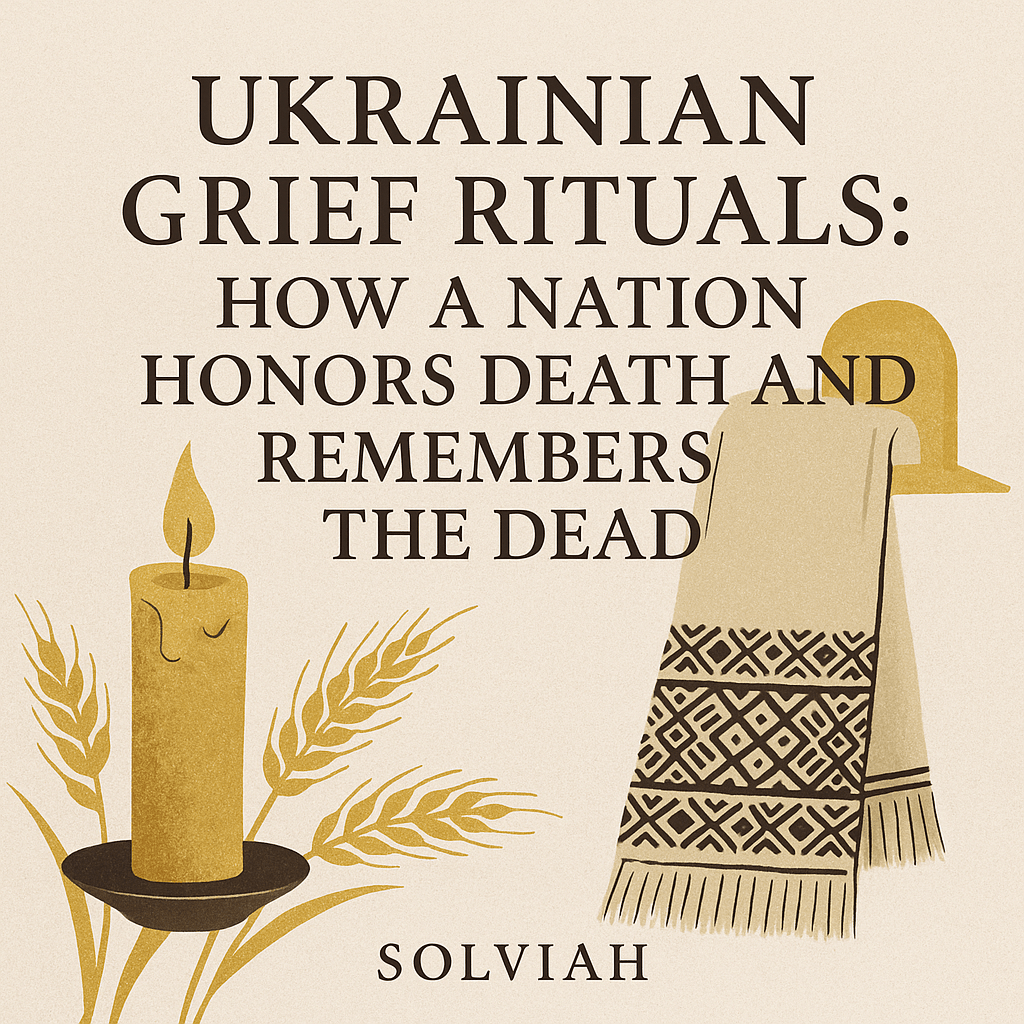
    Ukrainian Grief Rituals: How a Nation Honors Death and Remembers the Dead

    “The soul does not die; it just changes its house.”
    — Ukrainian proverb

    🕯️ A Candle in the Window

    In a small apartment overlooking the golden domes of Lviv, a grandmother ties a black headscarf under her chin. The air smells of beeswax and dill. A single candle flickers by the window—its light a beacon for the soul of her departed son, lost to war. Beside her, a child stirs honey into a bowl of kutia. The forty-day vigil has begun.

    This is not just mourning. This is memory as resistance. This is grief woven into ritual.

    ↑ Back to top


    🌾 Mourning the Ukrainian Way

    Ukraine’s grief traditions blend Orthodox Christianity, pre-Christian folklore, and family-based practices into a slow, reverent process. Death is not abrupt—it is a passage, and the soul must be cared for and remembered.

    Grief unfolds through all five senses in Ukraine:

    • Winter funerals: often take place in frozen soil, where mourners stamp their boots in silence.
    • Summer burials: may involve open-air memorials with blooming wildflowers laid across fresh graves.
    • Food: comforts the living and honors the dead. Kutia—sweet, nutty, and laced with symbolism—is always the first dish served (Pavlyshyn, 2021).

    Every element—from embroidered rushnyk cloths draped over icons to the solemn ring of church bells—grounds the experience of loss in culture and continuity.

    ↑ Back to top


    🧵 Traditional Mourning Practices

    What the Body Wears: The deceased is dressed in their best clothes—often white or embroidered, symbolizing purity. Women mourners wear dark clothing and a black kerchief for up to a year. Jewelry and bright colors are avoided out of respect.

    Funeral Rites: A priest offers the Panakhyda (memorial service), reciting Psalms and prayers (Wikipedia, n.d.). The body may remain in the home for up to three days with mirrors covered and candles burning beside the coffin. At the grave, earth is placed in the sign of the cross on the casket before final prayers.

    Memorial Meals – Pomynky: After burial, families gather to share ritual foods like kutia, cabbage rolls, rye bread, and vodka. Additional meals and prayers are held on the 3rd, 9th, and 40th days (Wikipedia, n.d.).

    ↑ Back to top


    ⏳ The Forty Days

    In Orthodox belief, the soul wanders Earth for forty days after death:

    • On Day 3: The soul is shown Heaven.
    • On Day 9: It sees the torments of Hell.
    • On Day 40: It stands before the throne of judgment (Wikipedia, n.d.).

    But the forty days are not just theological. They are emotional. Candles are lit every evening. A rushnyk cloth may be placed near a photo of the deceased. Children watch. Elders repeat. And slowly, grief begins to find shape.

    ↑ Back to top


    🫂 Communal Grief and Collective Memory

    To grieve in Ukraine today is to do so not alone, but as part of a people who understand loss as shared history. When a child loses a parent to war, the village mourns. When a soldier is buried, strangers attend. When air raid sirens pierce a funeral, mourners hold hands and keep praying.

    In Kyiv, walls bear the faces of fallen heroes (Kulyk, 2020). In the Hutsul highlands, the “Provody” tradition continues—centuries-old and now revived during war (The Guardian, 2024). Along highways, communities kneel to honor passing funeral processions (War.ukraine.ua, 2023). These are not customs. They are collective acts of dignity and memory.

    ↑ Back to top

    From collective mourning to personal support, the next section explores how we can stand beside those grieving across cultures.

    🤝 For Supporters and Friends

    Grief makes many feel unsure of what to say. Silence can feel safer—but also like abandonment. Instead, offer presence, understanding, and respect for Ukrainian mourning customs (INTO, 2019).

    What You Can Say:

    • “I lit a candle for them today.”
    • “Would you like to share a memory?”
    • “Is there a ritual I can honor with you?”

    What to Avoid:

    • “They’re in a better place now.”
    • “Everything happens for a reason.”
    • “At least they died for something.”

    Other Gestures: Bring symbolic food. Offer to help mark the 40th day. Say their name weeks later. Presence often matters more than words.

    ↑ Back to top


    ⚖️ Comparison with Western Traditions

    Aspect Ukraine Western Traditions
    Mourning Period 40 days + annual rituals 1 week or less
    Food Traditions Kutia, pomynky feasts Buffets or potlucks
    Public Grief High—community kneeling, murals Often private

    ↑ Back to top


    🪞 What Ukraine Teaches Us

    Ukraine shows us that grief is not a detour from life—it is a sacred road through it. Rituals remind us:

    • Love does not vanish with death.
    • Memory is a collective inheritance.
    • Grief can be slow, beautiful, and shared.

    Reflection Prompt: Have you ever participated in a grief ritual that felt deeply healing—or one that left you wanting more? Share your story in the comments—we’d be honored to learn from you.

    ↑ Back to top


    📚 Glossary

    • Kutia: Sweet wheat-based funeral dish.
    • Pomynky: Communal meal after a funeral.
    • Radonitsa: Joyful remembrance day held at cemeteries in spring.
    • Panakhyda: Orthodox memorial service for the dead.
    • Rushnyk: Traditional embroidered cloth used in rites of passage.

    ↑ Back to top


    🔗 References

    • Hrytsak, Y. (2019). Historical memory and mourning rituals in Ukraine.
    • Kulyk, V. (2020). Public mourning and national identity in Ukraine.
    • Pavlyshyn, M. (2021). Food and funeral: Ukrainian rituals of remembrance.
    • Wikipedia. (n.d.). Memorial service in the Eastern Orthodox Church.
    • War.ukraine.ua. (2023). How Ukraine honors its fallen defenders.
    • The Guardian. (2024). The Hutsul “Provody”.
    • INTO. (2019). Supporting young people and children from Ukraine.
    ↑ Back to top

  • German Grief Culture: Comforting Quotes and Rituals for Healing After Loss

    German Grief Culture: Comforting Quotes and Rituals for Healing After Loss

    Wrestling with Loss through German Culture

    Grief crosses every border, but how we move through it is shaped by the place we call home. In German culture, mourning is steeped in silence, ritual, and poetry. While outward expressions of grief may seem controlled, they cloak a powerful emotional depth that’s rooted in both Christian and philosophical traditions. In the German experience, loss is met with both solemnity and structure—a quiet respect for death that offers comfort through order, memory, and sacred stillness.

    This article explores how quotes, traditions, and psychology in German culture shape the grieving process. Whether you’re grieving a loved one or walking with someone who is, German wisdom may offer a surprising pathway to healing.

    “Der Tod ist groß…” — Rainer Maria Rilke

    “Death is great. We are his when our mouths laugh. When we think we are in the midst of life, he dares to weep in our midst.”

    Rainer Maria Rilke, one of Germany’s most profound poets, gives us a glimpse into the duality of joy and sorrow. His words illustrate that grief is not just for cemeteries—it lives alongside laughter. In German grief culture, this is embodied in the phrase “Mein herzliches Beileid” (“My heartfelt condolences”): formal, understated, but rich in compassion.

    The funeral itself—die Trauerfeier—is a reflective ceremony, often structured and poetic. Rituals matter here. Black dress. Grave visits. Handwritten obituaries. Every act, quiet as it may be, affirms that grief is not chaos. It is sacred ground.

    Devotional Reflection: The Strength of Stillness

    “Seid stille und erkennet, dass ich Gott bin.” – Psalm 46:10

    Translated: “Be still and know that I am God.”

    German Protestant traditions (particularly Lutheran) have long emphasized Stille—holy silence—as a spiritual practice. In grief, stillness becomes a sanctuary. It allows the pain to surface slowly, without judgment. As Dr. Liane Dahlem (2021) observes, “Structured silence in German mourning is not passive. It’s active containment—emotional safeguarding.”

    This theological grounding transforms grief into a spiritual apprenticeship. To sit with sorrow in stillness is to meet God, not in noise or productivity, but in breath and being.

    Reflective Question: In what still places of your life have you encountered your grief most honestly?

    Cultural Psychology of German Grief: Ordnung, Sehnsucht, and Lament

    German culture holds Ordnung (order) and Besinnung (reflection) as central values. Even in death, there is form: the design of the cemetery, the layout of an obituary, the cadence of a condolence card. These aren’t cold or impersonal; they are protective frames that allow grief to unfold safely.

    Dr. Robert Neimeyer (2020) identifies meaning-making as a key to healing. In German mourning, language is one of the primary vehicles for this. Words like:

    • Vergänglichkeit – a poetic word for impermanence, gently reminding us all things fade
    • Sehnsucht – an untranslatable longing that aches with hope
    • Heimat – not just a place, but a soul-home, something (or someone) you yearn to return to

    These words don’t merely describe grief; they guide it.

    Prof. Anja Zwingenberger’s (2022) research shows that Germans who participate in mourning rituals (grave tending, memorial gatherings, Totensonntag) experience lower levels of unresolved grief. “Rituals allow the bereaved to reestablish control, meaning, and connection,” she writes.

    Modern German Mourning: Tradition Meets Transformation

    While older generations uphold traditional rituals, younger Germans are adapting. Urban memorial cafes, biodegradable urn forests (Friedwälder), and personalized grave art are modern responses to ancient needs.

    Some still find comfort in the Lutheran funeral liturgy; others blend mindfulness, philosophy, or humanist readings. Yet the cultural threads remain: space, structure, and reflection. And always, the language.

    Comforting German Quotes on Grief and Healing

    • “Was man tief in seinem Herzen besitzt, kann man nicht durch den Tod verlieren.”
      “What one holds deep in the heart, cannot be lost to death.”
    • “Die Erinnerung ist ein Fenster, durch das wir dich sehen können, wann immer wir wollen.”
      “Memory is a window through which we can see you whenever we wish.”
    • “Jeder Mensch geht durch denselben Tod. Doch das Leben, das er gelebt hat, bleibt einzigartig.”
      “Each person passes through the same death. But the life they lived remains unique.”

    These quotes offer more than words; they hold space for sorrow.

    Faith and Culture: Bonhoeffer’s Quiet Courage

    “Nothing can make up for the absence of someone we love… but this gap, as long as it remains unfilled, preserves the bond between us.” – Dietrich Bonhoeffer

    This is a theology of presence in absence—echoed across German grief traditions. It helps mourners honor what was, not erase it.

    Totensonntag

    On the last Sunday before Advent, Protestant churches observe Totensonntag—Sunday of the Dead. Names of the departed are read aloud; families light candles at graves. It’s a cultural and spiritual rhythm that brings the dead into memory before welcoming the hope of Christ’s birth.

    It affirms: grief returns in cycles, not because we are stuck, but because love still speaks.

    Closing Tip: Bringing German Grief Comfort into Your Life

    Try incorporating these elements into your own grief practice:

    • Create a small Erinnerungsecke (memory corner) in your home with photos, quotes, and a candle.
    • Use German quotes in sympathy cards or journal entries.
    • Mark anniversaries with acts of remembrance (planting a flower, writing a letter, attending a memorial).
    • Visit a cemetery—even if not your loved one’s. Walk in stillness. Let it teach you how to mourn well.

    References (APA Style)

    • Attig, T. (2011). How We Grieve: Relearning the World. Oxford University Press.
    • Dahlem, L. (2021). Structured Silence: Emotional Regulation and Mourning in German Households. Journal of Cross-Cultural Psychology, 52(8), 721–735. https://doi.org/10.1177/00220221211014591
    • Neimeyer, R. A. (2020). Meaning Reconstruction in the Wake of Loss. Death Studies, 44(5), 269–276. https://doi.org/10.1080/07481187.2019.1644953
    • Schnabel, U. (2019). Facing Mortality: German Cultural Norms and Death Education. Zeit Wissen, 12(4), 44–51.
    • Zwingenberger, A. M. (2022). Ritual Resilience: The Psychological Impact of Grief Practices in Contemporary Germany. European Journal of Cultural Psychology, 13(1), 18–34.