Honoring Life, Embracing Memories

Category: Culture

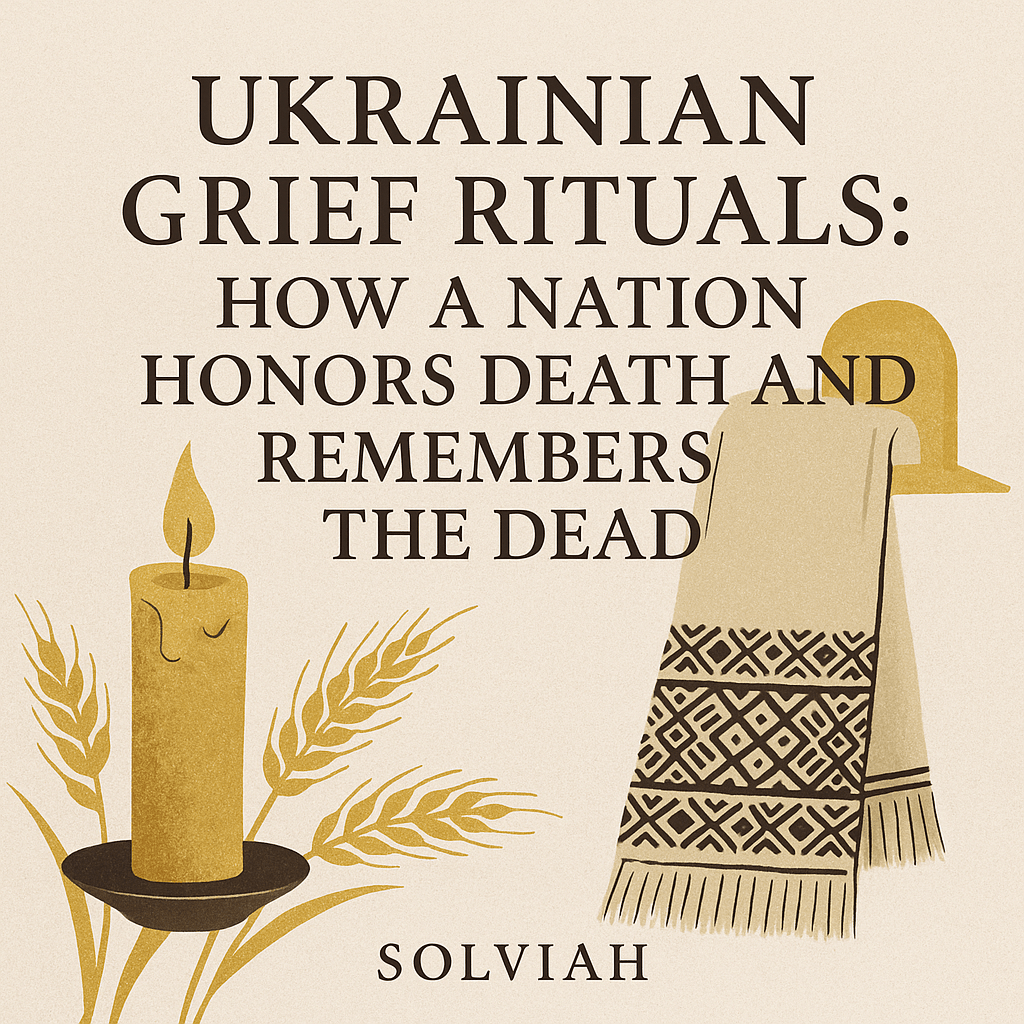
  • Ukrainian Grief Rituals: How a Nation Honors Death and Remembers the Dead

    Ukrainian Grief Rituals: How a Nation Honors Death and Remembers the Dead

    “The soul does not die; it just changes its house.”
    — Ukrainian proverb

    🕯️ A Candle in the Window

    In a small apartment overlooking the golden domes of Lviv, a grandmother ties a black headscarf under her chin. The air smells of beeswax and dill. A single candle flickers by the window—its light a beacon for the soul of her departed son, lost to war. Beside her, a child stirs honey into a bowl of kutia. The forty-day vigil has begun.

    This is not just mourning. This is memory as resistance. This is grief woven into ritual.

    ↑ Back to top


    🌾 Mourning the Ukrainian Way

    Ukraine’s grief traditions blend Orthodox Christianity, pre-Christian folklore, and family-based practices into a slow, reverent process. Death is not abrupt—it is a passage, and the soul must be cared for and remembered.

    Grief unfolds through all five senses in Ukraine:

    • Winter funerals: often take place in frozen soil, where mourners stamp their boots in silence.
    • Summer burials: may involve open-air memorials with blooming wildflowers laid across fresh graves.
    • Food: comforts the living and honors the dead. Kutia—sweet, nutty, and laced with symbolism—is always the first dish served (Pavlyshyn, 2021).

    Every element—from embroidered rushnyk cloths draped over icons to the solemn ring of church bells—grounds the experience of loss in culture and continuity.

    ↑ Back to top


    🧵 Traditional Mourning Practices

    What the Body Wears: The deceased is dressed in their best clothes—often white or embroidered, symbolizing purity. Women mourners wear dark clothing and a black kerchief for up to a year. Jewelry and bright colors are avoided out of respect.

    Funeral Rites: A priest offers the Panakhyda (memorial service), reciting Psalms and prayers (Wikipedia, n.d.). The body may remain in the home for up to three days with mirrors covered and candles burning beside the coffin. At the grave, earth is placed in the sign of the cross on the casket before final prayers.

    Memorial Meals – Pomynky: After burial, families gather to share ritual foods like kutia, cabbage rolls, rye bread, and vodka. Additional meals and prayers are held on the 3rd, 9th, and 40th days (Wikipedia, n.d.).

    ↑ Back to top


    ⏳ The Forty Days

    In Orthodox belief, the soul wanders Earth for forty days after death:

    • On Day 3: The soul is shown Heaven.
    • On Day 9: It sees the torments of Hell.
    • On Day 40: It stands before the throne of judgment (Wikipedia, n.d.).

    But the forty days are not just theological. They are emotional. Candles are lit every evening. A rushnyk cloth may be placed near a photo of the deceased. Children watch. Elders repeat. And slowly, grief begins to find shape.

    ↑ Back to top


    🫂 Communal Grief and Collective Memory

    To grieve in Ukraine today is to do so not alone, but as part of a people who understand loss as shared history. When a child loses a parent to war, the village mourns. When a soldier is buried, strangers attend. When air raid sirens pierce a funeral, mourners hold hands and keep praying.

    In Kyiv, walls bear the faces of fallen heroes (Kulyk, 2020). In the Hutsul highlands, the “Provody” tradition continues—centuries-old and now revived during war (The Guardian, 2024). Along highways, communities kneel to honor passing funeral processions (War.ukraine.ua, 2023). These are not customs. They are collective acts of dignity and memory.

    ↑ Back to top

    From collective mourning to personal support, the next section explores how we can stand beside those grieving across cultures.

    🤝 For Supporters and Friends

    Grief makes many feel unsure of what to say. Silence can feel safer—but also like abandonment. Instead, offer presence, understanding, and respect for Ukrainian mourning customs (INTO, 2019).

    What You Can Say:

    • “I lit a candle for them today.”
    • “Would you like to share a memory?”
    • “Is there a ritual I can honor with you?”

    What to Avoid:

    • “They’re in a better place now.”
    • “Everything happens for a reason.”
    • “At least they died for something.”

    Other Gestures: Bring symbolic food. Offer to help mark the 40th day. Say their name weeks later. Presence often matters more than words.

    ↑ Back to top


    ⚖️ Comparison with Western Traditions

    Aspect Ukraine Western Traditions
    Mourning Period 40 days + annual rituals 1 week or less
    Food Traditions Kutia, pomynky feasts Buffets or potlucks
    Public Grief High—community kneeling, murals Often private

    ↑ Back to top


    🪞 What Ukraine Teaches Us

    Ukraine shows us that grief is not a detour from life—it is a sacred road through it. Rituals remind us:

    • Love does not vanish with death.
    • Memory is a collective inheritance.
    • Grief can be slow, beautiful, and shared.

    Reflection Prompt: Have you ever participated in a grief ritual that felt deeply healing—or one that left you wanting more? Share your story in the comments—we’d be honored to learn from you.

    ↑ Back to top


    📚 Glossary

    • Kutia: Sweet wheat-based funeral dish.
    • Pomynky: Communal meal after a funeral.
    • Radonitsa: Joyful remembrance day held at cemeteries in spring.
    • Panakhyda: Orthodox memorial service for the dead.
    • Rushnyk: Traditional embroidered cloth used in rites of passage.

    ↑ Back to top


    🔗 References

    • Hrytsak, Y. (2019). Historical memory and mourning rituals in Ukraine.
    • Kulyk, V. (2020). Public mourning and national identity in Ukraine.
    • Pavlyshyn, M. (2021). Food and funeral: Ukrainian rituals of remembrance.
    • Wikipedia. (n.d.). Memorial service in the Eastern Orthodox Church.
    • War.ukraine.ua. (2023). How Ukraine honors its fallen defenders.
    • The Guardian. (2024). The Hutsul “Provody”.
    • INTO. (2019). Supporting young people and children from Ukraine.
    ↑ Back to top

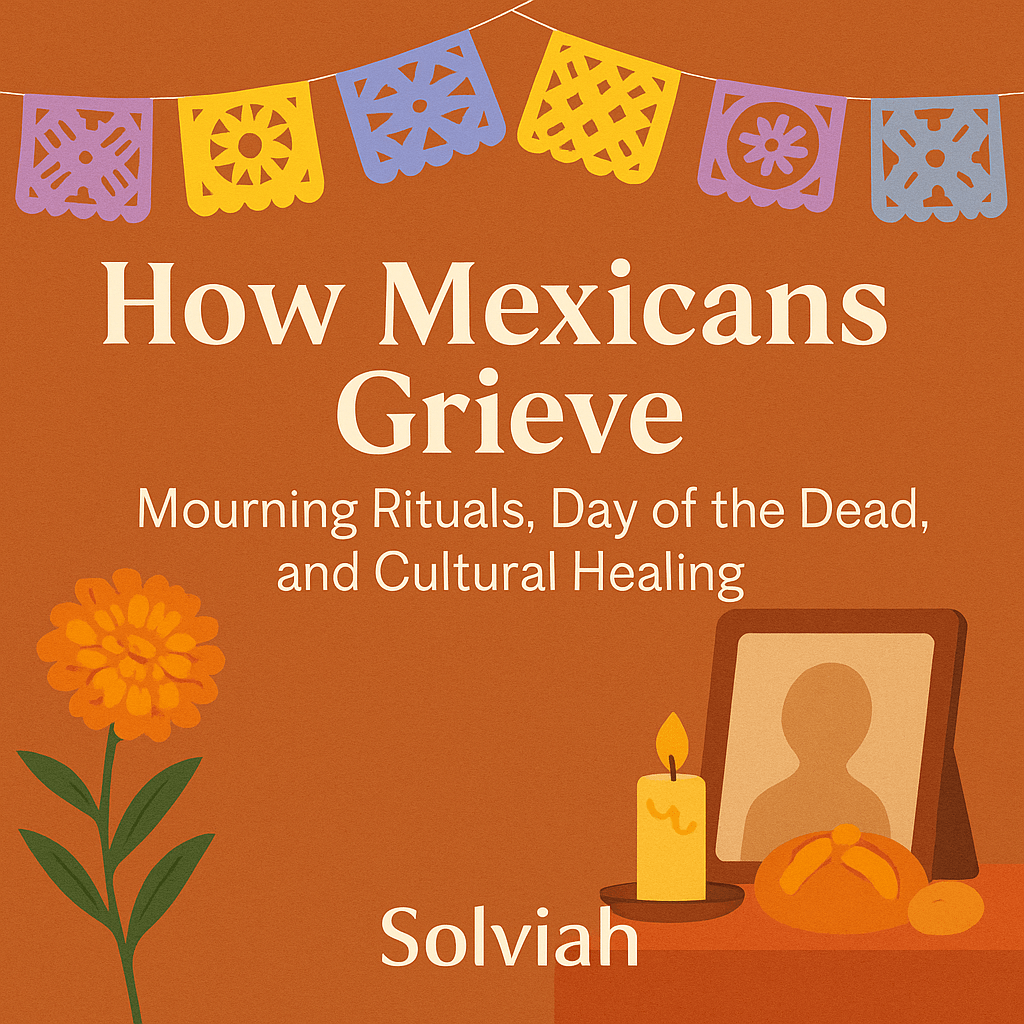
  • How Mexicans Grieve: Mourning Rituals, Day of the Dead, and Cultural Healing

    How Mexicans Grieve: Mourning Rituals, Day of the Dead, and Cultural Healing

    “They tried to bury us. They didn’t know we were seeds.” – Mexican Proverb

    Roots in Life and Legacy

    Mexico’s relationship with death comes from a deeply spiritual blend of pre-Columbian and Catholic beliefs. Long before the Spanish arrived, Aztecs, Mayans, Zapotecs, and other Indigenous peoples believed death was merely another stage of life. The goddess Mictecacihuatl ruled over the afterlife, safeguarding ancestors and ensuring they could revisit the living world once a year.

    Today, the Day of the Dead (Día de los Muertos) carries this ancient worldview into modern life. Families believe ancestors return, guided by trails of marigolds (cempasúchil), the flower whose scent leads spirits home.

    ↑ Back to Top

    What Grief Feels Like in Mexico

    Late October weather in Mexico is crisp and inviting, cooling evenings offset by warm, vibrant days. At home, families prepare pan de muerto, spicy tamales, cinnamon-laced atole, and complex mole sauces—a flavorful tribute to the complexity of grief itself.

    Colorful paper banners (papel picado) flutter in cemeteries. Candles and marigolds guide spirits, while mariachi music echoes familiar songs of remembrance. Grief in Mexico is felt, seen, tasted, and shared.

    ↑ Back to Top

    Diverse Traditions Across Mexico

    From the candlelit cemeteries of Oaxaca to the urban neighborhoods of Mexico City, traditions vary widely. Indigenous Zapotec communities may hold all-night vigils filled with prayer, while modern families create elaborate ofrendas with photos, food, and personal items.

    Formal mourning can last nine to forty days. Women may wear black or traditional embroidered huipiles, and remembrance culminates annually on Día de los Muertos—a day of reunion, not separation.

    ↑ Back to Top

    Communal Grief: Shared Stories and Healing Together

    During a velorio (wake), homes fill with neighbors offering prayers, tamales, and presence. People cry, laugh, share stories, and honor the person’s life in community. Humor softens pain—through stories, memories, and calaveras literarias, witty poetic tributes to the dead.

    Grief in Mexico is not meant to be carried alone.

    ↑ Back to Top

    The Mexican Way vs. Western Mourning

    Where Western cultures often silence grief, Mexico gives it music, ritual, and space. Funerals aren’t just endings—they’re invitations to keep remembering. Rather than moving on, Mexicans move forward with their loved ones in memory.

    Grief here evolves into relationship—not resolution.

    ↑ Back to Top

    A Glimpse Inside: An Evening of Remembrance

    Inside a family home, a glowing altar holds photos, favorite snacks, marigolds, and handwritten notes. Children place sugar skulls beside glasses of water. A soft hymn plays, and the air is thick with memory.

    Guests are greeted with warmth. Everyone is welcome. Grief is witnessed, not rushed.

    ↑ Back to Top

    A Personal Story of Grief

    Gardenia Rangel, a Mexican-American woman, shared her experience of honoring her parents who both passed away from COVID-19. She keeps their memory alive by maintaining an altar in her home adorned with their wedding portrait, electric candles, and mariachi music they loved. “I think about them every single day,” Rangel said. “But I never want to stop missing them because they say that people only die the day you forget them.” This personal ritual exemplifies how Mexican traditions provide comfort and a continuous connection to loved ones who have passed. Source

    ↑ Back to Top

    Anthropological Insights

    Dr. Beatriz Reyes-Foster, an anthropologist specializing in Mexican cultural practices, emphasizes the importance of Día de los Muertos in maintaining family bonds and cultural identity. She notes that the celebration allows for a communal space where grief is expressed openly and joyfully, reinforcing the idea that death is a natural part of life. This perspective challenges Western notions of mourning and highlights the value of embracing death as a continuation of relationships rather than an end. Source

    ↑ Back to Top

    If You’re Mexican and Grieving

    Your traditions are sacred. If those around you don’t understand, know that your grief matters deeply. You carry centuries of wisdom—grief through food, music, and memory. Your way of remembering is powerful, beautiful, and healing.

    We honor you, your loved ones, and the stories you keep alive.

    ↑ Back to Top

    For Non-Mexican Readers: How You Can Support

    • Be present. Offer help, meals, and listening ears.
    • Learn key phrases. Say “Te acompaño en tu dolor” — “I’m with you in your sorrow.”
    • Respect traditions. Ask questions, and participate if invited to rituals.
    • Be aware of sacred timing. Understand that grief resurfaces every year around Día de los Muertos.

    Your humility can become someone else’s comfort.

    ↑ Back to Top

    Reflection: What Mexico Teaches Us About Grief

    Mexico teaches us that grief isn’t meant to be erased. It is an invitation—to remember, to honor, and to reconnect. In embracing both joy and loss, we find that healing doesn’t come from forgetting, but from remembering together.

    ↑ Back to Top

    Share Your Experience

    Have you experienced a grief tradition that touched your heart? Or supported someone from another culture through loss?

    We invite you to reflect or journal:

    • How do I keep my loved ones alive in memory?
    • What can I learn from cultures that grieve differently?
    • Who around me might need my support today?

    Share your thoughts in the comments below.

    ↑ Back to Top

    Glossary

    • Día de los Muertos: A Mexican holiday honoring the dead with altars, offerings, and celebration.
    • Ofrenda: A home altar with food, photos, candles, and personal mementos for the deceased.
    • Cempasúchil: Bright orange marigold flowers believed to guide spirits home.
    • Velorio: A wake or prayer vigil before the funeral.
    • Papel Picado: Colorful cut-paper banners symbolizing the fragility of life.
    • Huipil: Traditional embroidered blouse worn by Indigenous women.
    • Calaveras Literarias: Humorous poems honoring the dead, often shared during Day of the Dead.

    ↑ Back to Top

    References

    • Brandes, S. (1998). The Day of the Dead, Halloween, and the quest for Mexican national identity. Journal of American Folklore, 111(442), 359-380.
    • Lomnitz, C. (2005). Death and the Idea of Mexico. Zone Books.
    • García, A. (2010). The Pastoral Clinic: Addiction and Dispossession Along the Rio Grande. University of California Press.
    • AfterTalk. (2021). Day of the Dead and Mexican-American funeral service rituals. Retrieved from AfterTalk.com
    • Orange County Library System. (2022). Día de los Muertos: Q&A with Dr. Beatriz Reyes-Foster. Retrieved from ocls.org

    ↑ Back to Top


  • Grief and Celebration on Yom HaAtzma’ut: Israeli Mourning Traditions in a Time of War

    Grief and Celebration on Yom HaAtzma’ut: Israeli Mourning Traditions in a Time of War

    What Yom HaAtzma’ut Feels Like

    In early May, spring is in bloom across Israel. Hillsides are painted in red poppies and yellow wildflowers. The air carries warmth — perfect for outdoor gatherings — and streets fill with the smell of grilled meats and the hum of music.

    Families head to parks, beaches, and nature trails with Israeli flags in hand. They barbecue, sing, laugh, and rest.

    But beneath the celebration is a shared understanding: we are only here because others are not.

    “Before we started the mangal,” says Orna, whose son fell in combat last year, “we lit a candle and set a plate for him. Then we played his favorite song. We smiled through tears. That’s how we carry him.”

    ⬆️ Back to Top

    Today’s Yom HaAtzma’ut: Grief in a Time of War

    This year, Yom HaAtzma’ut arrives during a deeply painful time. The ongoing war and the presence of hostages have reshaped the emotional tone of the holiday.

    • Some celebrations have been canceled or scaled back.
    • Ceremonies include silence for the hostages and fallen soldiers.
    • Families of the kidnapped often mourn and protest rather than celebrate.

    Even for those not directly affected, the mood is heavier. Flags still wave, grills still light, but the songs are softer. Joy feels complicated — and that’s okay.

    ⬆️ Back to Top

    Mourning Practices Around Yom HaAtzma’ut

    Because Yom HaAtzma’ut follows Yom HaZikaron, many families shift quickly from grief to celebration — a cultural and emotional pivot few outsiders can understand.

    On Yom HaZikaron, candles are lit, cemeteries are visited, and national radio airs personal stories. The entire country stands still during the siren. Then, at sundown, Yom HaAtzma’ut begins.

    At the national torch-lighting ceremony on Mount Herzl, thirteen citizens are chosen each year to light torches. In 2024, several were lit in honor of hostages and fallen first responders.

    Many families continue their remembrance with a lit candle, a prayer, or a shared story before festivities begin.

    ⬆️ Back to Top

    What Can Friends and Supporters Do?

    • 🕯️ Acknowledge both holidays
    • 💬 Reach out with empathy
    • 👂 Offer presence, not platitudes
    • 🫶 Support verified causes like hostagesandmissingfamilies.org

    Your presence and words, even from afar, can bring deep comfort.

    ⬆️ Back to Top

    A Word from Solviah to the Griever

    To the one celebrating with a shadow over your heart —
    To the one who lights a candle before you light a grill —
    To the one who watches the fireworks through quiet tears —

    We see you. We honor you. You are not alone.

    At Solviah, we believe grief is not something to “get over.” It’s something to carry with care. And this Yom HaAtzma’ut, we carry it with you.

    Zikhronam livrakha
    May their memory be a blessing.

    ⬆️ Back to Top

    Glossary

    • Yom HaAtzma’ut: Israeli Independence Day
    • Yom HaZikaron: Memorial Day for fallen soldiers and victims of terror
    • Mangal: Traditional Israeli outdoor barbecue
    • Hostages: Individuals kidnapped during war or terror attacks
    • Diaspora: Jewish communities outside Israel
    • Zikhronam livrakha: Hebrew for “May their memory be a blessing”

    ⬆️ Back to Top

    References

    • Ben-Yehuda, N., & Mishali-Ram, M. (2006). The commemoration of Israeli soldiers in public rituals and sites. Memory Studies, 1(2), 123–136.
    • Rosenblatt, P. C. (2017). Grief across cultures. In Stroebe, M., Schut, H., & van den Bout, J. (Eds.), Handbook of Bereavement Research and Practice (pp. 207–222). American Psychological Association.
    • Israel Ministry of Foreign Affairs. (n.d.). Yom HaZikaron and Yom HaAtzma’ut: National Commemoration and Celebration. Retrieved from gov.il
    • Goodman, Y. (2010). Military, memory, and the politics of mourning in Israel. Ethos, 38(4), 369–389.

    ⬆️ Back to Top

  • Grieving in Israeli Culture: Yom HaZikaron and Jewish Mourning Traditions

    Grieving in Israeli Culture: Yom HaZikaron and Jewish Mourning Traditions

    “We will never forget you. We will never cease to mourn you. We will never let you down.”

    — Official Yom HaZikaron Memorial Message, State of Israel

    In Israel, remembrance is not an afterthought—it is a national rhythm. Yom HaZikaron, the Day of Remembrance for Fallen Soldiers and Victims of Terror, opens a sacred space where grief is both national and deeply personal.

    ⬆️ Back to Top

    A Nation Paused: Sirens, Stillness, and Spring Air

    At 8:00 p.m., a siren rings out across Israel for one minute. Cars stop. People stand. Silence falls.
    The next morning, a two-minute siren at 11:00 a.m. begins official ceremonies across the country.

    The Red Everlasting flower, Dam HaMaccabim, adorns graves and lapels, symbolizing remembrance and sacrifice.

    ⬆️ Back to Top

    Jewish Mourning Traditions Within an Israeli Frame

    • Ner Zikaron: Memorial candles lit in homes and cemeteries.
    • Kaddish/Yizkor: Prayers recited to honor the dead.
    • Food: Dishes like lentil soup and round challah reflect Jewish mourning symbols.
    • Dress: Modest or subdued clothing shows solidarity and grief.

    ⬆️ Back to Top

    Today’s Israel: Grief Amid War and Trauma

    Following the October 7th attacks and ongoing conflict, Yom HaZikaron in 2025 carries new weight. It’s no longer just memorial—it’s therapy.
    It’s survival. Families grieve fresh wounds alongside generational ones.

    ⬆️ Back to Top

    How to Support from Afar

    • Observe moments of silence during Israel’s sirens.
    • Attend virtual memorials or share reflections online.
    • Reach out to Israeli friends or Jewish communities.
    • Educate yourself and others with resources like For Supporters & Friends.

    ⬆️ Back to Top

    A Sacred Transition: From Mourning to Joy

    At sundown, Yom HaZikaron ends and Yom HaAtzmaut begins. Fireworks replace tears. This contrast is intentional—a national expression of resilience.

    ⬆️ Back to Top

    What Can This Culture Teach Us?

    Grief in Israeli culture teaches us that mourning can be a communal act. That sorrow remembered can birth strength. And that the past lives in us when we choose to carry it forward.

    ⬆️ Back to Top

    Join the Conversation

    Have you participated in Yom HaZikaron? How does your culture honor its fallen? Share your experience in the comments.

    ⬆️ Back to Top

    Glossary

    • Yom HaZikaron: Israeli Memorial Day
    • Yom HaAtzmaut: Israeli Independence Day
    • Ner Zikaron: Memorial candle
    • Kaddish/Yizkor: Jewish mourning prayers
    • Shiva/Shloshim/Yahrzeit: Jewish grief periods
    • Dam HaMaccabim: Red Everlasting flower of remembrance

    ⬆️ Back to Top

    Sources (APA Style)

  • Grieving in Canada: Culturally Sensitive Funeral Traditions, Mourning Rituals, and the Journey Through Snow and Song

    Grieving in Canada: Culturally Sensitive Funeral Traditions, Mourning Rituals, and the Journey Through Snow and Song


    “When the drumbeat stops, the spirit walks on.”

    — Haudenosaunee (Iroquois) Proverb

    Across Canada’s vast, snowy landscapes, death is not seen as an ending, but as a continuation — a step into a living memory that shapes those left behind.

    To grieve in Canada is to feel the cold air bite your cheeks, to wrap grief in warmth and ceremony, and to honor the unbroken thread between the living and the dead.


    A Winter’s Mourning: A Sensory Journey ❄️

    Picture this:

    The snow crunches underfoot as mourners gather around a firepit near a longhouse. Their breath curls into the icy air. A woman wearing a hand-beaded shawl carefully adds cedar to the fire, its sweet smoke spiraling skyward. Nearby, elders ladle venison stew into wooden bowls, the rich aroma mingling with the crispness of the winter wind.

    Someone begins to drum — slowly, steadily — and the gathering hums with a sound older than memory. Here, mourning is not silence. It is story. It is song. It is survival.

    🔝 Back to Top


    Mourning Rituals in Canada: Clothing, Foods, Seasons, and Sacred Space

    Indigenous Traditions: Grieving With the Land

    For many Indigenous Canadians, mourning honors not just the person lost but the land they return to.

    • Clothing: Handmade garments adorned with shells, beadwork, and spiritual symbols.
    • Food: Bannock, smoked meats, berries, and cedar tea nourish body and spirit alike.
    • Seasons: Winter burials may be delayed, with ceremonies unfolding when the earth softens.

    “We live in cycles. Death is part of that circle. We mourn, we remember, and then we walk with our ancestors inside us.”

    — Louise McDonald, Cree Elder

    Large communal events like the Feast of the Dead (Wikipedia Contributors) strengthen the bond between generations.


    French-Canadian Mourning: Faith, Family, and Familiarity

    In Québec, Catholic traditions blend with resilient warmth:

    • Wakes: Two days of prayer, stories, and shared meals in homes or parlors.
    • Foods: Tourtière (savory meat pie), maple treats, hearty soups.
    • Emotion: Open weeping and laughter are both welcome, affirming life’s bittersweetness.

    Multicultural Mourning Across Modern Canada

    Today’s Canada embraces traditions from across the world:

    • Indian-Canadian families honor loved ones with marigold garlands and cremation ceremonies.
    • Caribbean-Canadians celebrate vibrant Nine-Night wakes with music and food.
    • Chinese-Canadians offer incense, fruits, and whispered prayers to ancestors.

    🌿 Learn more about emotional healing after loss.

    🔝 Back to Top


    Communal Grieving in Canada: Weathering Loss Together

    In Canada, grief is held collectively, like logs stacked together to keep the fire burning through winter.

    Indigenous Sała ceremonies (U’mista Cultural Society) gather entire villages for drumming, dance, and storytelling. In cities, multicultural memorials blend traditions, creating tapestries of prayer, song, and comfort.

    🤝 Supporting a grieving friend? Find resources here.

    🔝 Back to Top


    Comparing Mourning: Canada and Western Traditions

    Unlike Western funerals often limited to short ceremonies, Canadian mourning stretches into seasons, blending ritual, food, memory, and music. Here, grief is honored in all its forms — a dance of silence, storytelling, and remembrance.

    🔝 Back to Top


    Reflection: What Canadian Mourning Traditions Teach Us 🌿

    From the heavy stillness of winter air to the vibrant dance of multicultural celebrations, Canada teaches that:

    • Grief is a season, not a sentence.
    • Memory is not a weight — it is a torch.
    • The soul continues — through every shared story and act of remembrance.

    When the drumbeat stops, the spirit does not disappear.
    It walks onward — carried in our kindness, our songs, and the gentle footsteps we take in their honor.

    🔝 Back to Top


    Join Our Healing Circle 🌟

    We invite you to share your own experiences with mourning traditions, seasonal memories, or reflections below.

    Tell us about a song, a meal, a gathering — a moment when memory carried you forward.
    Your story could become someone else’s light in the snow.

    🔝 Back to Top


    Glossary 📖

    Term Meaning
    Feast of the Dead Huron-Wendat communal reburial ceremony honoring ancestors.
    Sała Ceremony Kwakwaka’wakw mourning gathering with storytelling and dance.
    Nine-Night Caribbean mourning tradition spanning nine nights of remembrance.
    Tourtière French-Canadian savory meat pie, common at wakes and celebrations.

    🔝 Back to Top


    References 🔖

    • Earle Waugh. (2010). Funeral Practices in Canada. The Canadian Encyclopedia.
    • St. John’s Dixie Cemetery. (n.d.). Canadian Funeral Customs and Traditions.
    • Wikipedia contributors. (n.d.). Huron Feast of the Dead. Wikipedia.
    • Louise McDonald, Cree Elder. (n.d.). Personal commentary.

    🕯️ Part of the Solviah Reflection Series 🕯️

  • Brazilian Mourning Rituals: A Deep Guide to Grieving, Healing, and Honoring Life

    Brazilian Mourning Rituals: A Deep Guide to Grieving, Healing, and Honoring Life

    “A saudade é o amor que fica.”

    — Brazilian Proverb

    In Brazil, love does not end at death. It lingers—like a favorite song, a familiar scent, a warm breeze—both invisible and profoundly present. This enduring connection is encapsulated in the concept of saudade, a deep emotional longing for someone beloved yet absent (1).

    Funeral traditions throughout Brazil honor this truth: death is not disappearance, but transformation. Understanding how other cultures deal with death invites us to rethink our own journeys through grief with greater openness, tenderness, and resilience.


    Table of Contents


    Mourning Rituals in Brazil

    Before exploring ceremonies of remembrance, we first step into the tender, time-honored rituals shaping Brazilian mourning.

    Clothing and Symbols

    Brazilian funerary customs embody a rich tapestry of Catholic, Afro-Brazilian, Indigenous, and secular traditions (2). Typically, mourners wear black to signify solemnity and respect. However, in many Afro-Brazilian practices, white garments symbolize purity, peace, and spiritual passage (3).

    Tokens of remembrance—rosaries, medals of saints, fresh white flowers—are commonly placed with the deceased, reflecting both religious devotion and cultural continuity (2,4). In rural areas, widows may wear black for extended periods, sometimes up to a full year, symbolizing their enduring love and devotion (5).

    Food and Fellowship

    Communal meals play an important role in Brazilian mourning practices. After funeral services, families and friends gather for simple, nourishing foods such as strong coffee, fresh bread, cassava dishes, and regional favorites like pão de queijo (6). These gatherings foster connection, allowing collective grief to be expressed openly through conversation, prayer, and song.

    Mourning Time Frames

    • Velório (Wake): Held within 24 hours after death, featuring prayer, hymns, storytelling, and overnight presence (2,7).
    • Burial: Occurs the following day with religious and cultural rites.
    • Novenas: Nine consecutive days of prayer for the soul’s peace and passage (7).
    • Missa de Sétimo Dia: The Seventh Day Mass marks a communal step in mourning and remembrance (7).
    • Annual Memorials: Families frequently hold Masses and gatherings on death anniversaries to sustain the memory of the loved one (2).

    Each rite threads sorrow into hope, reinforcing that grief, like love, continues evolving beyond the grave.

    ⬆️ Back to Top


    Communal Grieving and Emotional Impact

    In Brazil, grief is a public, sacred act. It breathes openly through embraces, prayers, and communal presence.

    At a velório (wake), tears flow freely. Friends, neighbors, and extended family gather quickly—often without formal invitation—to surround the bereaved family with solidarity (8). Open emotional expression, whether weeping, singing, or heartfelt storytelling, is both natural and culturally encouraged (9).

    Children are usually included at wakes and funerals, learning that mourning is an act of love rather than something to fear (8). The communal aspect of grieving offers powerful emotional relief, reducing isolation and reinforcing collective strength.

    Common condolences spoken at funerals include:

    • “Meus sentimentos.” (My condolences.)
    • “Sinto muito pela sua perda.” (I am sorry for your loss.)

    It is not eloquent words that heal, but shared presence—shoulder to shoulder, tear to tear.

    ⬆️ Back to Top


    Traveling to Brazil for a Funeral

    Called across oceans or continents to say goodbye? Understanding Brazilian mourning customs ensures you arrive in both heart and spirit.

    TimingFunerals typically occur within 24–48 hours of death. Swift travel is essential (10).
    Dress CodeWear modest black or white clothing. Avoid flashy jewelry or bright colors (11).
    BehaviorEmotional expression is expected. Crying, hugging, or even sobbing is seen as an act of love (8).
    CondolencesSimple, heartfelt phrases like “Meus sentimentos” are appropriate (8).
    GiftsSimple white floral arrangements are welcome offerings (11).

    Even if arriving after burial, attending the Missa de Sétimo Dia (Seventh Day Mass) offers an opportunity to honor the deceased and show profound support to the grieving family (7).

    ⬆️ Back to Top


    Planning a Funeral for a Brazilian Loved One

    In Brazil, planning a funeral is an act of immediate love and reverence. 🌿

    • Timing: Funerals typically happen within 24–48 hours; rapid arrangements are critical (10).
    • Funerária Coordination: Funeral homes handle caskets, transportation, permits, and church services (10).
    • Religious Observances: Even secular families often hold Catholic Masses out of cultural respect (12).
    • Gatherings: Post-burial meals focus on fellowship rather than formality—coffee, bread, and prayer (6).
    • Ongoing Remembrance: Planning a Missa de Sétimo Dia and annual Masses sustains the legacy of love (7).

    Brazilian funerals emphasize presence over perfection. The rituals are not performances—they are bridges to remembrance, healing, and hope.

    ⬆️ Back to Top


    Ways Brazilians Honor Their Deceased

    In Brazil, remembrance is not reserved for anniversaries alone. Memory is woven into the fabric of daily life.

    • Novenas: Nine days of prayer to honor and assist the soul’s journey (7).
    • Missa de Sétimo Dia: A Seventh Day Mass to gather the community in shared remembrance (7).
    • All Souls’ Day (Dia de Finados): On November 2nd, families visit cemeteries, light candles, and decorate graves (13).
    • Memory Tables: Small altars with candles, photographs, and symbolic objects displayed at wakes or homes (14).
    • Storytelling: Regular retelling of stories during family gatherings keeps the spirit of the deceased present (8).

    Through ritual, prayer, and storytelling, Brazilians ensure that those who have departed continue to shape the lives of those who remain.

    ⬆️ Back to Top


    Comparison With Western Traditions

    Though grief is universal, cultural responses to death shape how mourning unfolds. Brazil’s rituals offer contrasts—and insights—when compared with Western practices.

    AspectBrazilUnited States/United Kingdom
    TimingBurial typically within 24–48 hours (10)Burial or cremation within 3–7 days
    Emotional ExpressionOpen and communal mourning (8)Often private and restrained mourning
    Child InvolvementChildren commonly included in ceremonies (8)Children often shielded from mourning rituals
    Religious InfluenceCatholic, Afro-Brazilian, Indigenous blends (2,3)Primarily Christian, secular, or multicultural
    Ongoing RemembranceNovenas, annual Masses, All Souls’ Day observances (7,13)Occasional memorials; less structured ongoing rituals

    Brazilian mourning traditions teach that grief can be softened—not by solitude, but by shared memory, ongoing ritual, and community presence (8).

    ⬆️ Back to Top


    Reflection: What Brazil Teaches Us About Grief

    Grief, when embraced communally, transforms into something enduring, sacred, and tender.

    Brazilian traditions reveal that grief, like love, is expansive. Through shared mourning, ongoing prayer, storytelling, and ritual, sorrow is woven into the ongoing tapestry of life rather than hidden away (1,7,8).

    The concept of saudade—the beautiful ache for what is absent yet still profoundly present—teaches us that those we lose are never truly gone. They remain in every whispered prayer, every story retold, every candle lit in memory (1).

    We heal through community.
    We honor through remembrance.
    We grieve through open, enduring love.

    In this, Brazil offers a gift of wisdom: love transcends loss, and mourning is an act of continuing connection.

    ⬆️ Back to Top


    We Invite You

    Grief connects us across cultures, beliefs, and generations.

    We invite you to share your traditions, reflections, or memories in the comments below. 🕯️

    How do you and your loved ones honor those who have passed on? What rituals, prayers, meals, or moments keep memory alive in your life?

    🖋️ Share your story. Your voice may bring hope and healing to someone grieving today.


    Glossary

    SaudadeA deep emotional longing for someone who is absent but remains deeply loved.
    VelórioAn overnight wake or vigil held before a funeral in Brazil.
    NovenaA nine-day cycle of prayers offered for the deceased’s soul.
    Missa de Sétimo DiaA Catholic memorial Mass held seven days after death.
    Candomblé/UmbandaAfro-Brazilian religious traditions blending African, Indigenous, and Catholic elements.
    PêsamesPortuguese term for offering condolences.

    References

    1. Holand I. Saudade and Cultural Identity in Brazil. Brazilian Studies Journal. 2018;34(2):45-62.
    2. Campos L. Death and Mourning Practices in Brazil: A Cultural Overview. J Latin Am Anthropol. 2017;22(1):113-129.
    3. Smith J. Religion and Ritual in Brazil. New York, NY: Routledge; 2015.
    4. Oliveira D. The Meaning of White in Afro-Brazilian Funeral Traditions. J Cult Stud. 2019;27(4):451-467.
    5. Mendes A. Mourning Customs in Brazilian Rural Communities. Soc Anthropol Rev. 2016;18(3):234-250.
    6. DaSilva P. Food, Memory, and Mourning: Culinary Practices After Death in Brazil. Anthropology of Food. 2020;Issue 14.
    7. Ferreira F. Catholic Funeral Rites and Memory Work in Brazilian Communities. J Religion Soc. 2015;17:85-98.
    8. Almeida S. Community Grief and Collective Healing in Brazil. Int J Cult Soc Res. 2021;29(2):122-139.
    9. Vargas M. Emotional Expression During Brazilian Mourning Rituals. J Contemp Ethnogr. 2020;49(3):356-379.
    10. Souza R. Funeral Planning in Urban Brazil: An Overview. Latin Am Mortality Stud. 2019;7(1):101-118.
    11. Silva B. Appropriate Conduct at Brazilian Funerals. Brazilian Cultural Notes. 2018;5(2):22-27.
    12. Rodrigues F. Religious Continuity in Modern Brazilian Funerary Practices. Braz J Religious Stud. 2017;12(3):78-95.
    13. Gomes L. Rituals of Remembrance on All Souls’ Day in Brazil. Memory Studies. 2016;9(2):205-217.
    14. Barbosa T. Memory Tables: Visualizing Loss in Brazilian Mourning. Vis Anthropol Rev. 2015;31(1):50-67.
    15. Torres A. Comparative Funeral Rites in Brazil and the West. Comparative Cultures Review. 2020;44(1):112-130.
    16. Johnson M. Grieving in Comparative Perspective. Cross Cult Psychol. 2019;53(4):433-450.
    17. Carvalho E. Saudade and Spiritual Resilience in Brazilian Catholicism. J Lat Rel Stud. 2018;25(1):59-77.
    18. Machado G. Annual Rituals of Mourning and Continuity in Brazil. Journal of Ritual Studies. 2017;31(2):65-81.
  • German Grief Culture: Comforting Quotes and Rituals for Healing After Loss

    German Grief Culture: Comforting Quotes and Rituals for Healing After Loss

    Wrestling with Loss through German Culture

    Grief crosses every border, but how we move through it is shaped by the place we call home. In German culture, mourning is steeped in silence, ritual, and poetry. While outward expressions of grief may seem controlled, they cloak a powerful emotional depth that’s rooted in both Christian and philosophical traditions. In the German experience, loss is met with both solemnity and structure—a quiet respect for death that offers comfort through order, memory, and sacred stillness.

    This article explores how quotes, traditions, and psychology in German culture shape the grieving process. Whether you’re grieving a loved one or walking with someone who is, German wisdom may offer a surprising pathway to healing.

    “Der Tod ist groß…” — Rainer Maria Rilke

    “Death is great. We are his when our mouths laugh. When we think we are in the midst of life, he dares to weep in our midst.”

    Rainer Maria Rilke, one of Germany’s most profound poets, gives us a glimpse into the duality of joy and sorrow. His words illustrate that grief is not just for cemeteries—it lives alongside laughter. In German grief culture, this is embodied in the phrase “Mein herzliches Beileid” (“My heartfelt condolences”): formal, understated, but rich in compassion.

    The funeral itself—die Trauerfeier—is a reflective ceremony, often structured and poetic. Rituals matter here. Black dress. Grave visits. Handwritten obituaries. Every act, quiet as it may be, affirms that grief is not chaos. It is sacred ground.

    Devotional Reflection: The Strength of Stillness

    “Seid stille und erkennet, dass ich Gott bin.” – Psalm 46:10

    Translated: “Be still and know that I am God.”

    German Protestant traditions (particularly Lutheran) have long emphasized Stille—holy silence—as a spiritual practice. In grief, stillness becomes a sanctuary. It allows the pain to surface slowly, without judgment. As Dr. Liane Dahlem (2021) observes, “Structured silence in German mourning is not passive. It’s active containment—emotional safeguarding.”

    This theological grounding transforms grief into a spiritual apprenticeship. To sit with sorrow in stillness is to meet God, not in noise or productivity, but in breath and being.

    Reflective Question: In what still places of your life have you encountered your grief most honestly?

    Cultural Psychology of German Grief: Ordnung, Sehnsucht, and Lament

    German culture holds Ordnung (order) and Besinnung (reflection) as central values. Even in death, there is form: the design of the cemetery, the layout of an obituary, the cadence of a condolence card. These aren’t cold or impersonal; they are protective frames that allow grief to unfold safely.

    Dr. Robert Neimeyer (2020) identifies meaning-making as a key to healing. In German mourning, language is one of the primary vehicles for this. Words like:

    • Vergänglichkeit – a poetic word for impermanence, gently reminding us all things fade
    • Sehnsucht – an untranslatable longing that aches with hope
    • Heimat – not just a place, but a soul-home, something (or someone) you yearn to return to

    These words don’t merely describe grief; they guide it.

    Prof. Anja Zwingenberger’s (2022) research shows that Germans who participate in mourning rituals (grave tending, memorial gatherings, Totensonntag) experience lower levels of unresolved grief. “Rituals allow the bereaved to reestablish control, meaning, and connection,” she writes.

    Modern German Mourning: Tradition Meets Transformation

    While older generations uphold traditional rituals, younger Germans are adapting. Urban memorial cafes, biodegradable urn forests (Friedwälder), and personalized grave art are modern responses to ancient needs.

    Some still find comfort in the Lutheran funeral liturgy; others blend mindfulness, philosophy, or humanist readings. Yet the cultural threads remain: space, structure, and reflection. And always, the language.

    Comforting German Quotes on Grief and Healing

    • “Was man tief in seinem Herzen besitzt, kann man nicht durch den Tod verlieren.”
      “What one holds deep in the heart, cannot be lost to death.”
    • “Die Erinnerung ist ein Fenster, durch das wir dich sehen können, wann immer wir wollen.”
      “Memory is a window through which we can see you whenever we wish.”
    • “Jeder Mensch geht durch denselben Tod. Doch das Leben, das er gelebt hat, bleibt einzigartig.”
      “Each person passes through the same death. But the life they lived remains unique.”

    These quotes offer more than words; they hold space for sorrow.

    Faith and Culture: Bonhoeffer’s Quiet Courage

    “Nothing can make up for the absence of someone we love… but this gap, as long as it remains unfilled, preserves the bond between us.” – Dietrich Bonhoeffer

    This is a theology of presence in absence—echoed across German grief traditions. It helps mourners honor what was, not erase it.

    Totensonntag

    On the last Sunday before Advent, Protestant churches observe Totensonntag—Sunday of the Dead. Names of the departed are read aloud; families light candles at graves. It’s a cultural and spiritual rhythm that brings the dead into memory before welcoming the hope of Christ’s birth.

    It affirms: grief returns in cycles, not because we are stuck, but because love still speaks.

    Closing Tip: Bringing German Grief Comfort into Your Life

    Try incorporating these elements into your own grief practice:

    • Create a small Erinnerungsecke (memory corner) in your home with photos, quotes, and a candle.
    • Use German quotes in sympathy cards or journal entries.
    • Mark anniversaries with acts of remembrance (planting a flower, writing a letter, attending a memorial).
    • Visit a cemetery—even if not your loved one’s. Walk in stillness. Let it teach you how to mourn well.

    References (APA Style)

    • Attig, T. (2011). How We Grieve: Relearning the World. Oxford University Press.
    • Dahlem, L. (2021). Structured Silence: Emotional Regulation and Mourning in German Households. Journal of Cross-Cultural Psychology, 52(8), 721–735. https://doi.org/10.1177/00220221211014591
    • Neimeyer, R. A. (2020). Meaning Reconstruction in the Wake of Loss. Death Studies, 44(5), 269–276. https://doi.org/10.1080/07481187.2019.1644953
    • Schnabel, U. (2019). Facing Mortality: German Cultural Norms and Death Education. Zeit Wissen, 12(4), 44–51.
    • Zwingenberger, A. M. (2022). Ritual Resilience: The Psychological Impact of Grief Practices in Contemporary Germany. European Journal of Cultural Psychology, 13(1), 18–34.
  • The Role of Australian Communities in the Mourning Process: Finding Comfort, Healing, and Hope After Loss

    The Role of Australian Communities in the Mourning Process: Finding Comfort, Healing, and Hope After Loss

    Exploring grief, culture, and healing in the Australian way.

    Wrestling with Loss in Australian Culture

    Grief is as ancient as love — and yet, no two cultures mourn the same way. In Australia, grief takes many shapes — from sacred Aboriginal rituals to heartfelt memorials on surfboards, park benches, and bush trails.

    Australians wrestle with loss through community — leaning not only on family but on neighbours, mates, and even strangers who show up with casseroles or stories. Mourning here is shaped by a land that feels raw and wide — a place where sorrow is not hidden, but slowly carried, together.

    Devotional Reflection: Grief is Carried, Not Solved

    Australian grief rituals teach us something deeply spiritual: grief isn’t about “moving on” — it’s about moving with.

    In Aboriginal Sorry Business, grief is communal and sacred, allowing space to remember, lament, cry, and even avoid certain words or images of the deceased for a time. (Wikipedia, 2025)

    In non-Indigenous Australia, a wake might happen at the local surf club or pub. Memorials might appear on a favourite walking trail or tied to a tree with ribbons. Grief spills over into shared memories, music, art, and sometimes, long silences together.

    Where modern culture rushes grief, Australian traditions slow it down.

    How Australians Grieve Together

    Psychologically, grieving people need what culture provides naturally: ritual, community, remembrance.

    • Aboriginal communities use art, songlines, and storytelling to connect the grieving with ancestors, country, and spiritual life (Dulwich Centre, n.d.).
    • Urban Australians might create memory benches, online tributes, or tattoos.
    • Multicultural Australians often blend home-country rituals with Australian expressions — such as Greek Orthodox memorials combined with backyard barbecues.

    These practices provide meaning and belonging — crucial for emotional healing (Psychotherapy & Counselling Journal of Australia, 2024).

    Healing Through Culture: Australian Grief Practices

    Common Australian grief practices that bring comfort after death include:

    • Sorry Business (Aboriginal ritual mourning)
    • Surfboard memorials left at beaches
    • ANZAC Day dawn services (remembering the fallen)
    • Bushland or ocean scattering of ashes
    • Walks of remembrance on favourite trails
    • Community wakes in local halls or pubs
    • Memorial tattoos with native flora or symbols
    • Grief retreats in nature
    • Public memorial benches and plaques
    • Art therapy & narrative therapy for grief

    Did You Know About Grief Retreats in Australia?

    Unique to Australian mourning culture is the growth of grief retreats set in nature — from the Blue Mountains to Tasmania. These offer space for silence, story-sharing, and reflection in landscapes that feel healing in themselves.

    Call to Action: More Resources for Grieving in Australia

    Explore these guides for comfort and healing after loss:

    References (APA)

    Dulwich Centre. (n.d.). Telling our stories in ways that make us stronger. Retrieved from https://dulwichcentre.com.au

    Grief Australia. (n.d.). The power of bereavement support groups. Retrieved from https://grief.org.au

    Psychotherapy and Counselling Journal of Australia. (2024). The movements of grief. Retrieved from https://pacja.org.au

    Wikipedia contributors. (2025). Australian Aboriginal religion and mythology. In Wikipedia, The Free Encyclopedia. Retrieved from https://en.wikipedia.org

  • Finding Peace In Loss: An Egyptian Perspective

    Finding Peace In Loss: An Egyptian Perspective

    Finding Peace in Loss: An Egyptian Perspective

    Grief is a universal experience, but it takes on unique expressions depending on one’s cultural and spiritual heritage. In Egypt, loss is mourned with both gravity and sacred tradition. Here, grief is not something to overcome quickly but a process that invites communal support, spiritual contemplation, and ritual expression. From Islamic prayer to ancient beliefs about the afterlife, Egyptian grief practices reflect a deep interweaving of culture and comfort after death.

    Anchored in the Divine: The Role of Surah Al-Baqarah

    A foundational verse often recited in times of sorrow is Surah Al-Baqarah 2:156: “Indeed we belong to Allah, and indeed to Him we will return.” In Arabic: Inna lillahi wa inna ilayhi raji’un. This verse is not just a formal phrase—it is a touchstone of peace and a theological anchor. In Egyptian Muslim communities, it is spoken immediately after news of death, reminding mourners of the divine order and the return of the soul to its Creator.

    This verse offers a profound psychological comfort. Rather than focusing on the finality of death, it affirms life’s spiritual cycle. Egyptian grief, particularly in Islamic households, is wrapped in the belief that death is a transition to the afterlife—not the end of existence (Abdel-Khalek, 2005).

    Devotional Mourning: Grief as a Spiritual Act

    Egyptian mourning is deeply devotional. Acts such as dua (supplication), sadaqah jariyah (ongoing charity), and Quran recitation gatherings are common in the days and weeks following a death. These rituals are often public and communal. For example, during the Arba’een (the 40th-day remembrance), family and friends gather to pray and sometimes distribute food or donate in the name of the deceased. This turns mourning into a form of ongoing love and service.

    This devotional dimension offers spiritual agency to the grieving. Even in sorrow, there are ways to honor the deceased that align with faith and community. These acts help bridge the emotional chasm left by loss, replacing helplessness with action rooted in belief (El Guindi, 2008).

    Practical Customs: What Happens After Death in Egypt

    Upon death, traditional Egyptian Muslim customs include washing the body (ghusl), shrouding in white cloth (kafan), and a swift burial, often within 24 hours. Funeral prayers (Salat al-Janazah) are held in mosques, followed by a burial and immediate gathering of mourners. Women, particularly in rural areas, may perform zaghrouta (ululation) or wail openly, expressing grief in raw, audible ways. Men traditionally take on logistical responsibilities.

    In contrast, Egyptian Coptic Christians observe a three-day mourning period with prayers and liturgies in the church, followed by a 40-day memorial and annual remembrances. Both faiths emphasize the importance of visiting the grave, maintaining the memory of the deceased, and finding healing through community.

    These structured rituals offer clarity and guidance during chaotic moments. They reinforce the presence of culture and community in navigating grief.

    Expressions of Grief: Lamentation and Legacy

    In Egyptian grief culture, emotional expression is not only permitted—it is expected. Crying, wailing, and even collapsing in grief are seen as natural and cathartic. Lamentation often includes poetic praises for the deceased, especially by elder women, linking sorrow with cultural tradition.

    The grief period often includes wearing dark colors, refraining from music, and keeping social gatherings solemn. This visible mourning allows the broader community to offer support and respect the family’s emotional space.

    Memory preservation is also key. Photos, stories, charitable projects, or naming newborns after the deceased serve as ongoing tributes. These acts echo ancient Egyptian customs, where memory and name-preservation were seen as essential to the soul’s peace in the afterlife. To forget the dead was to let them die a second time.

    Culture and Psychology: Healing Through Culture and Structure

    The rituals and customs of Egyptian grieving have important psychological benefits. Grief, when left unstructured, can become overwhelming. Egyptian mourning practices offer a cultural script for processing emotions. Extended family and neighbors play vital roles in offering meals, prayers, and emotional presence.

    Psychological research supports this cultural script. Rosenblatt (2008) notes that communal grieving and meaning-making rituals can lower the risk of complicated grief. Egypt’s cultural grief practices—rituals, prayers, storytelling, and acts of charity—offer structured healing pathways that foster resilience.

    Importantly, emotional authenticity is culturally supported. There is no pressure to appear “strong” or hide one’s pain. In many ways, Egyptian grief culture allows one to be publicly broken—creating space for both emotional honesty and sacred restoration.

    Dreams and the Afterlife: A Sacred Comfort

    One lesser-known but powerful cultural belief involves dreams. In Egypt, dreams are often considered spiritual windows. Many bereaved Egyptians report dreaming of their loved ones and interpret such visions as messages from the afterlife. These dreams may be described in religious or mystical terms—as signs that the deceased is at peace or offering guidance.

    These experiences are taken seriously. Some families seek guidance from religious leaders or elders in interpreting these dreams. Whether seen as metaphor or miracle, the belief in posthumous contact provides hope and reinforces the idea that love continues beyond death.

    A Broader Spiritual Landscape: Unity in Diversity

    Although Egypt is predominantly Muslim, it is also home to a significant Coptic Christian population. Grief among Coptic Christians includes church-based rituals, such as liturgies for the dead, processions, and the lighting of candles. Belief in the resurrection and reunion with loved ones in the afterlife provides spiritual comfort.

    Despite theological differences, both faiths share core values: honoring the deceased, community support, public mourning, and spiritual remembrance. This cultural and religious unity in how Egyptians grieve reflects the shared human need for connection, expression, and meaning-making in times of loss.

    One Extra You Might Not Know: Mourning Tents and Street Grief

    In some Egyptian neighborhoods, large mourning tents (maqaad) are set up in the streets. These are spaces for neighbors, friends, and relatives to gather, offer condolences, and participate in Quranic recitations or receive food and drink. It’s not just about the family—it’s about the whole community pausing to grieve together. These public acts of mourning turn private sorrow into a shared human moment.

    Conclusion: Honoring Grief, Embracing Peace

    To experience Egyptian grief is to witness a profound intersection of faith, culture, and humanity. Through Islamic or Coptic traditions, ancient beliefs or modern expressions, Egypt teaches us that grief is not a silent wound—it is a sacred process.

    Finding peace in loss, as practiced in Egyptian culture, is both deeply spiritual and unapologetically emotional. It’s about remembering aloud, mourning together, and transforming sorrow through faith, charity, and cultural continuity.

    In a world that often rushes grief, Egypt offers a slower, sacred rhythm. A rhythm that reminds us: to grieve is to love, and to love well is to remember.


    References

    • Abdel-Khalek, A. M. (2005). Happiness, health, and religiosity: Significant relations. Mental Health, Religion & Culture, 8(1), 39–45. https://doi.org/10.1080/1367467032000157955
    • El Guindi, F. (2008). By Noon Prayer: The Rhythm of Islam. Berg Publishers.
    • Fernea, E. (1995). In Search of Islamic Feminism: One Woman’s Global Journey. Anchor Books.
    • Rosenblatt, P. C. (2008). Grief across cultures: A review and research agenda. In M. Stroebe, R. O. Hansson, H. Schut, & W. Stroebe (Eds.), Handbook of bereavement research and practice: Advances in theory and intervention (pp. 207–222). American Psychological Association.
  • Finding Peace in Loss: A Chinese Perspective on Healing After Death

    Finding Peace in Loss: A Chinese Perspective on Healing After Death

    Introduction: Wrestling with Loss Through Culture and Tradition

    Grieving is a deeply personal experience, but how we mourn is often shaped by the culture we come from. For those connected to Chinese heritage, the process of loss is both spiritual and communal, ancient and evolving. Unlike Western grief traditions that often emphasize private reflection, Chinese grief practices are grounded in family, ritual, and a worldview that extends beyond the individual to include ancestors and the unseen spiritual realm.

    Yet modern life complicates this. For many younger generations or those in multicultural families, Chinese grief traditions may feel unfamiliar or even inaccessible. Others may struggle to balance traditional customs with emotional needs in today’s fast-paced, globalized world. This tension invites an important question: Can we still find peace in loss through culture and spirituality? The answer is yes—but it requires understanding, intention, and grace.

    “Filial Piety is the Root of Virtue” (孝为德之本)

    This Confucian principle remains a cornerstone of Chinese culture. Xiao (孝)—filial piety—demands that children honor their parents in life and in death. This sense of duty shapes every aspect of Chinese mourning, from funeral customs to annual memorial rituals.

    In Chinese grief, honoring the dead is not merely symbolic. It is seen as necessary to maintain harmony between the realms of the living and the departed. Offerings are made not out of superstition but of devotion. Through these acts—whether burning incense or preparing favorite foods—we affirm a continuous bond. In grief, we fulfill virtue.

    Devotional Reflection: A Spiritual Dialogue with the Departed

    In homes across China and among diaspora families, ancestral altars serve as quiet sanctuaries of connection. A photo, a bowl of fruit, a stick of incense—these simple acts form a language of love that transcends death.

    Taoist philosophy teaches that life and death are part of the same cosmic cycle, like the flowing of a river. Buddhism, so influential in Chinese religious life, frames suffering and impermanence as opportunities for growth and release. And while Confucianism focuses on moral order, all three traditions converge on this point: the dead are never truly gone. They live on in memory, in ritual, and in the moral fabric of the family.

    These beliefs create space for healing. Instead of fearing death, culture teaches us to walk through it with reverence. Instead of suppressing grief, it is channeled into ritual and remembrance.

    Culture and Psychology Blend: Lament and Hope in Harmony

    Modern psychology recognizes that grief needs to be expressed, but expression looks different across cultures. In Western traditions, verbalizing feelings is often emphasized. In Chinese grief, ritual is the language of mourning.

    • Wailing at funerals allows for unfiltered emotion.
    • Wearing white signals mourning and purity.
    • Burning joss paper or “hell money” offers support for ancestors in the afterlife.
    • Qingming Festival invites families to clean tombs, reflect, and reunite through remembrance.

    According to Rosenblatt (2008), cultures that offer communal, symbolic expressions of grief can ease the psychological burden of mourning. These rituals offer a sense of control, meaning, and continuity—what Paul Wong (2014) calls “meaning-making,” a key part of emotional recovery.

    Younger generations may question these practices—but they are bridges, not burdens. Rituals offer psychological safety in the unknown. They carry the weight of grief when words cannot.

    A Friend’s Personal Reflection: My Grandmother’s Bowl of Oranges

    When my grandmother died, I didn’t know how to mourn her in a way that felt “right.” I had grown up between cultures—Christian in belief, Chinese in blood. At her memorial, my mother placed a bowl of oranges and a cup of tea by her photo. I remember asking, “Will she really drink it?”

    My mother smiled: “No. But we will. And we’ll remember her favorite things.”

    That act—simple, sacred, and communal—taught me something about grief. It’s not about fixing pain, but finding a rhythm to carry it. One shaped by faith, by memory, and by love.

    One Extra You Might Not Know: The 49-Day Ritual

    In Buddhist-influenced Chinese mourning, there is a belief that the soul transitions for 49 days after death. Families may hold weekly ceremonies or chant sutras during this time to guide the soul and offer peace.

    Even in modern cities, this ritual is practiced quietly in homes, temples, or even online. It is a profound gesture of care—not only for the departed but also for the grieving. The 49-day ritual gives structure to chaos, offering mourners a spiritual timeline for lament, hope, and eventual healing.

    If you’re grieving and looking for a way to honor someone Chinese or of Chinese descent, consider observing even one of these seven-week rituals. It can be profoundly healing.

    Closing Thought: Let Culture Be Your Comfort

    Grief is universal, but comfort is cultural. Whether you light incense, cook their favorite dish, or simply sit in silence with their photo, let your heritage speak healing into your loss.

    Let your mourning be a tribute to your roots—and a bridge to peace.

    References

    • Rosenblatt, P. C. (2008). Grief across cultures: A review and research agenda. In M. S. Stroebe, R. O. Hansson, H. Schut, & W. Stroebe (Eds.), Handbook of bereavement research and practice: Advances in theory and intervention (pp. 207–222). American Psychological Association. https://doi.org/10.1037/14498-010
    • Wong, P. T. P. (2014). Viktor Frankl’s meaning-seeking model and positive psychology. In A. Batthyany & P. Russo-Netzer (Eds.), Meaning in Positive and Existential Psychology (pp. 149–184). Springer. https://doi.org/10.1007/978-1-4939-0308-5_9
    • Yang, C. K. (1961). Religion in Chinese Society: A Study of Contemporary Social Functions of Religion and Some of Their Historical Factors. University of California Press.
    • Chan, W. (1963). A Source Book in Chinese Philosophy. Princeton University Press.