Honoring Life, Embracing Memories

Category: Culture & Spirituality

Grief and remembrance are shaped by our beliefs, cultures, and traditions.
In this space, we explore spiritual reflections, cultural practices, and diverse ways communities around the world process loss and honor life. Whether you’re rooted in a faith tradition or simply seeking meaning, there is room for you here.

  • Jewish Grief and the Meaning of Second Passover (Pesach Sheni): Finding Belonging in Sacred Time

    Jewish Grief and the Meaning of Second Passover (Pesach Sheni): Finding Belonging in Sacred Time


    “Why should we be kept from bringing the Lord’s offering?”
    —Numbers 9:7

    “Even in darkness, light dawns for the upright…”
    —Psalm 112:4

    🕯️ When You Miss Both Tables

    Some people miss the first Passover because someone died. Then grief lingers—or deepens. Another death comes. And they miss Second Passover too.

    What if you’re too sad to celebrate again? What if the grief never lifted from the first loss—let alone made space for another? What if sacred time feels like it’s passing without you?

    You are not alone. Many mourners feel disoriented when holidays return too soon. Rituals arrive with songs and memory, but the heart may still be in silence. Second Passover is not a deadline. It is mercy.

    It is a whisper: “Even if you missed the feast, your place remains.”

    “Don’t rush back to the table. Sit as long as you need. I am not waiting for a ritual—I am already in your memory, your love, your life.”
    —A whisper from the ones you grieve

    Back to Top ↑

    🌸 Ways to Honor a Loved One

    • 🕯️ Light a candle and whisper their name
    • 🍽️ Share their favorite dish with someone who knew them
    • 💝 Donate to a cause they cared about
    • 📖 Recite a line from a favorite poem or psalm
    • 🧘 Sit with their memory without rushing to feel better

    Back to Top ↑

    🗣️ Voices from the Community

    “My father died the day before Passover. I couldn’t bring myself to go to the seder. Then, a month later, I lit a candle on Second Passover and just sat with his photo. It wasn’t a feast. But it was sacred.”
    —Leah S., Brooklyn, NY

    “My rabbi said God gave us Second Passover because even grief belongs in the story of freedom. That stayed with me.”
    —David R., Jerusalem

    Back to Top ↑

    🤝 Interfaith Reflection

    Even if you’re not Jewish, the concept of Pesach Sheni offers something timeless: a second chance to honor grief, to mark remembrance, to find sacred space after a missed moment. Light a candle. Share a meal in silence. Say their name. Rituals don’t need to be religious to be real.

    Back to Top ↑

    ❤️ How to Support Someone

    If someone you love has missed both Passovers due to overlapping grief, don’t pressure them to return to joy. Offer quiet presence, ongoing kindness, and thoughtful invitations without expectation.

    • 🫶 Offer a meal with no conversation required
    • 💬 Send a message weeks later: “I’m still thinking of you.”
    • 🌿 Invite them to a walk or space to just be

    Back to Top ↑

    🌅 The Path to Heaven

    In Judaism, access to the World to Come (Olam HaBa) is rooted in righteousness, memory, mercy, and community. The Talmud says: “All Israel has a share in the World to Come… and the righteous of all nations too.” Heaven is not earned by perfection—it is entered by compassion.

    Back to Top ↑

    📘 Glossary

    • Pesach Sheni – Second Passover, observed one month after the first
    • Olam HaBa – The World to Come in Jewish belief
    • Shiva – Seven-day mourning period
    • Kaddish – Mourner’s prayer praising God
    • Yahrzeit – Anniversary of a loved one’s death
    • Yizkor – Memorial prayer recited on holidays
    • Tzedakah – Charitable giving in someone’s memory
    • Aninut – Period between death and burial

    Back to Top ↑

    💬 Share Your Story

    Have you experienced grief that collided with a holiday? Please share your story or a remembrance in the comments below. Someone else may need your words today.


    Explore More:

  • Ukrainian Grief Rituals: How a Nation Honors Death and Remembers the Dead

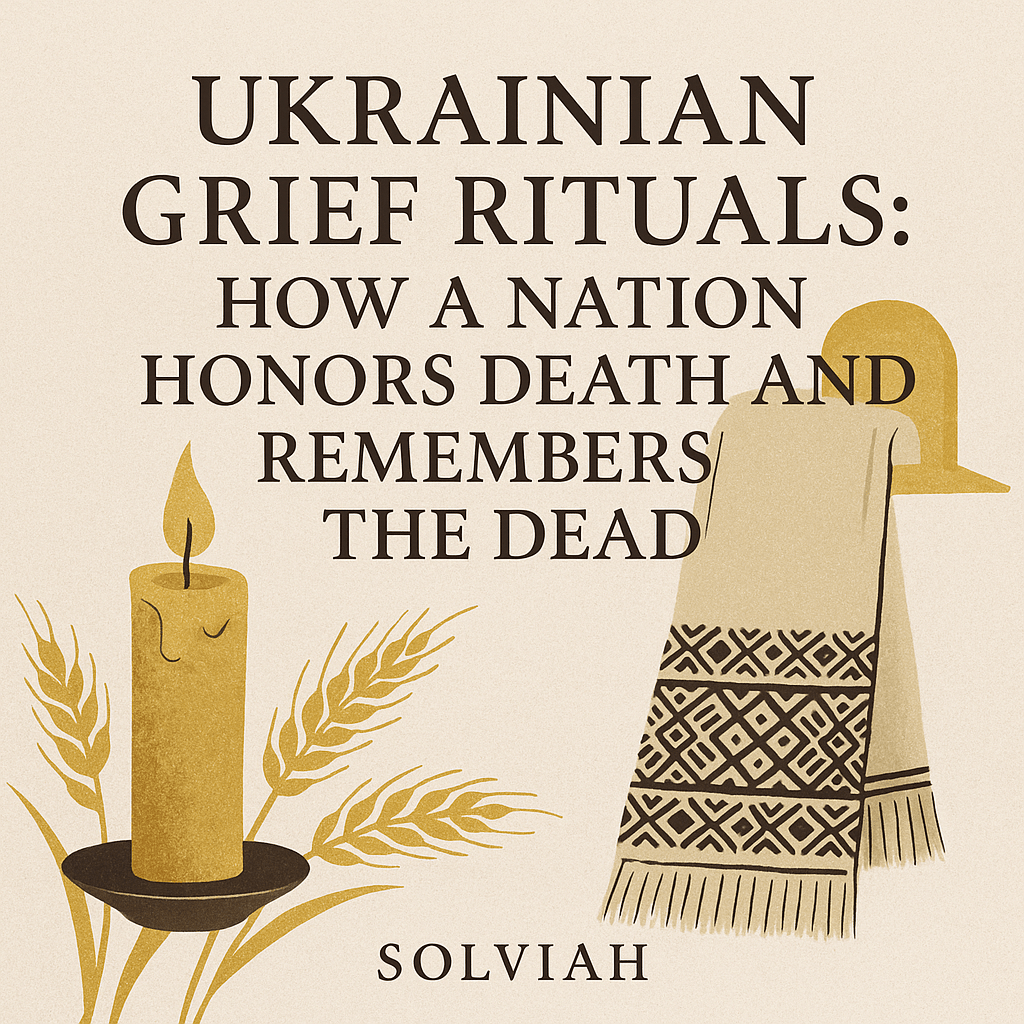
    Ukrainian Grief Rituals: How a Nation Honors Death and Remembers the Dead

    “The soul does not die; it just changes its house.”
    — Ukrainian proverb

    📘 Table of Contents

    🕯️ A Candle in the Window

    In a small apartment overlooking the golden domes of Lviv, a grandmother ties a black headscarf under her chin. The air smells of beeswax and dill. A single candle flickers by the window—its light a beacon for the soul of her departed son, lost to war. Beside her, a child stirs honey into a bowl of kutia. The forty-day vigil has begun.

    This is not just mourning. This is memory as resistance. This is grief woven into ritual.

    ↑ Back to top


    🌾 Mourning the Ukrainian Way

    Ukraine’s grief traditions blend Orthodox Christianity, pre-Christian folklore, and family-based practices into a slow, reverent process. Death is not abrupt—it is a passage, and the soul must be cared for and remembered.

    Grief unfolds through all five senses in Ukraine:

    • Winter funerals: often take place in frozen soil, where mourners stamp their boots in silence.
    • Summer burials: may involve open-air memorials with blooming wildflowers laid across fresh graves.
    • Food: comforts the living and honors the dead. Kutia—sweet, nutty, and laced with symbolism—is always the first dish served (Pavlyshyn, 2021).

    Every element—from embroidered rushnyk cloths draped over icons to the solemn ring of church bells—grounds the experience of loss in culture and continuity.

    ↑ Back to top


    🧵 Traditional Mourning Practices

    What the Body Wears: The deceased is dressed in their best clothes—often white or embroidered, symbolizing purity. Women mourners wear dark clothing and a black kerchief for up to a year. Jewelry and bright colors are avoided out of respect.

    Funeral Rites: A priest offers the Panakhyda (memorial service), reciting Psalms and prayers (Wikipedia, n.d.). The body may remain in the home for up to three days with mirrors covered and candles burning beside the coffin. At the grave, earth is placed in the sign of the cross on the casket before final prayers.

    Memorial Meals – Pomynky: After burial, families gather to share ritual foods like kutia, cabbage rolls, rye bread, and vodka. Additional meals and prayers are held on the 3rd, 9th, and 40th days (Wikipedia, n.d.).

    ↑ Back to top


    ⏳ The Forty Days

    In Orthodox belief, the soul wanders Earth for forty days after death:

    • On Day 3: The soul is shown Heaven.
    • On Day 9: It sees the torments of Hell.
    • On Day 40: It stands before the throne of judgment (Wikipedia, n.d.).

    But the forty days are not just theological. They are emotional. Candles are lit every evening. A rushnyk cloth may be placed near a photo of the deceased. Children watch. Elders repeat. And slowly, grief begins to find shape.

    ↑ Back to top


    🫂 Communal Grief and Collective Memory

    To grieve in Ukraine today is to do so not alone, but as part of a people who understand loss as shared history. When a child loses a parent to war, the village mourns. When a soldier is buried, strangers attend. When air raid sirens pierce a funeral, mourners hold hands and keep praying.

    In Kyiv, walls bear the faces of fallen heroes (Kulyk, 2020). In the Hutsul highlands, the “Provody” tradition continues—centuries-old and now revived during war (The Guardian, 2024). Along highways, communities kneel to honor passing funeral processions (War.ukraine.ua, 2023). These are not customs. They are collective acts of dignity and memory.

    ↑ Back to top

    From collective mourning to personal support, the next section explores how we can stand beside those grieving across cultures.

    🤝 For Supporters and Friends

    Grief makes many feel unsure of what to say. Silence can feel safer—but also like abandonment. Instead, offer presence, understanding, and respect for Ukrainian mourning customs (INTO, 2019).

    What You Can Say:

    • “I lit a candle for them today.”
    • “Would you like to share a memory?”
    • “Is there a ritual I can honor with you?”

    What to Avoid:

    • “They’re in a better place now.”
    • “Everything happens for a reason.”
    • “At least they died for something.”

    Other Gestures: Bring symbolic food. Offer to help mark the 40th day. Say their name weeks later. Presence often matters more than words.

    ↑ Back to top


    ⚖️ Comparison with Western Traditions

    Aspect Ukraine Western Traditions
    Mourning Period 40 days + annual rituals 1 week or less
    Food Traditions Kutia, pomynky feasts Buffets or potlucks
    Public Grief High—community kneeling, murals Often private

    ↑ Back to top


    🪞 What Ukraine Teaches Us

    Ukraine shows us that grief is not a detour from life—it is a sacred road through it. Rituals remind us:

    • Love does not vanish with death.
    • Memory is a collective inheritance.
    • Grief can be slow, beautiful, and shared.

    Reflection Prompt: Have you ever participated in a grief ritual that felt deeply healing—or one that left you wanting more? Share your story in the comments—we’d be honored to learn from you.

    ↑ Back to top


    📚 Glossary

    • Kutia: Sweet wheat-based funeral dish.
    • Pomynky: Communal meal after a funeral.
    • Radonitsa: Joyful remembrance day held at cemeteries in spring.
    • Panakhyda: Orthodox memorial service for the dead.
    • Rushnyk: Traditional embroidered cloth used in rites of passage.

    ↑ Back to top


    🔗 References

    • Hrytsak, Y. (2019). Historical memory and mourning rituals in Ukraine.
    • Kulyk, V. (2020). Public mourning and national identity in Ukraine.
    • Pavlyshyn, M. (2021). Food and funeral: Ukrainian rituals of remembrance.
    • Wikipedia. (n.d.). Memorial service in the Eastern Orthodox Church.
    • War.ukraine.ua. (2023). How Ukraine honors its fallen defenders.
    • The Guardian. (2024). The Hutsul “Provody”.
    • INTO. (2019). Supporting young people and children from Ukraine.

    ↑ Back to top

  • Still a Mother: For the Ones Missing a Child on Mother’s Day

    Still a Mother: For the Ones Missing a Child on Mother’s Day

    A quiet space for the ones missing a child today. You are not alone here.

    🌿 Table of Contents


    💔 Still a Mother

    You felt it before you opened your eyes.
    That quiet heaviness. That ache beneath your ribs.

    Today is Mother’s Day.

    You stood in the kitchen this morning and didn’t know what to do with your hands.
    You scrolled past the posts.
    You smiled when someone said it—just to survive the moment.

    You haven’t forgotten.
    Your body hasn’t forgotten.
    And love like that doesn’t disappear.

    Even if no one says their name.
    Even if no one says yours.

    You are still a mother.
    You don’t have to be okay today.
    And you are not alone.

    Back to Top ↑


    🫁 To the Mother Who Can’t Breathe Today

    You’ve already made it through hours.
    Maybe you answered messages.
    Maybe you stayed silent.

    Underneath it all, you’re holding something sharp.
    The ache. The anger. The emptiness.
    The weight of what should have been.

    You might feel jealous. Then guilty.
    You might feel nothing at all.

    That doesn’t make you weak.
    It makes you human.

    Mother’s Day can feel like salt in a wound.

    And still—here you are.
    Breathing.
    That’s enough.

    Back to Top ↑


    🕊️ You Are Still a Mother

    Even if no one says it.
    Even if your arms are empty.
    Even if your motherhood looks nothing like theirs.

    You carried love—and you still do.
    You show up for a child the world can’t see.
    You keep going with a heart that has been torn open.

    That’s not weakness.
    That’s a different kind of strength.

    You are still a mother.
    Not in spite of the grief.
    Because of the love that never left.

    Back to Top ↑


    🤍 If You Love a Mother Who’s Grieving Today

    Don’t just tell her she’s strong.
    See her pain, too.

    See the part of her that’s smiling and screaming at the same time.
    The part that showed up to the party, but hasn’t breathed since she walked in.
    The part that’s quiet—but carrying the weight of a lifetime.

    You don’t need to fix it.
    You don’t need the right words.
    You just need to show up. And stay.

    Say her child’s name.
    Say you remember.
    Say nothing, if that’s what the moment calls for.
    But be there.

    Her strength isn’t in pretending she’s fine.
    It’s in feeling everything and still finding a way to move through the day.

    Grief doesn’t need a rescue.
    It needs a witness.

    Back to Top ↑


    💬 From Mothers Who’ve Been There

    “The world moved on. But I never stopped being her mom.”
    —Mother of a stillborn daughter

    “I mother in memories now. And in love that never left.”
    —Mother of a son gone too soon

    “Grief didn’t end. But neither did my love.”
    —Anonymous

    Back to Top ↑


    📩 If You’re Not Sure What to Say

    It’s okay if you don’t have the perfect words.
    You don’t have to fix her day.
    But your message might be the one thing that reminds her she’s not alone.

    Try this:

    “I know today might be painful. I’m thinking of you and your baby. You’re still a mother. I see you.”

    “No words—just love. I’m here.”

    One honest message means more than a thousand silent scrolls.

    Back to Top ↑


    🔁 Before You Go

    If this met you in the quiet,
    if it reminded you of something true—

    share it with someone who should see it.

    With someone who’s grieving.
    With someone who wants to support but doesn’t know how.

    No one should carry this kind of love alone.

    Back to Top ↑

    📚 Suggested Reading

    • Bonanno, G. A. (2009). The Other Side of Sadness: What the New Science of Bereavement Tells Us About Life After Loss. Basic Books.
    • American Psychological Association. (2020). Grief: Coping with the loss of your loved one
    • Worden, J. W. (2018). Grief Counseling and Grief Therapy (5th ed.). Springer Publishing.
  • Infertility, Miscarriage, and Mother’s Day: Coping with Guilt, Grief, and Invisible Loss

    Infertility, Miscarriage, and Mother’s Day: Coping with Guilt, Grief, and Invisible Loss

    🌸 Table of Contents


    “I wanted to stay home. But I went to brunch for my mother. I smiled for the photo. I toasted with mimosas. I didn’t cry until the car ride home.”

    This is what Mother’s Day looks like for many women who are grieving infertility or pregnancy loss.

    Sometimes, it’s sitting through church as they hand out flowers to moms. Sometimes, it’s dodging group texts about brunch. Sometimes, it’s scrolling past photo after photo of handmade cards and families you wanted to be part of.

    💔 The Ache That Has No Name

    You might not have a name for what you’re feeling. But what you might really be feeling is grief—the grief of someone you never got to meet. Of a future you imagined but couldn’t hold.

    This kind of grief is called ambiguous grief. And on a day like Mother’s Day, when the world turns glittery and loud, it can feel unbearable.

    😔 What Guilt Feels Like When You Can’t Have a Baby

    You might think:

    • “Maybe if I had started sooner…”
    • “Maybe this is punishment.”

    But guilt is a liar. It shows up when we feel powerless. Dr. George Bonanno explains that guilt often masks helplessness and loss of control (Bonanno, 2009).

    🕊️ A Special Kind of Guilt: When You Did Do Something

    Maybe you delayed motherhood. Maybe you had an abortion, or lived through addiction, or something that still feels like your fault.

    “You made the best decision you could with what you had, who you were, and what you knew at the time.”

    ✍️ Journal Prompt

    What decision have I been punishing myself for?
    What does Mother’s Day bring up about this choice?
    What would someone who loved me say back?

    🌿 If You’ve Lost a Pregnancy

    Miscarriage grief is not the same as infertility, but it walks beside it. Some women carry both stories—and both deserve space.

    “You are a mother. Even if your arms are empty.” — SHARE Pregnancy & Infant Loss Support

    ✍️ Journal Prompt

    What would I say to the baby I carried, even for a short time?
    What do I want them to know about how loved they were?

    Ritual: Light a candle and whisper their name—or simply say “my little one.” Let that be enough today.

    🛑 Surviving Mother’s Day

    You can be kind and still say no—to the brunch, the church service, the school event. Protecting your heart is not selfish. It’s sacred.

    🌬️ Breathing Mantra

    Inhale: My love is real.
    Exhale: I release blame.

    Repeat five times. Let this be your breath prayer when words are too much.

    🤝 What You Wish Others Knew

    Yes—it’s okay to reach out. Even if it’s been months. Even if you’re not sure what to say. Especially on Mother’s Day.

    Say:
    “I know today might be hard. No need to respond—I just want you to know I’m thinking of you.”

    Avoid:
    Advice. Comparisons. Or saying “Happy Mother’s Day” unless you’re sure it’s welcome.

    🪶 A Different Kind of Ending

    There’s no bow to tie around this grief. But there can be room.

    On a day like Mother’s Day, when the world feels loud and full, you deserve a quiet space to grieve what never was—or what didn’t last. Or what you hoped might still be.

    You can still be seen. You can still be heard. You can still be held.

    Leave a comment if this spoke to you. You don’t have to explain everything. Just say you were here. That matters.

    📚 References

    • American Psychological Association. (2020). Infertility and mental health.
      View Source
    • Bonanno, G. A. (2009). The Other Side of Sadness. Basic Books.
    • Doka, K. J. (2002). Disenfranchised Grief. Lexington Books.
    • Devine, M. (2017). It’s OK That You’re Not OK. Sounds True.
    • Samuel, J. (2017). Grief Works. Scribner.
    • SHARE Pregnancy & Infant Loss Support. (2023).
      Visit Website
    • Centers for Disease Control and Prevention. (2022). Infertility.
      CDC Infertility Page
  • Feeling Off in 2025? What Grief, Burnout, and Shifting Seasons Might Be Saying

    Feeling Off in 2025? What Grief, Burnout, and Shifting Seasons Might Be Saying

    ✯ Table of Contents

    🌿 A Note Before We Begin

    This isn’t just another article about grief or burnout. It’s a gentle, grounded guide for anyone going through loss, transition, or emotional unraveling—especially when life is already shaky.

    You might be grieving a death. Or maybe you’re grieving something harder to name—your career path, your sense of purpose, the version of yourself that used to feel whole. Lately, it seems more and more of us are carrying invisible weights we don’t know how to talk about.

    This guide offers language for what you’re feeling, space to breathe, and spiritual insight that doesn’t rush to fix you. It doesn’t pretend to hold all the answers—but it hopes to walk with you toward steadier ground.

    Along the way, we’ll also explore what Christian prophets are saying—because strangely, and profoundly, their words have been aligning with what many of us are living through. Whether or not you consider yourself religious, it might be worth paying attention.

    Each section unpacks a layer of what you may be carrying: emotional weariness, cultural upheaval, spiritual shaking, personal loss—and how to begin again in a world that no longer feels familiar.

    Wherever you are in your process, may this meet you there.

    Back to Top

    🕊️ Invisible Grief: Why So Many Feel Emotionally Exhausted Right Now

    You’re not imagining it.

    There’s a heaviness in the air—one that words like “stress” or “tired” don’t fully capture. Even those who haven’t lost someone recently are grieving something: who they used to be, what they thought life would become, the safety they assumed would last.

    And if you have lost someone—especially while juggling the fragile pieces of everything else—then it’s more than sorrow. It’s disorientation. A sense that the ground itself has shifted, and you can’t find the horizon.

    This is invisible grief.

    Not always the kind with funerals or condolences—but the kind that lingers when your identity, security, or story is quietly slipping through your fingers. It’s the ache of becoming someone new without meaning to. Psychologist Kenneth Doka calls this disenfranchised grief—the kind society doesn’t always recognize, but that lives in us all the same (Doka, 2002).

    And according to trauma researcher Bessel van der Kolk, this kind of invisible loss doesn’t just affect the mind—it leaves an imprint on the body, too. We carry the stress physically, often without knowing why (van der Kolk, 2014).

    What makes it harder is how strangely collective it feels. So many people are unraveling in parallel. So many are whispering, “Something is off,” without knowing why.

    Could there be something beneath it all?

    We’ll name the griefs that don’t often get named. We’ll explore what prophetic voices have been saying for years, and why their words are echoing loudly now. We’ll also look to the skies—literally—and consider whether what’s happening above us might help us make sense of what’s happening within us.

    Because if this ache is shared… maybe so is the hope.

    Back to Top

    🔥 What’s Causing Emotional Burnout in 2025 (And Why It’s Not Just You)

    Even if you haven’t lost someone, you may still feel like something is slipping: your sense of purpose, your drive, your belief that life should feel more stable by now.

    It’s not just burnout. It’s something deeper—emotional fatigue, spiritual burnout, a quiet unraveling happening across industries, relationships, and identities. A sense that the ground has shifted, and no one handed you a new map.

    So what’s really behind this collective weariness?

    • Economic anxiety isn’t just about dollars—it’s about fear. Even those with good jobs worry they’re one layoff away from chaos (APA, 2023).
    • Success has changed shape. It’s no longer enough to be good at your job. You’re expected to have a calling, a brand, a clear purpose—and that pressure can be paralyzing (Pratt et al., 2006).
    • Work-life balance has eroded. Devices keep us half-working even while resting. We’re always reachable, never truly restored (Maslach & Leiter, 2016).
    • Comparison culture floods us with curated images of other people’s wins, leaving us unsure whether we’re behind—or just invisible (Huang, 2017).
    • Corporate trust is fading. Layoffs, pivots, and instability have made people question if any role is truly secure (APA, 2023).
    • And under it all, a quiet ache. A question few dare to say aloud: What if I don’t want this life anymore?

    Layer these pressures on top of personal grief, family stress, or spiritual fatigue—and it’s more than stress. It’s a slow unraveling of identity, security, and clarity all at once.

    And if all of this feels bigger than personal stress—maybe it is.

    Maybe something spiritual is stirring underneath the unraveling.

    Back to Top

    📖 What Christian Prophets Are Saying About This Season of Change

    Is this discomfort spiritual? What prophetic voices are noticing—and why it might matter.

    Maybe you’ve had this thought lately:

    “Everything feels off—but I can’t tell if it’s me… or something bigger.”

    That sense isn’t new—and it’s not just yours.

    In many Christian traditions, prophetic voices are people who listen closely for God’s heart—not to predict headlines, but to help interpret the times. And for years now, some of these voices have been pointing to a season just like this.

    They call it a divine repositioning.

    Prophets like Kris Vallotton, Lana Vawser, and others have described this as a global shaking—one that reaches into both personal lives and public systems. Not to destroy, but to shift. To break the illusion of control. To prepare people for what’s next. And what they’ve said feels strangely aligned with what many are now living.

    1. Shaking before repositioning

    That sense that your old rhythm no longer fits? It may not be failure—it may be spiritual movement. Prophetic voices suggest that God often allows discomfort to dislodge us from what’s too small. What feels like chaos might be permission to let go.

    “God offends the mind to reveal the heart.” — Kris Vallotton

    2. Transfer of influence

    Many have spoken about a “Joseph and Daniel moment”—a season where those who’ve been faithful in hidden places are being quietly prepared for influence. Not for fame, but for fruitfulness. You may not feel ready. But maybe your readiness isn’t the point.

    3. Marketplace revival

    This isn’t just happening in churches. Prophetic voices believe God is moving in business, education, tech, media—in the middle of everyday work. If your job has felt strangely unsettled, it might not be punishment. It might be preparation.

    4. Refinement of identity

    Perhaps most deeply, this shift is about identity. God may be stripping away false metrics—“I’m only valuable if I’m productive,” “If I’m not thriving, I’m failing.” What’s left isn’t emptiness—it’s truth. Who you are when nothing performs.

    5. The unveiling of the hidden ones

    Prophets like Lana Vawser have described this season as one where God is bringing His “hidden ones” into view—not through striving, but through divine timing. Whether you’ve been healing, raising children, serving quietly, or simply holding things together behind the scenes—this may be your unveiling.

    “The ones who have felt unseen, forgotten, and hidden—this is the hour where the Lord is bringing them into greater visibility for His glory.” — Lana Vawser

    This isn’t performance. It’s permission. A holy release into the next thing—just as you are.

    Some call this a shift. Others call it a calling. But either way, it’s a pattern too consistent to ignore.

    Even if you’re not sure what you believe, maybe part of you has already felt it:

    • The old way doesn’t fit.
    • You’re between stories.
    • And something sacred is stirring beneath the surface.

    It’s the moment midair—after releasing one trapeze bar, before catching the next.

    You’re not falling. You’re just between.

    Could it be that what feels like obscurity… was always preparation?

    Back to Top

    ✨ Celestial Signs in May 2025: Biblical Meaning and Prophetic Insight

    What if the sky isn’t just beautiful—but intentional?

    Maybe you’ve looked up recently—at the moon, the stars, or a flash of meteor light—and felt something you couldn’t explain. A stirring. A pause. A sense that the timing of it all means more than we think.

    Throughout scripture, the heavens are more than backdrop—they’re message-bearers.

    “The heavens declare the glory of God, and the sky above proclaims His handiwork.” — Psalm 19:1

    From the star over Bethlehem to the apocalyptic signs in Revelation, the biblical narrative uses celestial movement not for fortune-telling—but for timing. Divine moments often echo in the skies. And in May 2025, many believe we’re standing beneath one of those echoes.

    What May 2025 Is Revealing

    • May 3–4: Eta Aquariid Meteor Shower

      Formed from remnants of Halley’s Comet, these meteors streak the sky before dawn. In prophetic imagery, meteors often represent sudden insight—divine interruptions that illuminate what’s been there all along.

    • May 12: Full Flower Micromoon

      This distant full moon symbolizes hidden growth. It may not look large, but its presence reminds us: not all flourishing is loud. Some of the most sacred change happens in quiet places.

    • May 14: Pesach Sheni (Second Passover)

      A biblical “do-over” date. In Numbers 9, God allowed those who missed Passover the first time to celebrate a month later. It’s a reminder: you haven’t missed your moment. Redemption still reaches.

    • May 15–16: Lag BaOmer

      Traditionally a break in a season of mourning, this Jewish holiday brings light and joy into heavy times. It represents breakthrough in the middle of grief.

    • May 26: New Moon

      In ancient Israel, new moons marked the beginning of sacred cycles. It was a moment to pause, reset, and step forward into what’s next (Numbers 28:11–15).

    • May 29: Ascension Day

      Honoring the moment Jesus was taken into heaven, Ascension is not about endings—it’s about commissioning. The moment where waiting turns into movement. “Go.”

    These dates may seem unrelated—but they trace a clear arc: from divine interruption… to hidden growth… to second chances… to joy… to renewal… to release.

    This Isn’t Prediction. It’s Invitation.

    You don’t have to believe in signs. But you’re allowed to wonder.

    Maybe you’ve felt it already—something stirring in you. A direction. A question. A truth you’ve known for a while but haven’t yet moved toward.

    Christian prophets aren’t saying to look for fireworks. They’re saying: notice the alignment. Let the sky remind you that God’s timing is never random. And neither is yours.

    Some believe what May 2025 is saying is this:

    The shaking has done its work. The delay has had its meaning. Now… it’s time to begin.

    You don’t need full clarity. You just need one true step.

    “There will be signs in the sun, moon, and stars… When these things begin to take place, stand up and lift your heads, because your redemption is drawing near.” — Luke 21:25–28

    Even if all you have is a flicker of faith, even if all you feel is tired—look up anyway.

    Look up. Breathe. Begin.

    Back to Top

    💔 Grieving When the Loss Is Personal

    What if the thing that broke wasn’t your job… but your heart?

    We’ve just explored the idea that this season of shaking might be spiritual—that perhaps God is allowing certain things to fall away so that something more eternal can take root.

    But what if what fell wasn’t your schedule, your plans, or your sense of direction?

    • What if it was your mother?
    • Your spouse?
    • Your child?
    • Your only friend?
    • Your anchor in this world?

    What if the shaking took your person?

    Grief can already feel like spiritual whiplash. And the thought that God allowed it—that He stood by while it happened—can feel less like mercy and more like cruelty.

    And if someone dared to tell you, “It’s all part of a bigger plan,” you might want to walk away from that kind of God altogether.

    You wouldn’t be wrong to feel that way.

    Because when you lose someone you love—especially in a season when you were already barely holding it together—it doesn’t feel redemptive.

    It feels like betrayal.

    Like abandonment.

    Like being dropped while you were already drowning.

    “I don’t care about spiritual shaking,” one reader said. “I just want my dad back. He was the only one who understood me.”

    And still—this much we know:

    “When Jesus saw her weeping… He was deeply moved in spirit and troubled… Jesus wept.” — John 11:33–35

    He knew resurrection was coming. And He still wept.

    He didn’t offer explanations. He didn’t say, “This had to happen.”

    He stood beside Mary in her grief. He felt the injustice. And He cried.

    Maybe that’s what He’s doing with you now.

    Not fixing it. Not skipping it. Just sitting in the silence—with you.

    Maybe He didn’t cause the loss. Maybe He didn’t will the death. But He knew it would come.

    And instead of rushing you toward resolution, He’s walking through this part with you—at your pace, in your pain.

    Maybe the shaking didn’t take your anchor so you’d become stronger.

    Maybe it took your anchor… so He could be the one to hold you through the storm.

    “The Lord is close to the brokenhearted and saves those who are crushed in spirit.” — Psalm 34:18

    You don’t have to make sense of this. Not now.

    You don’t have to move on.

    But maybe—just for today—you let yourself be held.

    Back to Top

    🏗️ Rebuilding in the Rubble

    You may not be rebuilding the same life. But you’re not building alone.

    By now, you may feel like your world has been stripped down to studs. What once defined you—your roles, your plans, your relationships—may be gone or unrecognizable. And the person you were before this season? She might feel just as lost.

    But if you’re still breathing, still asking questions, still reading this—That means something remains. And that something can become the foundation for a different kind of future.

    The Healing Will Look Nothing Like the Old Life

    You’re not going back to “normal.” There is no going back. But there may be something better ahead—not because it erases your grief, but because it honors it.

    “You don’t move on. You move with it. The grief walks beside you. But so does grace.”

    This isn’t toxic positivity. This is sacred rebuilding.

    “Though the fig tree does not bud and there are no grapes on the vines… yet I will rejoice in the Lord.” — Habakkuk 3:17–18

    What Rebuilding Might Look Like

    • You wake up one morning and don’t feel dread.
    • You go for a walk and notice the trees again.
    • You remember something about your loved one—and smile instead of cry.
    • You say no to something you used to say yes to—because now you know your limits.
    • You start making plans—not because you’re fully healed, but because you’re still here.

    You’re not starting from scratch—you’re starting from sacred debris.

    “They will rebuild the ancient ruins and restore the places long devastated.” — Isaiah 61:4

    Biblical Anchors for What Feels Unstable

    • When finances are uncertain: “The Lord is my shepherd, I lack nothing.” — Psalm 23:1
    • When your identity feels lost: “You are mine. I have called you by name.” — Isaiah 43:1
    • When you are tired and stretched thin: “Come to me… and I will give you rest.” — Matthew 11:28
    • When the future feels terrifying: “Do not fear, for I am with you.” — Isaiah 41:10
    • When you feel deeply alone: “Even if my father and mother forsake me, the Lord will receive me.” — Psalm 27:10

    What Remains Is Still Alive. And That Means Something.

    Maybe you don’t feel strong. Maybe you feel buried.

    But seeds aren’t lost when they’re in the dark. They’re preparing to break open. Preparing to rise.

    Even if no one sees it—especially when no one sees it—something in you is still here. Breathing. Noticing. Reaching.

    That’s not nothing. That’s the beginning of strength.

    You don’t have to bloom today. You don’t have to fix everything by tomorrow. But if you’re still breathing, there’s more to come.

    The ones who rise slowly often rise strongest. Not because they pushed through—but because they grew through. Deep. Quiet. Fierce.

    You may feel buried. But maybe… you’re rooted.

    And that is not the end of the story.

    Back to Top

    🌱 A Final Blessing

    Maybe this hasn’t answered every question.

    Maybe it didn’t fix what still feels broken.

    But if you’ve made it this far, it’s because something in you is still reaching for light.

    Maybe it’s not fire. Maybe it’s not fierce.

    But it’s alive. And that matters.

    There’s a kind of strength that doesn’t shout. It roots. Deep and unseen. Quiet and sure.

    And when it finally rises, it doesn’t just survive. It shelters others, too.

    So even if your grief still aches… even if your future feels dim… even if today is more silence than clarity—

    May you carry forward something real.

    Not because it’s all okay.

    But because something in you still is.

    So here’s to what remains.

    To what is still alive in you, however quiet.

    To the sacred rebuilding happening in silence.

    And to the person you are becoming—braver, deeper, more whole than ever before.

    A Blessing for the Journey

    May your grief give way to gentleness.

    May your questions stretch into something sacred.

    May you find strength not in perfection, but in quiet resilience.

    May you carry forward what mattered most—not by force, but by becoming.

    And as your roots grow deep in this broken soil,

    May something bloom in you that honors the life you lost,

    And the legacy you’re still living.

    Whatever your path, whatever your pace,

    May you know: you are not alone.

    Back to Top

    💬 Share What Resonated With You

    If something in this article stirred something in you—a phrase, a truth, a quiet strength—would you be willing to share it below?

    Scroll down and leave a comment. Let’s make this more than a page. Let’s make it a place to feel seen.

    📚 References

    • Doka, K. J. (2002). Disenfranchised Grief: Recognizing Hidden Sorrow. Lexington Books.
    • van der Kolk, B. (2014). The Body Keeps the Score: Brain, Mind, and Body in the Healing of Trauma. Viking.
    • American Psychological Association. (2023). Stress in America™ Report. View Report
    • Maslach, C., & Leiter, M. P. (2016). Understanding the burnout experience. World Psychiatry, 15(2), 103–111.
    • Pratt, M. G., Rockmann, K. W., & Kaufmann, J. B. (2006). Constructing professional identity. Academy of Management Journal, 49(2), 235–262.
    • Huang, C. (2017). Time on social networks and psychological well-being. Cyberpsychology, Behavior, and Social Networking, 20(6), 346–354.
    • Vallotton, K. (2020). Spiritual Intelligence. Chosen Books.
    • Vawser, L. (2021–2024). Prophetic Words. www.lanavawser.com
    • Genesis 37–50 – The story of Joseph and divine repositioning.
    • Daniel 1–2 – Influence through faithfulness in exile.
    • Isaiah 45:3 – “Treasures of darkness and hidden riches.”
    • 1 Samuel 16:11–13 – David’s anointing from hiddenness.
    • Neimeyer, R. A. (2001). Meaning Reconstruction & the Experience of Loss.
    • Park, C. L. (2010). Meaning-making and adjustment to life stress. Psychological Bulletin.

    Back to Top

  • May 2025: Celestial and Sacred Alignments—God’s Message to the Grieving

    May 2025: Celestial and Sacred Alignments—God’s Message to the Grieving

    May 2025: Celestial and Sacred Alignments—God’s Message to the Grieving

    “And God said, ‘Let there be lights in the expanse of the heavens to separate the day from the night. And let them be for signs and for seasons…” —Genesis 1:14

    Jump To:


    Understanding Biblical Astronomy

    Biblical astronomy recognizes celestial bodies as divine instruments marking sacred times and conveying God’s messages. Unlike astrology, which attempts to dictate human destiny through star signs, biblical astronomy sees the heavens as a canvas where God reveals His plans and promises.

    “The heavens declare the glory of God, and the sky above proclaims his handiwork.” —Psalm 19:1

    ↑ Back to Top

    Chronological Events in May 2025

    May 1: 🇮🇱 Yom HaAtzma’ut (Israeli Independence Day)

    Commemorates the modern rebirth of Israel. A sign of God’s faithfulness to restore what was scattered.

    May 3–4: ✨ Eta Aquariid Meteor Shower Peak

    From Halley’s Comet. 50 meteors/hour before dawn. A celebratory light show in Heaven? Possibly.

    May 12: Full Flower Moon (Micromoon)

    “Consider the lilies… not even Solomon in all his glory was arrayed like one of these.” —Luke 12:27

    May 14: Pesach Sheni (Second Passover)

    God offers second chances. A grace-filled provision for the late and the overlooked.

    May 15–16: Lag BaOmer

    A break in mourning. A celebration of hidden joy. A release from sorrow.

    May 26: Jerusalem Day

    Marks the reunification of Jerusalem. A sign of divine restoration and hope.

    May 27: New Moon

    When the moon disappears, God invites stillness. Something new is being birthed in the unseen.

    May 29: Ascension of Jesus

    Jesus ascends, declaring, “It is finished.” Our hope is secured. Our access is open.

    ↑ Back to Top

    April vs. May: What Is God Doing?

    April 2025 aligned Orthodox and Western Easter with Jewish Passover. It was a unified honoring of Jesus—the Lamb of God—by all His people. That moment declared that what Jesus accomplished on the cross is still enough. Hebrews 10:14 says, “For by one sacrifice He has made perfect forever those who are being made holy.”

    Now in May, we see a shift. Heaven isn’t silent. God is still speaking. May speaks of freedom. Restoration. Second chances. Beauty in bloom. And divine ascension. God is not only aligning—He’s activating.

    Read the April article →

    ↑ Back to Top

    🕊️ Prophetic Alignment: What Prophets Are Saying

    Kris Vallotton: “The Shift Has Begun”

    On April 28, 2025, Vallotton said he woke up to the voice of the Lord: “The shift has begun.” It echoes the cosmos—movement, breakthrough, freedom.

    Chuck Pierce: Grace & Conflict in Tension

    He prophesied a 30-day period of intensity from April 20–May 20. This is not just about waiting—it’s about alignment and transformation.

    Cindy Jacobs: Prayer and Israel

    She urges the Church to stand with Israel and intercede against unrest. That urgency lines up with Jerusalem Day and Yom HaAtzma’ut.

    Bill Hamon: Advance the Kingdom

    Hamon calls this a time to act. To rise. To speak. To move forward in our prophetic assignments.

    These voices are echoing Heaven: the shift has begun.

    ↑ Back to Top

    💔 A Message to the Grieving

    To the one grieving: this May is for you.

    You who feel forgotten—watch the stars dance above you. You who feel weary—let the moonlight soothe you. You who feel lost—God has never stopped arranging beauty on your behalf.

    “The Lord is near to the brokenhearted and saves the crushed in spirit.” —Psalm 34:18

    This season is not about performance. It’s about presence. God’s presence. He is not asking you to climb. He is coming down to meet you, whispering hope in the night sky.

    🌿 Gentle Grief Practices for This Season

    • Stargazing Prayer: Speak to God under the stars—no script, just soul.
    • Gratitude Journal: Note one thing each day God has held you through.
    • Light a Candle: In memory, in hope, in the silence of the sacred.
    • Scripture Meditation: Read Psalm 23 or Isaiah 61 slowly, aloud.
    • Breath Prayer: Inhale: “You are with me.” Exhale: “I trust You.”

    Let May be the month where you begin to heal—not by force, but by divine rhythm. ✨

    ↑ Back to Top

    ✝️ The Gospel Invitation: Step Into the Shift

    Jesus was sinless—holy, pure, unable to be held by death. He bore every sin of every person and used them as His key to descend into death itself. But because death had no hold on Him, He rose—and we now rise with Him.

    “God made him who had no sin to be sin for us, so that in him we might become the righteousness of God.” —2 Corinthians 5:21

    This is your invitation into eternal life, into divine freedom, into healing. The same God aligning the stars is aligning your life.

    Are you ready to receive the gift Jesus died to give you?

    🙏 Prayer of Salvation

    “Jesus, I need You. I believe You died for me and rose again. I confess my sins and turn from my old ways. Make me new. Fill me with Your Spirit. Lead me in Your truth. I give You my heart—completely. Amen.”

    Next Steps

    • 📖 Read the Word: Start with the Gospel of John.
    • Find Community: Join a Bible-believing church or home group.
    • 🚶 Walk in Truth: Live with bold love, humble obedience, and full joy.

    ↑ Back to Top

    💬 Has this stirred something in you?

    Share your thoughts in the comments. We read and respond to every story. You’re not alone.

    ↑ Back to Top

    📚 Glossary

    • Celestial: Related to objects in the sky (stars, moon, sun, planets).
    • Cosmic: Pertaining to the larger universe or spiritual atmosphere.
    • Astronomical: Based on scientific study of celestial bodies.
    • Conjunction: When planets or celestial bodies appear very close together in the sky.
    • Eclipse: When one body blocks the light of another (e.g., sun or moon).
    • Pentecost: 50 days after Easter, when the Holy Spirit was poured out on the disciples (Acts 2).

    ↑ Back to Top

    Explore More on Solviah:

  • How Mexicans Grieve: Mourning Rituals, Day of the Dead, and Cultural Healing

    How Mexicans Grieve: Mourning Rituals, Day of the Dead, and Cultural Healing

    “They tried to bury us. They didn’t know we were seeds.” – Mexican Proverb

    Table of Contents

    Roots in Life and Legacy

    Mexico’s relationship with death comes from a deeply spiritual blend of pre-Columbian and Catholic beliefs. Long before the Spanish arrived, Aztecs, Mayans, Zapotecs, and other Indigenous peoples believed death was merely another stage of life. The goddess Mictecacihuatl ruled over the afterlife, safeguarding ancestors and ensuring they could revisit the living world once a year.

    Today, the Day of the Dead (Día de los Muertos) carries this ancient worldview into modern life. Families believe ancestors return, guided by trails of marigolds (cempasúchil), the flower whose scent leads spirits home.

    ↑ Back to Top

    What Grief Feels Like in Mexico

    Late October weather in Mexico is crisp and inviting, cooling evenings offset by warm, vibrant days. At home, families prepare pan de muerto, spicy tamales, cinnamon-laced atole, and complex mole sauces—a flavorful tribute to the complexity of grief itself.

    Colorful paper banners (papel picado) flutter in cemeteries. Candles and marigolds guide spirits, while mariachi music echoes familiar songs of remembrance. Grief in Mexico is felt, seen, tasted, and shared.

    ↑ Back to Top

    Diverse Traditions Across Mexico

    From the candlelit cemeteries of Oaxaca to the urban neighborhoods of Mexico City, traditions vary widely. Indigenous Zapotec communities may hold all-night vigils filled with prayer, while modern families create elaborate ofrendas with photos, food, and personal items.

    Formal mourning can last nine to forty days. Women may wear black or traditional embroidered huipiles, and remembrance culminates annually on Día de los Muertos—a day of reunion, not separation.

    ↑ Back to Top

    Communal Grief: Shared Stories and Healing Together

    During a velorio (wake), homes fill with neighbors offering prayers, tamales, and presence. People cry, laugh, share stories, and honor the person’s life in community. Humor softens pain—through stories, memories, and calaveras literarias, witty poetic tributes to the dead.

    Grief in Mexico is not meant to be carried alone.

    ↑ Back to Top

    The Mexican Way vs. Western Mourning

    Where Western cultures often silence grief, Mexico gives it music, ritual, and space. Funerals aren’t just endings—they’re invitations to keep remembering. Rather than moving on, Mexicans move forward with their loved ones in memory.

    Grief here evolves into relationship—not resolution.

    ↑ Back to Top

    A Glimpse Inside: An Evening of Remembrance

    Inside a family home, a glowing altar holds photos, favorite snacks, marigolds, and handwritten notes. Children place sugar skulls beside glasses of water. A soft hymn plays, and the air is thick with memory.

    Guests are greeted with warmth. Everyone is welcome. Grief is witnessed, not rushed.

    ↑ Back to Top

    A Personal Story of Grief

    Gardenia Rangel, a Mexican-American woman, shared her experience of honoring her parents who both passed away from COVID-19. She keeps their memory alive by maintaining an altar in her home adorned with their wedding portrait, electric candles, and mariachi music they loved. “I think about them every single day,” Rangel said. “But I never want to stop missing them because they say that people only die the day you forget them.” This personal ritual exemplifies how Mexican traditions provide comfort and a continuous connection to loved ones who have passed. Source

    ↑ Back to Top

    Anthropological Insights

    Dr. Beatriz Reyes-Foster, an anthropologist specializing in Mexican cultural practices, emphasizes the importance of Día de los Muertos in maintaining family bonds and cultural identity. She notes that the celebration allows for a communal space where grief is expressed openly and joyfully, reinforcing the idea that death is a natural part of life. This perspective challenges Western notions of mourning and highlights the value of embracing death as a continuation of relationships rather than an end. Source

    ↑ Back to Top

    If You’re Mexican and Grieving

    Your traditions are sacred. If those around you don’t understand, know that your grief matters deeply. You carry centuries of wisdom—grief through food, music, and memory. Your way of remembering is powerful, beautiful, and healing.

    We honor you, your loved ones, and the stories you keep alive.

    ↑ Back to Top

    For Non-Mexican Readers: How You Can Support

    • Be present. Offer help, meals, and listening ears.
    • Learn key phrases. Say “Te acompaño en tu dolor” — “I’m with you in your sorrow.”
    • Respect traditions. Ask questions, and participate if invited to rituals.
    • Be aware of sacred timing. Understand that grief resurfaces every year around Día de los Muertos.

    Your humility can become someone else’s comfort.

    ↑ Back to Top

    Reflection: What Mexico Teaches Us About Grief

    Mexico teaches us that grief isn’t meant to be erased. It is an invitation—to remember, to honor, and to reconnect. In embracing both joy and loss, we find that healing doesn’t come from forgetting, but from remembering together.

    ↑ Back to Top

    Share Your Experience

    Have you experienced a grief tradition that touched your heart? Or supported someone from another culture through loss?

    We invite you to reflect or journal:

    • How do I keep my loved ones alive in memory?
    • What can I learn from cultures that grieve differently?
    • Who around me might need my support today?

    Share your thoughts in the comments below.

    ↑ Back to Top

    Glossary

    • Día de los Muertos: A Mexican holiday honoring the dead with altars, offerings, and celebration.
    • Ofrenda: A home altar with food, photos, candles, and personal mementos for the deceased.
    • Cempasúchil: Bright orange marigold flowers believed to guide spirits home.
    • Velorio: A wake or prayer vigil before the funeral.
    • Papel Picado: Colorful cut-paper banners symbolizing the fragility of life.
    • Huipil: Traditional embroidered blouse worn by Indigenous women.
    • Calaveras Literarias: Humorous poems honoring the dead, often shared during Day of the Dead.

    ↑ Back to Top

    References

    • Brandes, S. (1998). The Day of the Dead, Halloween, and the quest for Mexican national identity. Journal of American Folklore, 111(442), 359-380.
    • Lomnitz, C. (2005). Death and the Idea of Mexico. Zone Books.
    • García, A. (2010). The Pastoral Clinic: Addiction and Dispossession Along the Rio Grande. University of California Press.
    • AfterTalk. (2021). Day of the Dead and Mexican-American funeral service rituals. Retrieved from AfterTalk.com
    • Orange County Library System. (2022). Día de los Muertos: Q&A with Dr. Beatriz Reyes-Foster. Retrieved from ocls.org

    ↑ Back to Top


  • Zoroastrian Grief Rituals: Ancient Faith, Sacred Prayers, and the Chinvat Bridge

    Zoroastrian Grief Rituals: Ancient Faith, Sacred Prayers, and the Chinvat Bridge


    “As thou dost desire, O holy one! so shalt thou be; holy shalt thou cause thy soul to pass over the Chinvat Bridge; holy shalt thou come into Heaven.”
    — Yasna 71, Avesta

    When someone beloved dies, Zoroastrians do not simply mourn—they prepare the soul for its most sacred journey. Rooted in the world’s oldest known monotheistic tradition, this journey leads across the Chinvat Bridge, guided by prayers, rituals, and a legacy of good deeds.


    Table of Contents


    🕯️ A Sacred Story of Life After Death

    An old tale tells of a kind-hearted man who gave shelter to the poor and refused to gossip. When he died, his soul lingered three days near his home. On the dawn of the fourth, he stood before the Chinvat Bridge—where three divine judges weighed his deeds. The bridge widened, and a radiant maiden, the embodiment of his own good actions, walked beside him into the House of Song. There, light never dimmed, and music never ceased.

    This story expresses the Zoroastrian belief: the soul is judged not by belief alone, but by the harmony it created through thoughts, words, and deeds.

    ↑ Back to Top

    ⚖️ What Zoroastrians Believe About Death

    Zoroastrianism teaches that life is a moral struggle between asha (truth) and druj (falsehood). When someone dies, the soul (urvan) stays near the body for three days. On the fourth, it crosses the Chinvat Bridge, where three divine judges await:

    • Mithra — Covenant and Witness
    • Sraosha — Conscience and Protector
    • Rashnu — Justice and Weighing of Deeds

    Those who lived in asha are welcomed into Garo Demana (the House of Song). Those who served druj fall into Druj Demana, a place of darkness.

    ↑ Back to Top

    📿 Sacred Prayers and Mourning Rituals

    Zoroastrians honor the dead through rituals designed to protect both the soul and the elements. Traditionally, bodies are placed in a dakhma (Tower of Silence). Today, cremation or burial may be used, with adapted rites.

    Key prayers and ceremonies:

    • Geh Sarnu — comforting hymns
    • Patet Pashemani — confessional prayer
    • Sraosh Hadokht — prayer for protection
    • Uthamna — fourth-day soul release ceremony
    • Dahmah — charity done in the name of the deceased

    These rituals affirm that love continues beyond life and offer structure to support those who grieve.

    ↑ Back to Top

    🧠 Ancient Wisdom Meets Modern Healing

    Psychologists note that ritual, repetition, and meaning-making ease the pain of loss. Zoroastrian grief practices align closely with this wisdom:

    • Structured mourning rituals create safety and continuity
    • The soul’s journey provides spiritual purpose and meaning
    • Community prayers build connection and memory

    Grief becomes not just pain, but a sacred transformation of presence into legacy.

    ↑ Back to Top

    🤝 Across Faiths: Threads of Common Ground

    Zoroastrianism is often compared to Christianity due to its belief in a final judgment and heaven. In Yasna 30:9 we read:

    “Let good thoughts prevail in the world and evil thoughts perish. Let good words be spoken and evil ones be silenced. Let good deeds increase and evil ones fade away.”

    This mirrors the Christian principle to “overcome evil with good” (Romans 12:21).

    Other faiths also echo this sacred rhythm:

    • Judaism: Sitting shiva honors memory with community presence
    • Islam: Mourning includes prayer and charity for the soul’s peace
    • Buddhism: Grief is eased through acceptance of impermanence

    Such reflections reveal that in grief, we are not divided by belief—but connected by love.

    ↑ Back to Top

    💞 For Supporters and Friends

    If someone you love is grieving within the Zoroastrian faith, your compassion can be a bridge of comfort. Here are gentle ways to support:

    • Honor the first three days: These are sacred for the soul’s transition. Presence, not pressure, matters most.
    • Use spiritual language: Words like “May their soul cross in light” or “May their deeds lead them to peace” align with their beliefs.
    • Respect the rituals: Ask before bringing food, gifts, or flowers—some families observe specific customs around purity and space.
    • Offer to help with Dahmah: Assist in charitable acts made in memory of the deceased.
    • Share good memories: Speaking of the person’s kindness or courage honors their legacy.

    Kindness, even quiet kindness, is a sacred act.

    ↑ Back to Top

    🌟 Heaven, But Not As You Know It

    Garo Demana, the House of Song, is Zoroastrianism’s vision of heaven. It is a place of eternal light, music, and unity with Ahura Mazda. Entry is not earned by belief alone—but by how one lives.

    When the soul approaches the Chinvat Bridge, three divine entities weigh their life:

    • Mithra (truthfulness)
    • Sraosha (obedience to conscience)
    • Rashnu (justice)

    If the soul lived in asha, the bridge widens and leads them across into joy. This belief invites every Zoroastrian to live with moral courage, knowing eternity awaits.

    ↑ Back to Top

    📘 Glossary

    • Asha — Truth, righteousness, divine order
    • Druj — Falsehood, deceit, disorder
    • Urvan — The soul of the deceased
    • Chinvat Bridge — Bridge of judgment after death
    • Garo Demana — House of Song (Zoroastrian heaven)
    • Druj Demana — House of Lies (place of sorrow)
    • Dakhma — Tower of Silence for traditional sky burial
    • Uthamna — Fourth-day soul release ceremony
    • Patet Pashemani — Confessional prayer
    • Sraosh Hadokht — Prayer for soul’s journey
    • Dahmah — Acts of charity in memory of the deceased

    ↑ Back to Top

    💨 A Breath Prayer for the Grieving

    Inhale: I walk with truth
    Exhale: My soul is not alone

    Reflection:
    What good words or deeds can I speak in their memory today?

    ↑ Back to Top

    🗣️ Share Your Story

    Have you experienced grief through the lens of faith—Zoroastrian or otherwise?

    Leave a comment to honor your loved one, share your tradition, or ask a question. Your voice may be the bridge someone else needs today.

    Continue exploring:

    ↑ Back to Top

    Written for Solviah, where grief is met with gentleness, wisdom, and sacred remembering.
  • Finding Christian Comfort in Grief: God’s Appointed Times, Celestial Signs, and Seasons of Healing

    Finding Christian Comfort in Grief: God’s Appointed Times, Celestial Signs, and Seasons of Healing

    Table of Contents

    When Time Fractures

    “Do not let your hearts be troubled. Trust in God; trust also in Me. In My Father’s house are many rooms… I am going there to prepare a place for you.”
    —John 14:1-3

    There are moments when grief shatters your world. Maybe it was the phone call, the empty chair, the silent room. Life moved forward, but part of you remained in that moment, caught between breaths. Yet even here—especially here—God meets you.

    ↥ Return to Top

    God’s Sacred Calendar: Finding Hope in Holy Moments

    God placed rhythms of healing and hope within His sacred calendar—special moments to remind us He is near. Christianity continues to honor these holy days as reminders of God’s nearness in all seasons:

    • Christmas: God is present in our human struggles.
    • Passover & Easter: Death is defeated.
    • Pentecost: The Spirit comes to dwell with us.
    • Rosh Hashanah: Awakens us to eternity’s promise.
    • Yom Kippur: Assures us of total forgiveness.
    • Sukkot: God makes His home with the hurting.
    • Good Friday & Ascension: God understands loss—and promises reunion.

    “The eternal kind of life we receive from God is not interrupted by death.”
    —Dallas Willard, 1998

    ↥ Return to Top

    Celestial Events: When the Heavens Whisper Comfort

    “The heavens declare the glory of God… night after night they reveal knowledge.”
    —Psalm 19:1-2

    Celestial signs—meteors, eclipses, comets—are more than astronomical phenomena. Within Christian traditions, the heavens reflect God’s nearness. Pastor and theologian Robert Alexander Portillo notes that God may use these signs to realign us with His comforting presence. “God uses celestial signs to align us—not just with His will, but with His comfort.” They aren’t messages of fear. They’re reminders that the God who holds galaxies also holds your heart.

    When grief numbs your heart, these heavenly whispers remind you: You’re seen. Held. Never forgotten.

    ↥ Return to Top

    Real-Life Comfort in Grief

    Maria, a Greek Orthodox grandmother, lost her husband just before Easter. Grief weighed heavily until the candle-lit moment at midnight when her grandson whispered, “Christ is risen, Grandma.” Hope broke through.

    God doesn’t wait until you’re ready—He gently comes to where you already are.

    ↥ Return to Top

    Gentle Encouragement: You Are Not Alone

    Your grief is sacred. God honors your pain. He never rushes your healing.

    If you’re grieving someone whose eternity feels uncertain, remember: God’s mercy surpasses our deepest fears.

    “The Lord is compassionate and gracious, slow to anger, abounding in love.”
    —Psalm 103:8

    God holds mysteries we cannot fully understand—but we can fully trust His kindness.

    ↥ Return to Top

    Breath Prayer

    • Inhale: “Jesus, You hold my grief.”
    • Exhale: “I trust Your healing love.”
    • If grieving uncertain faith:
    • Inhale: “God, I trust Your mercy.”
    • Exhale: “Hold my loved one in Your kindness.”
    ↥ Return to Top

    Salvation: Your Eternal Comfort and Hope

    Salvation means entering eternal life with God—free from guilt, sorrow, and death. Jesus lived without sin so He could take every sin ever committed, including yours. Accepting Him ensures full forgiveness and eternal life with God.

    You matter deeply to God.

    Pray:

    Jesus, I trust Your sacrifice for my sins. I invite You into my heart as Savior and Healer. Comfort me in my grief. Guide me toward eternal peace. Amen.

    ↥ Return to Top

    Next Steps in Your Journey

    • Find a Bible-teaching church in your area.
    • Join a small group or supportive community.
    • Begin reading the Gospel of John.
    ↥ Return to Top

    Journaling Prompts

    • How have I felt God’s gentle presence, even subtly?
    • What sacred calendar moments comfort me most?
    • Have I sensed God communicating through creation or celestial events?
    ↥ Return to Top

    Glossary

    • Pascha: Orthodox Easter celebration.
    • Celestial Signs: Events in the heavens often interpreted spiritually.
    • Mo’edim: Hebrew for “appointed times,” referring to God’s sacred feasts.
    ↥ Return to Top

    Join the Conversation

    Your experience matters. Have you sensed God’s comfort in grief? Share your thoughts in the comments below.

    ↥ Return to Top

    Explore More at Solviah

    ↥ Return to Top
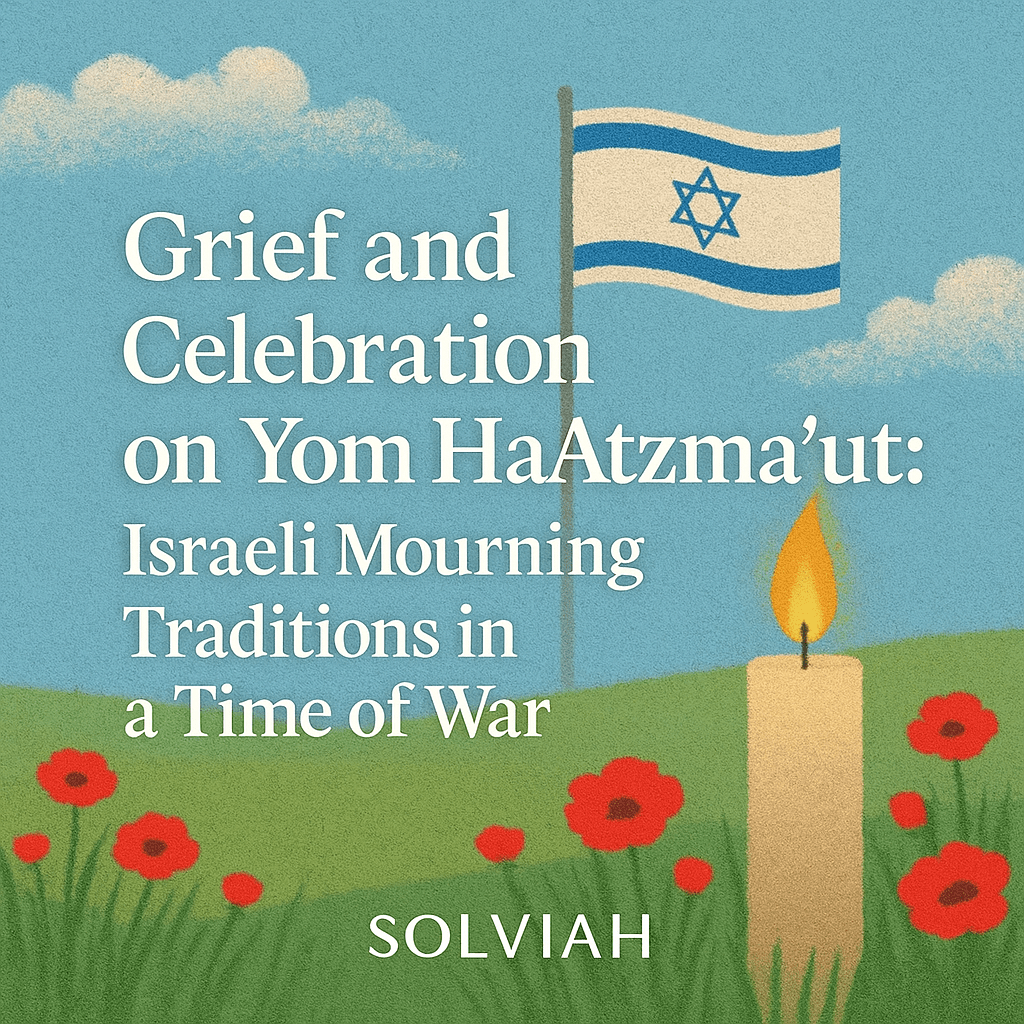
  • Grief and Celebration on Yom HaAtzma’ut: Israeli Mourning Traditions in a Time of War

    Grief and Celebration on Yom HaAtzma’ut: Israeli Mourning Traditions in a Time of War

    Table of Contents

    What Yom HaAtzma’ut Feels Like

    In early May, spring is in bloom across Israel. Hillsides are painted in red poppies and yellow wildflowers. The air carries warmth — perfect for outdoor gatherings — and streets fill with the smell of grilled meats and the hum of music.

    Families head to parks, beaches, and nature trails with Israeli flags in hand. They barbecue, sing, laugh, and rest.

    But beneath the celebration is a shared understanding: we are only here because others are not.

    “Before we started the mangal,” says Orna, whose son fell in combat last year, “we lit a candle and set a plate for him. Then we played his favorite song. We smiled through tears. That’s how we carry him.”

    ⬆️ Back to Top

    Today’s Yom HaAtzma’ut: Grief in a Time of War

    This year, Yom HaAtzma’ut arrives during a deeply painful time. The ongoing war and the presence of hostages have reshaped the emotional tone of the holiday.

    • Some celebrations have been canceled or scaled back.
    • Ceremonies include silence for the hostages and fallen soldiers.
    • Families of the kidnapped often mourn and protest rather than celebrate.

    Even for those not directly affected, the mood is heavier. Flags still wave, grills still light, but the songs are softer. Joy feels complicated — and that’s okay.

    ⬆️ Back to Top

    Mourning Practices Around Yom HaAtzma’ut

    Because Yom HaAtzma’ut follows Yom HaZikaron, many families shift quickly from grief to celebration — a cultural and emotional pivot few outsiders can understand.

    On Yom HaZikaron, candles are lit, cemeteries are visited, and national radio airs personal stories. The entire country stands still during the siren. Then, at sundown, Yom HaAtzma’ut begins.

    At the national torch-lighting ceremony on Mount Herzl, thirteen citizens are chosen each year to light torches. In 2024, several were lit in honor of hostages and fallen first responders.

    Many families continue their remembrance with a lit candle, a prayer, or a shared story before festivities begin.

    ⬆️ Back to Top

    What Can Friends and Supporters Do?

    • 🕯️ Acknowledge both holidays
    • 💬 Reach out with empathy
    • 👂 Offer presence, not platitudes
    • 🫶 Support verified causes like hostagesandmissingfamilies.org

    Your presence and words, even from afar, can bring deep comfort.

    ⬆️ Back to Top

    A Word from Solviah to the Griever

    To the one celebrating with a shadow over your heart —
    To the one who lights a candle before you light a grill —
    To the one who watches the fireworks through quiet tears —

    We see you. We honor you. You are not alone.

    At Solviah, we believe grief is not something to “get over.” It’s something to carry with care. And this Yom HaAtzma’ut, we carry it with you.

    Zikhronam livrakha
    May their memory be a blessing.

    ⬆️ Back to Top

    Glossary

    • Yom HaAtzma’ut: Israeli Independence Day
    • Yom HaZikaron: Memorial Day for fallen soldiers and victims of terror
    • Mangal: Traditional Israeli outdoor barbecue
    • Hostages: Individuals kidnapped during war or terror attacks
    • Diaspora: Jewish communities outside Israel
    • Zikhronam livrakha: Hebrew for “May their memory be a blessing”

    ⬆️ Back to Top

    References

    • Ben-Yehuda, N., & Mishali-Ram, M. (2006). The commemoration of Israeli soldiers in public rituals and sites. Memory Studies, 1(2), 123–136.
    • Rosenblatt, P. C. (2017). Grief across cultures. In Stroebe, M., Schut, H., & van den Bout, J. (Eds.), Handbook of Bereavement Research and Practice (pp. 207–222). American Psychological Association.
    • Israel Ministry of Foreign Affairs. (n.d.). Yom HaZikaron and Yom HaAtzma’ut: National Commemoration and Celebration. Retrieved from gov.il
    • Goodman, Y. (2010). Military, memory, and the politics of mourning in Israel. Ethos, 38(4), 369–389.

    ⬆️ Back to Top