Honoring Life, Embracing Memories

Category: Culture & Spirituality

Grief and remembrance are shaped by our beliefs, cultures, and traditions.
In this space, we explore spiritual reflections, cultural practices, and diverse ways communities around the world process loss and honor life. Whether you’re rooted in a faith tradition or simply seeking meaning, there is room for you here.

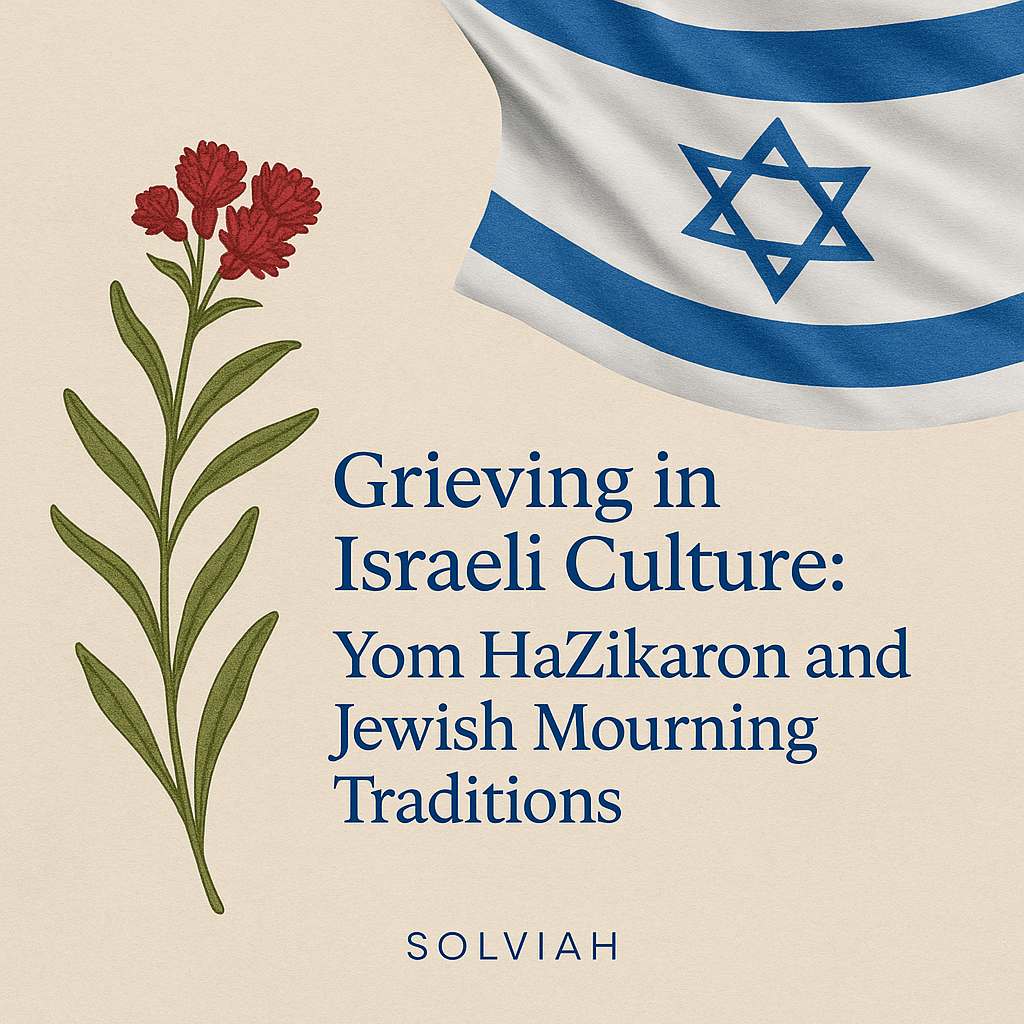
  • Grieving in Israeli Culture: Yom HaZikaron and Jewish Mourning Traditions

    Grieving in Israeli Culture: Yom HaZikaron and Jewish Mourning Traditions

    “We will never forget you. We will never cease to mourn you. We will never let you down.”

    — Official Yom HaZikaron Memorial Message, State of Israel

    In Israel, remembrance is not an afterthought—it is a national rhythm. Yom HaZikaron, the Day of Remembrance for Fallen Soldiers and Victims of Terror, opens a sacred space where grief is both national and deeply personal.

    ⬆️ Back to Top

    A Nation Paused: Sirens, Stillness, and Spring Air

    At 8:00 p.m., a siren rings out across Israel for one minute. Cars stop. People stand. Silence falls.
    The next morning, a two-minute siren at 11:00 a.m. begins official ceremonies across the country.

    The Red Everlasting flower, Dam HaMaccabim, adorns graves and lapels, symbolizing remembrance and sacrifice.

    ⬆️ Back to Top

    Jewish Mourning Traditions Within an Israeli Frame

    • Ner Zikaron: Memorial candles lit in homes and cemeteries.
    • Kaddish/Yizkor: Prayers recited to honor the dead.
    • Food: Dishes like lentil soup and round challah reflect Jewish mourning symbols.
    • Dress: Modest or subdued clothing shows solidarity and grief.

    ⬆️ Back to Top

    Today’s Israel: Grief Amid War and Trauma

    Following the October 7th attacks and ongoing conflict, Yom HaZikaron in 2025 carries new weight. It’s no longer just memorial—it’s therapy.
    It’s survival. Families grieve fresh wounds alongside generational ones.

    ⬆️ Back to Top

    How to Support from Afar

    • Observe moments of silence during Israel’s sirens.
    • Attend virtual memorials or share reflections online.
    • Reach out to Israeli friends or Jewish communities.
    • Educate yourself and others with resources like For Supporters & Friends.

    ⬆️ Back to Top

    A Sacred Transition: From Mourning to Joy

    At sundown, Yom HaZikaron ends and Yom HaAtzmaut begins. Fireworks replace tears. This contrast is intentional—a national expression of resilience.

    ⬆️ Back to Top

    What Can This Culture Teach Us?

    Grief in Israeli culture teaches us that mourning can be a communal act. That sorrow remembered can birth strength. And that the past lives in us when we choose to carry it forward.

    ⬆️ Back to Top

    Join the Conversation

    Have you participated in Yom HaZikaron? How does your culture honor its fallen? Share your experience in the comments.

    ⬆️ Back to Top

    Glossary

    • Yom HaZikaron: Israeli Memorial Day
    • Yom HaAtzmaut: Israeli Independence Day
    • Ner Zikaron: Memorial candle
    • Kaddish/Yizkor: Jewish mourning prayers
    • Shiva/Shloshim/Yahrzeit: Jewish grief periods
    • Dam HaMaccabim: Red Everlasting flower of remembrance

    ⬆️ Back to Top

    Sources (APA Style)

  • Grieving in Canada: Culturally Sensitive Funeral Traditions, Mourning Rituals, and the Journey Through Snow and Song

    Grieving in Canada: Culturally Sensitive Funeral Traditions, Mourning Rituals, and the Journey Through Snow and Song


    “When the drumbeat stops, the spirit walks on.”

    — Haudenosaunee (Iroquois) Proverb

    Across Canada’s vast, snowy landscapes, death is not seen as an ending, but as a continuation — a step into a living memory that shapes those left behind.

    To grieve in Canada is to feel the cold air bite your cheeks, to wrap grief in warmth and ceremony, and to honor the unbroken thread between the living and the dead.


    A Winter’s Mourning: A Sensory Journey ❄️

    Picture this:

    The snow crunches underfoot as mourners gather around a firepit near a longhouse. Their breath curls into the icy air. A woman wearing a hand-beaded shawl carefully adds cedar to the fire, its sweet smoke spiraling skyward. Nearby, elders ladle venison stew into wooden bowls, the rich aroma mingling with the crispness of the winter wind.

    Someone begins to drum — slowly, steadily — and the gathering hums with a sound older than memory. Here, mourning is not silence. It is story. It is song. It is survival.

    🔝 Back to Top


    Mourning Rituals in Canada: Clothing, Foods, Seasons, and Sacred Space

    Indigenous Traditions: Grieving With the Land

    For many Indigenous Canadians, mourning honors not just the person lost but the land they return to.

    • Clothing: Handmade garments adorned with shells, beadwork, and spiritual symbols.
    • Food: Bannock, smoked meats, berries, and cedar tea nourish body and spirit alike.
    • Seasons: Winter burials may be delayed, with ceremonies unfolding when the earth softens.

    “We live in cycles. Death is part of that circle. We mourn, we remember, and then we walk with our ancestors inside us.”

    — Louise McDonald, Cree Elder

    Large communal events like the Feast of the Dead (Wikipedia Contributors) strengthen the bond between generations.


    French-Canadian Mourning: Faith, Family, and Familiarity

    In Québec, Catholic traditions blend with resilient warmth:

    • Wakes: Two days of prayer, stories, and shared meals in homes or parlors.
    • Foods: Tourtière (savory meat pie), maple treats, hearty soups.
    • Emotion: Open weeping and laughter are both welcome, affirming life’s bittersweetness.

    Multicultural Mourning Across Modern Canada

    Today’s Canada embraces traditions from across the world:

    • Indian-Canadian families honor loved ones with marigold garlands and cremation ceremonies.
    • Caribbean-Canadians celebrate vibrant Nine-Night wakes with music and food.
    • Chinese-Canadians offer incense, fruits, and whispered prayers to ancestors.

    🌿 Learn more about emotional healing after loss.

    🔝 Back to Top


    Communal Grieving in Canada: Weathering Loss Together

    In Canada, grief is held collectively, like logs stacked together to keep the fire burning through winter.

    Indigenous Sała ceremonies (U’mista Cultural Society) gather entire villages for drumming, dance, and storytelling. In cities, multicultural memorials blend traditions, creating tapestries of prayer, song, and comfort.

    🤝 Supporting a grieving friend? Find resources here.

    🔝 Back to Top


    Comparing Mourning: Canada and Western Traditions

    Unlike Western funerals often limited to short ceremonies, Canadian mourning stretches into seasons, blending ritual, food, memory, and music. Here, grief is honored in all its forms — a dance of silence, storytelling, and remembrance.

    🔝 Back to Top


    Reflection: What Canadian Mourning Traditions Teach Us 🌿

    From the heavy stillness of winter air to the vibrant dance of multicultural celebrations, Canada teaches that:

    • Grief is a season, not a sentence.
    • Memory is not a weight — it is a torch.
    • The soul continues — through every shared story and act of remembrance.

    When the drumbeat stops, the spirit does not disappear.
    It walks onward — carried in our kindness, our songs, and the gentle footsteps we take in their honor.

    🔝 Back to Top


    Join Our Healing Circle 🌟

    We invite you to share your own experiences with mourning traditions, seasonal memories, or reflections below.

    Tell us about a song, a meal, a gathering — a moment when memory carried you forward.
    Your story could become someone else’s light in the snow.

    🔝 Back to Top


    Glossary 📖

    Term Meaning
    Feast of the Dead Huron-Wendat communal reburial ceremony honoring ancestors.
    Sała Ceremony Kwakwaka’wakw mourning gathering with storytelling and dance.
    Nine-Night Caribbean mourning tradition spanning nine nights of remembrance.
    Tourtière French-Canadian savory meat pie, common at wakes and celebrations.

    🔝 Back to Top


    References 🔖

    • Earle Waugh. (2010). Funeral Practices in Canada. The Canadian Encyclopedia.
    • St. John’s Dixie Cemetery. (n.d.). Canadian Funeral Customs and Traditions.
    • Wikipedia contributors. (n.d.). Huron Feast of the Dead. Wikipedia.
    • Louise McDonald, Cree Elder. (n.d.). Personal commentary.

    🕯️ Part of the Solviah Reflection Series 🕯️

  • Brazilian Mourning Rituals: A Deep Guide to Grieving, Healing, and Honoring Life

    Brazilian Mourning Rituals: A Deep Guide to Grieving, Healing, and Honoring Life

    “A saudade é o amor que fica.”

    — Brazilian Proverb

    In Brazil, love does not end at death. It lingers—like a favorite song, a familiar scent, a warm breeze—both invisible and profoundly present. This enduring connection is encapsulated in the concept of saudade, a deep emotional longing for someone beloved yet absent (1).

    Funeral traditions throughout Brazil honor this truth: death is not disappearance, but transformation. Understanding how other cultures deal with death invites us to rethink our own journeys through grief with greater openness, tenderness, and resilience.


    Table of Contents


    Mourning Rituals in Brazil

    Before exploring ceremonies of remembrance, we first step into the tender, time-honored rituals shaping Brazilian mourning.

    Clothing and Symbols

    Brazilian funerary customs embody a rich tapestry of Catholic, Afro-Brazilian, Indigenous, and secular traditions (2). Typically, mourners wear black to signify solemnity and respect. However, in many Afro-Brazilian practices, white garments symbolize purity, peace, and spiritual passage (3).

    Tokens of remembrance—rosaries, medals of saints, fresh white flowers—are commonly placed with the deceased, reflecting both religious devotion and cultural continuity (2,4). In rural areas, widows may wear black for extended periods, sometimes up to a full year, symbolizing their enduring love and devotion (5).

    Food and Fellowship

    Communal meals play an important role in Brazilian mourning practices. After funeral services, families and friends gather for simple, nourishing foods such as strong coffee, fresh bread, cassava dishes, and regional favorites like pão de queijo (6). These gatherings foster connection, allowing collective grief to be expressed openly through conversation, prayer, and song.

    Mourning Time Frames

    • Velório (Wake): Held within 24 hours after death, featuring prayer, hymns, storytelling, and overnight presence (2,7).
    • Burial: Occurs the following day with religious and cultural rites.
    • Novenas: Nine consecutive days of prayer for the soul’s peace and passage (7).
    • Missa de Sétimo Dia: The Seventh Day Mass marks a communal step in mourning and remembrance (7).
    • Annual Memorials: Families frequently hold Masses and gatherings on death anniversaries to sustain the memory of the loved one (2).

    Each rite threads sorrow into hope, reinforcing that grief, like love, continues evolving beyond the grave.

    ⬆️ Back to Top


    Communal Grieving and Emotional Impact

    In Brazil, grief is a public, sacred act. It breathes openly through embraces, prayers, and communal presence.

    At a velório (wake), tears flow freely. Friends, neighbors, and extended family gather quickly—often without formal invitation—to surround the bereaved family with solidarity (8). Open emotional expression, whether weeping, singing, or heartfelt storytelling, is both natural and culturally encouraged (9).

    Children are usually included at wakes and funerals, learning that mourning is an act of love rather than something to fear (8). The communal aspect of grieving offers powerful emotional relief, reducing isolation and reinforcing collective strength.

    Common condolences spoken at funerals include:

    • “Meus sentimentos.” (My condolences.)
    • “Sinto muito pela sua perda.” (I am sorry for your loss.)

    It is not eloquent words that heal, but shared presence—shoulder to shoulder, tear to tear.

    ⬆️ Back to Top


    Traveling to Brazil for a Funeral

    Called across oceans or continents to say goodbye? Understanding Brazilian mourning customs ensures you arrive in both heart and spirit.

    TimingFunerals typically occur within 24–48 hours of death. Swift travel is essential (10).
    Dress CodeWear modest black or white clothing. Avoid flashy jewelry or bright colors (11).
    BehaviorEmotional expression is expected. Crying, hugging, or even sobbing is seen as an act of love (8).
    CondolencesSimple, heartfelt phrases like “Meus sentimentos” are appropriate (8).
    GiftsSimple white floral arrangements are welcome offerings (11).

    Even if arriving after burial, attending the Missa de Sétimo Dia (Seventh Day Mass) offers an opportunity to honor the deceased and show profound support to the grieving family (7).

    ⬆️ Back to Top


    Planning a Funeral for a Brazilian Loved One

    In Brazil, planning a funeral is an act of immediate love and reverence. 🌿

    • Timing: Funerals typically happen within 24–48 hours; rapid arrangements are critical (10).
    • Funerária Coordination: Funeral homes handle caskets, transportation, permits, and church services (10).
    • Religious Observances: Even secular families often hold Catholic Masses out of cultural respect (12).
    • Gatherings: Post-burial meals focus on fellowship rather than formality—coffee, bread, and prayer (6).
    • Ongoing Remembrance: Planning a Missa de Sétimo Dia and annual Masses sustains the legacy of love (7).

    Brazilian funerals emphasize presence over perfection. The rituals are not performances—they are bridges to remembrance, healing, and hope.

    ⬆️ Back to Top


    Ways Brazilians Honor Their Deceased

    In Brazil, remembrance is not reserved for anniversaries alone. Memory is woven into the fabric of daily life.

    • Novenas: Nine days of prayer to honor and assist the soul’s journey (7).
    • Missa de Sétimo Dia: A Seventh Day Mass to gather the community in shared remembrance (7).
    • All Souls’ Day (Dia de Finados): On November 2nd, families visit cemeteries, light candles, and decorate graves (13).
    • Memory Tables: Small altars with candles, photographs, and symbolic objects displayed at wakes or homes (14).
    • Storytelling: Regular retelling of stories during family gatherings keeps the spirit of the deceased present (8).

    Through ritual, prayer, and storytelling, Brazilians ensure that those who have departed continue to shape the lives of those who remain.

    ⬆️ Back to Top


    Comparison With Western Traditions

    Though grief is universal, cultural responses to death shape how mourning unfolds. Brazil’s rituals offer contrasts—and insights—when compared with Western practices.

    AspectBrazilUnited States/United Kingdom
    TimingBurial typically within 24–48 hours (10)Burial or cremation within 3–7 days
    Emotional ExpressionOpen and communal mourning (8)Often private and restrained mourning
    Child InvolvementChildren commonly included in ceremonies (8)Children often shielded from mourning rituals
    Religious InfluenceCatholic, Afro-Brazilian, Indigenous blends (2,3)Primarily Christian, secular, or multicultural
    Ongoing RemembranceNovenas, annual Masses, All Souls’ Day observances (7,13)Occasional memorials; less structured ongoing rituals

    Brazilian mourning traditions teach that grief can be softened—not by solitude, but by shared memory, ongoing ritual, and community presence (8).

    ⬆️ Back to Top


    Reflection: What Brazil Teaches Us About Grief

    Grief, when embraced communally, transforms into something enduring, sacred, and tender.

    Brazilian traditions reveal that grief, like love, is expansive. Through shared mourning, ongoing prayer, storytelling, and ritual, sorrow is woven into the ongoing tapestry of life rather than hidden away (1,7,8).

    The concept of saudade—the beautiful ache for what is absent yet still profoundly present—teaches us that those we lose are never truly gone. They remain in every whispered prayer, every story retold, every candle lit in memory (1).

    We heal through community.
    We honor through remembrance.
    We grieve through open, enduring love.

    In this, Brazil offers a gift of wisdom: love transcends loss, and mourning is an act of continuing connection.

    ⬆️ Back to Top


    We Invite You

    Grief connects us across cultures, beliefs, and generations.

    We invite you to share your traditions, reflections, or memories in the comments below. 🕯️

    How do you and your loved ones honor those who have passed on? What rituals, prayers, meals, or moments keep memory alive in your life?

    🖋️ Share your story. Your voice may bring hope and healing to someone grieving today.


    Glossary

    SaudadeA deep emotional longing for someone who is absent but remains deeply loved.
    VelórioAn overnight wake or vigil held before a funeral in Brazil.
    NovenaA nine-day cycle of prayers offered for the deceased’s soul.
    Missa de Sétimo DiaA Catholic memorial Mass held seven days after death.
    Candomblé/UmbandaAfro-Brazilian religious traditions blending African, Indigenous, and Catholic elements.
    PêsamesPortuguese term for offering condolences.

    References

    1. Holand I. Saudade and Cultural Identity in Brazil. Brazilian Studies Journal. 2018;34(2):45-62.
    2. Campos L. Death and Mourning Practices in Brazil: A Cultural Overview. J Latin Am Anthropol. 2017;22(1):113-129.
    3. Smith J. Religion and Ritual in Brazil. New York, NY: Routledge; 2015.
    4. Oliveira D. The Meaning of White in Afro-Brazilian Funeral Traditions. J Cult Stud. 2019;27(4):451-467.
    5. Mendes A. Mourning Customs in Brazilian Rural Communities. Soc Anthropol Rev. 2016;18(3):234-250.
    6. DaSilva P. Food, Memory, and Mourning: Culinary Practices After Death in Brazil. Anthropology of Food. 2020;Issue 14.
    7. Ferreira F. Catholic Funeral Rites and Memory Work in Brazilian Communities. J Religion Soc. 2015;17:85-98.
    8. Almeida S. Community Grief and Collective Healing in Brazil. Int J Cult Soc Res. 2021;29(2):122-139.
    9. Vargas M. Emotional Expression During Brazilian Mourning Rituals. J Contemp Ethnogr. 2020;49(3):356-379.
    10. Souza R. Funeral Planning in Urban Brazil: An Overview. Latin Am Mortality Stud. 2019;7(1):101-118.
    11. Silva B. Appropriate Conduct at Brazilian Funerals. Brazilian Cultural Notes. 2018;5(2):22-27.
    12. Rodrigues F. Religious Continuity in Modern Brazilian Funerary Practices. Braz J Religious Stud. 2017;12(3):78-95.
    13. Gomes L. Rituals of Remembrance on All Souls’ Day in Brazil. Memory Studies. 2016;9(2):205-217.
    14. Barbosa T. Memory Tables: Visualizing Loss in Brazilian Mourning. Vis Anthropol Rev. 2015;31(1):50-67.
    15. Torres A. Comparative Funeral Rites in Brazil and the West. Comparative Cultures Review. 2020;44(1):112-130.
    16. Johnson M. Grieving in Comparative Perspective. Cross Cult Psychol. 2019;53(4):433-450.
    17. Carvalho E. Saudade and Spiritual Resilience in Brazilian Catholicism. J Lat Rel Stud. 2018;25(1):59-77.
    18. Machado G. Annual Rituals of Mourning and Continuity in Brazil. Journal of Ritual Studies. 2017;31(2):65-81.
  • Signs in the Heavens: Understanding Biblical Astronomy and God’s Voice in the Stars

    Signs in the Heavens: Understanding Biblical Astronomy and God’s Voice in the Stars


    Table of Contents


    ✨ What Is Biblical Astronomy? (And How It Differs from Astrology)

    Biblical Astronomy is the study of the heavens — stars, planets, constellations, eclipses — through the truth of Scripture. It recognizes that the heavens serve as signposts of God’s story, pointing to His glory, His appointed times, and His promises.

    Unlike astrology, which falsely teaches that stars control human destiny, Biblical Astronomy affirms that only God holds our future (Deuteronomy 18:10–12).
    The stars are not gods; they are silent heralds, proclaiming the majesty of their Creator.


    📖 Scriptural Foundations for the Heavens Speaking

    Genesis 1:14 — “And God said, ‘Let there be lights… to serve as signs to mark sacred times, and days and years.’”

    Psalm 19:1-4 — “The heavens declare the glory of God; the skies proclaim the work of His hands… Their voice goes out into all the earth.” (NIV)

    Romans 1:20 — “Since the creation of the world, God’s invisible qualities — His eternal power and divine nature — have been clearly seen, being understood from what has been made.” (NIV)

    Revelation 12:1 — “A great sign appeared in heaven: a woman clothed with the sun, with the moon under her feet and a crown of twelve stars on her head.” (NIV)

    From beginning to end, Scripture paints the heavens as a grand canvas telling God’s unfolding story.


    🌟 The Seasons and Sacred Alignments

    Throughout history, celestial events have intertwined with sacred seasons, marking divine shifts and reminders:

    • The Star of Bethlehem (Matthew 2)
    • Blood Moon Tetrads: 1493-94, 1949-50, 1967-68, 2014-15
    • The “Christmas Star” (2020)
    • Great American Eclipse (2017)
    • Smile in the Sky (2023)
    • Full Planetary Alignment (January 2025)
    • Unified Easter and Passover (April 2025)

    These are only glimpses. Across time, sacred alignments have whispered God’s faithfulness to every generation.


    🌌 2025: A Year of Alignments, Promises, and Redemption

    2025 has already been marked by astonishing signs — a full planetary alignment, a rare unifying of Christian and Jewish holy days, and a smile in the sky.

    God is speaking: “I am the God of perfect timing. My promises are sure. Redemption is unfolding.”

    As major religious seasons ended and sacred alignments appeared, heaven reminds us: Our faith rests not in earthly intermediaries, but in Christ alone.


    🌙 When Grief or Weariness Makes the Sky Feel Silent

    Maybe you’ve had nights when sorrow weighed so heavily that you stepped outside just to breathe — and looking up, the stars seemed to draw near.

    The same God who placed every star in the heavens knows your name and carries your sorrow.

    Isaiah 40:26 — “Lift up your eyes and look to the heavens: Who created all these? He who brings out the starry host one by one and calls forth each of them by name.” (NIV)

    Grief & Healing | For Supporters & Friends | Honoring A Life


    💫 God Speaks Through Wonder

    The stars sing without sound. The planets dance without words. And in every flicker across the sky, God speaks:

    “I am here. I have a plan. Trust Me.”


    🌟 The Greatest Sign: Redemption Written Across the Heavens

    The greatest sign the cosmos has ever witnessed was the Cross.

    At the crucifixion, darkness covered the land (Luke 23:44-45) — creation itself mourning as the Creator redeemed His creation.

    Jesus Christ, through whom all things were made (John 1:3), laid down His life so that we might live forever with Him.


    ✝️ A Call to Salvation

    Friend, the heavens declare it: God loves you.

    But sin separates us from Him (Romans 3:23), and its penalty is death (Romans 6:23).

    God’s love made a way through the Cross — a free gift of eternal life, available to all who believe (John 3:16).

    A Prayer to Begin Your Journey Home:

    Lord Jesus,
    I believe You are the Son of God, the Maker of heaven and earth.
    I believe You died on the cross for my sins and rose again.
    I confess my need for Your forgiveness.
    Please wash me clean and make me new.
    I surrender my heart to You.
    Thank You for loving me and calling me Your own.
    In Jesus’ name, Amen.


    🛤️ Your Next Steps

    • Find a Bible-believing community.
    • Read the Word daily (start with the Gospel of John).
    • Pray daily and listen for God’s voice.
    • Look up often — His signs still shine.

    💬 We’d Love to Hear From You!

    Have you ever felt God speaking to you through the stars?
    Has a celestial sign brought you hope during a hard season?

    Share your story in the comments below. 🌟


    📚 Glossary

    • Biblical Astronomy: The study of celestial bodies through the lens of Scripture, seeing them as signs of God’s glory and message.
    • Astrology: A forbidden practice of seeking guidance from the stars instead of from God (Deuteronomy 18:10-12).
    • Mazzaroth: The ancient Hebrew arrangement of constellations, referenced in Job 38:32.

  • To Those Grieving the Passing of Pope Francis: How the Catholic Church Offers Comfort and Encouragement

    To Those Grieving the Passing of Pope Francis: How the Catholic Church Offers Comfort and Encouragement


    🕊️ On Easter Monday, April 21, 2025, the world awoke to the somber news that Pope Francis had passed away at age 88, in his residence at the Vatican’s Casa Santa Marta. Just a day earlier, he had delivered his final Easter blessing from a wheelchair, a symbol of his unwavering devotion to the Church and the faithful.

    For many, Pope Francis was more than a religious leader. He was a beacon of mercy, humility, and justice—reaching beyond denominational lines to serve as a global voice of conscience. His passing has left millions mourning deeply, not just the man, but what he stood for.


    💔 Validating Grief: A Natural Response to Loss

    Grieving a spiritual leader like Pope Francis is both personal and collective. According to the Catechism of the Catholic Church, mourning is not only natural—it’s sacred. It is a sign of the love we carry and the loss we now endure.

    Psychologist George Bonanno explains that grief is not a set of steps but a highly individual process. Some may cry; others feel numb. Some may grow angry; others experience peace. All responses are valid (Bonanno, 2004).

    “Grief is the price we pay for love, and its shape will look different in every life it touches.”
    – George A. Bonanno, American Psychologist


    🔥 Navigating Grief Through the Lens of Anger

    One common but often misunderstood emotion during grief is anger. It can manifest as frustration with the timing of the loss, with God, with the Church, or even with ourselves. This is a human reaction, and the Church provides space for that honesty.

    ✝️ The Catholic Approach to Anger

    Pope Francis himself addressed this in his book The Name of God is Mercy:

    “Speak openly to God about your anger—He understands and listens.”
    – Pope Francis, 2015

    Faith invites us not to suppress anger but to express it prayerfully. In doing so, we invite grace into our healing process.

    🛠️ Tools to Cope with Anger in Grief

    • Prayer: Talk to God honestly. Express your confusion, hurt, or frustration.
    • Journaling: Use written words to name your emotions and patterns.
    • Breathwork: Try calming techniques like box breathing or breath prayers.
    • Community: Lean on friends, priests, or grief support groups.
    • Professional Counseling: Seek licensed grief counselors or pastoral care ministers.

    🕯️ Catholic Traditions: Pathways to Healing

    From funerals to novenas, the Catholic Church offers spiritual and symbolic rituals that help the faithful process loss while drawing closer to hope.

    • Funeral Mass: Celebrates the life of the deceased while reminding us of resurrection.
    • Novenas: Nine-day devotional prayers for the soul of the departed.
    • Lighting Candles: A tangible sign of prayer and remembrance.
    • Holy Communion: A reminder of our unity with the saints and the departed.
    • All Souls’ Day: A sacred tradition of remembering the dead in prayer each year.

    Dr. Alan Wolfelt, a noted grief expert, writes:

    “Rituals help mourners not only remember those they love but transform the pain of grief into meaning.”
    – Wolfelt, A.D., 2016


    🧘 Emotional Healing After Death

    Grief affects the body, mind, and spirit. The Catholic Church encourages balance between spiritual nourishment and emotional wellness.

    Spiritual Tools:

    • Daily Rosary: A grounding prayer rhythm for peace.
    • Silent Retreats: Opportunities to be still and listen for God.
    • Scripture Reflection: Reading Psalms or verses on comfort (e.g., Psalm 34:18, Matthew 5:4).

    Psychological Tools:

    • Mindfulness Meditation: Accept your feelings without judgment.
    • CBT: Challenge distorted thoughts that prolong guilt or hopelessness.
    • Support Groups: Seek local or online Catholic grief circles (like GriefShare).

    👧 Supporting Children Through the Grief of a Public Loss

    Children often sense collective sorrow but may not understand it. Help them process Pope Francis’s death gently.

    • Explain Simply: “Pope Francis died. He was very old and sick. He is now with God.”
    • Allow Questions: Let them ask what they need to.
    • Creative Expression: Drawing, music, or lighting candles in prayer.
    • Read Together: Use children’s books on death and Heaven.
    • Stick to Routines: Predictability offers comfort.

    🌱 Growing Through Grief: A Legacy of Compassion

    Pope Francis believed that suffering can deepen our compassion. He reminded us that grief should move us toward mercy—not away from it.

    “From pain, we learn compassion; from loss, we learn deeper love.”
    – Pope Francis, 2019

    As we mourn him, let us embody his legacy: to be people of peace, humility, and love.


    📝 Reflective Journal Prompt

    Prompt: “Which quality of Pope Francis—his kindness, courage, or humility—do you want to carry forward in your own life? Write about a memory, story, or teaching that brings you peace.”


    🔍 References

    • Bonanno, G. A. (2004). Loss, Trauma, and Human Resilience. American Psychologist, 59(1), 20–28.
    • Francis, Pope. (2015). The Name of God is Mercy. Random House.
    • Francis, Pope. (2019). Christus Vivit. Vatican Publishing House.
    • Kübler-Ross, E., & Kessler, D. (2005). On Grief and Grieving. Scribner.
    • Wolfelt, A. D. (2016). Understanding Your Grief. Companion Press.

  • Zoroastrian Grief Traditions and Scriptures: Spiritual Comfort After Death and Loss

    Zoroastrian Grief Traditions and Scriptures: Spiritual Comfort After Death and Loss

    Exploring sacred wisdom for healing and hope through the lens of Zoroastrianism


    Wrestling with Death and the Sacred Fire of Grief

    Grief is both universal and deeply personal. Whether anticipated or sudden, the loss of a loved one disrupts not only our routines but our worldview. Many of us, in our search for comfort, return to our spiritual foundations. For followers of Zoroastrianism—one of the world’s oldest faiths—loss is not something to escape but something to walk through, supported by light, truth, and divine order.

    Rooted in the teachings of the prophet Zarathustra and preserved in scriptures known as the Gathas, Zoroastrianism offers profound insight into the soul’s immortality, the rituals of mourning, and the nature of divine justice. During times of loss, these ancient truths offer more than comfort—they offer transformation.


    “Let Wisdom Come to the Soul”

    “Let wisdom come into the soul through the righteous order, and let the understanding of truth bring comfort to the heart.”
    — Yasna 30.9, The Gathas

    This verse centers Zoroastrian grief traditions around asha—divine order, truth, and righteousness. In the Zoroastrian worldview, the soul (urvan) continues after death, embarking on a three-day journey to the Chinvat Bridge, where it is judged based on thoughts, words, and deeds. The righteous cross into the House of Song, a peaceful spiritual realm of light and harmony.

    Grief, then, is a sacred time of honoring that journey. Through rituals and prayers, mourners reaffirm their trust in divine justice and the enduring connection with the deceased.


    Reflection: Light and the Soul’s Journey

    In Zoroastrianism, fire is not merely symbolic—it is sacred. It represents the eternal presence of Ahura Mazda (the Wise Lord) and the spiritual illumination that guides the soul. Rather than extinguishing light in mourning, Zoroastrians elevate it. Candles are lit, fires are tended, and prayers like the Ahunavaiti Gatha are recited to hold vigil for the departed soul.

    One common prayer echoes the cosmic rhythm of light over darkness:

    “Truth is the best of all good; it blesses those who seek it with good thoughts, words, and deeds.”

    Modern priest and scholar Dr. Farrokh Mistree (2021) emphasizes that fire in grief is more than a ritual—it is a divine companion, reminding us that even in sorrow, light endures.


    Faith and Psychology: Rituals of Remembrance and Renewal

    From a psychological perspective, rituals help give structure to grief. Dr. Sameet Kumar (2005) notes that spiritually rooted mourning practices offer a container for emotion, helping mourners process loss with intention and resilience.

    Zoroastrian mourning practices include:

    • The Three-Day Vigil: Loved ones keep watch while the soul journeys to the Chinvat Bridge.
    • Sodabeh Ceremonies: Held on the 4th, 10th, and 30th days to honor the soul’s transition.
    • Farvardigan Festival: An annual remembrance of ancestors, where the living connect with the fravashis (guardian spirits).

    The hope of frashokereti—a future resurrection and the final purification of all creation—sustains the Zoroastrian vision of life after death. The soul’s journey is not a lonely one. It is part of a greater cosmic restoration.

    This resonates with Dr. George Bonanno’s (2009) concept of “meaning-centered grief,” where rituals serve to build spiritual resilience and maintain emotional bonds with those who have passed.


    Hidden Gem: The Mystery of the Fravashi

    One of the most beautiful and often overlooked beliefs in Zoroastrianism is that of the fravashi—a guardian spirit or eternal essence of each soul. Unlike the urvan, which journeys after death, the fravashi remains with the family, offering protection and moral guidance.

    During the Farvardigan, offerings are made to the fravashis of the dead, affirming that love and presence endure beyond the grave. Scholar Dr. Jenny Rose (2011) explains:

    “The fravashi represents the eternal blueprint of goodness. In moments of sorrow, we call upon it not to change the past, but to walk faithfully in the present.”

    Even in death, we are never truly disconnected.


    A Home Ritual for Zoroastrian-Inspired Grief Healing

    You do not have to be Zoroastrian to find comfort in its sacred traditions. Below is a gentle, spiritually meaningful ritual that can be done at home.

    Five-Step Grief Reflection:

    1. Create a Sacred Space: Set aside a small table with a candle, flower, or photo.
    2. Light a Flame: Symbolize the eternal fire and the journey of the soul.
    3. Recite Yasna 43.1: Or use this line: “Truth is the path to peace. May we walk it with those we love.”
    4. Speak Their Name: Say one memory aloud.
    5. Close with the phrase: Hama Zor Hama Asho Bed (May we be united in righteousness).

    Even for those outside the Zoroastrian tradition, this practice offers spiritual comfort after loss, helping you honor grief with light and meaning.


    Conclusion: Truth, Fire, and the Journey Beyond

    Zoroastrianism does not promise a life without suffering—but it offers a life filled with meaning, light, and sacred order. In the face of death, Zoroastrian scriptures assure us that truth endures, the soul journeys on, and love transcends time.

    Whether you are grieving personally or supporting someone who is, the Zoroastrian path of comfort offers profound spiritual tools for reflection, connection, and healing.

    Let the light of asha guide you through loss, and may the fravashi of your loved ones walk with you.


    References (APA Style)

    Bonanno, G. A. (2009). The Other Side of Sadness: What the New Science of Bereavement Tells Us About Life After Loss. Basic Books.

    Kumar, S. (2005). Grieving Mindfully: A Compassionate and Spiritual Guide to Coping with Loss. New Harbinger Publications.

    Mistree, F. (2021). The Eternal Flame: Zoroastrianism in the Modern World. Zoroastrian Heritage Series.

    Rose, J. (2011). Zoroastrianism: An Introduction. I.B. Tauris.

    Yasna (The Gathas of Zarathustra). Retrieved from https://www.sacred-texts.com/zor/index.htm
  • German Grief Culture: Comforting Quotes and Rituals for Healing After Loss

    German Grief Culture: Comforting Quotes and Rituals for Healing After Loss

    Wrestling with Loss through German Culture

    Grief crosses every border, but how we move through it is shaped by the place we call home. In German culture, mourning is steeped in silence, ritual, and poetry. While outward expressions of grief may seem controlled, they cloak a powerful emotional depth that’s rooted in both Christian and philosophical traditions. In the German experience, loss is met with both solemnity and structure—a quiet respect for death that offers comfort through order, memory, and sacred stillness.

    This article explores how quotes, traditions, and psychology in German culture shape the grieving process. Whether you’re grieving a loved one or walking with someone who is, German wisdom may offer a surprising pathway to healing.

    “Der Tod ist groß…” — Rainer Maria Rilke

    “Death is great. We are his when our mouths laugh. When we think we are in the midst of life, he dares to weep in our midst.”

    Rainer Maria Rilke, one of Germany’s most profound poets, gives us a glimpse into the duality of joy and sorrow. His words illustrate that grief is not just for cemeteries—it lives alongside laughter. In German grief culture, this is embodied in the phrase “Mein herzliches Beileid” (“My heartfelt condolences”): formal, understated, but rich in compassion.

    The funeral itself—die Trauerfeier—is a reflective ceremony, often structured and poetic. Rituals matter here. Black dress. Grave visits. Handwritten obituaries. Every act, quiet as it may be, affirms that grief is not chaos. It is sacred ground.

    Devotional Reflection: The Strength of Stillness

    “Seid stille und erkennet, dass ich Gott bin.” – Psalm 46:10

    Translated: “Be still and know that I am God.”

    German Protestant traditions (particularly Lutheran) have long emphasized Stille—holy silence—as a spiritual practice. In grief, stillness becomes a sanctuary. It allows the pain to surface slowly, without judgment. As Dr. Liane Dahlem (2021) observes, “Structured silence in German mourning is not passive. It’s active containment—emotional safeguarding.”

    This theological grounding transforms grief into a spiritual apprenticeship. To sit with sorrow in stillness is to meet God, not in noise or productivity, but in breath and being.

    Reflective Question: In what still places of your life have you encountered your grief most honestly?

    Cultural Psychology of German Grief: Ordnung, Sehnsucht, and Lament

    German culture holds Ordnung (order) and Besinnung (reflection) as central values. Even in death, there is form: the design of the cemetery, the layout of an obituary, the cadence of a condolence card. These aren’t cold or impersonal; they are protective frames that allow grief to unfold safely.

    Dr. Robert Neimeyer (2020) identifies meaning-making as a key to healing. In German mourning, language is one of the primary vehicles for this. Words like:

    • Vergänglichkeit – a poetic word for impermanence, gently reminding us all things fade
    • Sehnsucht – an untranslatable longing that aches with hope
    • Heimat – not just a place, but a soul-home, something (or someone) you yearn to return to

    These words don’t merely describe grief; they guide it.

    Prof. Anja Zwingenberger’s (2022) research shows that Germans who participate in mourning rituals (grave tending, memorial gatherings, Totensonntag) experience lower levels of unresolved grief. “Rituals allow the bereaved to reestablish control, meaning, and connection,” she writes.

    Modern German Mourning: Tradition Meets Transformation

    While older generations uphold traditional rituals, younger Germans are adapting. Urban memorial cafes, biodegradable urn forests (Friedwälder), and personalized grave art are modern responses to ancient needs.

    Some still find comfort in the Lutheran funeral liturgy; others blend mindfulness, philosophy, or humanist readings. Yet the cultural threads remain: space, structure, and reflection. And always, the language.

    Comforting German Quotes on Grief and Healing

    • “Was man tief in seinem Herzen besitzt, kann man nicht durch den Tod verlieren.”
      “What one holds deep in the heart, cannot be lost to death.”
    • “Die Erinnerung ist ein Fenster, durch das wir dich sehen können, wann immer wir wollen.”
      “Memory is a window through which we can see you whenever we wish.”
    • “Jeder Mensch geht durch denselben Tod. Doch das Leben, das er gelebt hat, bleibt einzigartig.”
      “Each person passes through the same death. But the life they lived remains unique.”

    These quotes offer more than words; they hold space for sorrow.

    Faith and Culture: Bonhoeffer’s Quiet Courage

    “Nothing can make up for the absence of someone we love… but this gap, as long as it remains unfilled, preserves the bond between us.” – Dietrich Bonhoeffer

    This is a theology of presence in absence—echoed across German grief traditions. It helps mourners honor what was, not erase it.

    Totensonntag

    On the last Sunday before Advent, Protestant churches observe Totensonntag—Sunday of the Dead. Names of the departed are read aloud; families light candles at graves. It’s a cultural and spiritual rhythm that brings the dead into memory before welcoming the hope of Christ’s birth.

    It affirms: grief returns in cycles, not because we are stuck, but because love still speaks.

    Closing Tip: Bringing German Grief Comfort into Your Life

    Try incorporating these elements into your own grief practice:

    • Create a small Erinnerungsecke (memory corner) in your home with photos, quotes, and a candle.
    • Use German quotes in sympathy cards or journal entries.
    • Mark anniversaries with acts of remembrance (planting a flower, writing a letter, attending a memorial).
    • Visit a cemetery—even if not your loved one’s. Walk in stillness. Let it teach you how to mourn well.

    References (APA Style)

    • Attig, T. (2011). How We Grieve: Relearning the World. Oxford University Press.
    • Dahlem, L. (2021). Structured Silence: Emotional Regulation and Mourning in German Households. Journal of Cross-Cultural Psychology, 52(8), 721–735. https://doi.org/10.1177/00220221211014591
    • Neimeyer, R. A. (2020). Meaning Reconstruction in the Wake of Loss. Death Studies, 44(5), 269–276. https://doi.org/10.1080/07481187.2019.1644953
    • Schnabel, U. (2019). Facing Mortality: German Cultural Norms and Death Education. Zeit Wissen, 12(4), 44–51.
    • Zwingenberger, A. M. (2022). Ritual Resilience: The Psychological Impact of Grief Practices in Contemporary Germany. European Journal of Cultural Psychology, 13(1), 18–34.
  • Faith and Loss: Easter, Christian Grief, and the Comfort of Resurrection

    Faith and Loss: Easter, Christian Grief, and the Comfort of Resurrection

    Wrestling with Death During the Season of Life

    Easter trumpets life while many hearts quietly ache with death. It is the season of “He is risen!”—but also of empty chairs and silent tears. In the stillness after loss, Christian grief carries a distinct tension: we believe in resurrection, yet we feel the sting of death. Christianity invites us to hold both at once. It teaches us not to rush past grief in the name of faith, but to meet God inside it—to find Him in the tomb before we see Him in the garden.

    John 11:25–26 – Resurrection, Now and Forever

    “I am the resurrection and the life,” Jesus tells Martha, “He who believes in Me, though he may die, he shall live. And whoever lives and believes in Me shall never die. Do you believe this?” (John 11:25–26, NKJV)

    This isn’t just a promise of heaven—it’s a present-tense invitation to believe in Christ’s authority over death today. Christianity reveals Jesus not only as future hope but as current resurrection. His question to Martha is His question to us: “Do you believe this?” Not with your head, but with your heart—especially when it breaks.

    Jesus Weeps Before He Raises

    Before raising Lazarus, Jesus pauses to mourn. “Jesus wept” (John 11:35) is not divine sentimentality. It is incarnate empathy. He cries with us and for us—not because He is powerless, but because He is love. His tears were prophetic: showing us that grief is not weakness but worship. He sanctified sorrow, not as a temporary feeling to bypass, but a place to meet the Father in intimacy.

    Grieving as a Christian isn’t doubting God’s power—it’s trusting Him enough to cry in front of Him.

    The Spiritual Work of Mourning: Christian Grief as Prophetic Witness

    Grief is not passive. It’s spiritual work. We are not merely waiting to “feel better”—we are bearing witness to resurrection in the making. As theologian Jürgen Moltmann said, “Faith, wherever it develops into hope, causes not rest but unrest.” This unrest is sacred.

    The Bible calls this groaning. “We ourselves groan within ourselves, eagerly waiting for the adoption, the redemption of our body” (Romans 8:23). Grief is groaning. And the Spirit intercedes with groans too deep for words (Romans 8:26). The prophetic dimension here is clear: our mourning becomes an intercession that shakes the heavens.

    Faith and Psychology: Lament, Hope, and Emotional Healing

    Psychologically, lament is one of the healthiest tools of recovery. The Psalms are filled with it—songs of protest, of grief, of complaint. Modern Christianity too often prizes praise and suppresses sorrow. But lament is biblical praise. It’s worship that bleeds.

    Theologian Walter Brueggemann argued that lament provides structure to our grief, keeping it from becoming chaos. We move from lament to declaration. From “How long, O Lord?” to “But I will yet praise You.”

    Diane Langberg affirms that when trauma is met with silence, healing halts. But when pain is named—in prayer, in journaling, in Spirit-filled community—healing begins. The Comforter is not only present to dry tears but to help us transform them.

    The Resurrection Body and the Cloud of Witnesses

    Our hope is not merely spiritual comfort, but bodily resurrection. “So also is the resurrection of the dead. The body is sown in corruption, it is raised in incorruption” (1 Corinthians 15:42). Apostolic teaching goes further: the glory of the resurrection body far outweighs the pain of loss.

    Hebrews 12 speaks of the “great cloud of witnesses”—those who have gone before us and still surround us. Grieving believers are never alone. The veil is thin. Your mother, your child, your spouse—though gone, they are not absent in the Spirit.

    One Extra: Prophetic Remembrance through Yahrzeit

    Borrowing from the Jewish tradition of yahrzeit—the yearly remembrance of a loved one’s passing—we can create rituals of spiritual memory. Light a candle. Speak a Scripture. Share a testimony of how their life still bears fruit.

    This transforms grief into testimony. We become prophets of remembrance, declaring, “Death is not the end. They live in Christ, and we will see them again.”

    The Empty Tomb Is a Message to the Grieving

    Easter’s empty tomb doesn’t deny death—it defeats it. For those grieving, this is the hardest and holiest part of faith: to mourn what is gone and still proclaim that Christ is risen. Resurrection doesn’t cancel sorrow—it transforms it.

    The work of grief is holy. And as we walk through it, the Spirit groans with us, Jesus weeps with us, and the Father prepares a table for us—in the presence of our enemies, even death.

    References (APA Style)

    • Brueggemann, W. (1984). The Message of the Psalms: A Theological Commentary. Augsburg Fortress.
    • Deere, J. (2020). Even in Our Darkness: A Story of Beauty in a Broken Life. Zondervan.
    • Langberg, D. (2020). Suffering and the Heart of God: How Trauma Destroys and Christ Restores. New Growth Press.
    • Moltmann, J. (2004). The Coming of God: Christian Eschatology. Fortress Press.
    • Wright, N. T. (2003). The Resurrection of the Son of God. Fortress Press.
  • Healing Through Faith: 10 Bible Verses for Comfort After Loss

    Healing Through Faith: 10 Bible Verses for Comfort After Loss

    Spiritually nourishing, theologically rich, and prophetically honest

    When Faith Meets Grief

    Grief doesn’t wait for convenience—it arrives like a storm, disrupting our plans and unsettling our souls.
    In a culture that often treats grief as a detour or weakness, Christians are called to wrestle with loss through the lens of eternity.
    But how?

    In the Christian tradition, grief isn’t minimized—it’s met with power. God doesn’t only comfort—He rebuilds.
    He transforms ashes into beauty and mourning into purpose.
    This post explores how Christians can find deep comfort and healing through faith, blending biblical scriptures, and Christian psychological insights to walk through grief with both honesty and hope.

    Isaiah 61:1–3 — Beauty for Ashes

    “The Spirit of the Sovereign Lord is upon me… to comfort all who mourn… to bestow on them a crown of beauty instead of ashes…” (Isaiah 61:1–3, NIV)

    Isaiah 61 is a foundational text in Christianity. It not only predicts the coming of Christ but outlines His mission:
    to bring holistic healing to the soul, especially through grief. This isn’t a passive comfort—it’s an impartation.
    When Jesus quotes this in Luke 4:18, He declares that He is the fulfillment of comfort itself.

    The Hebrew word for “beauty” in verse 3 refers to a turban or crown, a royal adornment.
    This means God doesn’t just take away grief—He replaces it with honor, identity, and purpose.

    Devotional Reflection: The Grieving God

    “Jesus wept.” (John 11:35)

    When Jesus encountered Mary and Martha mourning the death of Lazarus, He did not jump to resurrection. He wept.
    Though He knew joy was coming, He allowed Himself to feel the sting of loss. This is the God who grieves with us—
    not from a distance, but eye to eye, shoulder to shoulder.

    In the prophetic worldview, Jesus’ tears were not only empathetic—they were intercessory.
    He joined their pain and shifted the spiritual atmosphere before performing the miracle.
    Your tears, too, carry prophetic power.

    Faith & Psychology: Lament, Hope, and the Sacred Role of Prayer

    Lament is a forgotten language in many Christian circles. But biblically, lament is not a sign of weakness—it is a form of worship.
    Over one-third of the Psalms are laments. They model how to cry out, question God, and still cling to Him.

    Christian psychologist and trauma expert Dr. Diane Langberg writes,
    “Trauma sufferers need to know that their cries do not exclude them from God’s presence. In fact, they are a door to it.” (Langberg, 2015).

    Modern neuroscience supports this. Dr. Harold Koenig found that prayer during grief decreases cortisol (stress hormone) levels and rewires the brain toward resilience (Koenig, 2012).
    This science aligns with spiritual truth: when we speak out our grief in prayer, heaven responds.

    10 Bible Verses for Christian Grief and Spiritual Comfort After Death

    1. Psalm 34:18 — “The Lord is close to the brokenhearted and saves those who are crushed in spirit.”
    2. Matthew 5:4 — “Blessed are those who mourn, for they will be comforted.”
    3. 2 Corinthians 1:3–4 — “The God of all comfort… comforts us in all our troubles.”
    4. Isaiah 41:10 — “Do not fear, for I am with you… I will strengthen you and help you.”
    5. Revelation 21:4 — “He will wipe every tear… there will be no more death.”
    6. John 14:1–3 — “Do not let your hearts be troubled… I am preparing a place for you.”
    7. Psalm 147:3 — “He heals the brokenhearted and binds up their wounds.”
    8. Romans 8:18 — “Our present sufferings are not worth comparing…”
    9. 1 Thessalonians 4:13–14 — “We do not grieve like the rest… for we believe Jesus died and rose again.”
    10. Lamentations 3:22–23 — “His mercies are new every morning.”

    These are not just comforting verses—they are divine declarations of God’s eternal plan to restore all things.

    One Extra Tip: Anointing as an Act of Healing

    Few Christians realize how powerful it is to anoint themselves or others with oil in grief.
    James 5:14 invites the elders to anoint the sick. But this sacred act also applies to emotional wounds.

    Try this:

    • Light a candle.
    • Anoint your head or heart with oil.
    • Read Isaiah 61.
    • Declare: “Beauty for ashes is my portion.”

    This practice anchors your soul in divine truth and invites the Holy Spirit to minister directly to the places where words fail.

    Conclusion: The Grief-Walking God

    Loss is real. The pain is sharp. But so is the promise. We grieve—but we do not grieve without hope (1 Thess. 4:13).
    Through Jesus, mourning becomes sacred ground. God doesn’t only meet you in the valley—He walks through it with you.

    In Christianity, we don’t merely survive grief—we declare resurrection through it.

    References (APA Style)

    • Koenig, H. G. (2012). Religion, spirituality, and health: The research and clinical implications. ISRN Psychiatry, 2012, 278730. https://doi.org/10.5402/2012/278730
    • Langberg, D. (2015). Suffering and the Heart of God: How Trauma Destroys and Christ Restores. New Growth Press.
    • The Holy Bible, New International Version. (2011). Biblica.
    • Wright, N. T. (2008). Surprised by Hope: Rethinking Heaven, the Resurrection, and the Mission of the Church. HarperOne.
  • 🌌 Biblical Signs in the Heavens: What the Stars Reveal During Holy Week and Easter (April 2025)

    🌌 Biblical Signs in the Heavens: What the Stars Reveal During Holy Week and Easter (April 2025)


    🌠 Do the Stars Speak?

    This Easter—falling on April 20, 2025—the skies are filled with light and mystery. The Lyrid meteor shower will streak across the heavens. Venus, Saturn, and the crescent moon will form a rare “smiley face” in the sky. But perhaps most striking of all: for the first time in many years, both Eastern (Orthodox) and Western (Catholic and Protestant) Easter are celebrated on the same day.

    This alignment is not merely calendrical—it is cosmological. The Orthodox Church calculates Easter based on the Jewish lunar calendar, as Jesus was crucified during Passover. The Western Church follows a solar calendar with different criteria. These calendars rarely coincide. When they do—and the heavens echo their unity with radiant signs—we should pause and listen.

    So what does it mean when the heavens, the Christian Church, and the Jewish calendar converge?
    What is God saying through the stars?


    🔭 Biblical Astronomy vs. Astrology: A Crucial Distinction

    To understand this moment, we must begin by distinguishing Biblical Astronomy from astrology.

    • Astrology seeks hidden meanings in the stars to guide individual fate. It is self-focused and often superstitious.
    • Biblical Astronomy is God-focused. It studies the heavens as God’s timepiece and message board, created to reflect His will, not ours.

    “Let there be lights… and let them be for signs and for seasons” — Genesis 1:14 (ESV)

    “The heavens declare the glory of God” — Psalm 19:1 (ESV)

    “A great sign appeared in heaven…” — Revelation 12:1 (ESV)

    From Genesis to Revelation, Scripture reveals that God uses the heavens to mark divine moments in history. The stars are not silent—they proclaim.


    🌌 What’s Happening in April 2025? Celestial Events and Sacred Timing

    • Passover (April 12–20) – Celebrating God’s deliverance of Israel.
    • Easter (April 20) – Marking Jesus’ resurrection from death.
    • Orthodox and Western Easter Together – A rare occurrence rooted in the Jewish lunar calendar and now reflected in unified celebration.
    • Lyrid Meteor Shower (April 21–22) – One of the oldest known meteor showers, lighting the sky just after Resurrection Sunday.
    • Planetary Alignment (April 25) – A “smiley face” appears in the sky, composed of Venus (the bright morning star), Saturn (the judge), and the crescent moon (biblically symbolic of cycles and renewal).

    These are not coincidences. When God aligns calendars, feasts, and constellations, it’s an invitation to look up and remember His faithfulness.


    🪐 What Is God Saying Through the Stars?

    To those wondering—what does it all mean?—here’s a clear and reassuring message:

    God is reminding us that He is still sovereign. He is still near. He is still redeeming.

    1. God is calling His people to unity.

    The alignment of Orthodox and Western Easter is more than rare—it’s prophetic. Jesus prayed in John 17:21, “that they may all be one.” This shared Easter reminds us that, despite denominational lines, we serve one Risen King.

    2. God is honoring His covenantal rhythm.

    By following the Jewish lunar calendar, Orthodox Easter ties us to God’s ancient promises. When both Easter dates align, it signals a bridge between Old and New Covenants—a fulfillment echoed in the cosmos.

    3. God is comforting those in grief.

    The Lyrid meteors and planetary smile are gentle reminders: even in sorrow, there is light. If you are walking through Christian grief, know this—you are seen. The heavens are not empty; they are full of divine reassurance.

    4. God is inviting the world to joy.

    The “smiley face” in the heavens is childlike, tender, and filled with delight. It tells us: hope is not dead. Death was defeated. Christ is risen. The cosmos rejoices—and so should we.


    🔎 Discerning the Message: How Do We Know?

    “To the law and to the testimony! If they do not speak according to this word, they have no light.” — Isaiah 8:20 (ESV)

    We discern God’s voice in the stars by confirming it through:

    • Scripture – Does it align with God’s Word?
    • Community – Are other believers sensing the same message?
    • Spirit – Does it bring peace, truth, conviction, or comfort?

    Biblical Astronomy is not about predictions. It’s about recognition—recognizing God’s movement, timing, and care through His creation.


    💔 Stars and Suffering: A Cosmic Comfort

    In the weariness of grief or daily overwhelm, many people don’t have time to ponder heavenly mysteries. That’s okay.
    Let the stars do the speaking.

    “He heals the brokenhearted and binds up their wounds. He determines the number of the stars; He gives to all of them their names.” — Psalm 147:3-4 (ESV)

    Every star has a name. And so do you. You are not forgotten in your grief.
    If God upholds the galaxies, He can uphold you.


    🙏 Receive the Morning Star

    The stars don’t point to fate. They point to faith.

    “I, Jesus… am the bright Morning Star.” — Revelation 22:16 (ESV)

    What is salvation?

    Salvation means being rescued—from sin, from death, from eternal separation from God. It’s a free gift through faith in Jesus Christ, who died for your sins and rose again so you could live forever.

    Pray this aloud or in your heart:

    Jesus, I believe You are the Son of God.
    I believe You died for my sins and rose again.
    I confess I need You. Please forgive me, heal me, and lead me.
    I surrender my life to You.
    Be my Savior. Be my Light. Be my Morning Star.
    In Your name, Amen.

    Next Steps:

    • Find a Church Community – Look for a Bible-based church near you. Don’t walk this road alone.
    • Get Baptized – Baptism is a public declaration of your faith.
    • Start Reading Scripture – Begin with the Book of John.

    ✨ Conclusion: Look Up—He Is Speaking

    April 2025 is not just another month. It is a divine convergence of calendars, creation, and covenant.
    The stars are aligned. The feasts are aligned.
    The Church is aligned.

    God is calling us into unity, joy, and holy awe. Don’t miss the message.

    Lift your eyes. Lift your heart. The heavens are declaring: He is risen. He is coming. And He has never stopped speaking.


    📚 References (APA Style)